
Angel Food Cake
A tall, snow-white, cloud-light cake made with twelve egg whites, no butter and no yolks, baked in an ungreased tube pan so it can climb.
🍳Cook alongOne move at a time, with real timers
 Edited by JP Lambiase
Change the estimate
Swaps change the price only: cook any meat to its own safe temperature. Where these numbers come from
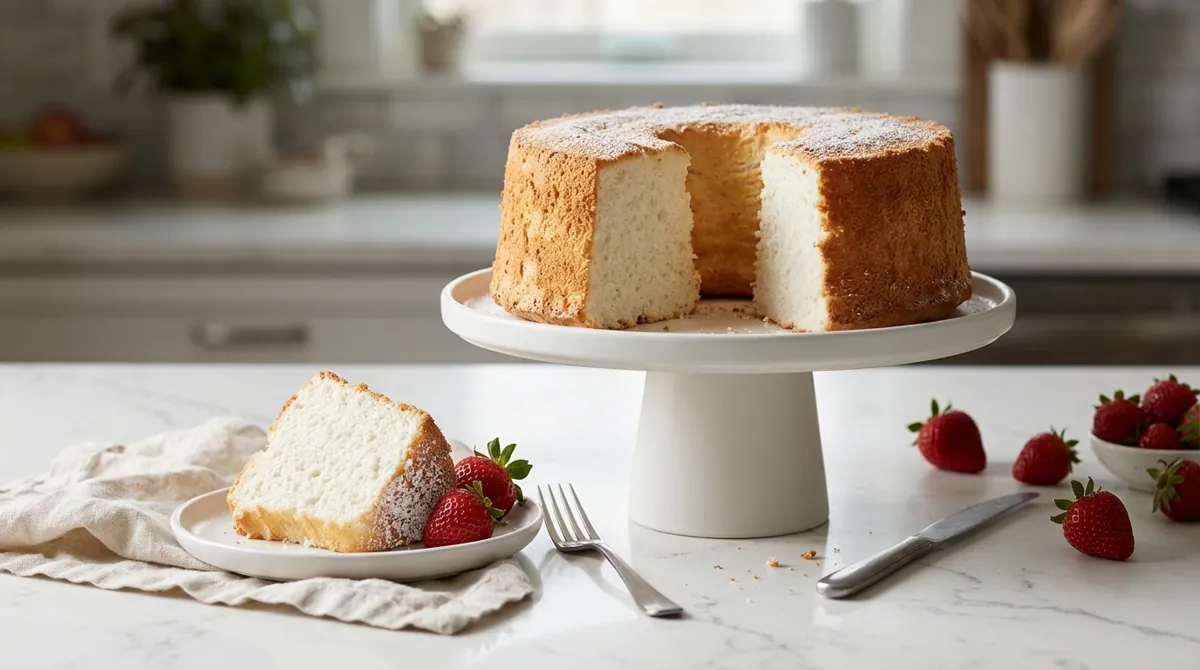
Angel food cake is an American invention of the 19th century, and the exact starting point is argued about. The popular story says frugal Pennsylvania Dutch cooks made it to use up the egg whites left over from making egg noodles. The food historian William Woys Weaver dates the cake among the Pennsylvania Dutch to the 1850s, but there is no firm documentation for either claim.
The paper trail is clearer than the folklore. A "white sponge" with no yolks appears in Lettice Bryan's The Kentucky Housewife in 1839, and an 1864 book reduced sponge cake to just sugar, flour and egg whites. The cake gained its name and its popularity in the 1870s, and the earliest use of "angels' food" for the cake that has been identified is in The Home Messenger of Detroit in 1878. The rotary egg beater, common after 1870, made whipping a dozen whites by hand far easier, and Mary Johnson Bailey Lincoln's Boston Cook Book printed a recipe in 1884, after which the cake spread across the country. Some people also credit St. Louis, but that claim is not documented in the sources checked here.
Why it works the kitchen science
No fat
Egg whites contain none, and any trace of yolk or grease keeps them from whipping to full volume; that is why the bowl must be spotless.
Cream of tartar
The acid stabilizes the foam so it holds its volume while it bakes.
Cake flour, sifted
It is low in protein and light, so it folds in without deflating the foam and gives a tender crumb.
An ungreased tube pan
The batter needs to cling to the sides to climb; grease makes it slip down. The tube lets heat reach the center.
Cooling upside down
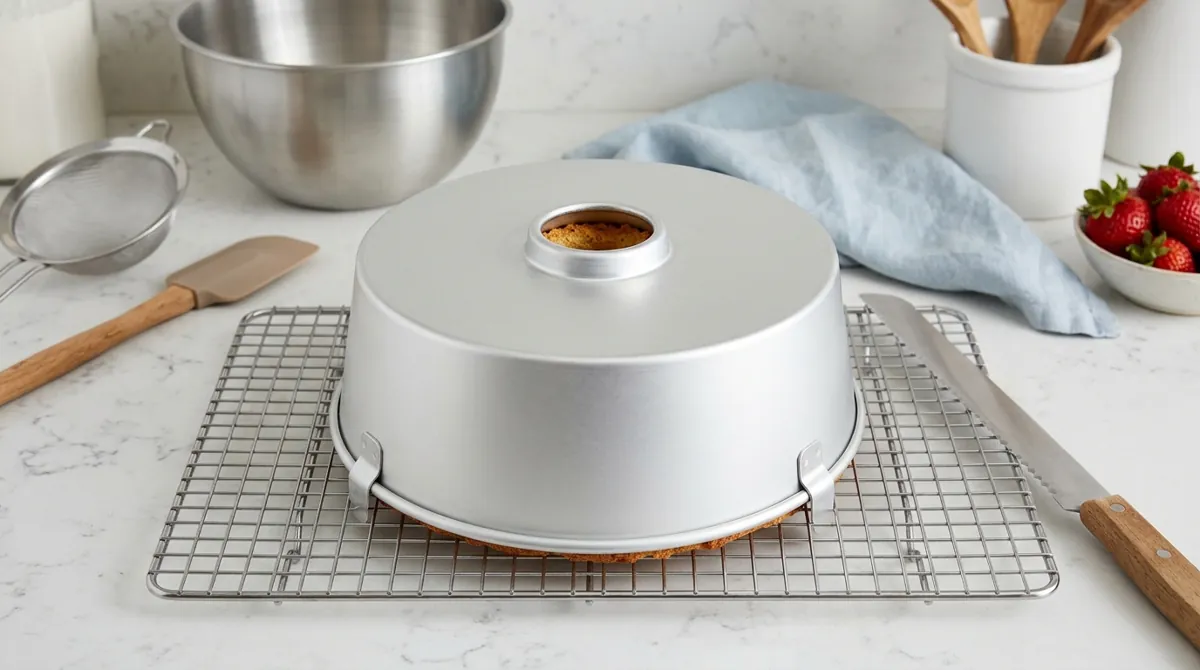
The cake is so airy that it would fall under its own weight while still warm; hanging it keeps the height.
🧰 You'll need 7 items
Everything the steps call for. Tick off what you have before you start.
Appliances
Tools
Supplies
Step by step
- Step 1
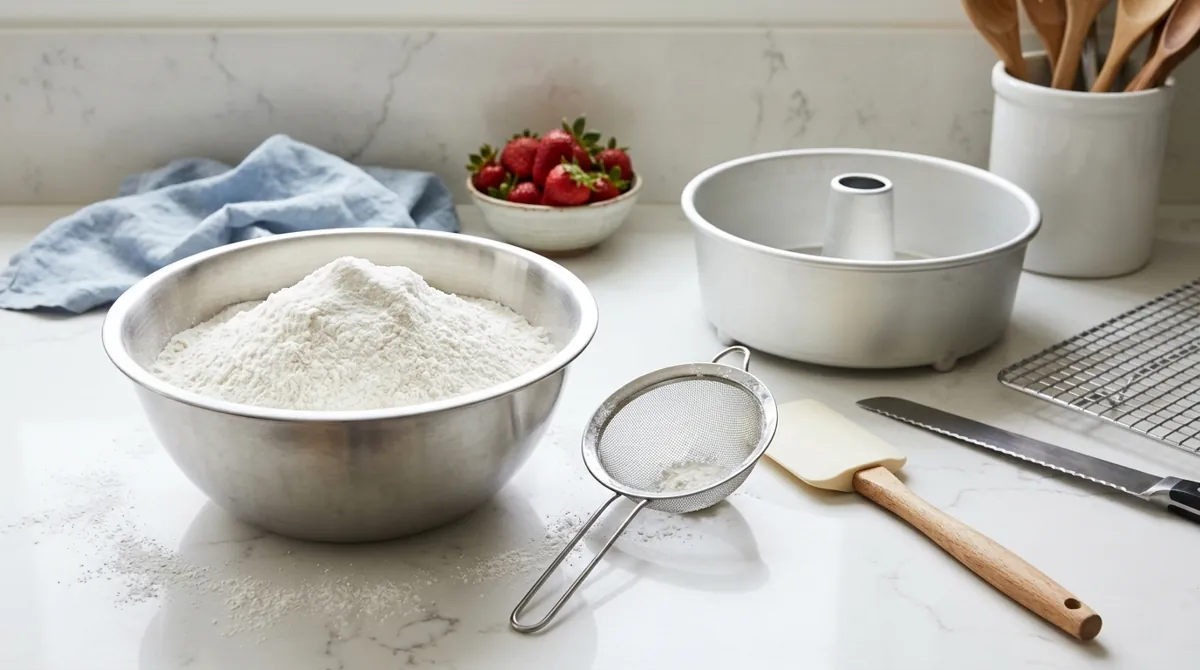
Heat the oven to 350°F with a rack in the lower third. Keep the 10 inch tube pan ungreased. Sift the flour, 3/4 cup of the sugar and the salt together twice, into a bowl, and set aside.
- Step 2
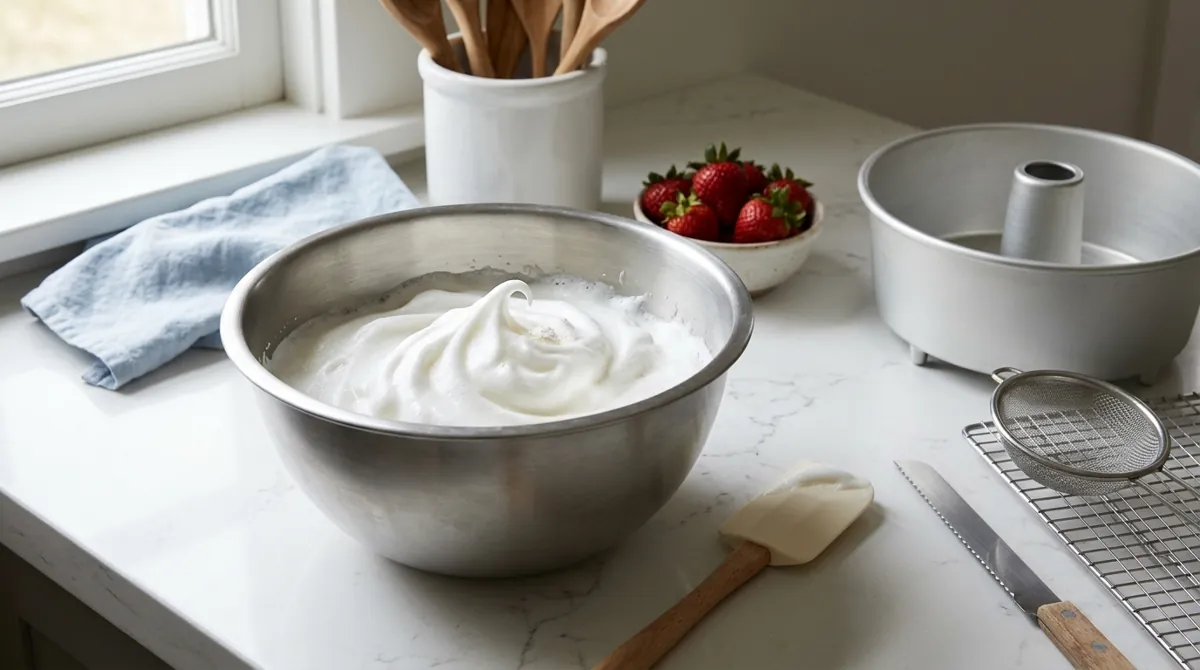
In a large, very clean metal or glass bowl, beat the egg whites on medium speed until foamy. Add the cream of tartar and beat until soft peaks form.
- Step 3
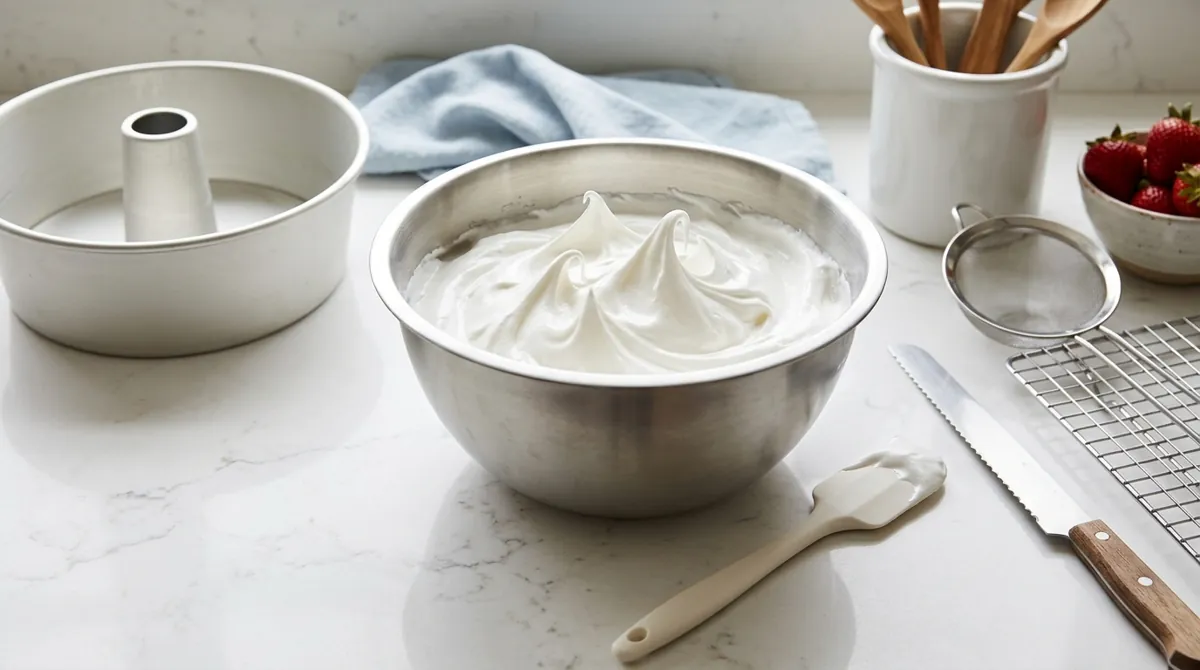
With the mixer on medium, add the remaining 3/4 cup sugar a spoonful at a time, then beat until the whites are stiff, glossy and hold a firm peak that stands up straight. Beat in the vanilla and almond extract.
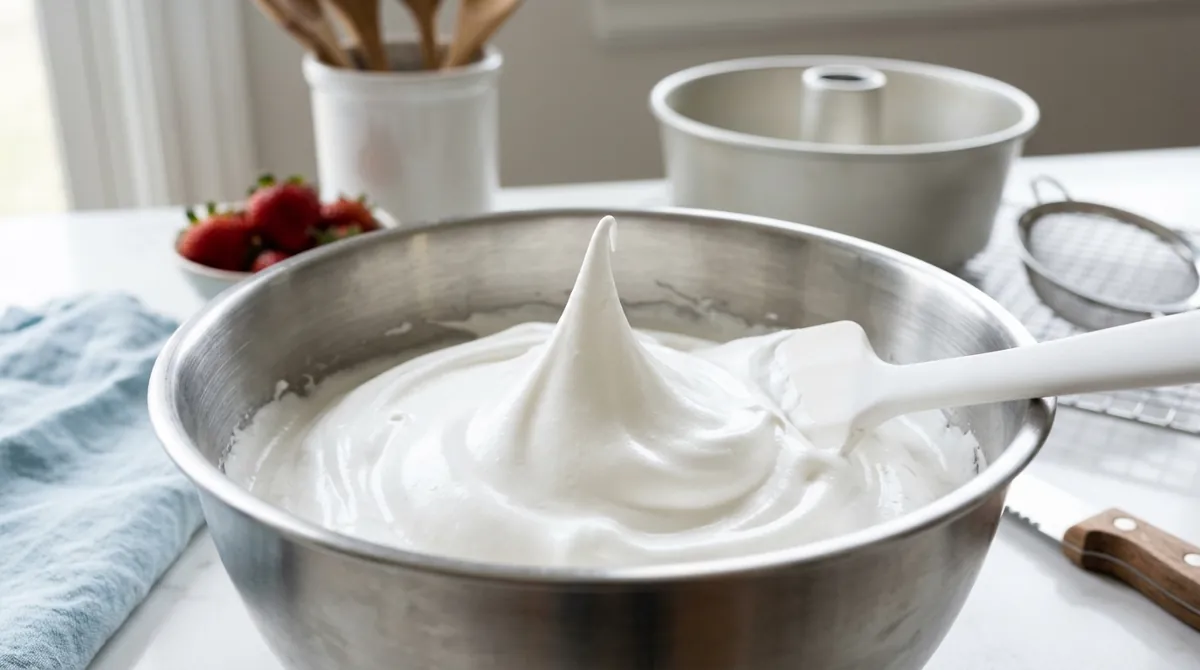
✓ What it should look like - Step 4
Sift the flour mixture over the whites in three batches, folding gently with a large spatula after each, just until no white flour streaks remain. Do not stir.
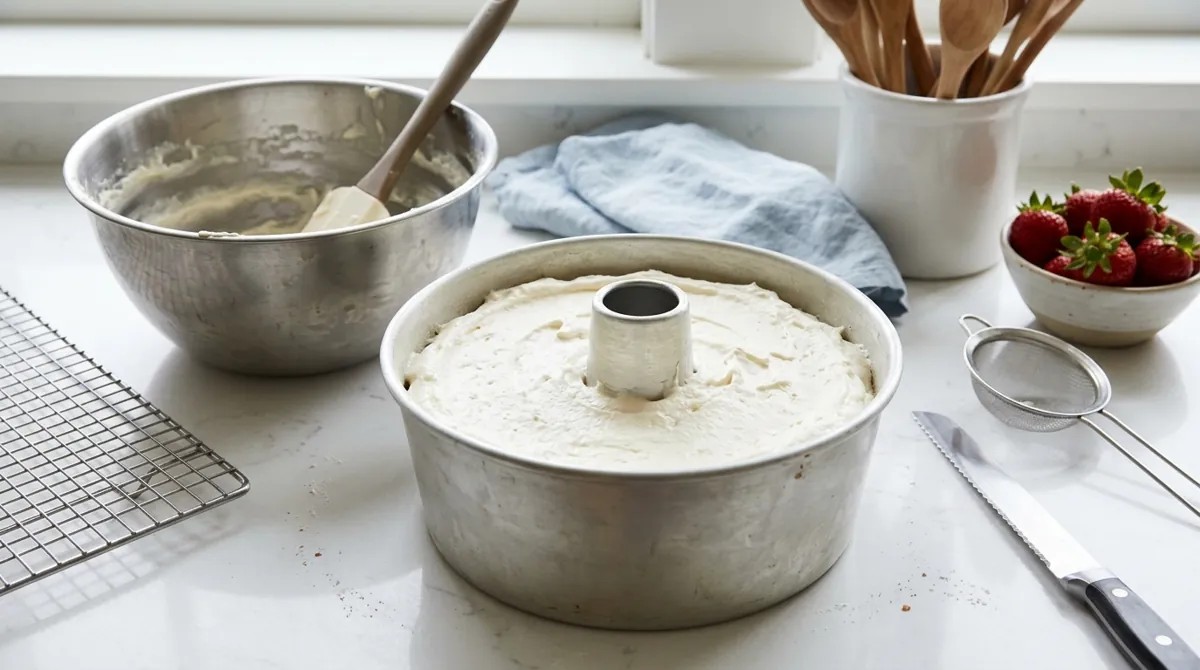
- Step 5
Scrape the batter into the pan and run a knife through it to break up big air pockets. Bake 35 to 40 minutes, until the top is deep golden, dry and springs back when touched, and a skewer comes out clean.
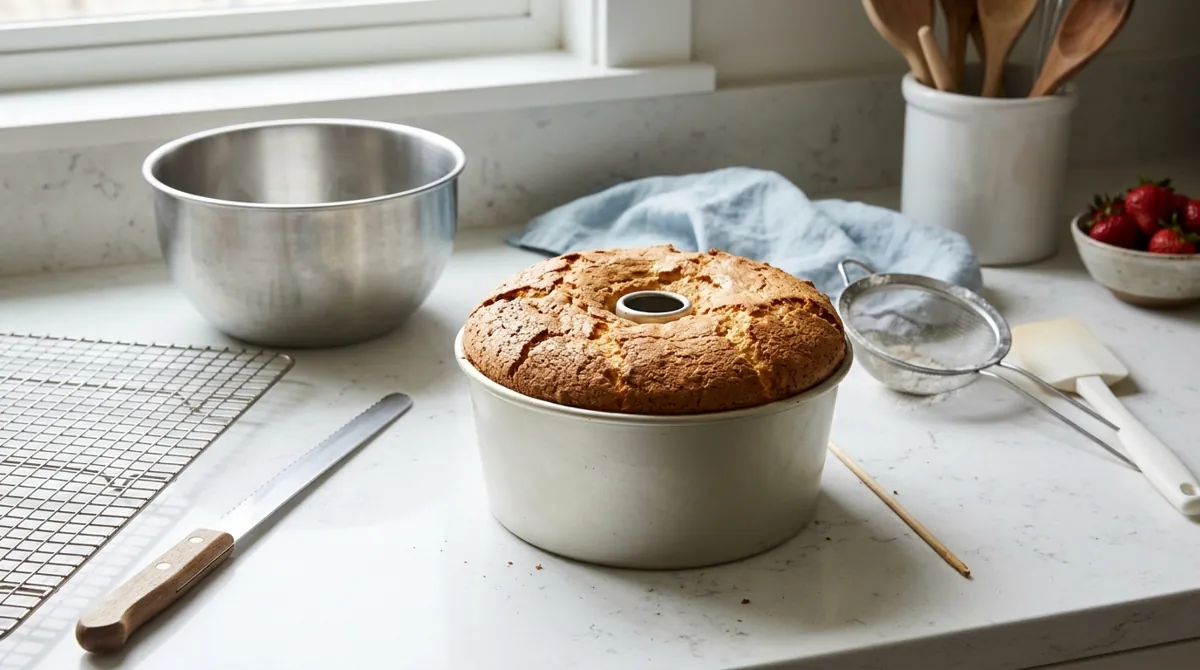
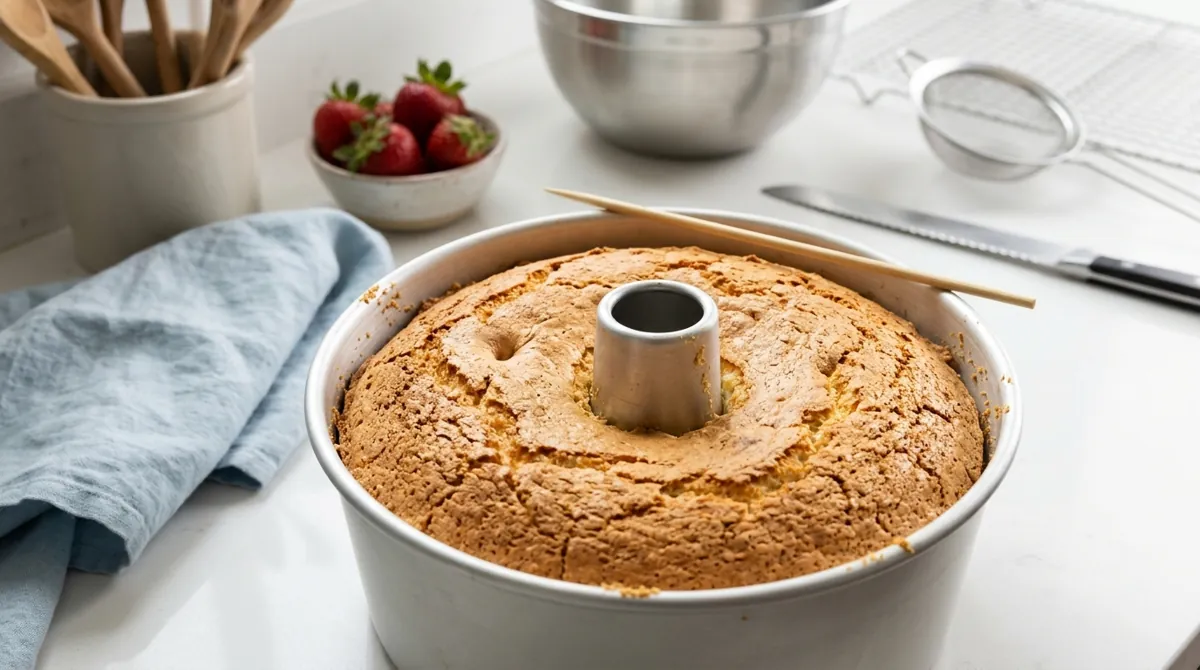
✓ What it should look like - Step 6
Turn the pan upside down at once, resting on its feet or over a bottle neck, and cool completely, at least 1 1/2 hours. Run a thin knife around the sides and the center tube, lift out the cake and slice with a serrated knife.
Angel Food Cake
Serves 12 · one 10 inch tube cake · 3 hr 10 min total
- 1 1/2 cups egg whites (about 12 large, 360 g), at room temperature
- 1 1/2 cups granulated sugar (300 g), divided in half
- 1 cup cake flour (115 g), not self-rising
- 1/4 tsp fine salt
- 1 1/2 tsp cream of tartar
- 1 1/2 tsp vanilla extract
- 1/2 tsp almond extract, optional
- Powdered sugar or fresh berries, to serve
Equipment: Oven, Hand or stand mixer, Chef's knife and cutting board, Measuring cups and spoons, Mixing bowls, Spatula, Skewers
Method
- Heat the oven to 350°F with a rack in the lower third. Keep the 10 inch tube pan ungreased. Sift the flour, 3/4 cup of the sugar and the salt together twice, into a bowl, and set aside.
- In a large, very clean metal or glass bowl, beat the egg whites on medium speed until foamy. Add the cream of tartar and beat until soft peaks form.
- With the mixer on medium, add the remaining 3/4 cup sugar a spoonful at a time, then beat until the whites are stiff, glossy and hold a firm peak that stands up straight. Beat in the vanilla and almond extract.
- Sift the flour mixture over the whites in three batches, folding gently with a large spatula after each, just until no white flour streaks remain. Do not stir.
- Scrape the batter into the pan and run a knife through it to break up big air pockets. Bake 35 to 40 minutes, until the top is deep golden, dry and springs back when touched, and a skewer comes out clean.
- Turn the pan upside down at once, resting on its feet or over a bottle neck, and cool completely, at least 1 1/2 hours. Run a thin knife around the sides and the center tube, lift out the cake and slice with a serrated knife.
Americanized house recipe, written for this site, within the standard proportions for a 10 inch tube pan (about 1 1/2 cups egg whites, 1 1/2 cups sugar, 1 cup cake flour, cream of tartar). History: Wikipedia, "Angel food cake" (Pennsylvania Dutch folk account, Weaver 1850s, The Kentucky Housewife 1839 precursor, The Home Messenger 1878, Boston Cook Book 1884). those pages were not fetched. en.wikipedia.org. Ingredient list follows the source; the method is in our own words.
All sources (2)
Tips
- Separate the eggs while cold, which is easier, then let the whites come to room temperature for about 30 minutes: they whip higher.
- Do not let any yolk reach the whites. Crack each egg over a small bowl first, then add it to the big one.
- Superfine sugar dissolves faster and gives a finer crumb; if you use regular sugar, add it slowly.
- Cut with a serrated knife and a gentle sawing motion; a regular knife squashes the crumb.
- Use the leftover yolks for creme brulee or lemon curd.
- Keeps 2 days at room temperature, covered, or 2 months wrapped in the freezer.
The rules people argue about
What the sources agree on, what they don't, and what is just a good story.
- Pennsylvania Dutch cooks invented it to use leftover noodle egg whites. Folklore: the story is widely repeated, but there is no firm documentation; William Woys Weaver dates the cake to the 1850s among the Pennsylvania Dutch.
- The 1870s is when it began. Disputed: precursor white sponge cakes exist from 1839 and 1864; the 1870s is when it got its name and popularity, and The Home Messenger 1878 is the earliest known use of "angels' food" for the cake.
- Why it is called angel food. Disputed: Stella Parks links it to a 16th century Book of Common Prayer reference to manna; Stephen Schmidt says "angel food" desserts were once frozen mousses made with egg whites and cream.
Meatballs of the World

Italian-American Meatballs
Big, tender meatballs braised for an hour in red sauce over spaghetti. The one most Americans grew up with.

Pallottine (Abruzzo Meatballs)
Tiny meatballs, smaller than a marble, tossed right through square spaghetti alla chitarra. No bread at all.

Swedish Meatballs (Köttbullar)
Small, soft meatballs browned in butter, in a cream sauce made from the same pan, with lingonberry jam on the plate.

Danish Frikadeller
Pork meatballs shaped with a spoon and fried slowly in butter, crusty outside and soft in the middle.

Königsberger Klopse
German meatballs that are never fried: poached, then served in a creamy white sauce with capers.

Spanish Albóndigas in Almond Saffron Sauce
The tapas bar classic: small meatballs in a golden sauce thickened with fried almonds and bread.

Mexican Albóndigas with Chipotle and Mint
Soft meatballs with rice and fresh mint inside, simmered in a smoky tomato and chipotle broth.

Izgara Köfte (Turkish Grilled Meatballs)
Small, flat meatballs kneaded hard, rested cold, and charred on a hot grill pan.

Lion's Head Meatballs
Big, soft pork meatballs, stirred into a sticky paste, fried to set, then braised in a savory sauce.

Chicken Tsukune
Japan's chicken meatball: kneaded sticky, grilled on skewers, glazed with sweet soy tare, dipped in egg yolk.