
Bagels
Chewy, shiny, malty rings boiled before they are baked: the New York deli bagel you can make at home with six ingredients.
🍳Cook alongOne move at a time, with real timers
 Edited by JP Lambiase
Change the estimate
Swaps change the price only: cook any meat to its own safe temperature. Where these numbers come from
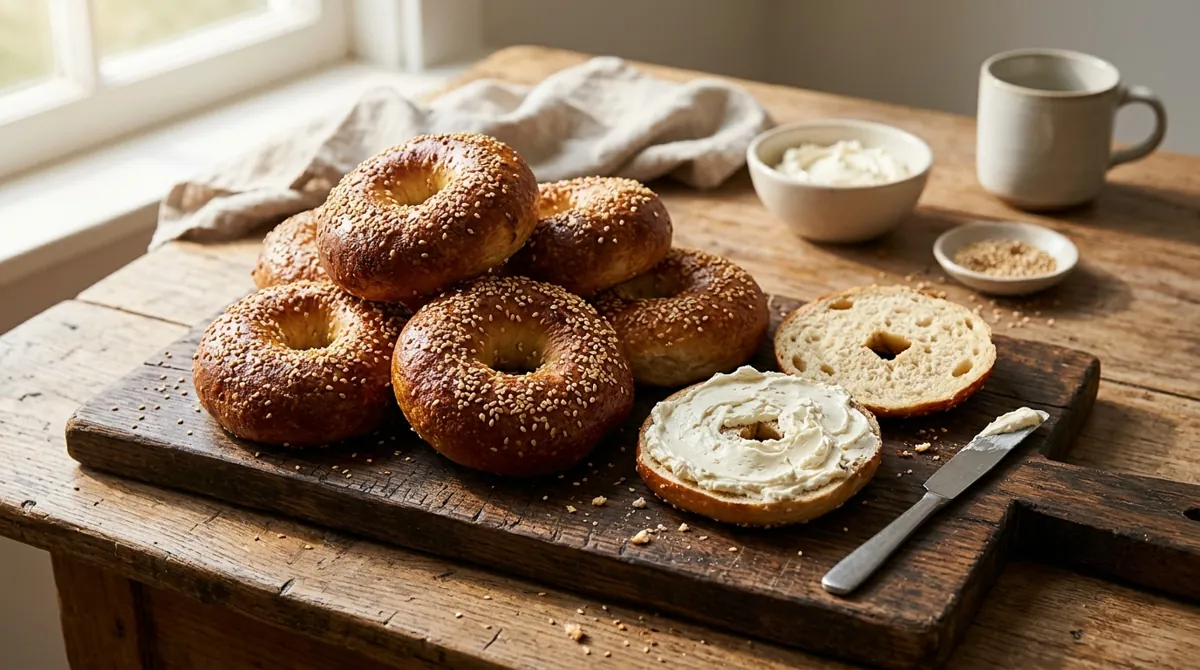
A bagel is a ring of yeast dough that is boiled briefly and then baked, which is what gives it a shiny, chewy crust and a dense crumb. Ring breads boiled or baked in Europe and western Asia are far older than the name. Wikipedia notes the Kraków obwarzanek was made by the 13th century and that ka'ak appears in a 10th-century Arabic cookbook.
The earliest known mention of the word, in Polish as bajgiel (from Yiddish bagel), is in Kraków's 1610 community regulations, which listed bagels as a gift to women in childbirth. Polish Jewish immigrants brought bagels to the United States, and for decades New York bagel making was controlled by Bagel Bakers Local 338, whose members hand-made nearly all the city's bagels. Machines arrived from the late 1950s, and in the 1960s the Lender family pioneered frozen, then pre-sliced, bagels, which spread them across the country.
The name's exact roots are not settled. Wikipedia reports links to German pretzels, to the Kraków ring breads and to Arabic ring breads, so "the first bagel" is DISPUTED.
Why it works the kitchen science
High-protein bread flour and a stiff, well-kneaded dough
The gluten gives the bagel its dense chew.
The boil
Setting the surface starch gelatinizes it into a shiny, thin skin before baking, so the bagel rises less and stays dense.
Malt or brown sugar in the bath
Sweetens the crust and helps it brown.
Cooling before cutting
The crumb is still setting when it comes out of the oven.
🧰 You'll need 7 items
Everything the steps call for. Tick off what you have before you start.
Appliances
Pans and pots
Tools
Supplies
Step by step
- Step 1
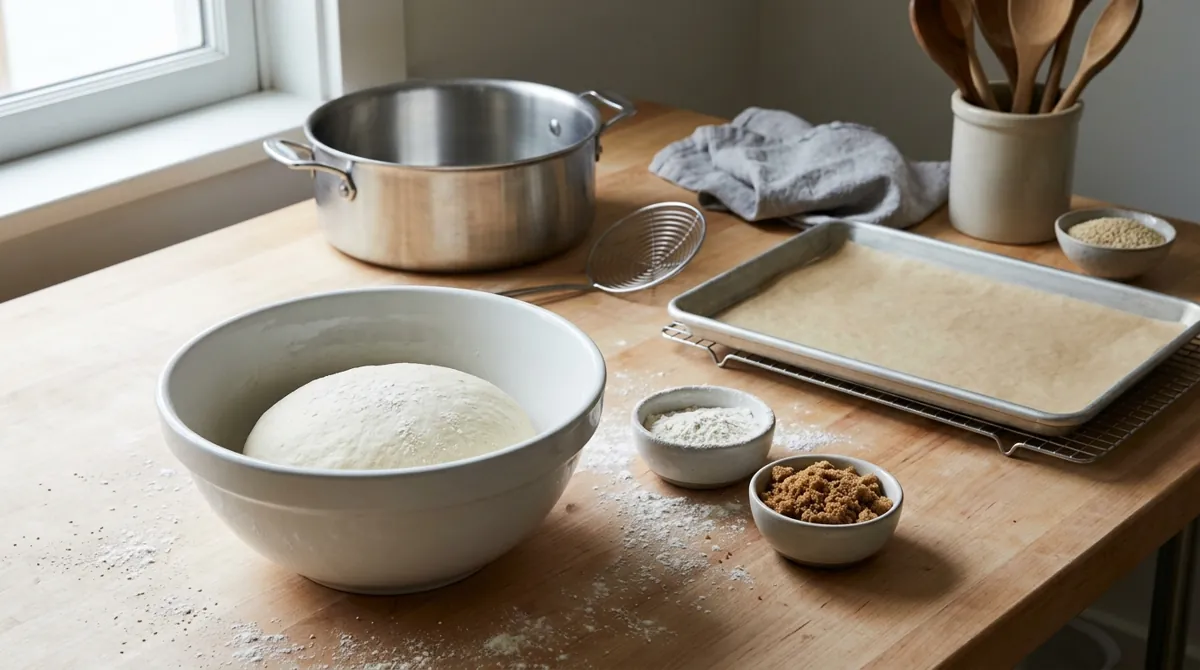
Mix the flour, yeast, salt, brown sugar and water, then knead 10 minutes in a mixer with a dough hook, or up to 15 by hand. The dough will be stiff and hold its shape.
- Step 2
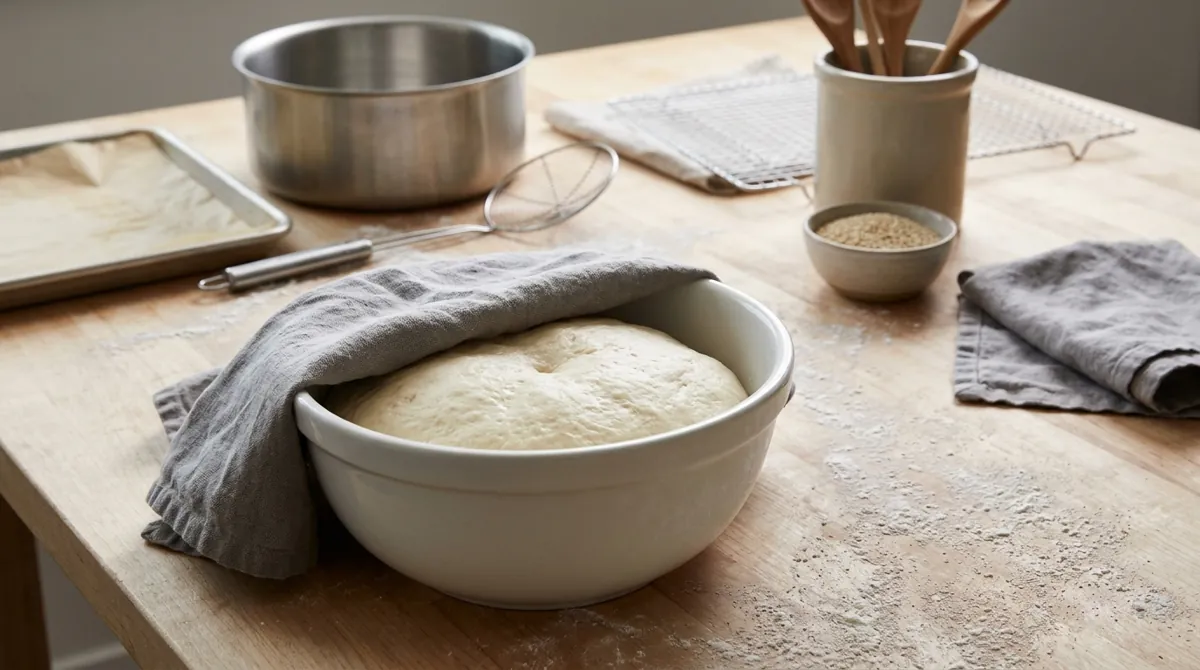
Put the dough in a lightly greased bowl, cover and let it rise 1 to 1 1/2 hours, until noticeably puffy.
- Step 3
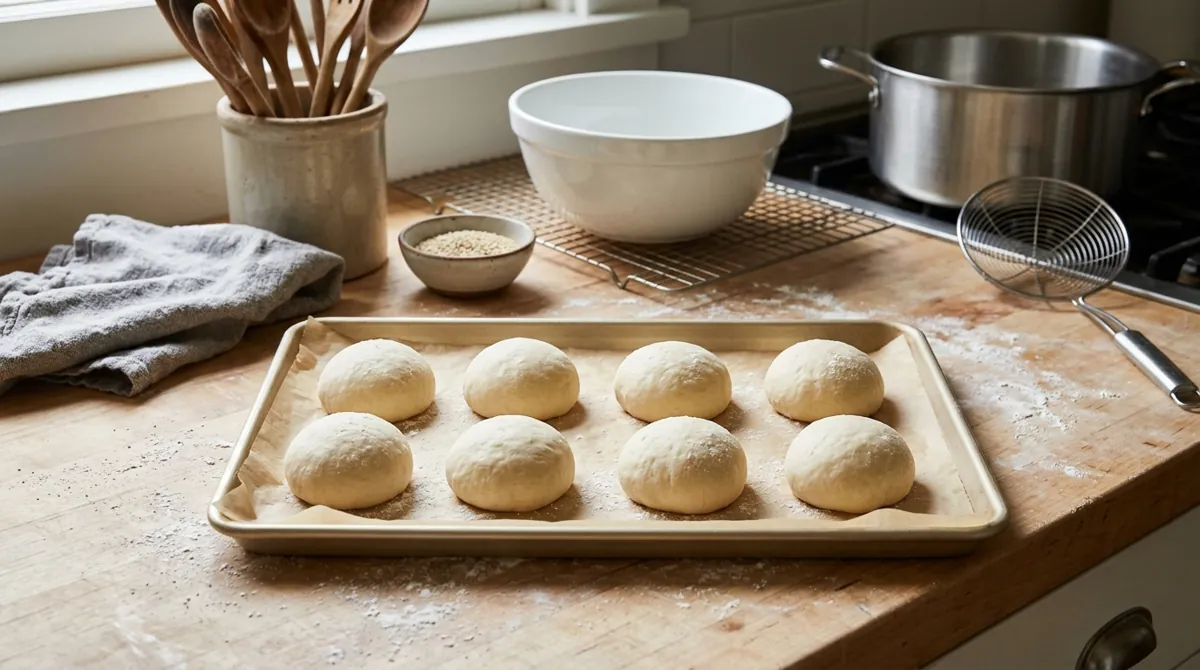
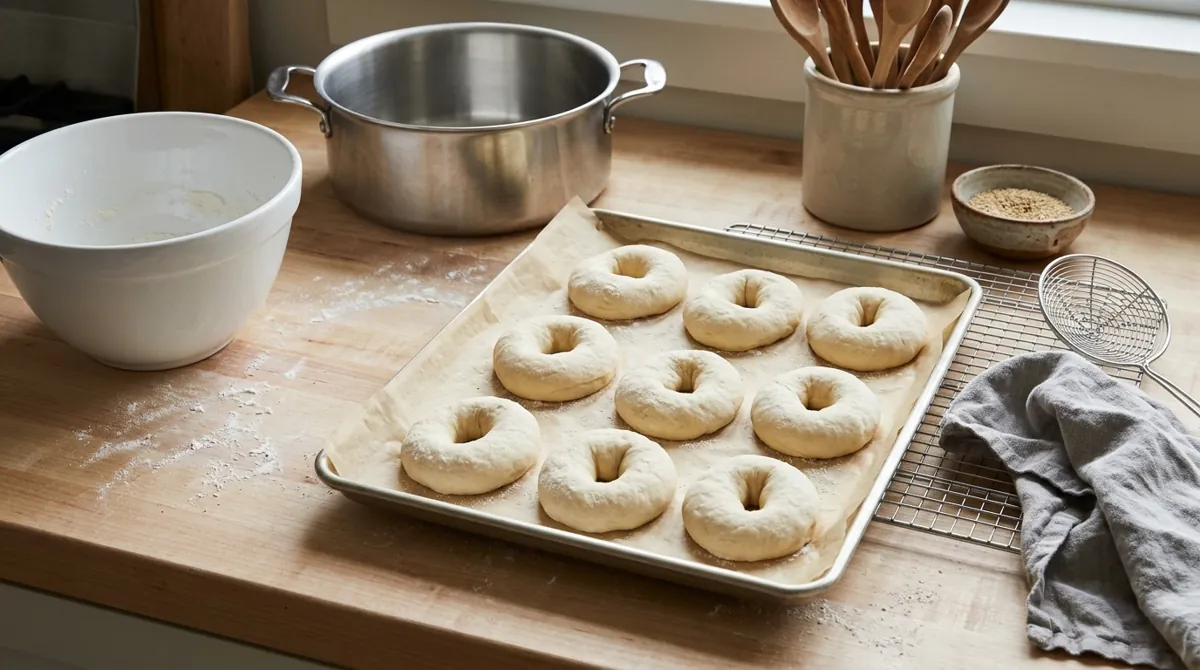
Divide the dough into 8 pieces. Roll each into a smooth tight ball on a greased or parchment-lined sheet, cover and rest 30 minutes.
- Step 4
Heat the oven to 425°F. Bring the water bath ingredients to a gentle boil in a wide pot.
- Step 5
Poke a hole through each ball with your finger and twirl it to widen the hole to 1 1/2 to 2 inches.
✓ What it should look like - Step 6
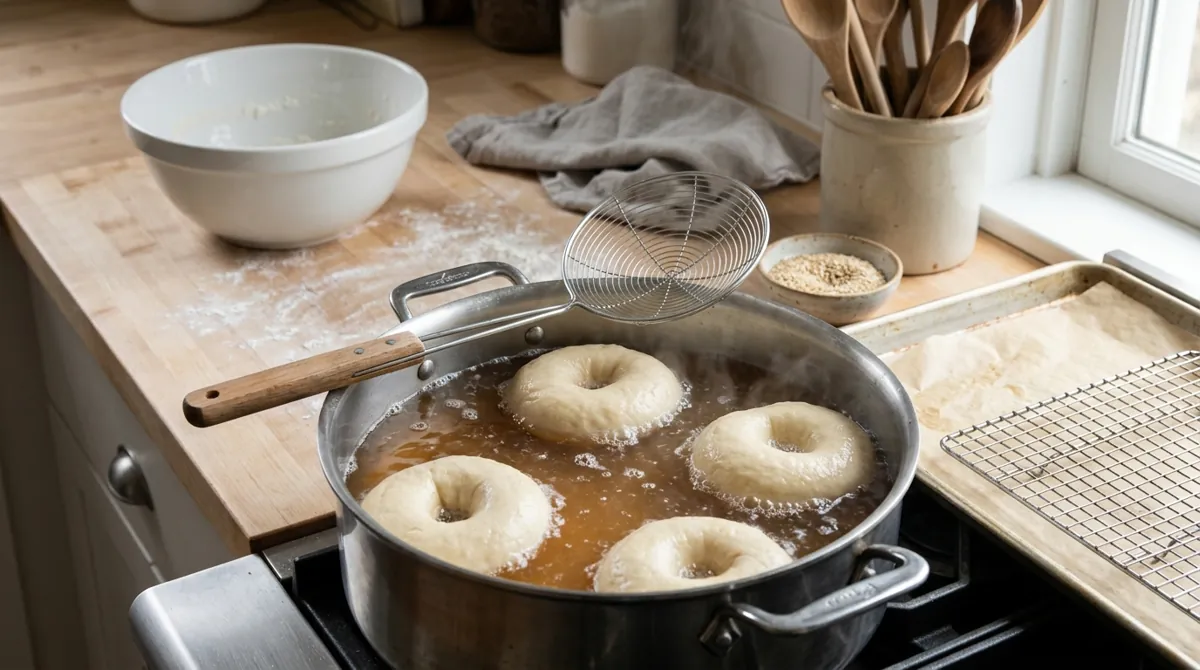
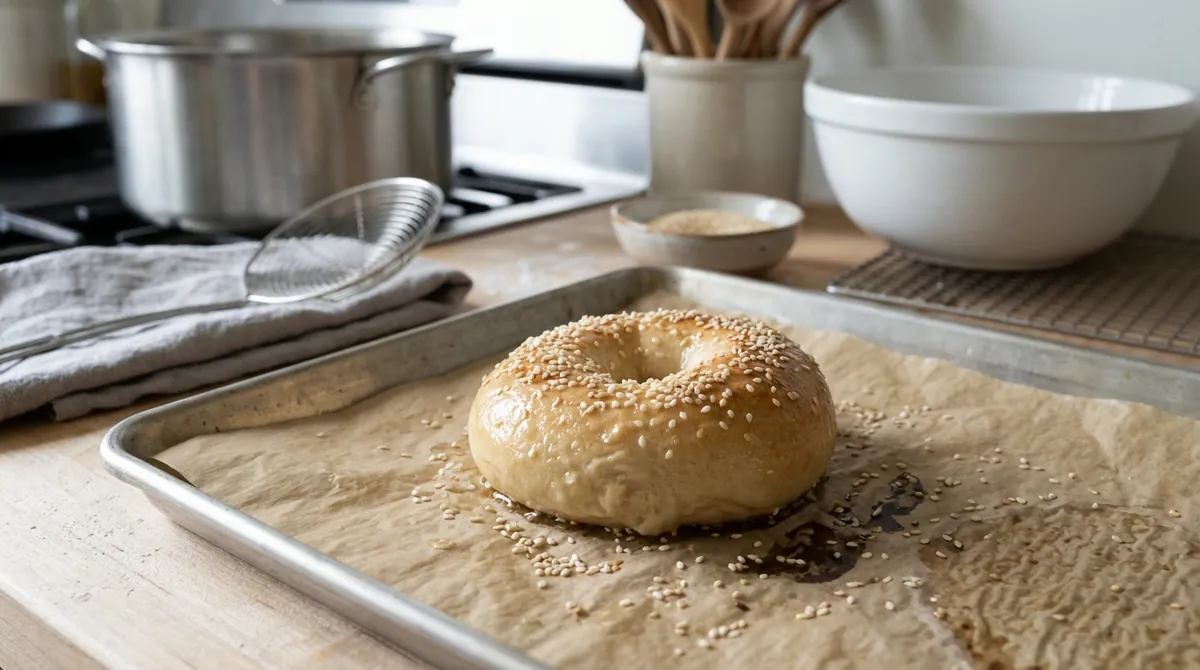
Boil the bagels, 3 or 4 at a time, 2 minutes on one side, flip, then 1 more minute. Drain them on the sheet and add toppings while wet.
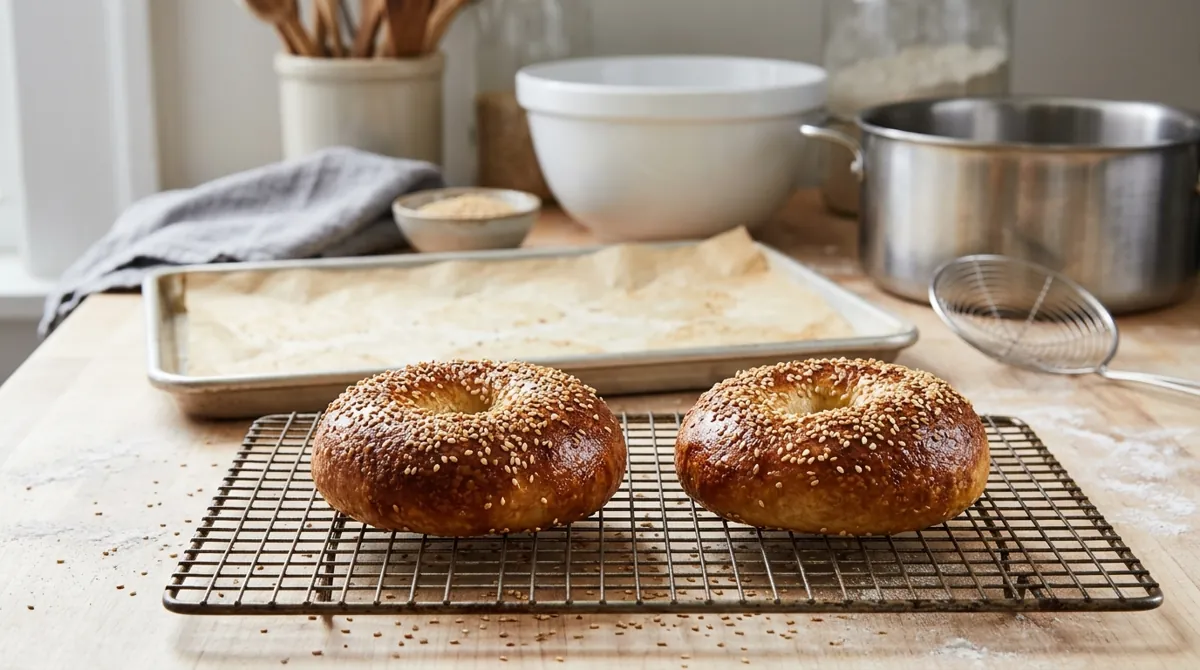
✓ What it should look like - Step 7
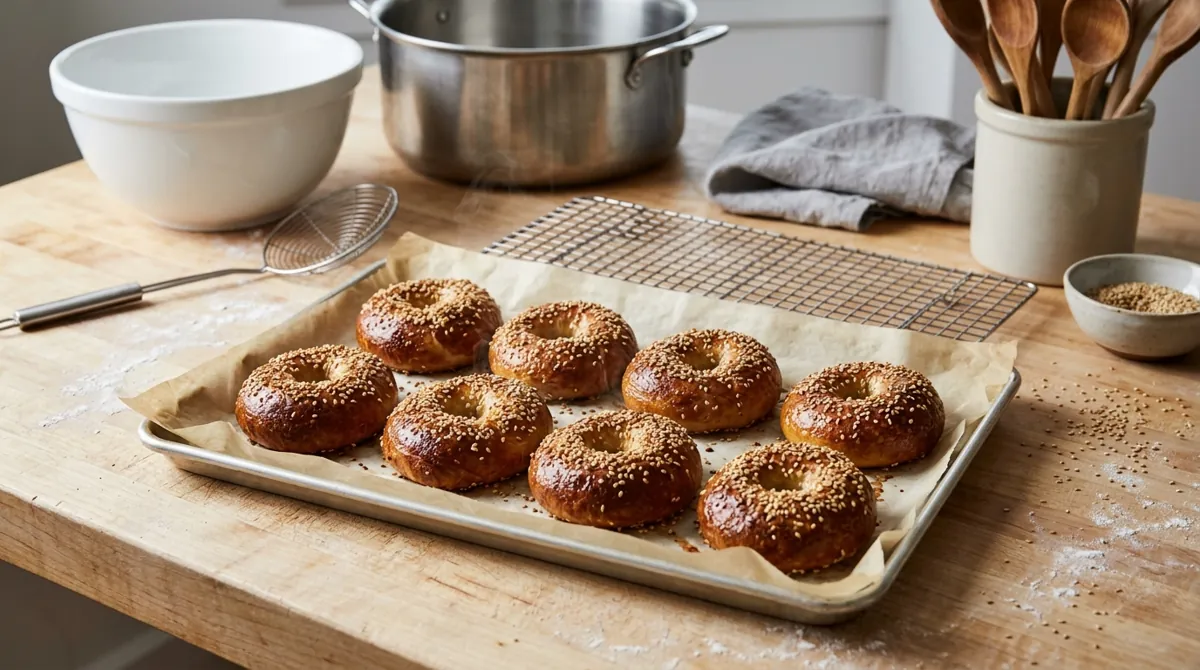
Bake 20 to 25 minutes, turning them over about 15 minutes in, until deep golden brown.
- Step 8
Cool completely on a rack before slicing.
Bagels
Serves 8 · 8 large bagels · 3 hr 15 min total
Dough
- 4 cups bread flour (480 g)
- 1 tablespoon instant yeast (9 g)
- 2 tsp fine salt (12 g)
- 1 tablespoon dark brown sugar (14 g), or barley malt syrup or malt powder
- 1 1/3 cups lukewarm water (303 g)
Water bath
- 2 quarts water (about 1.8 kg)
- 2 tablespoons dark brown sugar (28 g), or barley malt syrup
- 1 tablespoon granulated sugar (14 g)
Toppings, optional: sesame seeds, poppy seeds, everything seasoning
Equipment: Oven, Hand or stand mixer, Large pot, Measuring cups and spoons, Mixing bowls, Rolling pin, Parchment paper
Method
- Mix the flour, yeast, salt, brown sugar and water, then knead 10 minutes in a mixer with a dough hook, or up to 15 by hand. The dough will be stiff and hold its shape.
- Put the dough in a lightly greased bowl, cover and let it rise 1 to 1 1/2 hours, until noticeably puffy.
- Divide the dough into 8 pieces. Roll each into a smooth tight ball on a greased or parchment-lined sheet, cover and rest 30 minutes.
- Heat the oven to 425°F. Bring the water bath ingredients to a gentle boil in a wide pot.
- Poke a hole through each ball with your finger and twirl it to widen the hole to 1 1/2 to 2 inches.
- Boil the bagels, 3 or 4 at a time, 2 minutes on one side, flip, then 1 more minute. Drain them on the sheet and add toppings while wet.
- Bake 20 to 25 minutes, turning them over about 15 minutes in, until deep golden brown.
- Cool completely on a rack before slicing.
Americanized house recipe, adapted from King Arthur Baking's "Bagels" recipe (480 g bread flour, 303 g water, 9 g instant yeast, 12 g salt, a malt or brown-sugar water bath, a 425°F oven, 20 to 25 minutes). History: Wikipedia, "Bagel" (Kraków 1610 regulations, obwarzanek, ka'ak, New York Local 338, Lender family, malt and boiling, the "New York water" claim). King Arthur Baking. Ingredient list follows the source; the method is in our own words.
All sources (2)
Tips
- Poke test: if a bagel springs back slowly after a finger poke, it is ready to boil; if it springs back fast, give it more time.
- Boil in batches so the water stays at a gentle boil.
- Stored wrapped, they keep a day or two at room temperature; for longer, slice and freeze.
The rules people argue about
What the sources agree on, what they don't, and what is just a good story.
- New York's water makes the bagel. Disputed: a widely repeated claim, but a Brooklyn bagel maker told CNN the style comes from the recipe and the method, not the tap.
- A real bagel is boiled. Documented as the defining method: boiling before baking is what separates a bagel from a round roll with a hole, and steamed bagels are rolls by the purist view.
- The bagel was invented in Kraków in 1610. Disputed: 1610 is the earliest known mention of the word, not of the bread; older ring breads existed.
Meatballs of the World

Italian-American Meatballs
Big, tender meatballs braised for an hour in red sauce over spaghetti. The one most Americans grew up with.

Pallottine (Abruzzo Meatballs)
Tiny meatballs, smaller than a marble, tossed right through square spaghetti alla chitarra. No bread at all.

Swedish Meatballs (Köttbullar)
Small, soft meatballs browned in butter, in a cream sauce made from the same pan, with lingonberry jam on the plate.

Danish Frikadeller
Pork meatballs shaped with a spoon and fried slowly in butter, crusty outside and soft in the middle.

Königsberger Klopse
German meatballs that are never fried: poached, then served in a creamy white sauce with capers.

Spanish Albóndigas in Almond Saffron Sauce
The tapas bar classic: small meatballs in a golden sauce thickened with fried almonds and bread.

Mexican Albóndigas with Chipotle and Mint
Soft meatballs with rice and fresh mint inside, simmered in a smoky tomato and chipotle broth.

Izgara Köfte (Turkish Grilled Meatballs)
Small, flat meatballs kneaded hard, rested cold, and charred on a hot grill pan.

Lion's Head Meatballs
Big, soft pork meatballs, stirred into a sticky paste, fried to set, then braised in a savory sauce.

Chicken Tsukune
Japan's chicken meatball: kneaded sticky, grilled on skewers, glazed with sweet soy tare, dipped in egg yolk.