
Baklava
Crisp, buttery layers of phyllo around spiced walnuts and pistachios, soaked in a honey-lemon syrup: the pastry of Ottoman palace kitchens that Greeks, Turks and the Levant all claim.
🍳Cook alongOne move at a time, with real timers
 Edited by JP Lambiase
Change the estimate
Swaps change the price only: cook any meat to its own safe temperature. Where these numbers come from
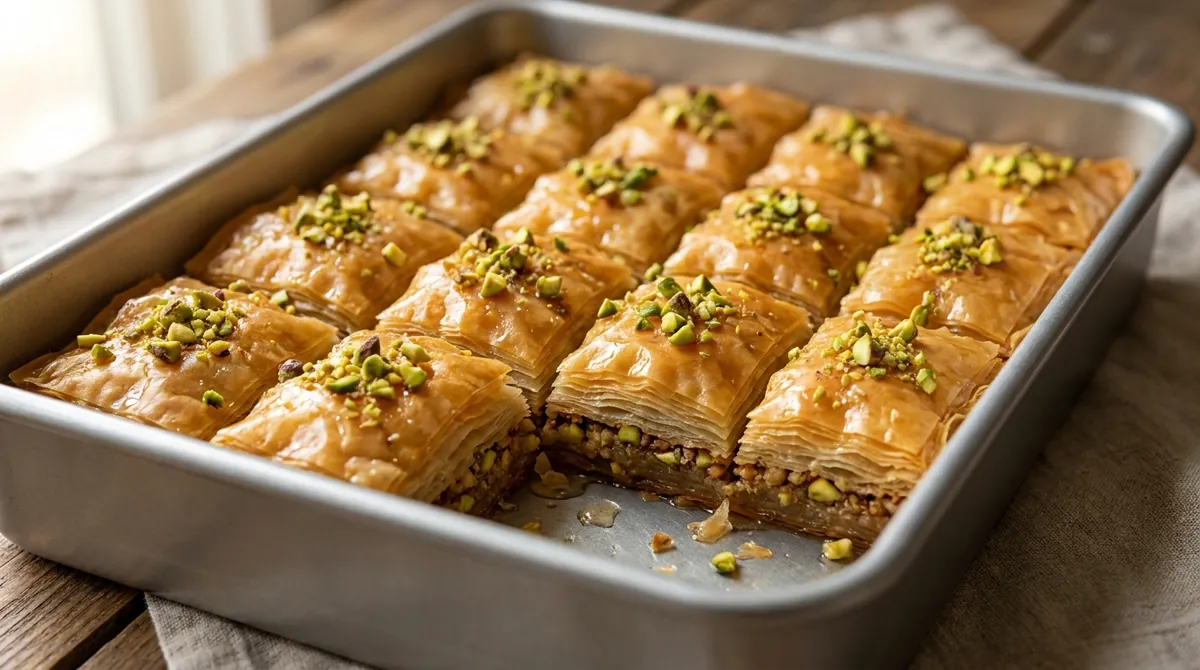
Baklava is a pastry of layered phyllo, chopped nuts and syrup, and almost everyone in the eastern Mediterranean has a claim to it. The word entered English in 1650 from Ottoman Turkish. Kitchen records show it was being made in the Topkapi Palace kitchens in Istanbul by 1473 to 1474, and on the 15th of Ramadan the sultan sent trays of it to the Janissaries in a ceremony called the Baklava Procession.
Where it started is not settled. Greek writers point to layered honey-nut cakes of the ancient and Byzantine world. Arab sources point to medieval nut sweets such as lauzinaj. Others point to layered flatbreads from Central Asia. What is agreed is that the thin-sheet, many-layered form we know today was refined in Ottoman kitchens.
Why it works the kitchen science
Butter between every sheet
Each layer fries slightly in the oven and separates into a flaky stack.
Cut before baking
A hot, set pastry would shatter; cut ahead, the pieces come apart cleanly.
Cool syrup on hot pastry
The temperature gap lets the syrup soak in without turning the crisp layers soggy.
🧰 You'll need 5 items
Everything the steps call for. Tick off what you have before you start.
Appliances
Tools
Step by step
- Step 1
Make the syrup first so it can cool: simmer the sugar, water, honey and lemon juice for 10 minutes until slightly thickened. Cool to room temperature.
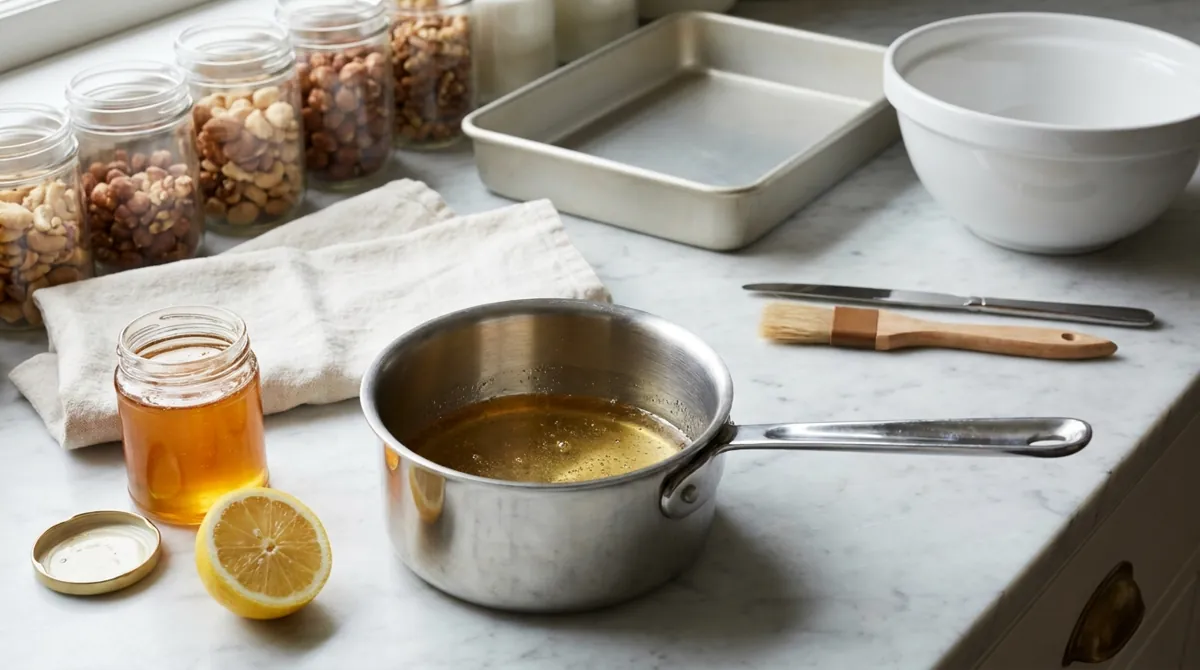
- Step 2
Heat the oven to 350°F. Butter a 9 by 13 inch pan. Mix the walnuts, pistachios, sugar and cinnamon in a bowl. Unroll the phyllo, trim it to fit the pan, and cover it with a damp towel.
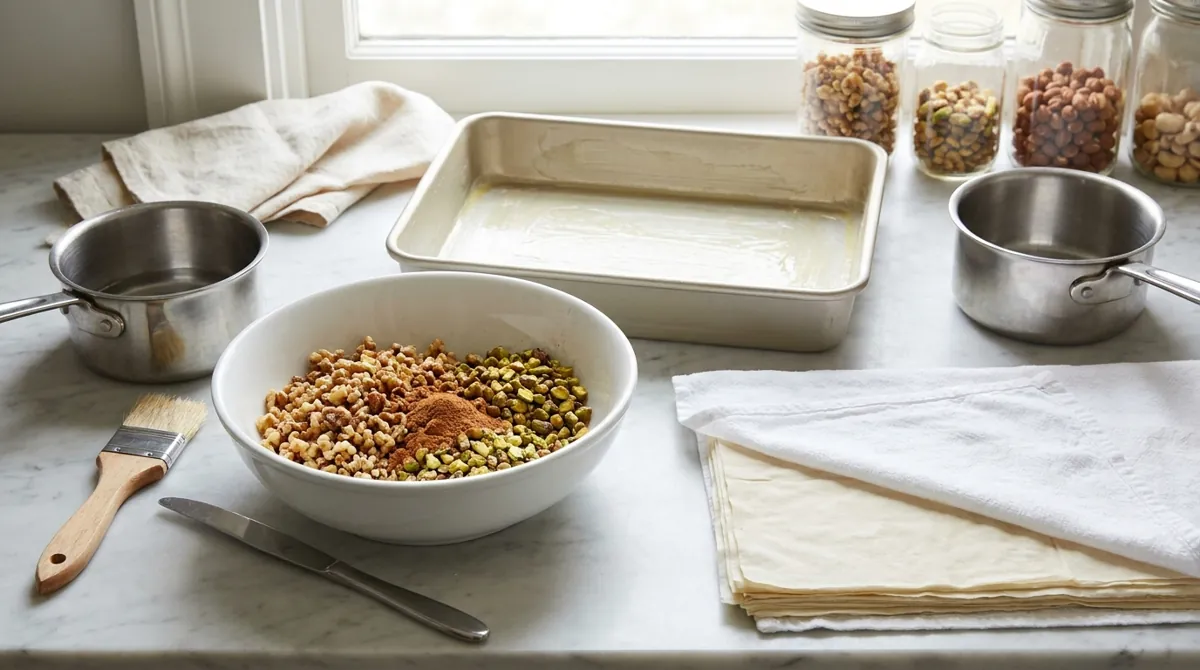
- Step 3
Lay one phyllo sheet in the pan and brush it with butter. Repeat until you have 8 buttered sheets.
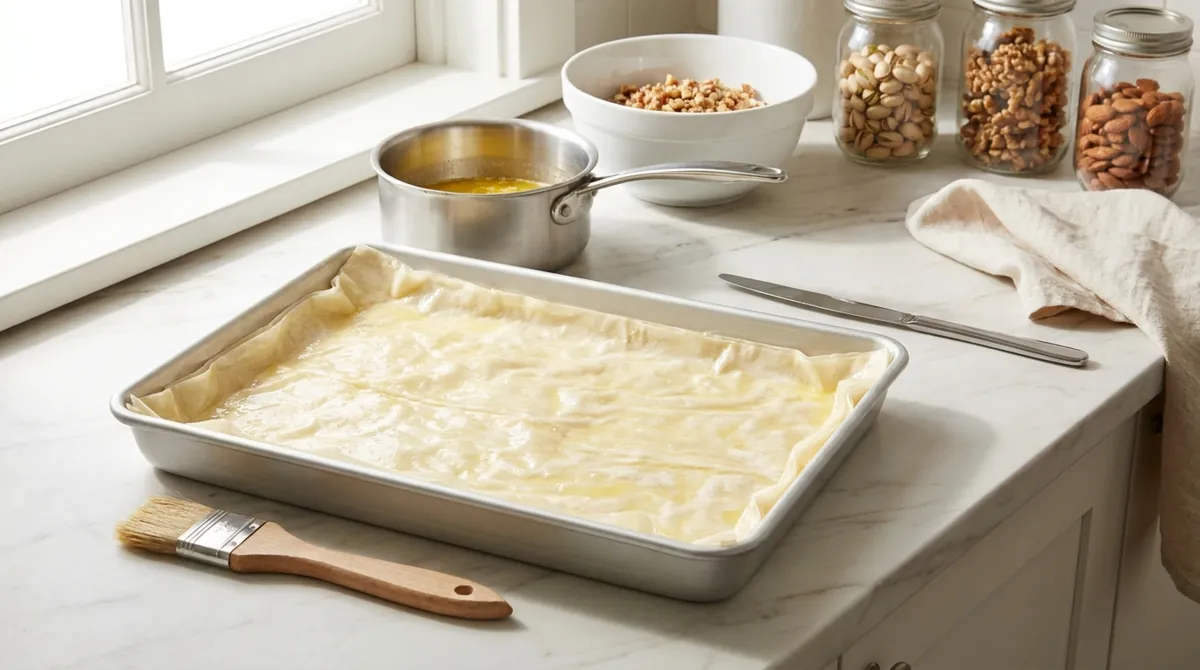
- Step 4
Spread half the nut mixture over the phyllo. Add 6 more sheets, brushing each with butter, then the rest of the nuts.
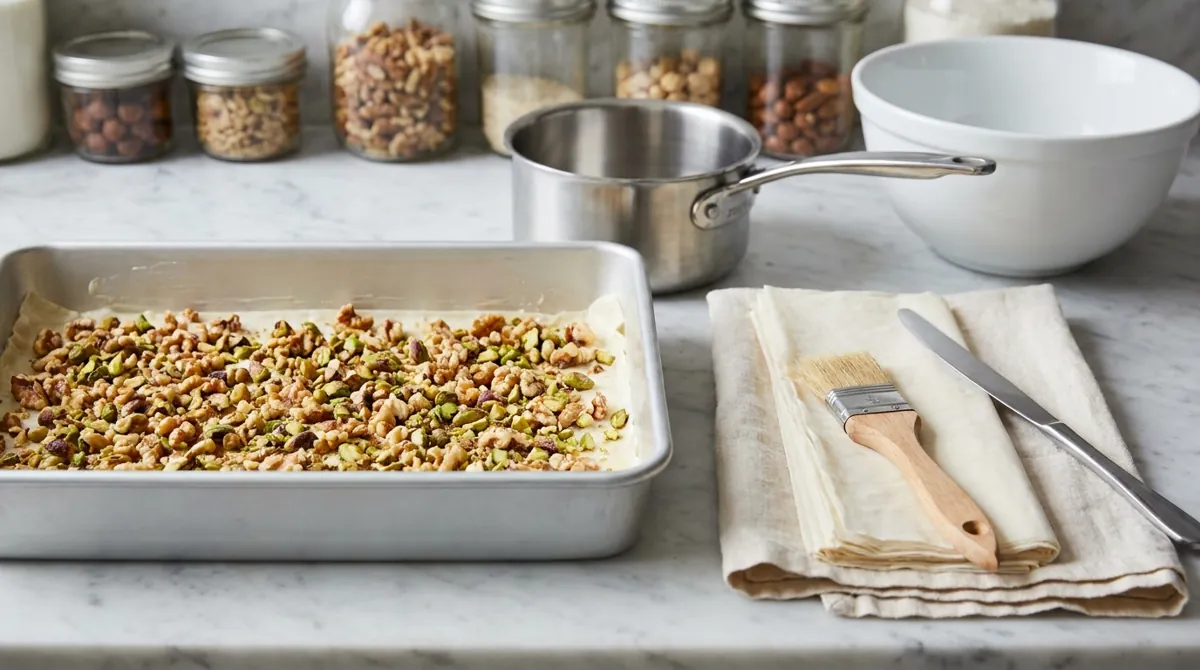
- Step 5
Finish with 8 more buttered sheets, brushing the top generously. With a sharp knife, score the top in diamonds or squares, cutting all the way through.
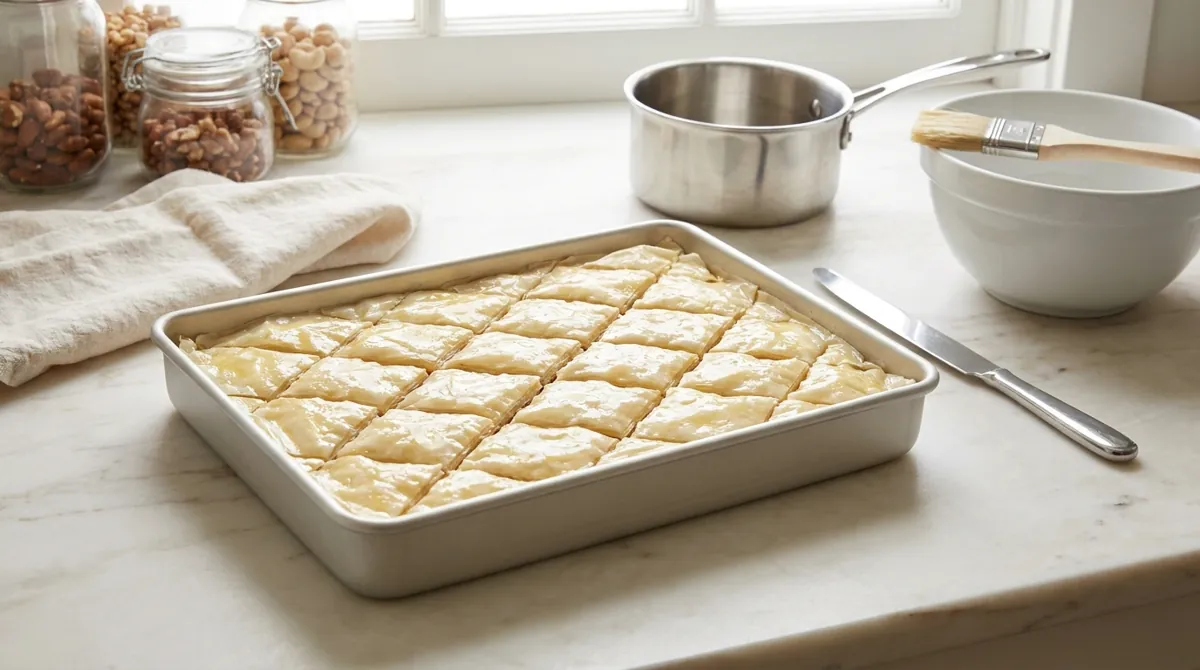
- Step 6
Bake 45 to 50 minutes until deep golden and crisp.
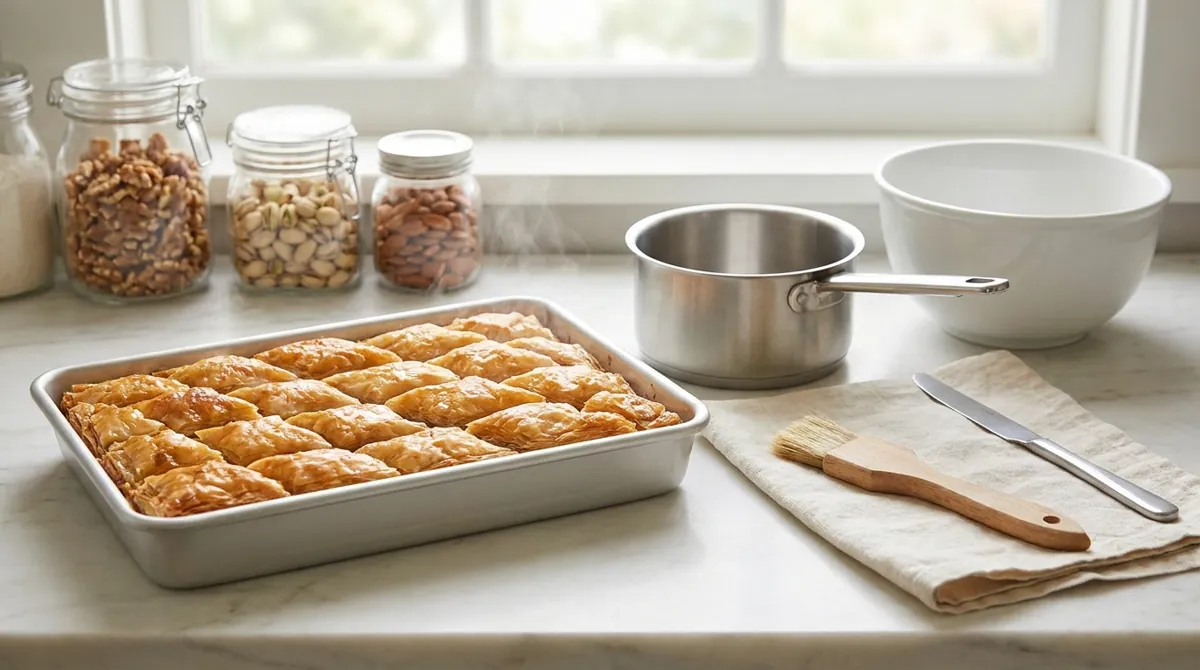
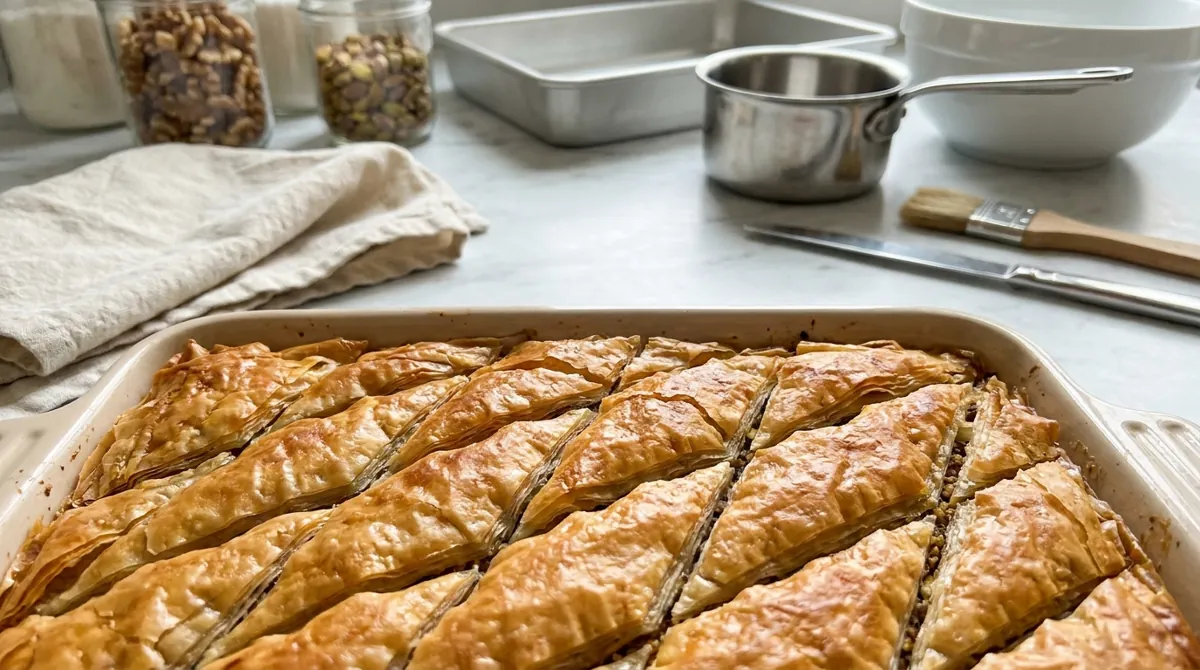
✓ What it should look like - Step 7
Spoon the cooled syrup evenly over the hot baklava straight from the oven. Let it sit uncovered at room temperature for at least 4 hours before serving.
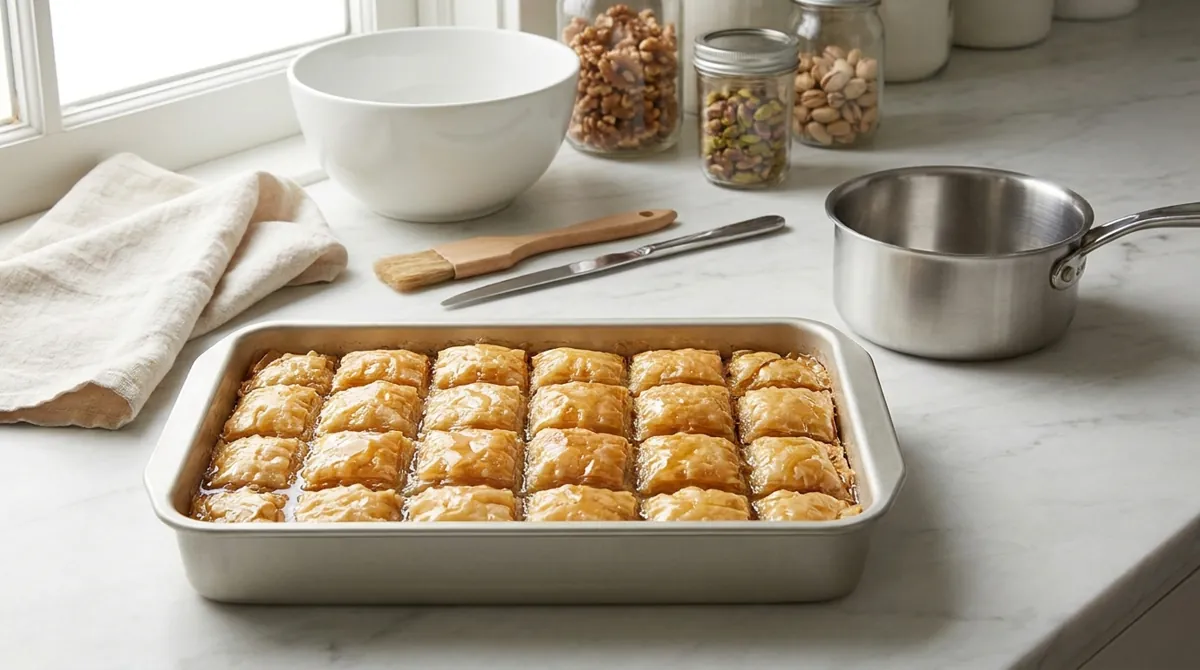
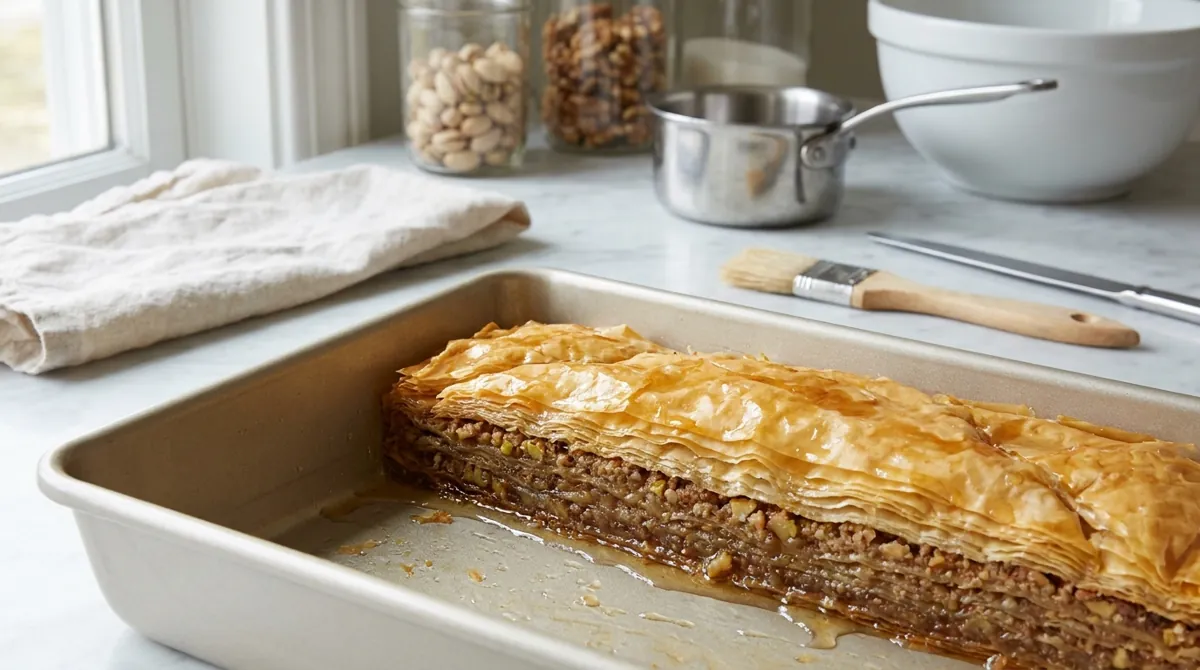
✓ What it should look like
Baklava
Serves 24 pieces · one 9 by 13 inch pan · 5 hr 30 min total
Filling
- 2 cups walnuts (200 g), finely chopped
- 1 cup shelled pistachios (125 g), finely chopped
- 1/4 cup granulated sugar (50 g)
- 1 tsp ground cinnamon
Layers
- 1 lb phyllo dough (454 g), thawed overnight in the fridge
- 1 cup unsalted butter (227 g), melted
Syrup
- 1 cup granulated sugar (200 g)
- 1 cup water
- 1/3 cup honey (112 g)
- 1 tbsp lemon juice (15 g)
Equipment: Oven, Chef's knife and cutting board, Measuring cups and spoons, Mixing bowls, Pastry brush
Method
- Make the syrup first so it can cool: simmer the sugar, water, honey and lemon juice for 10 minutes until slightly thickened. Cool to room temperature.
- Heat the oven to 350°F. Butter a 9 by 13 inch pan. Mix the walnuts, pistachios, sugar and cinnamon in a bowl. Unroll the phyllo, trim it to fit the pan, and cover it with a damp towel.
- Lay one phyllo sheet in the pan and brush it with butter. Repeat until you have 8 buttered sheets.
- Spread half the nut mixture over the phyllo. Add 6 more sheets, brushing each with butter, then the rest of the nuts.
- Finish with 8 more buttered sheets, brushing the top generously. With a sharp knife, score the top in diamonds or squares, cutting all the way through.
- Bake 45 to 50 minutes until deep golden and crisp.
- Spoon the cooled syrup evenly over the hot baklava straight from the oven. Let it sit uncovered at room temperature for at least 4 hours before serving.
Americanized house recipe, written for this site. History: Wikipedia, "Baklava" (the 1650 word, Topkapi kitchens by 1473 to 1474, the Baklava Procession, Greek, Arab and Central Asian claims, layer counts, Gaziantep's 2013 EU protected status). en.wikipedia.org. Ingredient list follows the source; the method is in our own words.
All sources (1)
Tips
- Thaw phyllo in the fridge overnight and keep it under a damp towel while you work, because it dries and cracks in minutes.
- Torn sheets are fine in the middle layers. Save the best sheets for the top.
- Store at room temperature, loosely covered, for up to 5 days. A sealed lid softens the crust.
The rules people argue about
What the sources agree on, what they don't, and what is just a good story.
- Baklava is Turkish. Disputed: the modern layered form is tied to Ottoman palace kitchens, and Gaziantep baklava has EU protected status, but Greeks, Arabs and others claim older roots.
- Baklava has 33 layers. Folklore that is Greek tradition, tied to the 33 years of Christ in some tellings; other places use 40, 25, 24 or fewer layers.
Meatballs of the World

Italian-American Meatballs
Big, tender meatballs braised for an hour in red sauce over spaghetti. The one most Americans grew up with.

Pallottine (Abruzzo Meatballs)
Tiny meatballs, smaller than a marble, tossed right through square spaghetti alla chitarra. No bread at all.

Swedish Meatballs (Köttbullar)
Small, soft meatballs browned in butter, in a cream sauce made from the same pan, with lingonberry jam on the plate.

Danish Frikadeller
Pork meatballs shaped with a spoon and fried slowly in butter, crusty outside and soft in the middle.

Königsberger Klopse
German meatballs that are never fried: poached, then served in a creamy white sauce with capers.

Spanish Albóndigas in Almond Saffron Sauce
The tapas bar classic: small meatballs in a golden sauce thickened with fried almonds and bread.

Mexican Albóndigas with Chipotle and Mint
Soft meatballs with rice and fresh mint inside, simmered in a smoky tomato and chipotle broth.

Izgara Köfte (Turkish Grilled Meatballs)
Small, flat meatballs kneaded hard, rested cold, and charred on a hot grill pan.

Lion's Head Meatballs
Big, soft pork meatballs, stirred into a sticky paste, fried to set, then braised in a savory sauce.

Chicken Tsukune
Japan's chicken meatball: kneaded sticky, grilled on skewers, glazed with sweet soy tare, dipped in egg yolk.