
Belgian Waffles
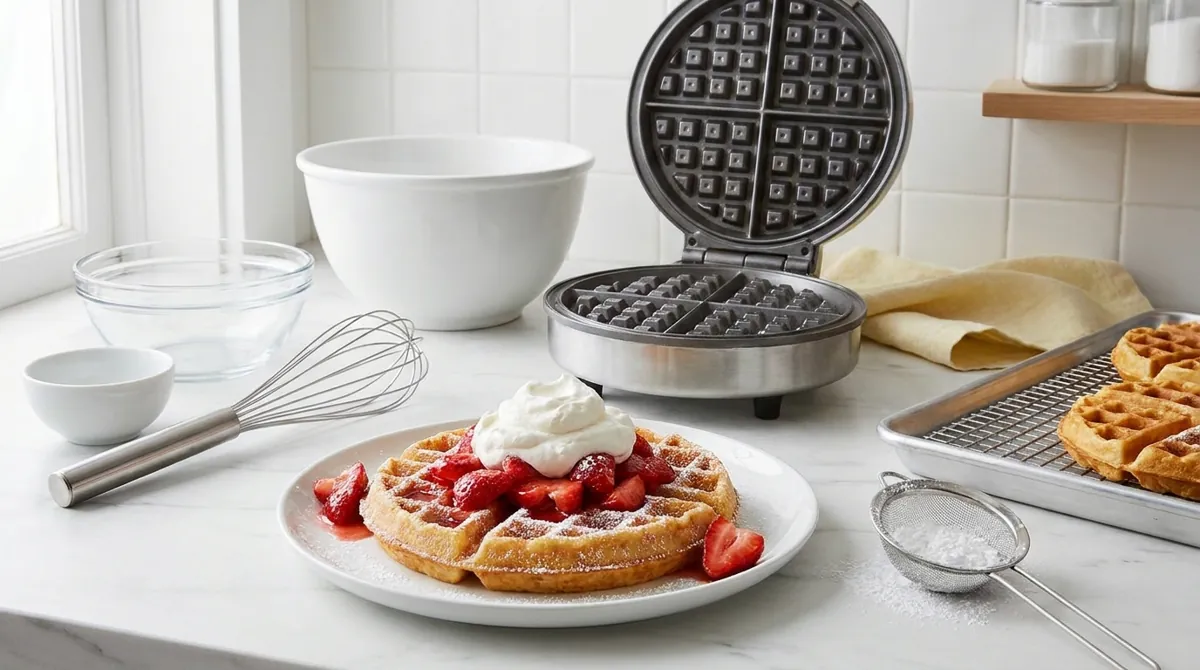
Tall, crisp, deep-pocketed yeast waffles from a Belgian waffle iron, piled with sliced strawberries, softly whipped cream and a dusting of powdered sugar: the "Bel-Gem" a Brussels family sold to Americans at the 1964 New York World's Fair.
🍳Cook alongOne move at a time, with real timers
 Edited by JP Lambiase
Change the estimate
Swaps change the price only: cook any meat to its own safe temperature. Where these numbers come from
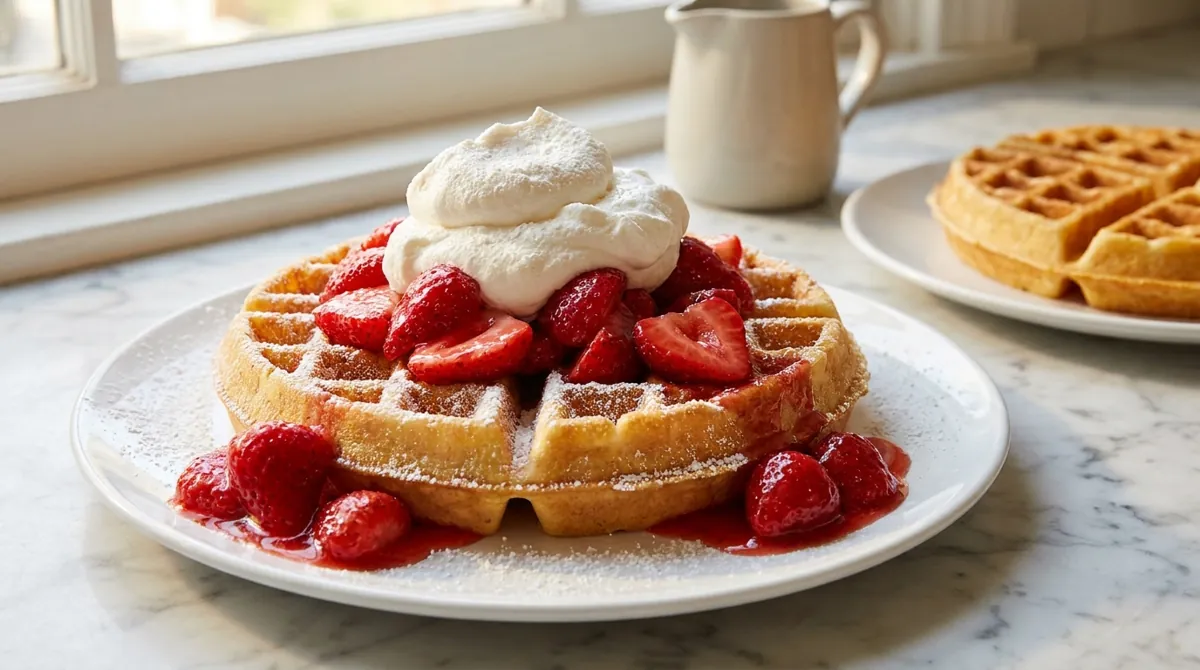
The waffle Americans call "Belgian" was made famous at a World's Fair. At the 1964 New York World's Fair in Flushing Meadows, Queens, Maurice and Rose Vermersch, emigrés from Brussels, ran a waffle stand in the fair's Belgian Village with their daughter MariePaule. Their waffles were thick, light and crisp, and Rose had the idea of loading them with whipped cream and sliced strawberries, which was not how waffles were eaten in Belgium. MariePaule later told the Associated Press that from the moment they opened there was a line, and that they served an average of 2,500 waffles a day.
They meant to call them Brussels waffles, after the capital, but Rose noticed that many Americans did not know where Brussels was. So they became "Bel-Gem" waffles, a play on Belgium, and Wikipedia records that they sold for a dollar. Belgian-style waffles had already appeared in America at the 1962 Seattle World's Fair, served by a Belgian named Walter Cleyman, but it was the Bel-Gem in New York that made the name stick.
Back home, the Brussels waffle is a light, crisp, rectangular waffle from a yeast or egg-white batter, usually eaten warm from a street stand with just powdered sugar. The chewier Liège waffle, made from a brioche-style dough with pearl sugar, is a different thing. The American "Belgian waffle" became a hybrid: a thick waffle from a deep-grid iron, usually raised with baking powder. This recipe goes back to yeast, as the Brussels waffle and the fair stand did, and tops it the way Rose Vermersch did.
Why it works the kitchen science
Yeast, not just baking powder
The long rise fills the batter with gas and flavor, so the waffle bakes up light inside and crisp outside, with a mild bready taste like the Brussels original.
A deep-grid belgian iron
The tall grid makes thick waffles with deep pockets that hold the strawberries and cream.
Melted butter and a warm milk batter
The butter crisps the outside, and lukewarm milk gets the yeast working quickly.
Holding on a rack in a low oven
Air underneath keeps the bottoms from steaming soft while you bake the rest.
🧰 You'll need 9 items
Everything the steps call for. Tick off what you have before you start.
Appliances
Pans and pots
Tools
Step by step
- Step 1
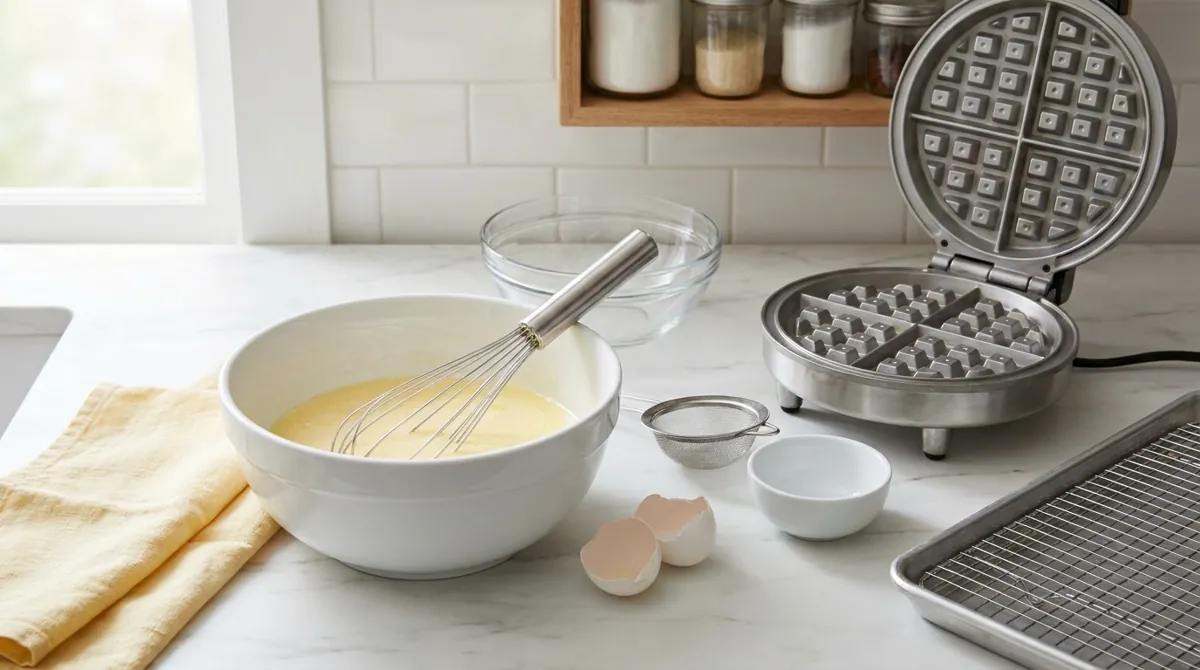
In a large mixing bowl (the batter will double), whisk the warm milk, melted butter, 2 tbsp sugar, salt, vanilla and eggs until smooth.
- Step 2
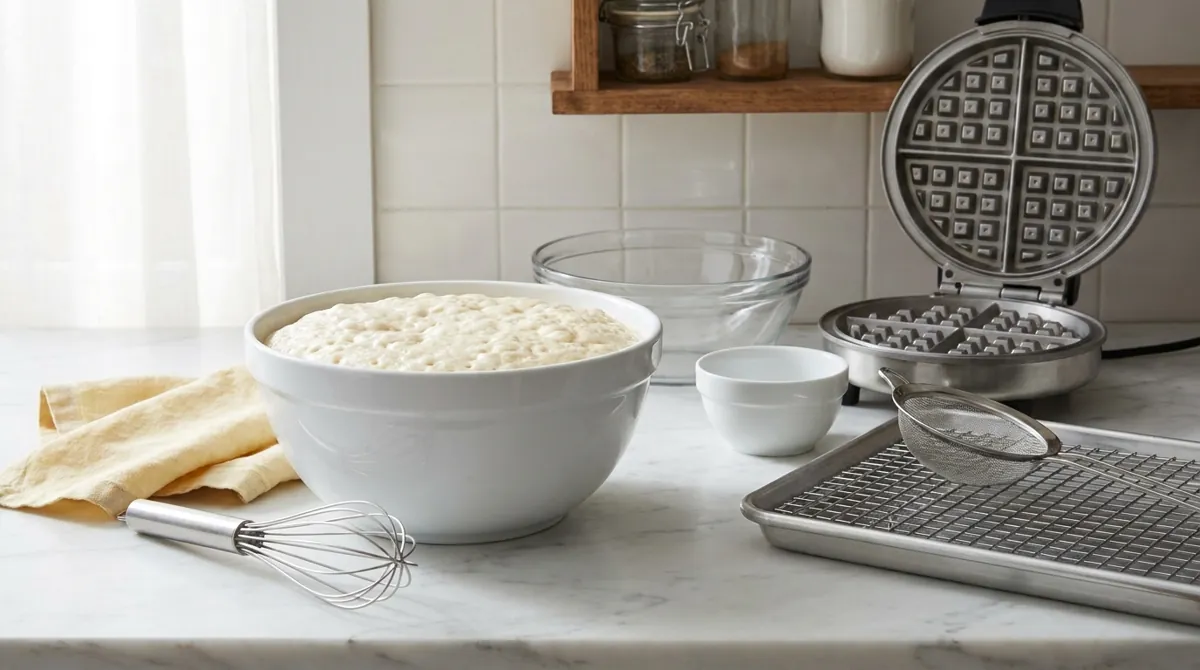
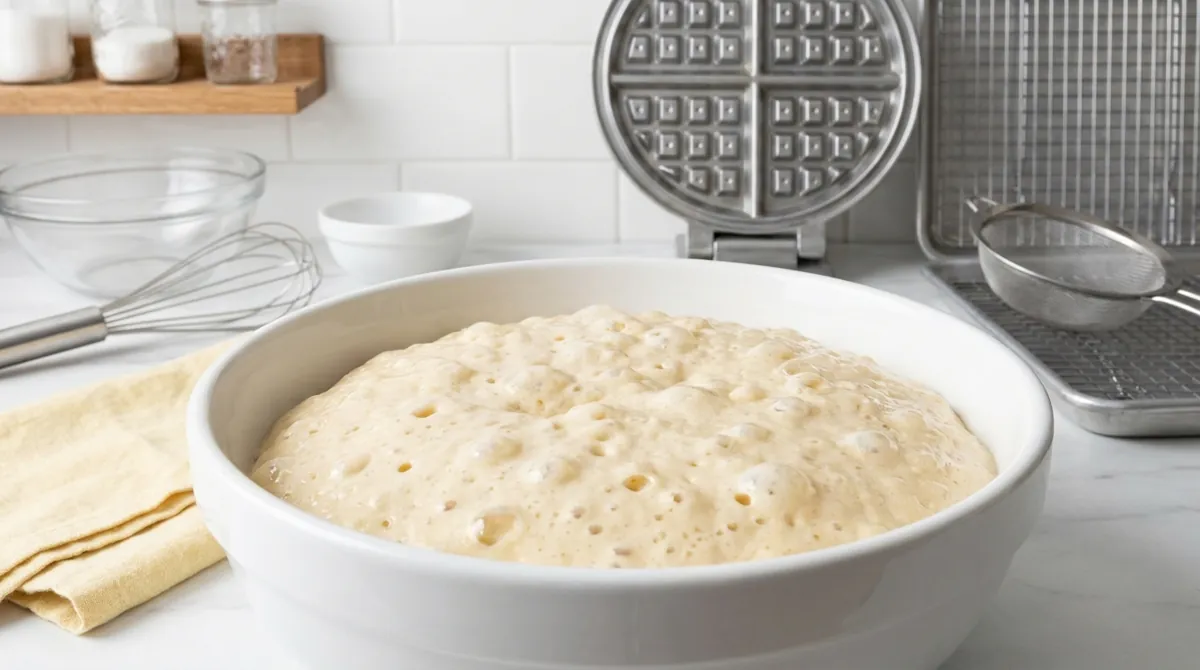
Add the flour and yeast and whisk just until combined; small lumps are fine. Cover and leave at room temperature about 1 hour, until the batter has risen and is full of bubbles. (Or refrigerate it overnight for a deeper, yeastier flavor and cook straight from the fridge.)
✓ What it should look like - Step 3
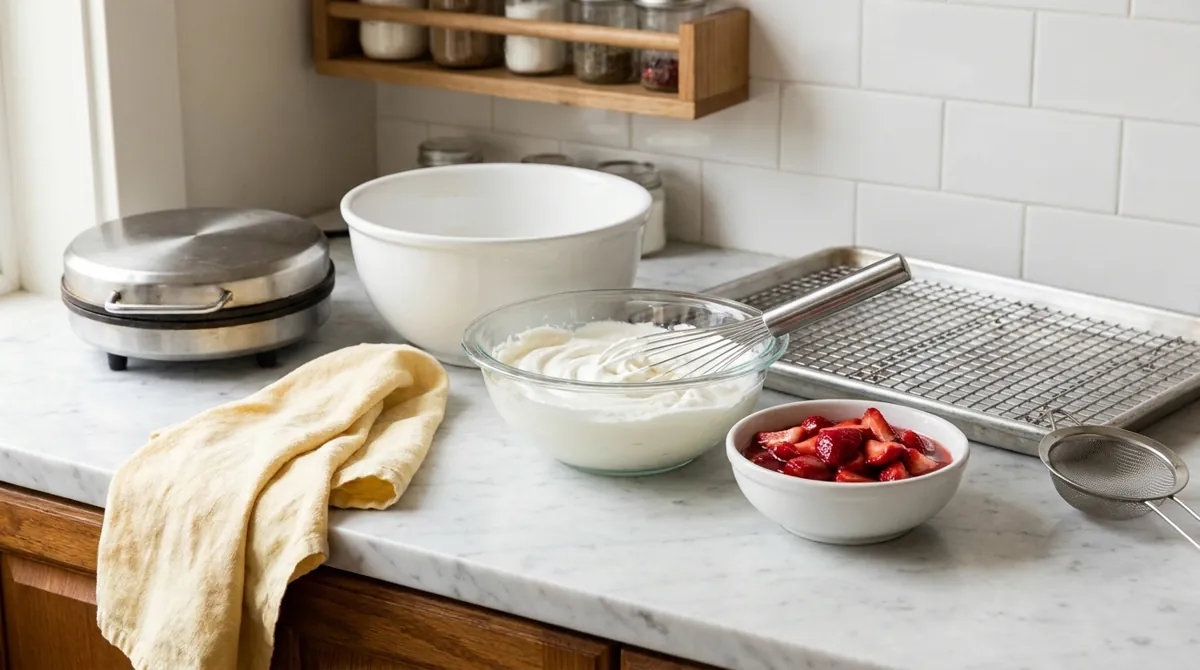
While the batter rises, toss the sliced strawberries with 1 tbsp sugar in a small bowl and let them turn juicy. Whip the cold cream with 2 tbsp powdered sugar to soft peaks in a medium bowl and refrigerate.
- Step 4
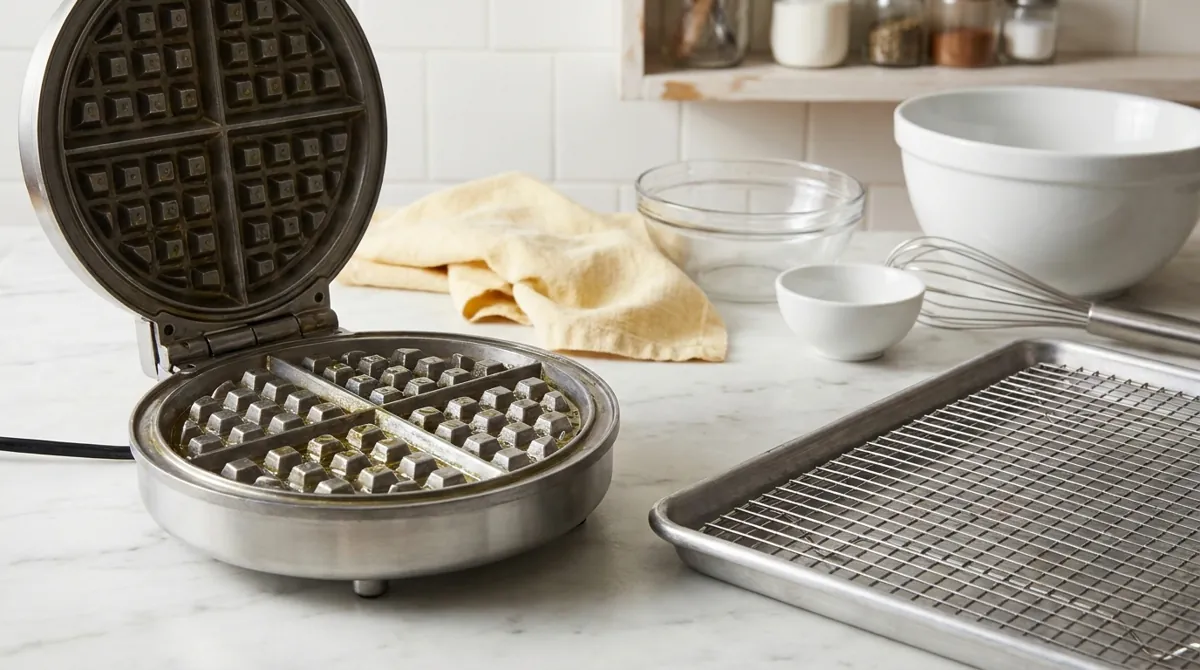
Heat the oven to 200°F and set a wire rack on a rimmed sheet pan inside. Heat a Belgian waffle iron and brush or spray it lightly with oil.
- Step 5
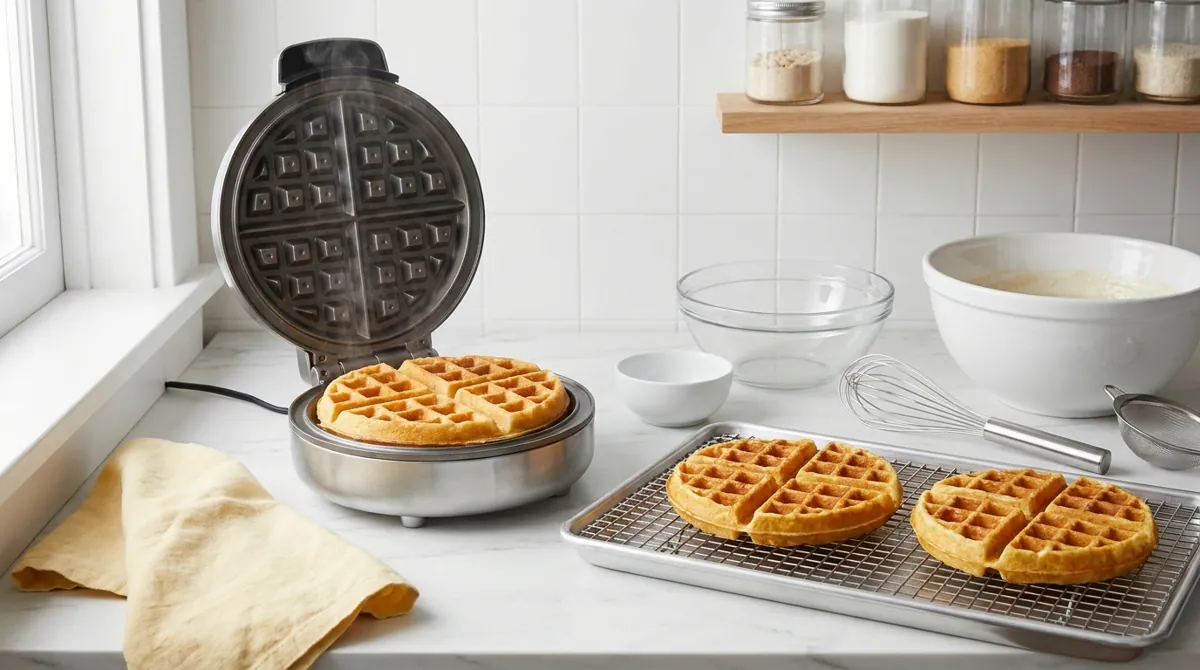
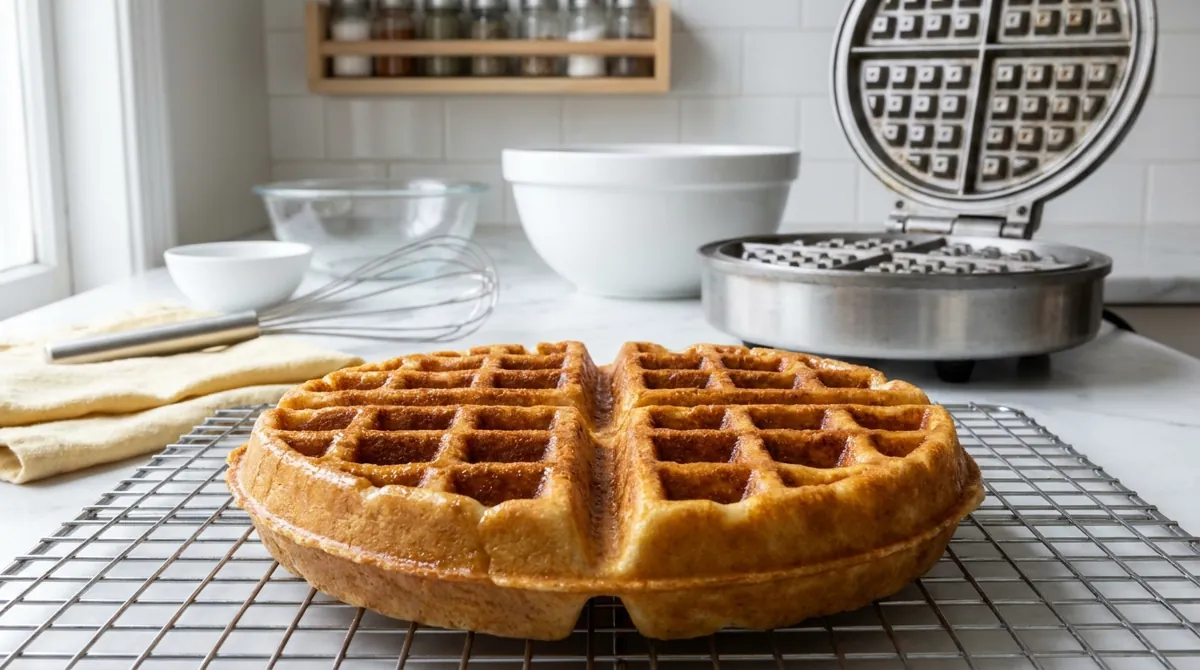
Stir the batter down gently, pour 2/3 to 3/4 cup into the center of the iron, spread it toward the edges, close the lid and bake 5 to 6 minutes, until deep golden brown and the steam has almost stopped. Move each waffle to the rack in the oven and repeat with the rest of the batter.
✓ What it should look like - Step 6
Serve right away: top each waffle with strawberries and their juice, a big spoonful of whipped cream and a dusting of powdered sugar through a small sieve.
Belgian Waffles
Serves 4 · about 4 deep-pocket 7 inch waffles · 1 hr 45 min total
Batter
- 1 1/2 cups whole milk, warmed to lukewarm (340 g)
- 6 tbsp unsalted butter, melted and cooled (85 g)
- 2 tbsp granulated sugar (25 g)
- 3/4 tsp fine salt
- 1 tsp vanilla extract
- 2 large eggs (100 g)
- 2 cups all-purpose flour (240 g)
- 1 1/2 tsp instant yeast (5 g)
- Neutral oil or nonstick spray for the iron
Topping
- 1 lb fresh strawberries, hulled and sliced (450 g)
- 1 tbsp granulated sugar (13 g), for the berries
- 1 cup cold heavy cream (240 g)
- 3 tbsp powdered sugar (25 g), 2 tbsp for the cream and 1 tbsp for dusting
Equipment: Oven, Waffle iron, Rimmed baking sheet, Wire rack, Chef's knife and cutting board, Measuring cups and spoons, Mixing bowls, Whisk, Fine-mesh strainer
Method
- In a large mixing bowl (the batter will double), whisk the warm milk, melted butter, 2 tbsp sugar, salt, vanilla and eggs until smooth.
- Add the flour and yeast and whisk just until combined; small lumps are fine. Cover and leave at room temperature about 1 hour, until the batter has risen and is full of bubbles. (Or refrigerate it overnight for a deeper, yeastier flavor and cook straight from the fridge.)
- While the batter rises, toss the sliced strawberries with 1 tbsp sugar in a small bowl and let them turn juicy. Whip the cold cream with 2 tbsp powdered sugar to soft peaks in a medium bowl and refrigerate.
- Heat the oven to 200°F and set a wire rack on a rimmed sheet pan inside. Heat a Belgian waffle iron and brush or spray it lightly with oil.
- Stir the batter down gently, pour 2/3 to 3/4 cup into the center of the iron, spread it toward the edges, close the lid and bake 5 to 6 minutes, until deep golden brown and the steam has almost stopped. Move each waffle to the rack in the oven and repeat with the rest of the batter.
- Serve right away: top each waffle with strawberries and their juice, a big spoonful of whipped cream and a dusting of powdered sugar through a small sieve.
Americanized house recipe, written for this site. Method and proportions adapted from King Arthur Baking, "Belgian-Style Yeast Waffles" (warm milk, melted butter, eggs, instant yeast, a 1 hour rise or an overnight rest in the fridge, 2/3 to 3/4 cup batter per 7 inch iron for 5 to 6 minutes, holding in a 200°F oven). History: Wikipedia, "Belgian waffle" (Expo 58 in Brussels, Walter Cleyman at the 1962 Seattle Century 21 Exposition with whipped cream and strawberries, Maurice Vermersch at the 1964 New York World's Fair, the Bel-Gem name because Americans could not place Brussels, the one dollar price, originally yeast-leavened, baking powder now common); Wikipedia, "Waffle" (Brussels waffle vs Liège waffle, the American Belgian waffle as a hybrid); Associated Press via Fox News, "She brought Belgian waffles to NYC's 1964 World's Fair, but she's not giving up the recipe" (2014: MariePaule Vermersch, 2,500 waffles a day, the Brussels name, fresh yeast or self-rising flour, the secret recipe, no syrup); Cabinet Magazine, Summer 2015 (Maurice and Rose Vermersch with MariePaule in the Belgian Village, Rose's whipped cream and strawberries); Rich Watson, "#WorldsFair64: The Taste of Belgian Waffles" (yeast, twenty-four irons); HuffPost UK, "The History Of The Belgian Waffle" (first American appearance at the 1962 Seattle fair). King Arthur Baking. Ingredient list follows the source; the method is in our own words.
Tips
- No yeasty flavor wanted? King Arthur's option: add 1 1/2 tsp baking powder with the yeast and rest the batter only 30 minutes.
- The overnight batter is the best batter. Mix it after dinner and breakfast is 25 minutes away.
- MariePaule Vermersch's advice: nothing syrupy, or the waffle turns into a sponge. Use the strawberry juice instead.
- Leftover waffles freeze well; reheat them in a toaster or a 350°F oven until crisp again.
The rules people argue about
What the sources agree on, what they don't, and what is just a good story.
- The Vermersch family brought the Belgian waffle to America in 1964. Disputed: Wikipedia and HuffPost say Belgian waffles first appeared in America at the 1962 Seattle World's Fair (Wikipedia names Walter Cleyman); the Vermersch Bel-Gem at the 1964 New York fair is what made them famous.
- Real Belgian waffles use yeast. Disputed: the Brussels waffle is yeast or egg-white raised, and Rich Watson writes the fair waffles used yeast, but MariePaule Vermersch told the AP the family recipe uses "fresh yeast or self-rising flour" and keeps the exact recipe secret. Most American Belgian waffles today use baking powder.
- Strawberries and whipped cream are Belgian. American fair idea: Cabinet Magazine credits Rose Vermersch, noting it departed from Belgian custom; in Brussels the street waffle comes with powdered sugar. Wikipedia says Cleyman also served them that way in Seattle in 1962, so who did it first is Disputed.
- The name Bel-Gem came from Americans not knowing Brussels. Documented: both Wikipedia and MariePaule Vermersch's account give that reason.
Meatballs of the World

Italian-American Meatballs
Big, tender meatballs braised for an hour in red sauce over spaghetti. The one most Americans grew up with.

Pallottine (Abruzzo Meatballs)
Tiny meatballs, smaller than a marble, tossed right through square spaghetti alla chitarra. No bread at all.

Swedish Meatballs (Köttbullar)
Small, soft meatballs browned in butter, in a cream sauce made from the same pan, with lingonberry jam on the plate.

Danish Frikadeller
Pork meatballs shaped with a spoon and fried slowly in butter, crusty outside and soft in the middle.

Königsberger Klopse
German meatballs that are never fried: poached, then served in a creamy white sauce with capers.

Spanish Albóndigas in Almond Saffron Sauce
The tapas bar classic: small meatballs in a golden sauce thickened with fried almonds and bread.

Mexican Albóndigas with Chipotle and Mint
Soft meatballs with rice and fresh mint inside, simmered in a smoky tomato and chipotle broth.

Izgara Köfte (Turkish Grilled Meatballs)
Small, flat meatballs kneaded hard, rested cold, and charred on a hot grill pan.

Lion's Head Meatballs
Big, soft pork meatballs, stirred into a sticky paste, fried to set, then braised in a savory sauce.

Chicken Tsukune
Japan's chicken meatball: kneaded sticky, grilled on skewers, glazed with sweet soy tare, dipped in egg yolk.