
Caesar Salad
Crisp whole romaine leaves in a garlicky dressing of coddled egg, lemon, olive oil, Worcestershire and Parmigiano, with crunchy olive-oil croutons: the salad an Italian restaurateur made in Tijuana in 1924 for Americans escaping Prohibition.
🍳Cook alongOne move at a time, with real timers
 Edited by JP Lambiase
Change the estimate
Swaps change the price only: cook any meat to its own safe temperature. Where these numbers come from
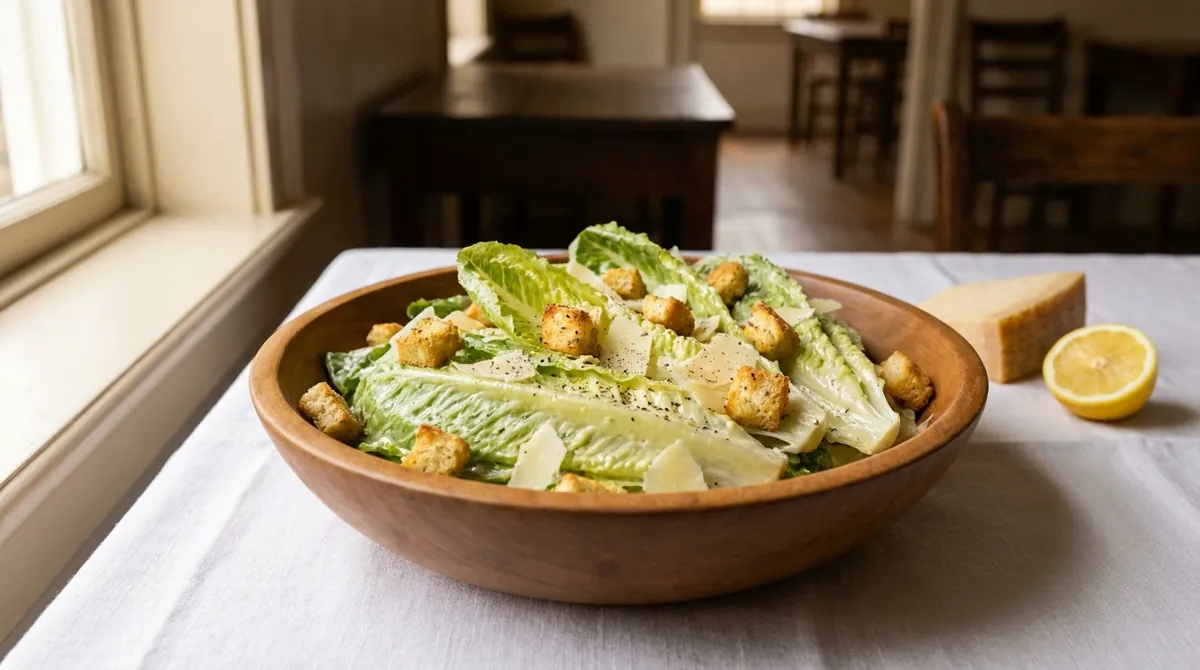
The Caesar salad is named for a man, not an emperor. Caesar Cardini was an Italian immigrant who lived in San Diego and ran a restaurant just over the border in Tijuana, where Americans could drink legally during Prohibition. The story told by his daughter Rosa is that on July 4, 1924, a holiday rush cleaned out the kitchen, and Cardini improvised a salad from what was left, tossing it at the table with a theatrical flourish. The original Caesar's restaurant still makes it tableside.
The original was plainer than most of today's versions. Rosa Cardini and other sources say it had whole romaine leaves meant to be eaten with the fingers, a coddled egg, olive oil, lemon or lime juice, garlic, Parmesan, croutons and Worcestershire sauce, and no anchovies, which her father thought too strong. Julia Child said she ate it at Cardini's in the 1920s as a girl. Hollywood took it up in the 1930s (in a 1952 interview Cardini credited a Paramount Pictures executive with spreading the recipe in 1937), and by 1946 a New York columnist was calling an anchovy and garlic version "the big food rage in Hollywood".
Who really invented it is still argued: Cardini's brother Alex claimed it as his "Aviator Salad", and the family of cook Livio Santini says he brought the recipe from his mother. This version keeps Cardini's coddled egg and Worcestershire and adds a few anchovies, the way most Americans know it.
Why it works the kitchen science
Coddling the egg
45 seconds in simmering water warms and slightly thickens the egg, so it emulsifies the oil into a creamy dressing (America's Test Kitchen's method). It does not make the egg safe; see Tips.
A thin stream of oil while whisking
The egg and mustard hold the oil in tiny droplets only if it goes in slowly. Dumped in, it separates.
Anchovy and worcestershire together
Worcestershire is itself made with anchovies, so the dressing gets its salty, savory depth from both, with or without whole fillets.
Whole inner leaves
The pale, crisp hearts stay crunchy under a heavy dressing, and whole leaves are the way Cardini served them.
Croutons baked through
Crisp to the center, they stay crunchy in the dressing for a few minutes longer than croutons that are only browned outside.
🧰 You'll need 7 items
Everything the steps call for. Tick off what you have before you start.
Appliances
Pans and pots
Tools
Step by step
- Step 1
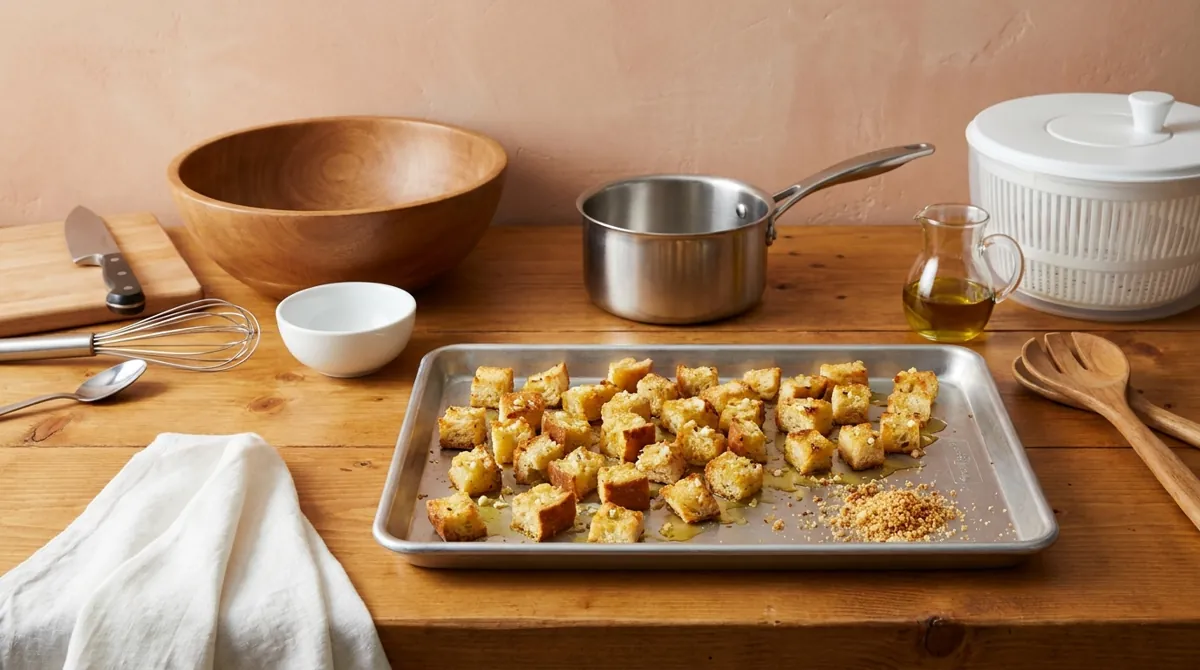
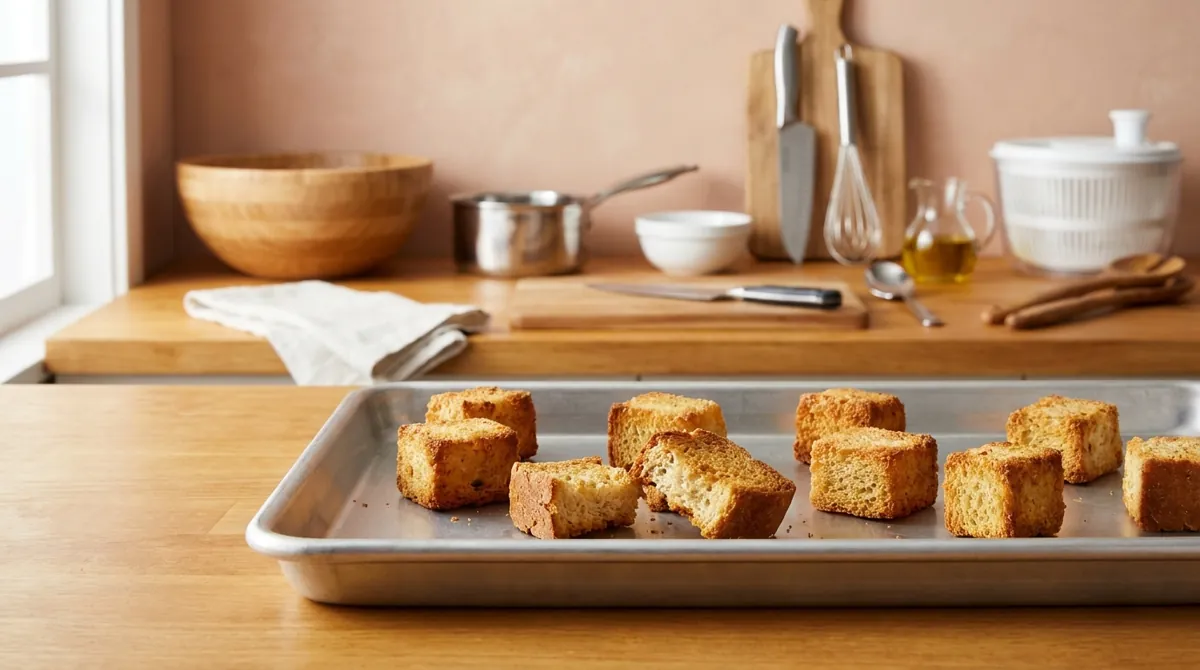
Heat the oven to 375°F. Toss the bread cubes with the 3 tbsp olive oil, the grated garlic and a pinch of salt on a rimmed sheet pan and bake 12 to 15 minutes, stirring once, until golden brown and crisp all the way through. Cool on the pan.
✓ What it should look like - Step 2
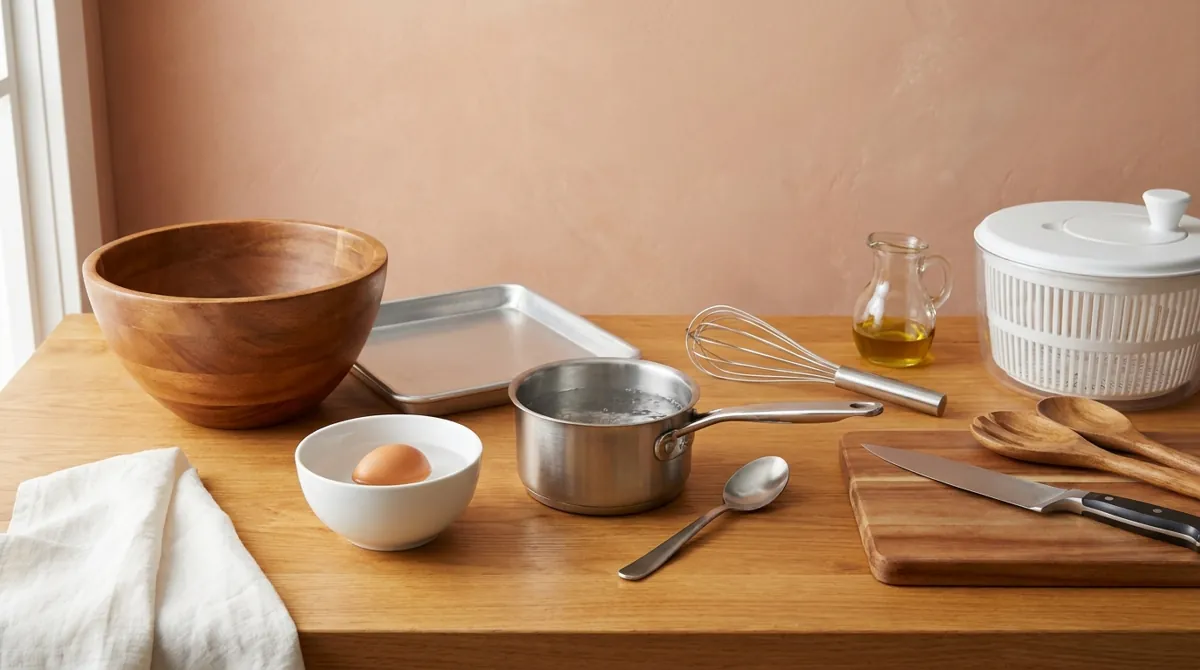
Coddle the egg: bring 2 inches of water to a simmer in a small saucepan, lower in the egg in its shell with a spoon and cook exactly 45 seconds. Move it to a bowl of cold water for 1 minute. The white will be barely set and the yolk still raw but warmed.
- Step 3
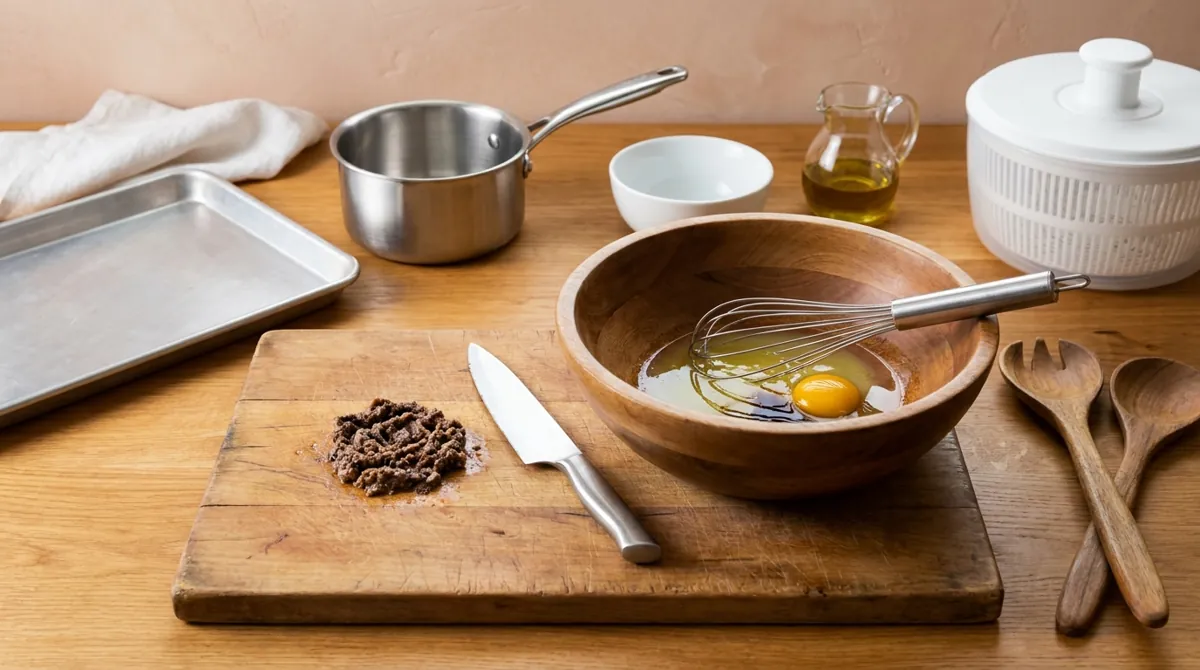
Mash the anchovies and garlic with a pinch of salt on a cutting board with the flat of a chef's knife until they form a smooth paste. Scrape it into a large wooden salad bowl and whisk in the lemon juice, Worcestershire, mustard and the coddled egg, scraping the egg from its shell.
- Step 4
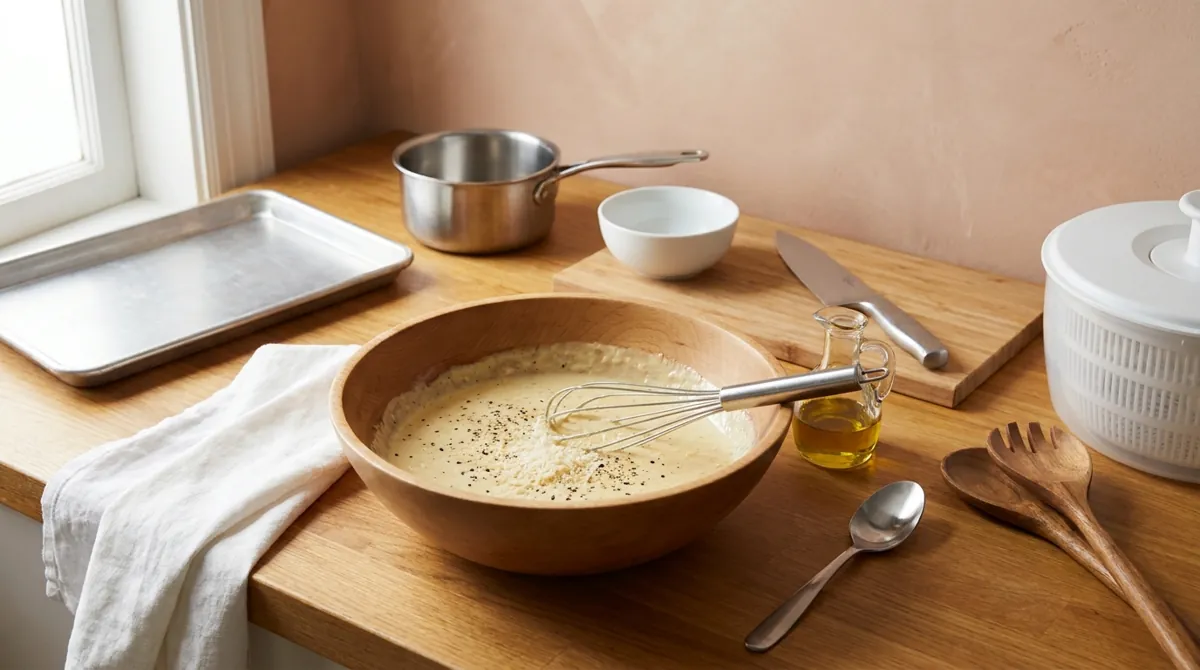
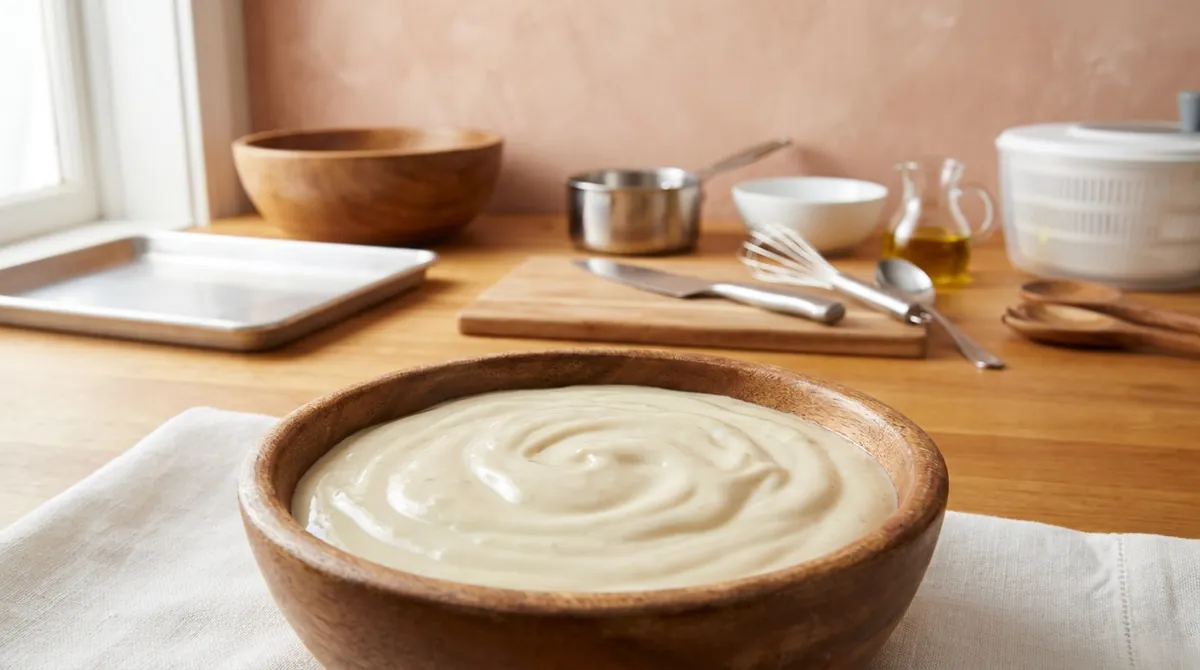
Whisk constantly while adding the olive oil in a thin, steady stream, until the dressing is thick, creamy and does not separate. Whisk in the 1/2 cup Parmesan and season with pepper.
✓ What it should look like - Step 5
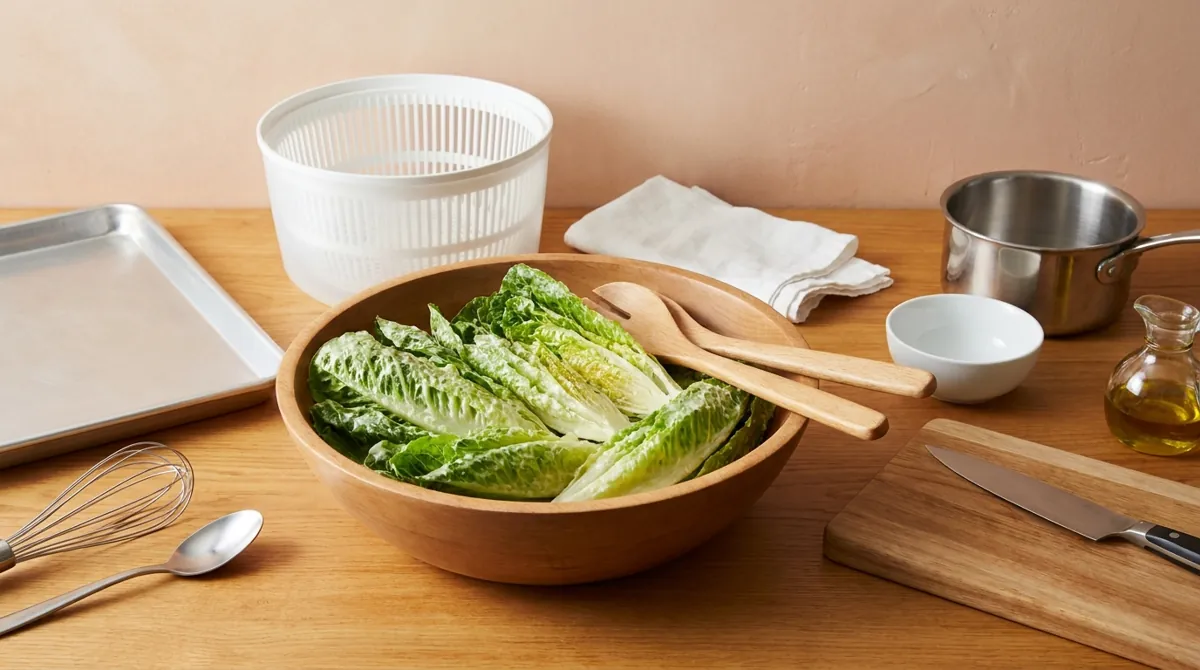
Add the whole romaine leaves to the bowl and toss gently until every leaf is lightly coated.
- Step 6
Add the croutons, toss once more, scatter the last 2 tbsp Parmesan and some black pepper on top and serve right away, before the croutons soften.
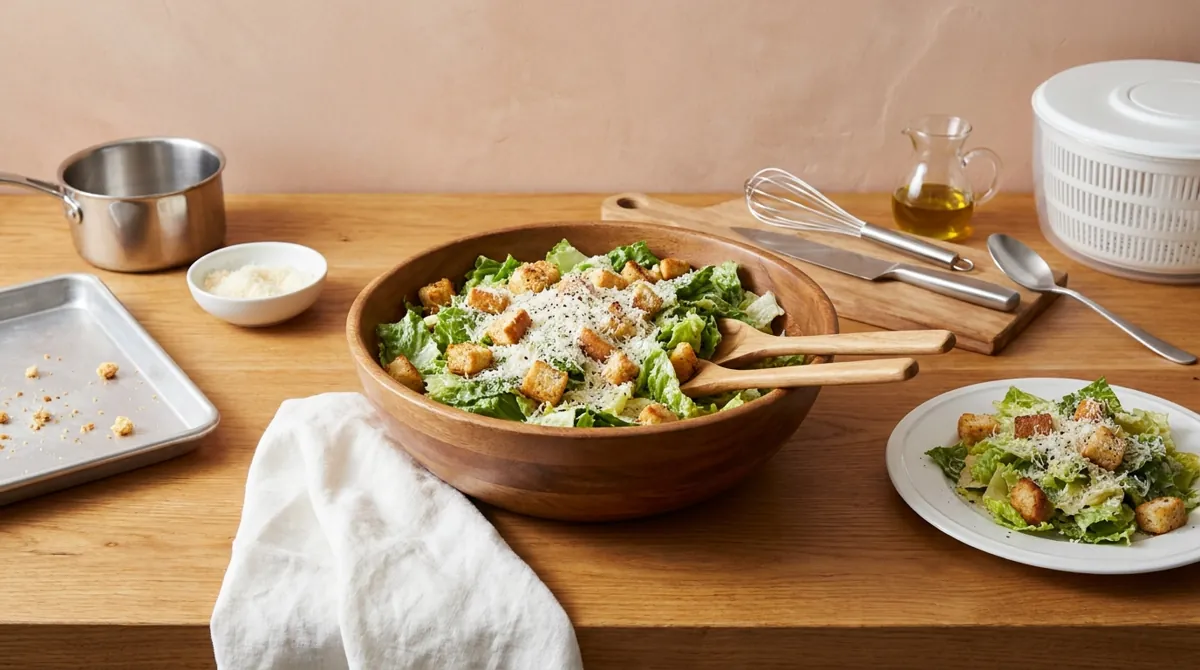
Caesar Salad
Serves 4 · 4 side salads or 2 large main salads · 40 min total
Croutons
- 4 oz day-old crusty Italian or French bread, cut into 3/4 inch cubes (113 g, about 3 cups)
- 3 tbsp extra-virgin olive oil (40 g)
- 1 small garlic clove, grated (3 g)
- Pinch of fine salt
Dressing
- 1 large egg, at room temperature (50 g)
- 4 anchovy fillets packed in oil, drained (16 g), optional (Cardini left them out)
- 1 small garlic clove, grated (3 g)
- 2 tbsp fresh lemon juice (30 g), or lime juice as in the original
- 1 tsp Worcestershire sauce (5 g)
- 1/2 tsp Dijon mustard, optional
- 1/3 cup extra-virgin olive oil (72 g)
- 1/2 cup finely grated Parmigiano-Reggiano (40 g), plus 2 tbsp (10 g) for the top
- Black pepper and fine salt to taste
Salad
- 2 large romaine hearts, inner leaves only, washed and dried (about 500 g)
Equipment: Oven, Rimmed baking sheet, Small saucepan, Chef's knife and cutting board, Measuring cups and spoons, Mixing bowls, Whisk
Method
- Heat the oven to 375°F. Toss the bread cubes with the 3 tbsp olive oil, the grated garlic and a pinch of salt on a rimmed sheet pan and bake 12 to 15 minutes, stirring once, until golden brown and crisp all the way through. Cool on the pan.
- Coddle the egg: bring 2 inches of water to a simmer in a small saucepan, lower in the egg in its shell with a spoon and cook exactly 45 seconds. Move it to a bowl of cold water for 1 minute. The white will be barely set and the yolk still raw but warmed.
- Mash the anchovies and garlic with a pinch of salt on a cutting board with the flat of a chef's knife until they form a smooth paste. Scrape it into a large wooden salad bowl and whisk in the lemon juice, Worcestershire, mustard and the coddled egg, scraping the egg from its shell.
- Whisk constantly while adding the olive oil in a thin, steady stream, until the dressing is thick, creamy and does not separate. Whisk in the 1/2 cup Parmesan and season with pepper.
- Add the whole romaine leaves to the bowl and toss gently until every leaf is lightly coated.
- Add the croutons, toss once more, scatter the last 2 tbsp Parmesan and some black pepper on top and serve right away, before the croutons soften.
Americanized house recipe, written for this site. History: Wikipedia, "Caesar salad" (Caesar Cardini, San Diego and Tijuana, Prohibition, July 4, 1924 and Rosa Cardini's account, tableside service, whole leaves eaten with the fingers, Julia Child in the 1920s and her 1975 recipe, the 1937 Hollywood spread in Cardini's 1952 interview, Dorothy Kilgallen's 1946 column, Alex Cardini's "Aviator Salad", Livio Santini's claim, the 2024 book backing Caesar Cardini, original without anchovies, the Julius Caesar myth); Salon, "Inside the history of Caesar salad, the world-famous salad that just turned 100" (the 100th anniversary, Tijuana historians, lime juice in the original); Encyclopaedia Britannica, "Caesar salad". Technique: America's Test Kitchen, "Best Caesar Salad" (a whole egg coddled 45 seconds instead of a raw yolk, white bread croutons); America's Test Kitchen, "Classic Chicken Caesar Salad" (coddled eggs with olive oil, lemon, Worcestershire, garlic and anchovy). en.wikipedia.org. Ingredient list follows the source; the method is in our own words.
Tips
- Coddled egg is still essentially raw. For anyone pregnant, very young, elderly or with a weak immune system, use a pasteurized egg or 2 tbsp mayonnaise in its place.
- Dry the romaine completely in a salad spinner; water on the leaves thins the dressing and keeps it from clinging.
- The croutons keep 3 days in an airtight container. The dressing keeps 1 day, covered, in the refrigerator.
- For a main course, top with sliced grilled chicken or grilled shrimp, an American addition that came much later.
The rules people argue about
What the sources agree on, what they don't, and what is just a good story.
- Caesar Cardini invented it in Tijuana on July 4, 1924. Disputed: it is the most accepted story, from his daughter Rosa, and a 2024 book backs Cardini; but his brother Alex claimed it as the "Aviator Salad", several former staff said they made it first, and the son of cook Livio Santini says his father brought it from his mother's recipe. The exact date rests on family memory.
- It is named for Julius Caesar. Folklore: it is named for Caesar Cardini (Wikipedia calls the Julius Caesar link a popular myth).
- A real Caesar has anchovies. Disputed: Rosa Cardini and other sources say the original had none, only Worcestershire, because her father found anchovies too bold. Anchovy versions were already the Hollywood rage by 1946, and most modern recipes use them.
- Lemon, not lime. Disputed: today's recipes use lemon; some Tijuana accounts say the original used lime.
Meatballs of the World

Italian-American Meatballs
Big, tender meatballs braised for an hour in red sauce over spaghetti. The one most Americans grew up with.

Pallottine (Abruzzo Meatballs)
Tiny meatballs, smaller than a marble, tossed right through square spaghetti alla chitarra. No bread at all.

Swedish Meatballs (Köttbullar)
Small, soft meatballs browned in butter, in a cream sauce made from the same pan, with lingonberry jam on the plate.

Danish Frikadeller
Pork meatballs shaped with a spoon and fried slowly in butter, crusty outside and soft in the middle.

Königsberger Klopse
German meatballs that are never fried: poached, then served in a creamy white sauce with capers.

Spanish Albóndigas in Almond Saffron Sauce
The tapas bar classic: small meatballs in a golden sauce thickened with fried almonds and bread.

Mexican Albóndigas with Chipotle and Mint
Soft meatballs with rice and fresh mint inside, simmered in a smoky tomato and chipotle broth.

Izgara Köfte (Turkish Grilled Meatballs)
Small, flat meatballs kneaded hard, rested cold, and charred on a hot grill pan.

Lion's Head Meatballs
Big, soft pork meatballs, stirred into a sticky paste, fried to set, then braised in a savory sauce.

Chicken Tsukune
Japan's chicken meatball: kneaded sticky, grilled on skewers, glazed with sweet soy tare, dipped in egg yolk.