
Chicken Biryani
Spiced yogurt-marinated chicken under layers of long, separate grains of basmati, deep brown fried onions, mint and saffron milk, sealed and steamed in its own pot: the celebration rice dish of the Indian subcontinent.
🍳Cook alongOne move at a time, with real timers
 Edited by JP Lambiase
Change the estimate
Swaps change the price only: cook any meat to its own safe temperature. Where these numbers come from
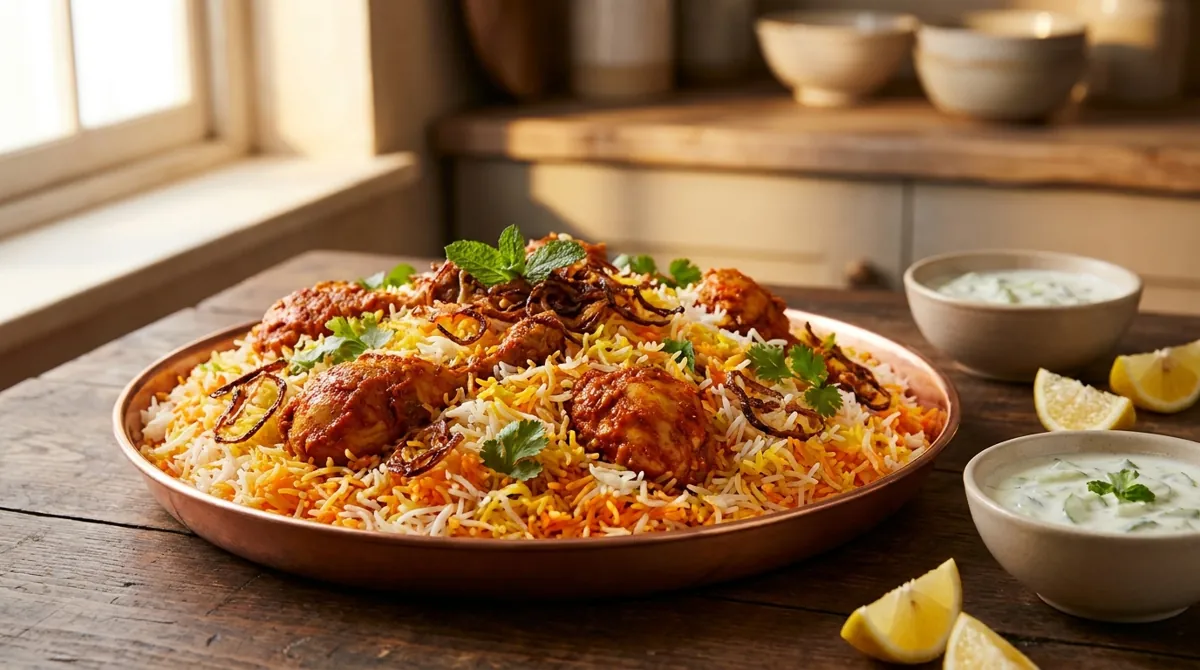
The name comes from Persian: biryan or beriyan means fried or roasted, and the dish is usually traced to the Persian birinj biryan, "fried rice," and the Persian pilau. Where and when it became biryani is argued over. The Ain-i-Akbari, the record of the emperor Akbar's court written in the 1590s, already lists biryani and pilau as separate dishes, and in 1641 the traveler Sebastien Manrique told "Persian" pilaos apart from "Mogol" biryanis. Historian Lizzie Collingham thinks it was most likely developed in the Mughal royal kitchens, where Persian pilau met yogurt-marinated meat and the spicy rice cooking of India. Others disagree: some writers think it came from Persia before the Mughals, perhaps through the Deccan in the south, and some credit Indian cooks working with pilau brought by traders. The story that the conqueror Timur brought it to India appears to be wrong, since there is no record of biryani in Central Asia at the time.
Today almost every region has its own. In Hyderabad, folklore credits the chef of the first Nizam with the city's biryani, and the classic is kacchi: raw marinated meat and rice sealed in a pot together. Lucknow seals mutton biryani in a clay pot under dough. Kolkata's has a potato in it, a touch credited to the exiled Nawab Wajid Ali Shah in the 1850s, and Old Dhaka serves mutton kacchi biryani at weddings.
This is the pakki style, the easier one for home cooks: the chicken and rice are cooked separately, layered, then sealed and steamed together, which is called dum.
Why it works the kitchen science
Yogurt marinade
The acid and enzymes tenderize the thighs, and the yogurt cooks down into a thick, clinging masala instead of a watery sauce.
Rinsed, soaked basmati
Rinsing takes off surface starch so the grains stay separate, and soaking helps them cook long and straight instead of breaking.
Rice boiled only 70 percent
It finishes in the steam from the chicken below, picking up its flavor without turning mushy.
Dum, the sealed pot
Foil and a lid trap the steam, so the rice and chicken finish together in their own juices, the method Wikipedia describes for kacchi biryani.
Deeply browned onions
They give the sweet, savory, almost burnt depth that is the backbone of a biryani.
🧰 You'll need 9 items
Everything the steps call for. Tick off what you have before you start.
Pans and pots
Tools
Supplies
Step by step
- Step 1
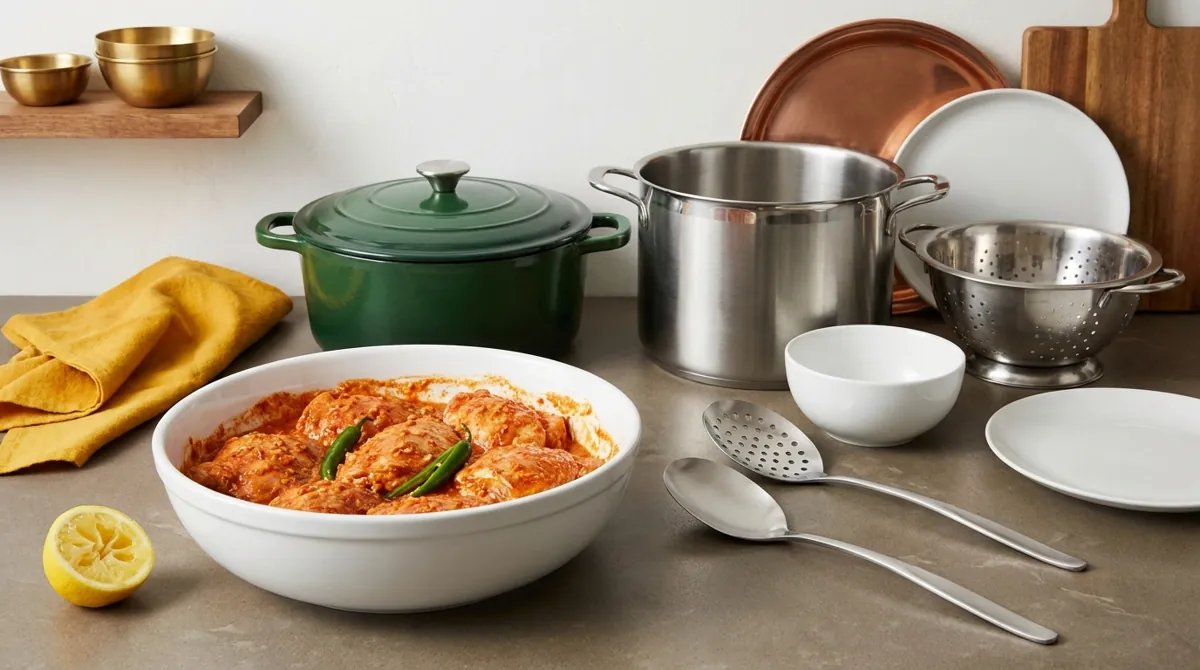
Stir the chicken with the yogurt, ginger, garlic, chiles, chili powder, turmeric, garam masala, salt and lemon juice in a large bowl. Cover and refrigerate at least 60 minutes, or up to overnight.
- Step 2
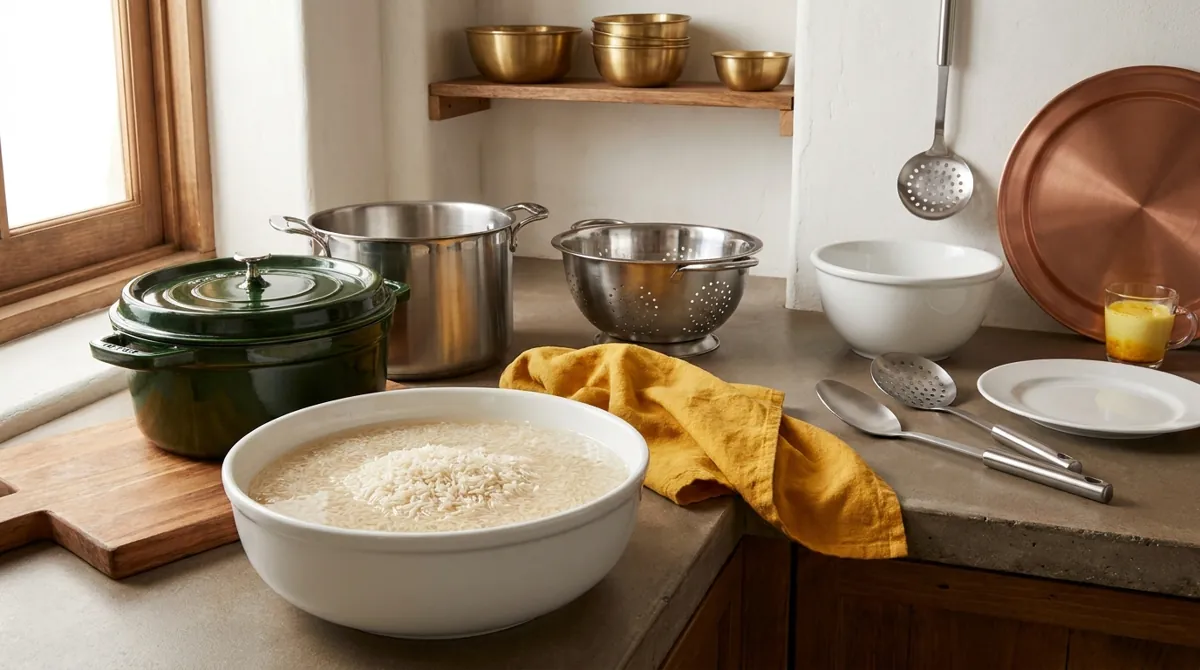
Rinse the basmati in a bowl of cold water, changing the water 3 or 4 times until it runs almost clear, then soak it in fresh water for 30 minutes.
- Step 3
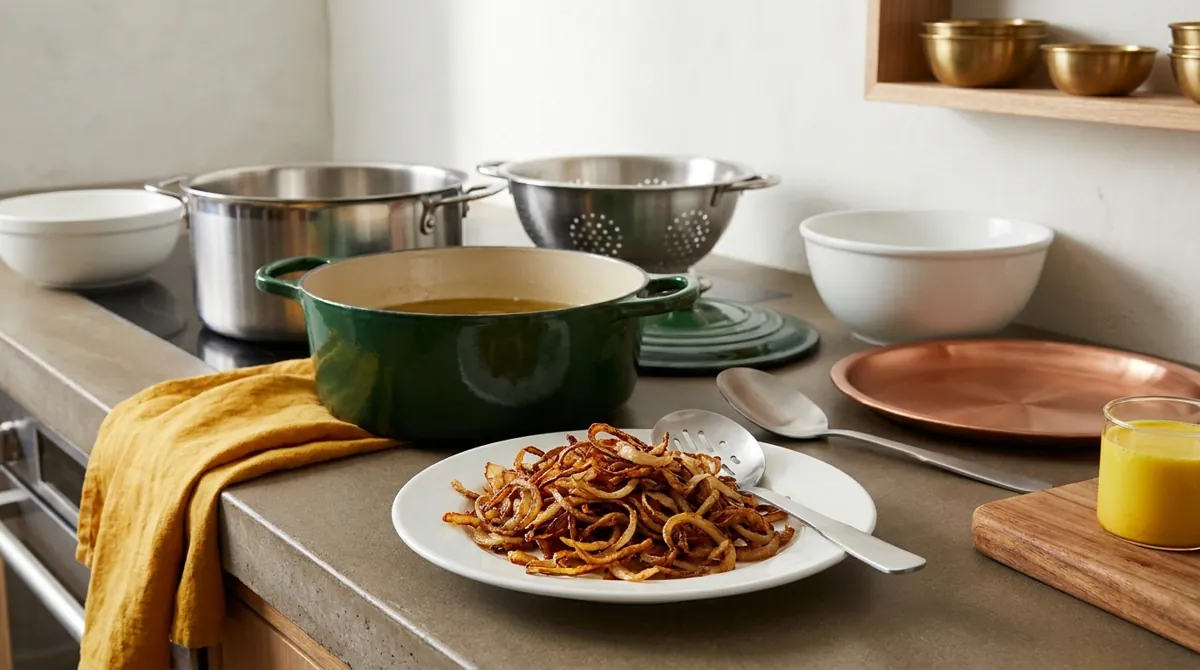
Heat the oil in the Dutch oven over medium-high heat. Add the onions and cook, stirring often, lowering the heat to medium as they color, until deep golden brown and crisp at the edges, 20 to 25 minutes. Scoop them onto a plate with the slotted spoon, leaving the oil in the pot.
- Step 4
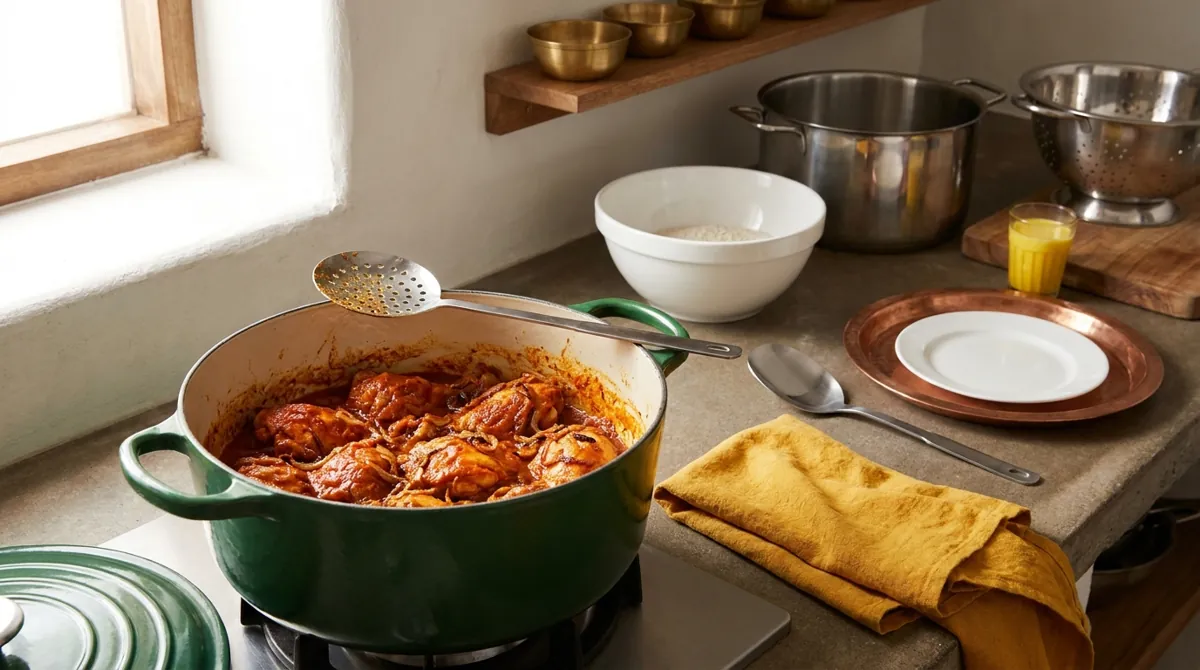
Add the chicken and all its marinade to the oil, with half the fried onions. Cook over medium heat, stirring now and then, until the sauce thickens and clings to the chicken, about 15 minutes. Spread it in an even layer.
- Step 5
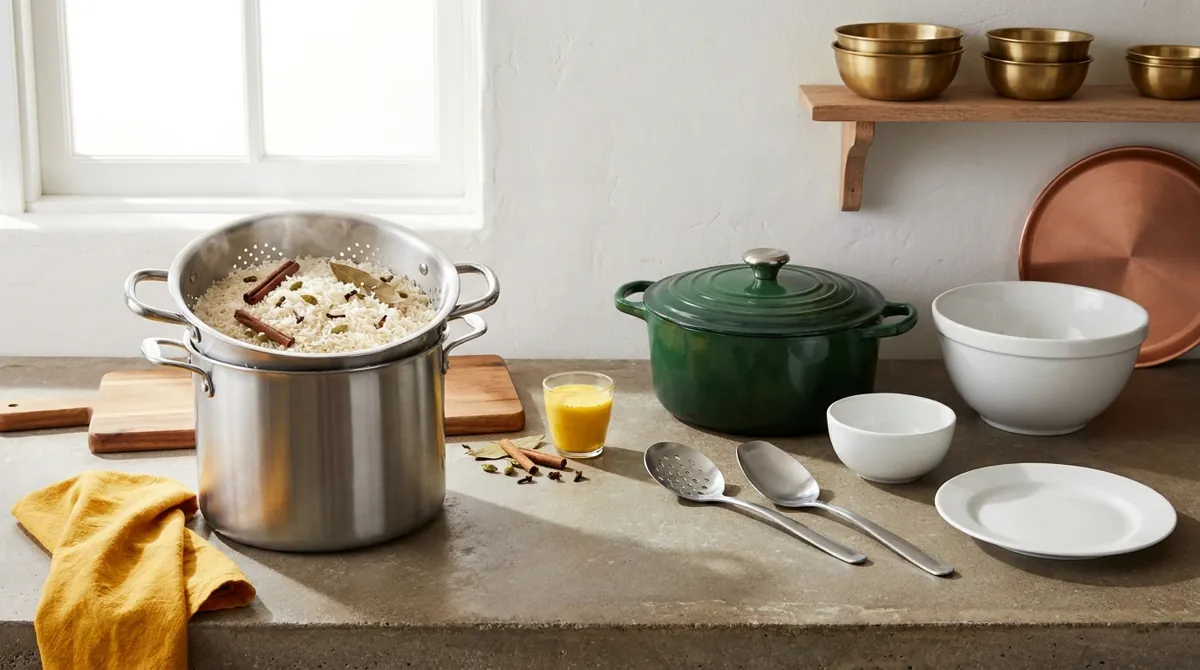
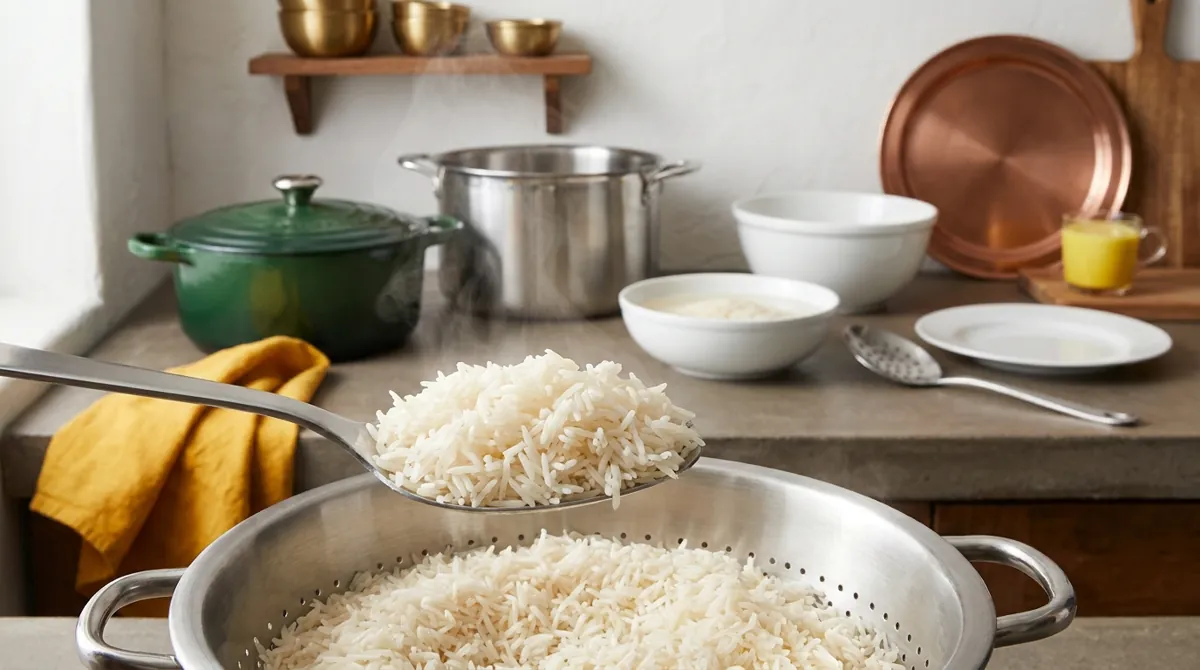
Meanwhile bring 4 quarts water to a boil in the stockpot with the 2 tbsp salt and the whole spices. Drain the rice, add it and boil 5 to 6 minutes, until a grain breaks easily between your fingers but still has a firm white core. Drain it well in the colander.
✓ What it should look like - Step 6
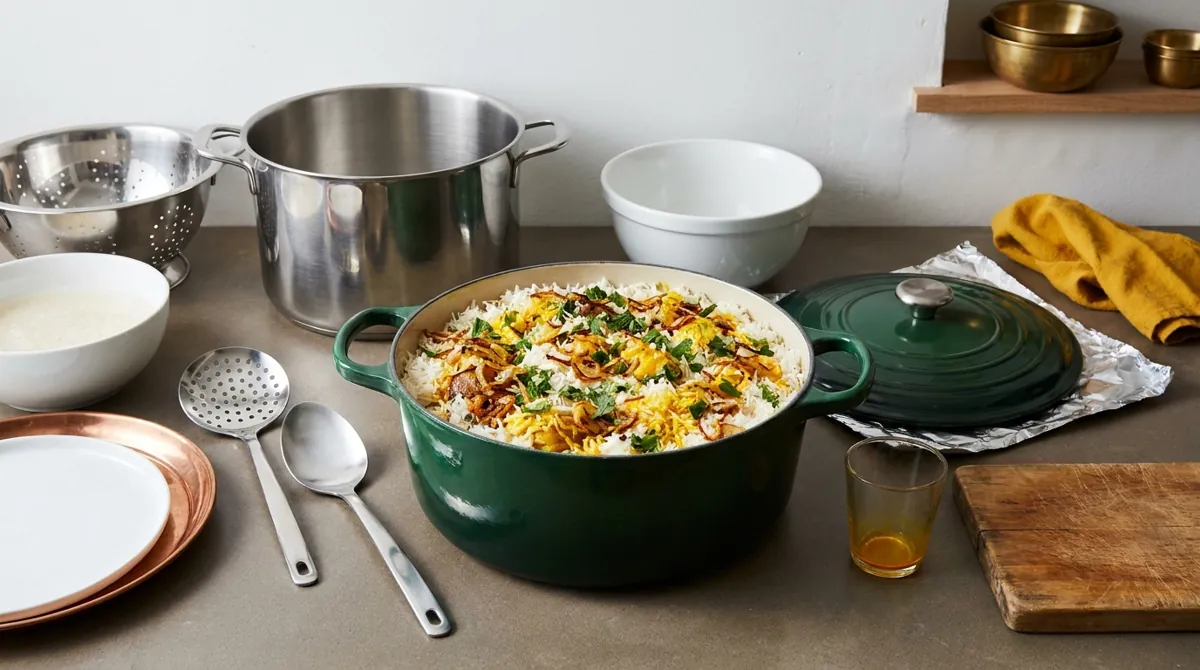
Spread the rice over the chicken without stirring. Scatter the mint, cilantro and the rest of the onions on top, spoon the saffron milk over in streaks and drizzle with the ghee. Cover the pot with foil, press the lid down on it, and cook over the lowest heat 20 to 25 minutes, until steam escapes around the lid, the rice is tender and the chicken reads 165°F. Rest 10 minutes without opening.
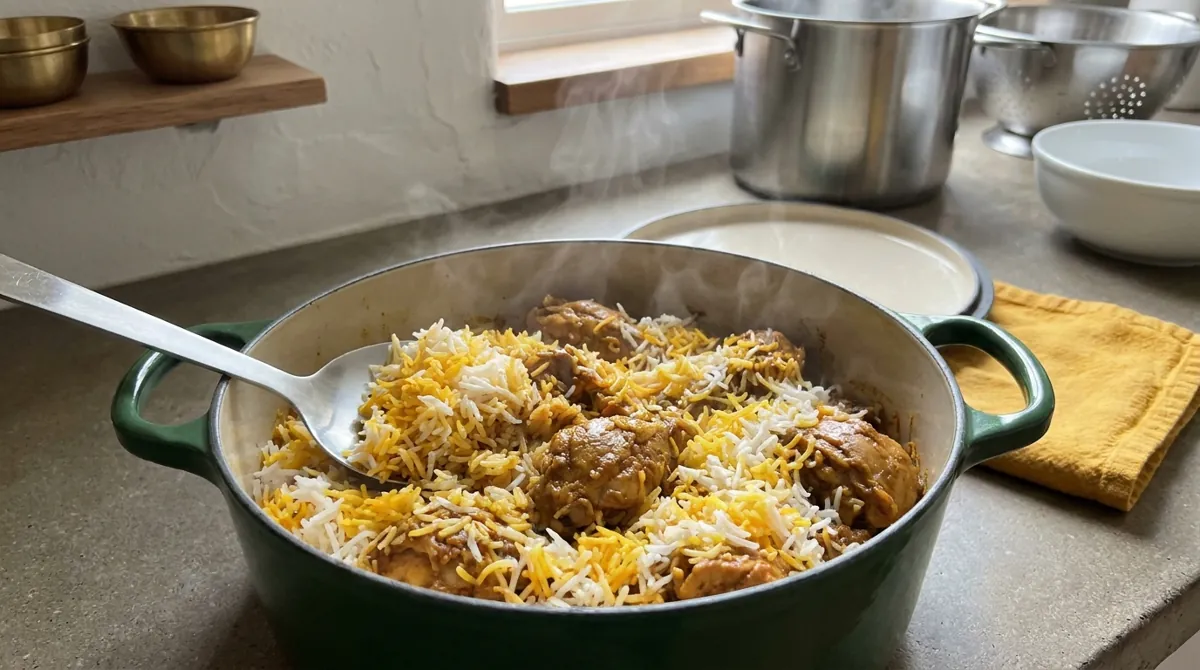
✓ What it should look like - Step 7
Scoop down to the bottom with a wide spoon so every serving gets white, saffron-gold and spiced rice and chicken. Serve with raita and lemon wedges.
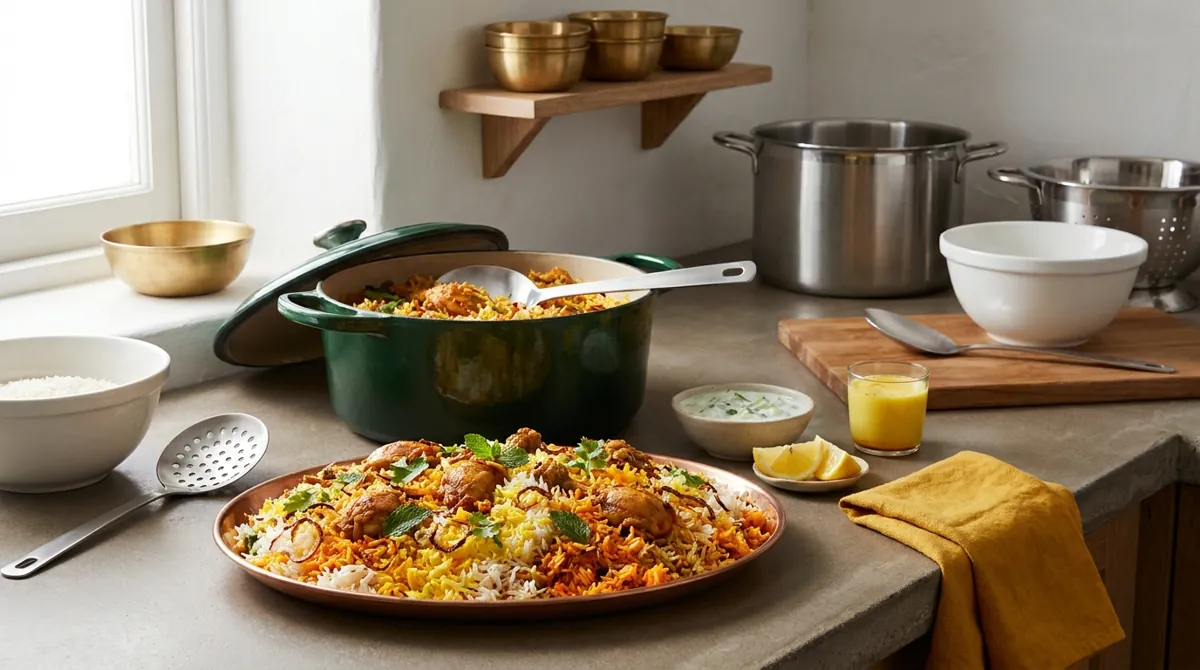
Chicken Biryani
Serves 6 · one 6 quart Dutch oven · 2 hr 45 min total
Chicken
- 2 lb boneless, skinless chicken thighs, cut into 1 1/2 inch pieces (900 g)
- 1 cup plain whole-milk yogurt (245 g)
- 1 piece fresh ginger, 2 inches, finely grated (15 g)
- 5 garlic cloves, finely grated (15 g)
- 2 green serrano chiles, slit lengthwise (12 g)
- 2 tsp Kashmiri chili powder or 1 tsp paprika and 1/2 tsp cayenne
- 1 tsp ground turmeric
- 2 tsp garam masala
- 2 tsp fine salt
- 2 tbsp lemon juice (30 g)
Fried onions
- 3 large onions, halved and thinly sliced (600 g)
- 1/2 cup neutral oil, such as canola (109 g)
Rice
- 2 cups basmati rice (380 g)
- 1 cinnamon stick, 4 green cardamom pods, 4 whole cloves, 2 bay leaves and 1 tsp cumin seeds
- 2 tbsp salt, for the water
To layer
- 1/2 cup chopped fresh mint (12 g)
- 1/2 cup chopped fresh cilantro (10 g)
- 1/4 tsp saffron threads, crumbled into 3 tbsp warm whole milk (45 g)
- 2 tbsp ghee, melted (26 g)
To serve
- Cucumber raita and lemon wedges
Equipment: Dutch oven, Large pot, Instant-read thermometer, Chef's knife and cutting board, Measuring cups and spoons, Mixing bowls, Slotted spoon or spider, Colander, Aluminum foil
Method
- Stir the chicken with the yogurt, ginger, garlic, chiles, chili powder, turmeric, garam masala, salt and lemon juice in a large bowl. Cover and refrigerate at least 60 minutes, or up to overnight.
- Rinse the basmati in a bowl of cold water, changing the water 3 or 4 times until it runs almost clear, then soak it in fresh water for 30 minutes.
- Heat the oil in the Dutch oven over medium-high heat. Add the onions and cook, stirring often, lowering the heat to medium as they color, until deep golden brown and crisp at the edges, 20 to 25 minutes. Scoop them onto a plate with the slotted spoon, leaving the oil in the pot.
- Add the chicken and all its marinade to the oil, with half the fried onions. Cook over medium heat, stirring now and then, until the sauce thickens and clings to the chicken, about 15 minutes. Spread it in an even layer.
- Meanwhile bring 4 quarts water to a boil in the stockpot with the 2 tbsp salt and the whole spices. Drain the rice, add it and boil 5 to 6 minutes, until a grain breaks easily between your fingers but still has a firm white core. Drain it well in the colander.
- Spread the rice over the chicken without stirring. Scatter the mint, cilantro and the rest of the onions on top, spoon the saffron milk over in streaks and drizzle with the ghee. Cover the pot with foil, press the lid down on it, and cook over the lowest heat 20 to 25 minutes, until steam escapes around the lid, the rice is tender and the chicken reads 165°F. Rest 10 minutes without opening.
- Scoop down to the bottom with a wide spoon so every serving gets white, saffron-gold and spiced rice and chicken. Serve with raita and lemon wedges.
Americanized house recipe, written for this site. History: Wikipedia, "Biryani" (Persian biryan and birinj biryan, the origin "debated," the Ain-i-Akbari listing biryani and pilau separately, Manrique's 1641 "Mogol" biryanis, Collingham's Mughal court kitchen argument against Hussein's pre-Mughal Persian and Deccan view and Karan's Indian origin view, Achaya's ancient rice and meat dishes and later concession, the Timur theory "appears to be incorrect," the Kolkata potato and Wajid Ali Shah, Old Dhaka's wedding kacchi, Lucknow's sealed clay pot, pakki and kacchi, biryani against pulao); Wikipedia, "Hyderabadi biryani" ("the exact origin of the dish is uncertain," folklore crediting the chef of the first Nizam, kacchi with meat marinated in yogurt and sealed with dough, basmati, fried onion, ghee, saffron). Technique: America's Test Kitchen, "Chicken Biryani" (boneless thighs, onions fried dark brown, rice boiled with cinnamon and cumin and drained, a yogurt and garam masala chicken layer, saffron water spiraled over the rice, covered steaming until steam escapes, fried onions, mint and cilantro on top). Safety: FoodSafety.gov, "Safe Minimum Internal Temperatures" (poultry 165°F). en.wikipedia.org. Ingredient list follows the source; the method is in our own words.
Tips
- Use thighs, not breast: breast dries out in the long steam.
- Fried onions keep a week in the fridge; many South Asian groceries sell them ready-made as birista.
- If the bottom of your pot is thin, set it on a flat cast iron griddle for the dum stage so the chicken does not scorch.
- For a Kolkata touch, brown 3 halved small potatoes with the chicken.
The rules people argue about
What the sources agree on, what they don't, and what is just a good story.
- Biryani was invented in the Mughal court. Disputed: Collingham thinks so; other writers argue for a pre-Mughal arrival from Persia through the Deccan, or for Indian origins. Wikipedia calls the origin debated.
- Timur brought biryani to India. Folklore: Wikipedia says this "appears to be incorrect," with no record of biryani in Central Asia then.
- Hyderabadi biryani was created by the first Nizam's chef. Folklore: Wikipedia says the exact origin is uncertain and calls this local folklore; a 2009 bid for a geographical indication failed for lack of documentary evidence.
- Biryani and pulao are different dishes. Disputed: Karan says biryani is layered and pulao is not, Sohail Hashmi says biryani has more gravy, cooks longer and has a scorched layer of rice, and Colleen Taylor Sen says they are sometimes almost impossible to tell apart.
Meatballs of the World

Italian-American Meatballs
Big, tender meatballs braised for an hour in red sauce over spaghetti. The one most Americans grew up with.

Pallottine (Abruzzo Meatballs)
Tiny meatballs, smaller than a marble, tossed right through square spaghetti alla chitarra. No bread at all.

Swedish Meatballs (Köttbullar)
Small, soft meatballs browned in butter, in a cream sauce made from the same pan, with lingonberry jam on the plate.

Danish Frikadeller
Pork meatballs shaped with a spoon and fried slowly in butter, crusty outside and soft in the middle.

Königsberger Klopse
German meatballs that are never fried: poached, then served in a creamy white sauce with capers.

Spanish Albóndigas in Almond Saffron Sauce
The tapas bar classic: small meatballs in a golden sauce thickened with fried almonds and bread.

Mexican Albóndigas with Chipotle and Mint
Soft meatballs with rice and fresh mint inside, simmered in a smoky tomato and chipotle broth.

Izgara Köfte (Turkish Grilled Meatballs)
Small, flat meatballs kneaded hard, rested cold, and charred on a hot grill pan.

Lion's Head Meatballs
Big, soft pork meatballs, stirred into a sticky paste, fried to set, then braised in a savory sauce.

Chicken Tsukune
Japan's chicken meatball: kneaded sticky, grilled on skewers, glazed with sweet soy tare, dipped in egg yolk.