
Chicken Cordon Bleu
Chicken breast rolled around ham and melted Swiss, breaded until crisp and baked golden: the dinner-party showpiece that turned a Swiss veal dish into an American classic.
🍳Cook alongOne move at a time, with real timers
 Edited by JP Lambiase
Change the estimate
Swaps change the price only: cook any meat to its own safe temperature. Where these numbers come from
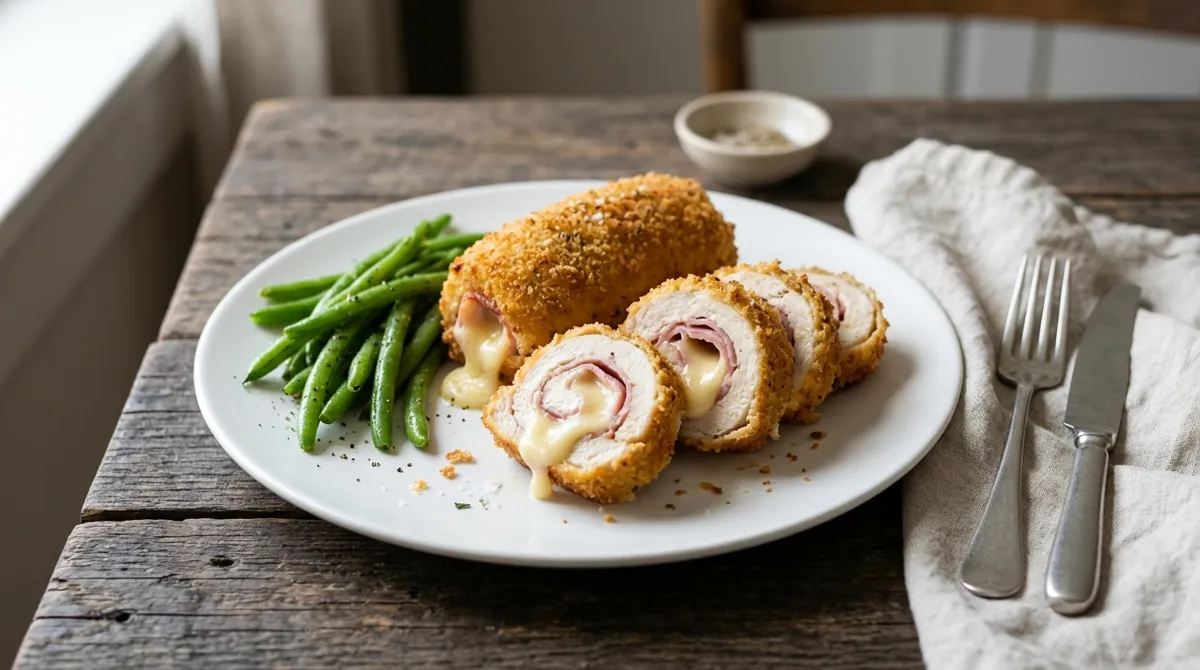
"Cordon bleu" means "blue ribbon" in French, an old phrase for top honors that was later applied to master cooks. The dish itself began as veal: a thin cutlet wrapped around ham and cheese, breaded and fried, which is a Swiss and Central European style of schnitzel. Wikipedia says its exact origin is unclear. The most accepted theory credits a woman cook in Valais, Switzerland; other stories point to a 1930 French cooking contest or a Swiss cook aboard the liner Bremen in 1933. The dish first shows up in a 1949 cookbook, and the earliest "veal cordon bleu" reference cited is a 1958 Los Angeles Times item.
The chicken version is the American one. Chicken breasts were cheap, lean and easy to pound, and the filled, breaded roll became a 1950s and 1960s dinner-party favorite, the kind of dish that looks fancy and can be assembled ahead. Today chicken is the most popular version.
Why it works the kitchen science
Pounding to an even thickness
The breast cooks through at the same time as the filling melts, so it stays juicy instead of drying at the thin end.
Ham and swiss inside
The cheese melts into the chicken and the ham adds salt, so it needs no extra sauce.
Flour, egg, then crumbs
Flour dries the surface, egg is the glue, crumbs give the crisp shell.
Chilling before baking
The coating sets so it clings and the cheese stays in.
🧰 You'll need 7 items
Everything the steps call for. Tick off what you have before you start.
Appliances
Pans and pots
Tools
Supplies
Step by step
- Step 1
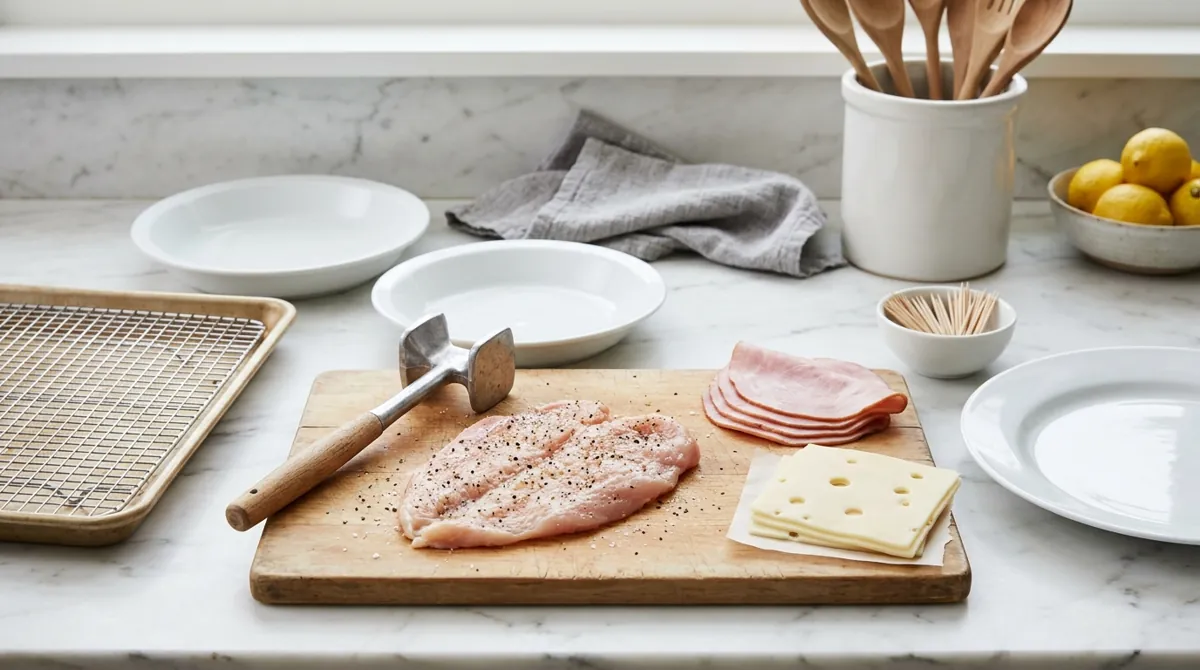
Heat the oven to 400°F. Slice each chicken breast horizontally almost through, open it like a book, and pound it between plastic wrap to about 1/2 inch thick. Season both sides with salt and pepper.
- Step 2
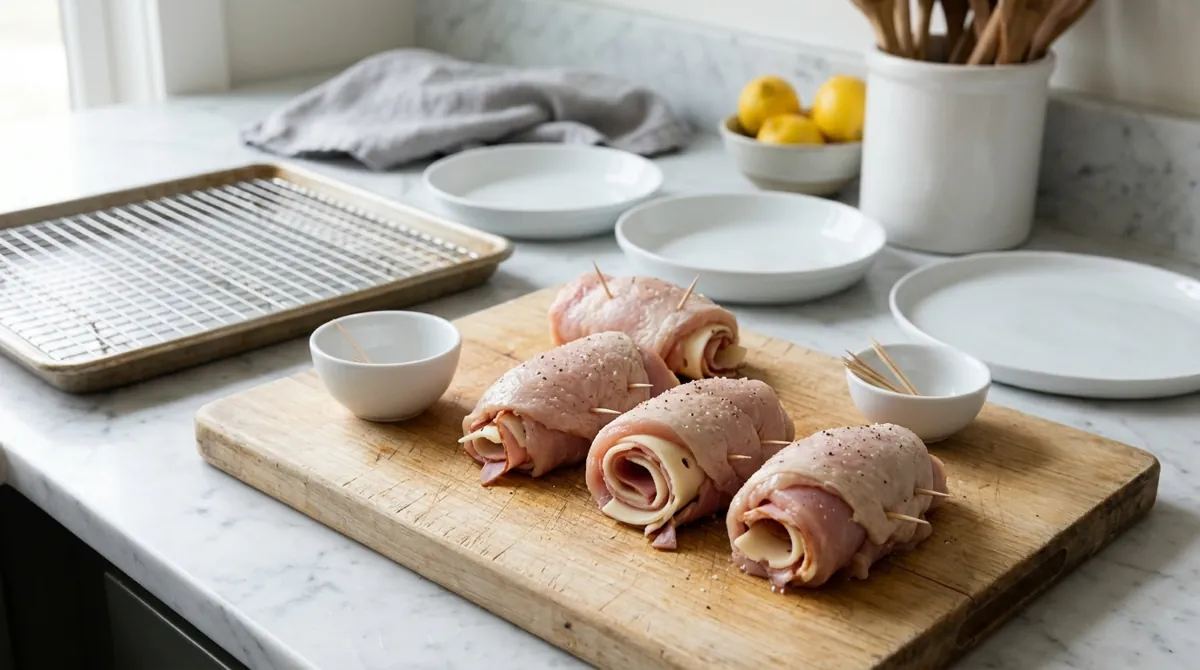
Lay a slice of ham and a slice of Swiss on each breast, leaving a 1/2 inch edge. Roll up from the short side, tuck in the ends and secure each roll with 2 toothpicks.
- Step 3
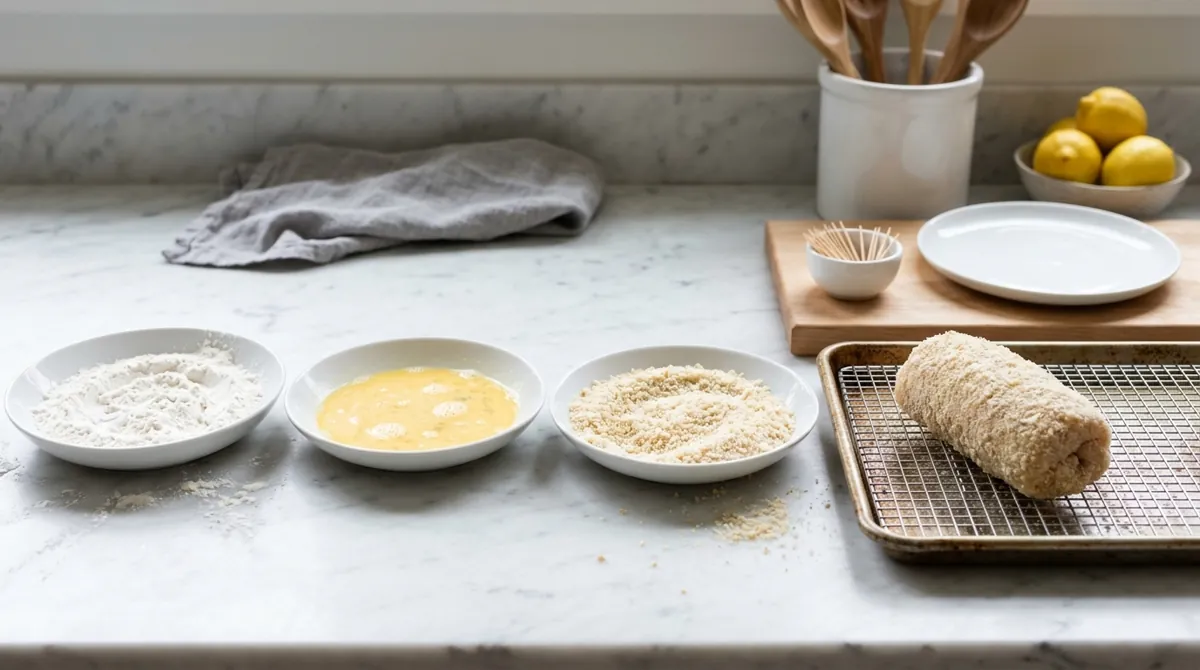
Set up three dishes: the flour, the beaten eggs and the breadcrumbs mixed with the oil. Coat each roll in flour, then egg, then breadcrumbs, pressing so the crumbs stick. Chill 10 minutes on a rack set on a baking sheet.
- Step 4
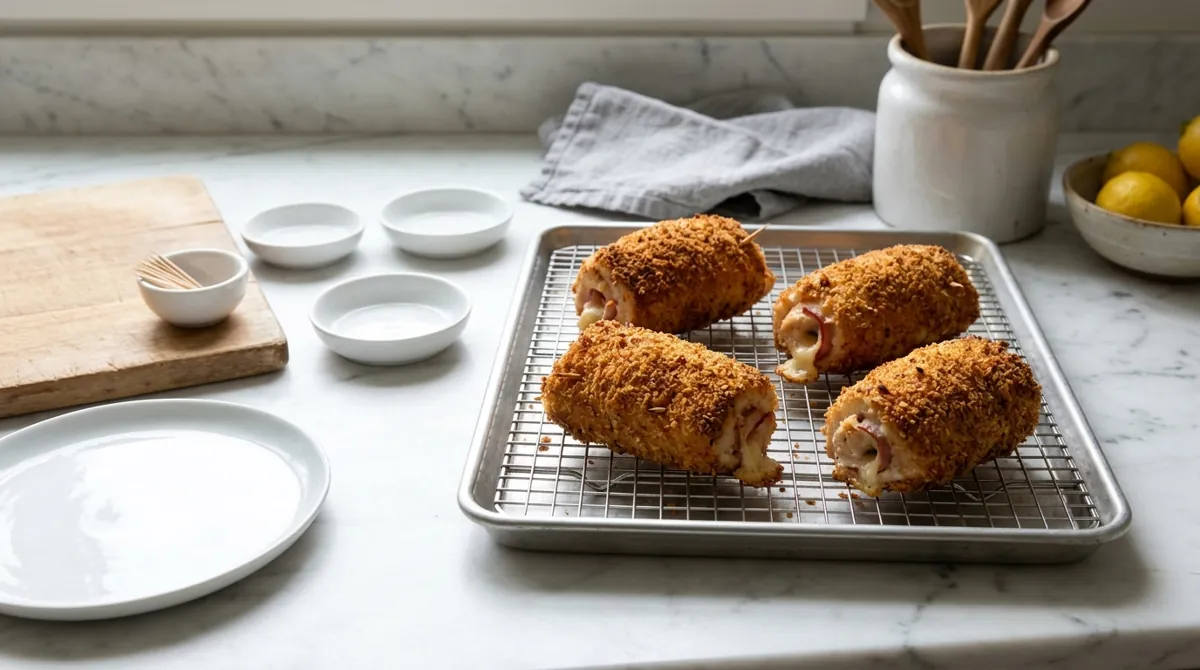
Bake 25 to 30 minutes, until the crumbs are deep golden and a thermometer in the center reads 165°F.
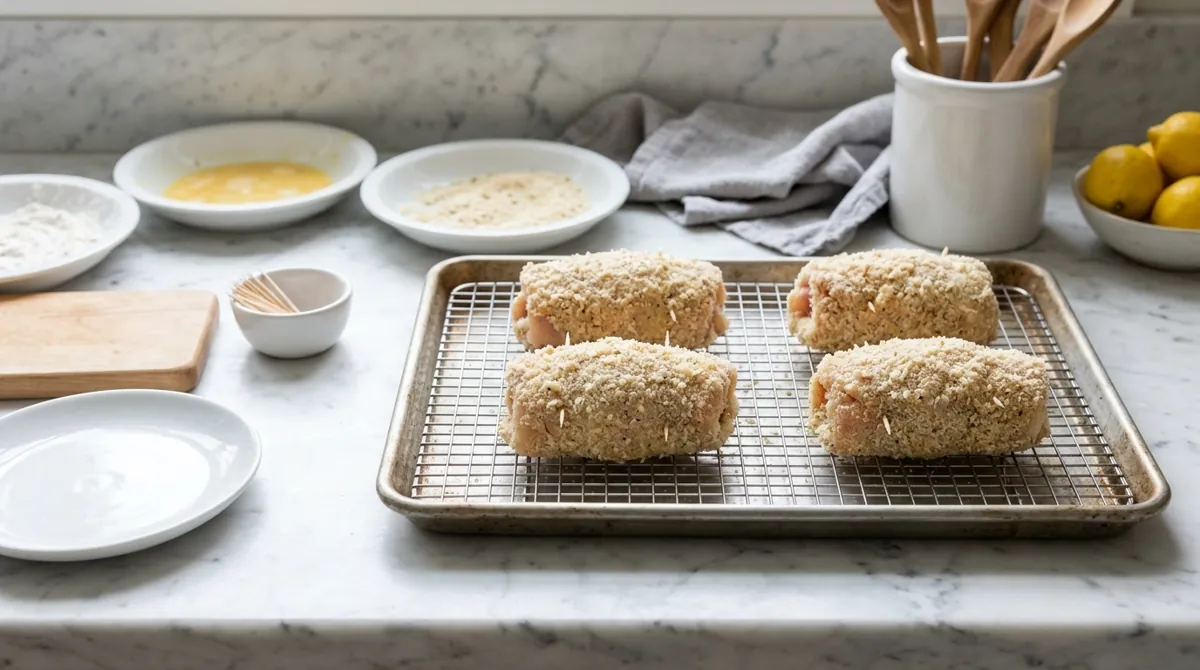
- Step 5
Rest 5 minutes, remove the toothpicks and serve whole or sliced in rounds to show the filling.
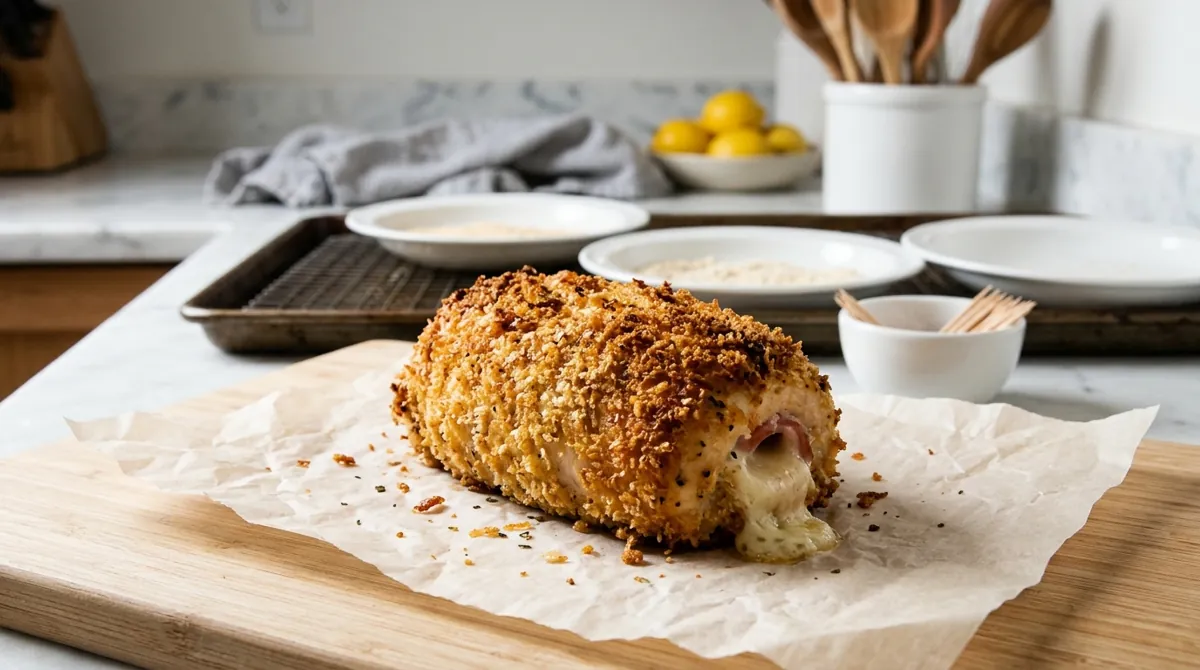
✓ What it should look like - Step 6
Spoon on a simple cream or Dijon sauce if you like (optional).
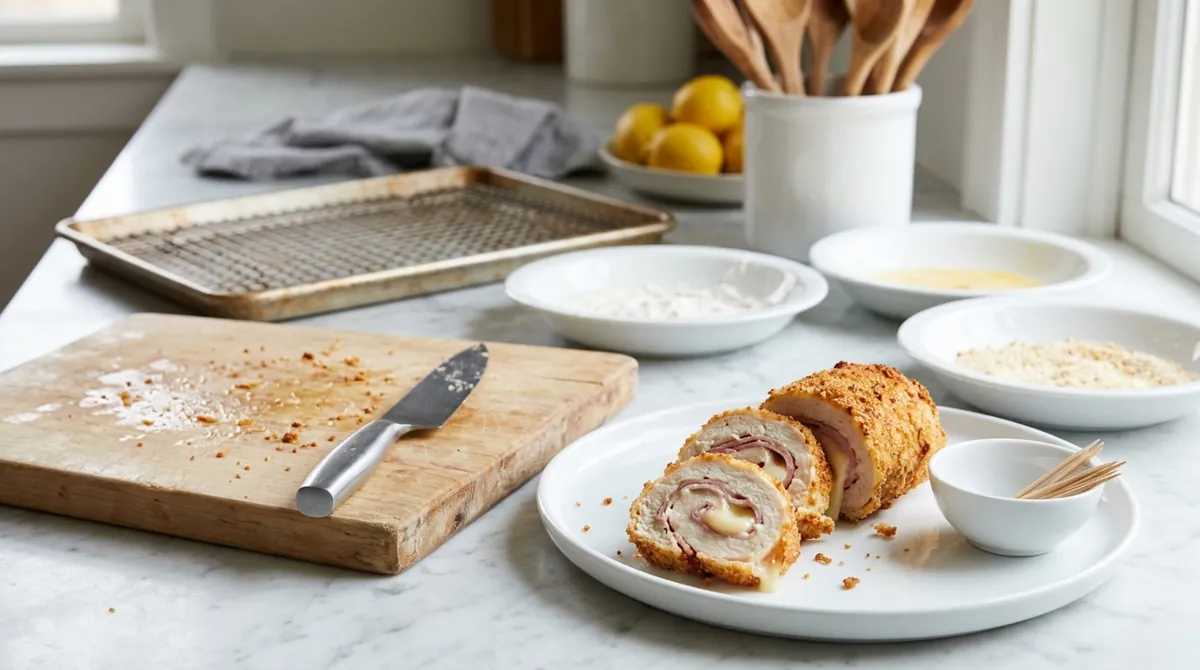
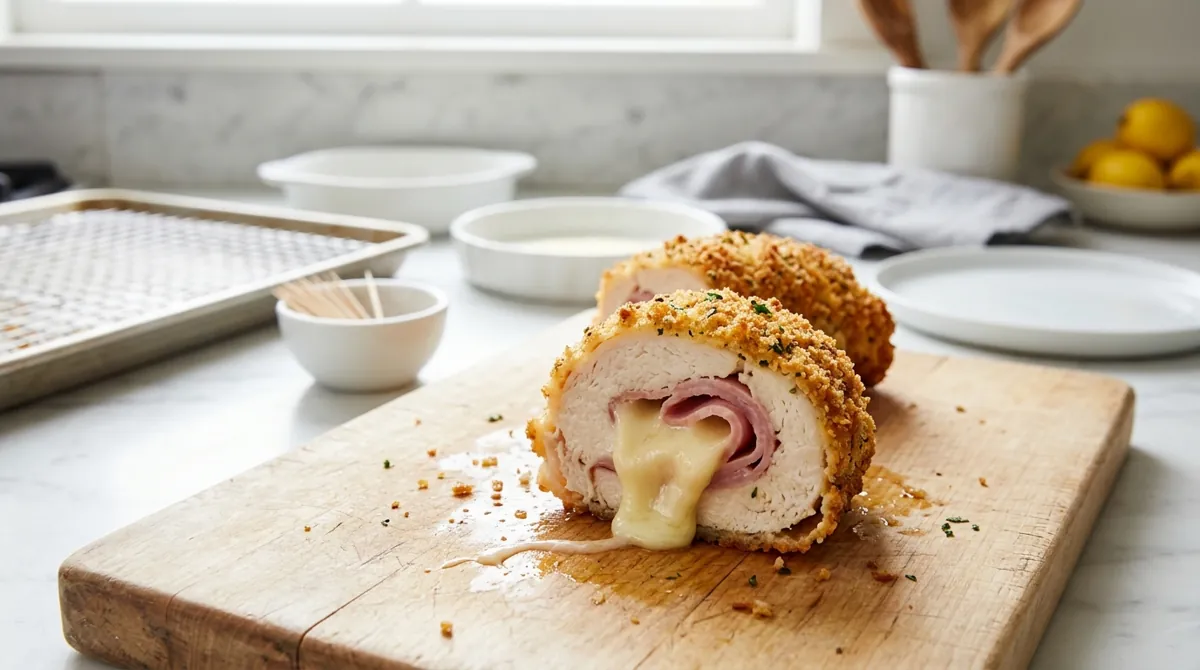
✓ What it should look like
Chicken Cordon Bleu
Serves 4 · 4 stuffed chicken breasts · 1 hr 10 min total
Chicken
- 4 boneless, skinless chicken breasts (about 680 g total, 170 g each)
- 4 slices deli ham (100 g)
- 4 slices Swiss cheese (112 g)
- Salt and black pepper
Breading
- 1/2 cup all-purpose flour (60 g)
- 2 large eggs (100 g), beaten with 1 tbsp water
- 1 cup dry plain breadcrumbs (108 g)
- 2 tbsp vegetable oil (28 g), for the pan
Equipment: Oven, Rimmed baking sheet, Instant-read thermometer, Chef's knife and cutting board, Measuring cups and spoons, Plastic wrap, Toothpicks
Method
- Heat the oven to 400°F. Slice each chicken breast horizontally almost through, open it like a book, and pound it between plastic wrap to about 1/2 inch thick. Season both sides with salt and pepper.
- Lay a slice of ham and a slice of Swiss on each breast, leaving a 1/2 inch edge. Roll up from the short side, tuck in the ends and secure each roll with 2 toothpicks.
- Set up three dishes: the flour, the beaten eggs and the breadcrumbs mixed with the oil. Coat each roll in flour, then egg, then breadcrumbs, pressing so the crumbs stick. Chill 10 minutes on a rack set on a baking sheet.
- Bake 25 to 30 minutes, until the crumbs are deep golden and a thermometer in the center reads 165°F.
- Rest 5 minutes, remove the toothpicks and serve whole or sliced in rounds to show the filling.
- Spoon on a simple cream or Dijon sauce if you like (optional).
Americanized house recipe, written for this site, a standard baked chicken breast method (butterflied or pounded to 1/2 inch, filled with ham and Swiss, breaded in flour, egg and dry breadcrumbs, baked at 400°F to 165°F inside). History: Wikipedia, "Cordon bleu (dish)" (unclear origin, Valais, 1949 cookbook, 1958 Los Angeles Times, chicken the most popular today)). The "chicken version is American, 1960s" timing was not on that page. en.wikipedia.org. Ingredient list follows the source; the method is in our own words.
All sources (1)
Tips
- Leave a clean 1/2 inch edge and do not overfill, or the cheese leaks out.
- Toasting the breadcrumbs in the oil first gives color without frying.
- Make ahead: coat the rolls, cover and refrigerate up to a day, then bake.
- Check the temperature; thick breasts can take longer than 30 minutes.
The rules people argue about
What the sources agree on, what they don't, and what is just a good story.
- Real cordon bleu is veal. Disputed: the original Swiss style is veal, but chicken is now the most popular version, and pork is also used.
- The dish was invented at a particular place and date. Disputed: Wikipedia lists a Valais cook, a 1930 French contest and a 1933 Swiss cook on the SS Bremen as competing stories, with no clear winner.
- The chicken version was invented in 1960s America. Disputed: it fits the earliest printed veal references (1949 and 1958) and chicken's later popularity, but no single inventor or recipe is documented.
Meatballs of the World

Italian-American Meatballs
Big, tender meatballs braised for an hour in red sauce over spaghetti. The one most Americans grew up with.

Pallottine (Abruzzo Meatballs)
Tiny meatballs, smaller than a marble, tossed right through square spaghetti alla chitarra. No bread at all.

Swedish Meatballs (Köttbullar)
Small, soft meatballs browned in butter, in a cream sauce made from the same pan, with lingonberry jam on the plate.

Danish Frikadeller
Pork meatballs shaped with a spoon and fried slowly in butter, crusty outside and soft in the middle.

Königsberger Klopse
German meatballs that are never fried: poached, then served in a creamy white sauce with capers.

Spanish Albóndigas in Almond Saffron Sauce
The tapas bar classic: small meatballs in a golden sauce thickened with fried almonds and bread.

Mexican Albóndigas with Chipotle and Mint
Soft meatballs with rice and fresh mint inside, simmered in a smoky tomato and chipotle broth.

Izgara Köfte (Turkish Grilled Meatballs)
Small, flat meatballs kneaded hard, rested cold, and charred on a hot grill pan.

Lion's Head Meatballs
Big, soft pork meatballs, stirred into a sticky paste, fried to set, then braised in a savory sauce.

Chicken Tsukune
Japan's chicken meatball: kneaded sticky, grilled on skewers, glazed with sweet soy tare, dipped in egg yolk.