
Chicken Fried Steak
Tenderized cube steak in a craggy, double-dredged buttermilk crust, shallow-fried golden in a cast iron skillet and smothered in peppery cream gravy made from the drippings: the Texas cousin of the Wiener schnitzel.
🍳Cook alongOne move at a time, with real timers
 Edited by JP Lambiase
Change the estimate
Swaps change the price only: cook any meat to its own safe temperature. Where these numbers come from
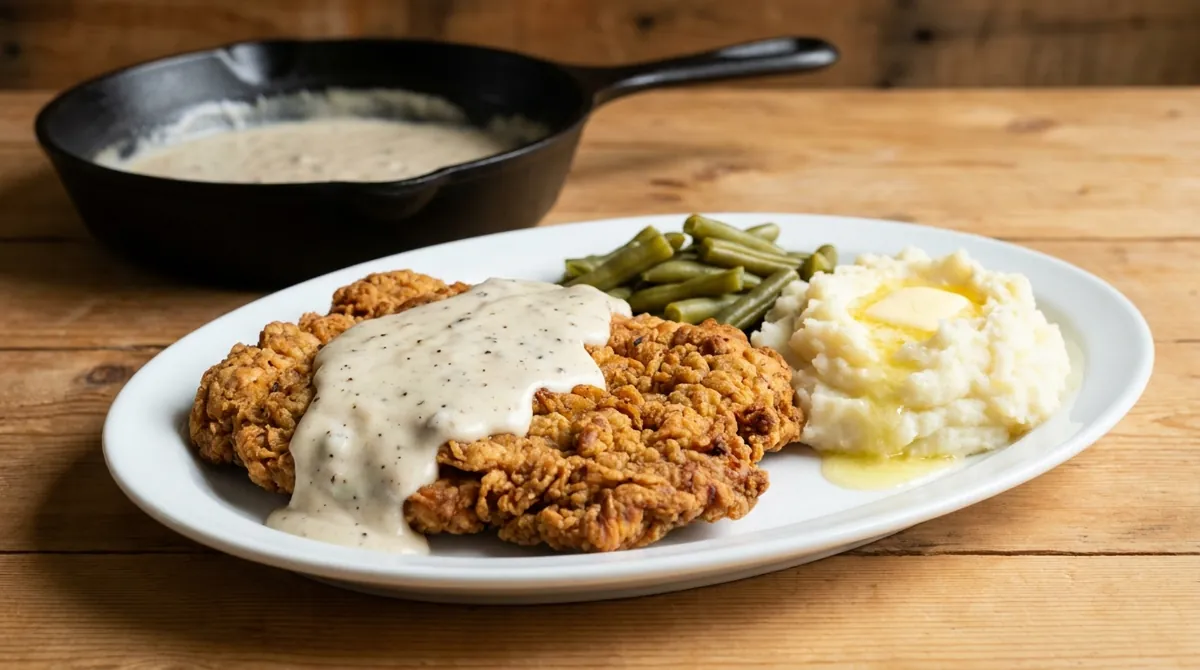
Chicken fried steak is beef cooked the way Southern cooks fry chicken: a cheap, tough steak pounded thin, coated in seasoned flour and fried crisp, then covered in cream gravy made from the pan drippings. Nobody knows exactly where it began. Many sources credit the German and Austrian immigrants who settled in Texas in the 19th century, who brought Wiener schnitzel with them and swapped in the beef that Texas had plenty of. Other historians point to batter-fried steaks in Southern cookbooks of the early 1800s; Mary Randolph's The Virginia Housewife (1838) already has a fried veal cutlet.
The name turns up early in the 20th century. The Oxford English Dictionary's earliest example of "chicken-fried steak" is a restaurant advertisement in the Colorado Springs Gazette on June 19, 1914, and printed recipes followed in the Los Angeles Times in 1924 and the Household Searchlight Recipe Book of Topeka in 1949. Lamesa, Texas, claims to be its birthplace, with a story that a short-order cook called Jimmy Don Perkins invented it by accident in 1911 when he misread an order; the Texas State Historical Association calls it a legend. The Pig Stand drive-ins, the first opened in Dallas in 1921, claimed the chicken fried steak sandwich. In 1988 Oklahoma made chicken fried steak part of its official state meal.
Texans argue over styles. The food writer Robb Walsh describes an East Texas version dipped in egg and flour like fried chicken, a Central Texas one breaded like schnitzel, and a West Texas one with no egg at all, close to the pan-fried steak of the cattle drives. This recipe is the egg-and-buttermilk, double-dredged style, with a peppery white cream gravy.
Why it works the kitchen science
Pounding and cube steak
Cube steak is a tough round or chuck cut already run through a tenderizer, and pounding it even makes it cook through in the time the crust takes to brown. Robb Walsh warns against over-tenderizing, which turns it mushy (Handbook of Texas).
The double dredge
Flour, then buttermilk and egg, then flour again builds the craggy, crunchy coat of Southern fried chicken, which is where the name comes from. Baking powder in the flour puffs it lighter, as America's Test Kitchen does with its wash.
Resting the coated steaks
10 minutes lets the flour hydrate and stick, so the crust stays on in the pan.
Watching the oil
Steaks drop the temperature, and oil that is too cool gives a greasy crust; oil that is too hot browns it before the meat is done, another of Walsh's three mistakes.
Gravy from the drippings
The browned bits and frying fat flavor a simple flour and milk gravy. Cook the roux briefly so it tastes toasty, not raw.
Season boldly
Under-seasoned batter is the first mistake on Walsh's list, so the flour gets salt, black pepper and cayenne.
🧰 You'll need 9 items
Everything the steps call for. Tick off what you have before you start.
Appliances
Pans and pots
Tools
Supplies
Step by step
- Step 1
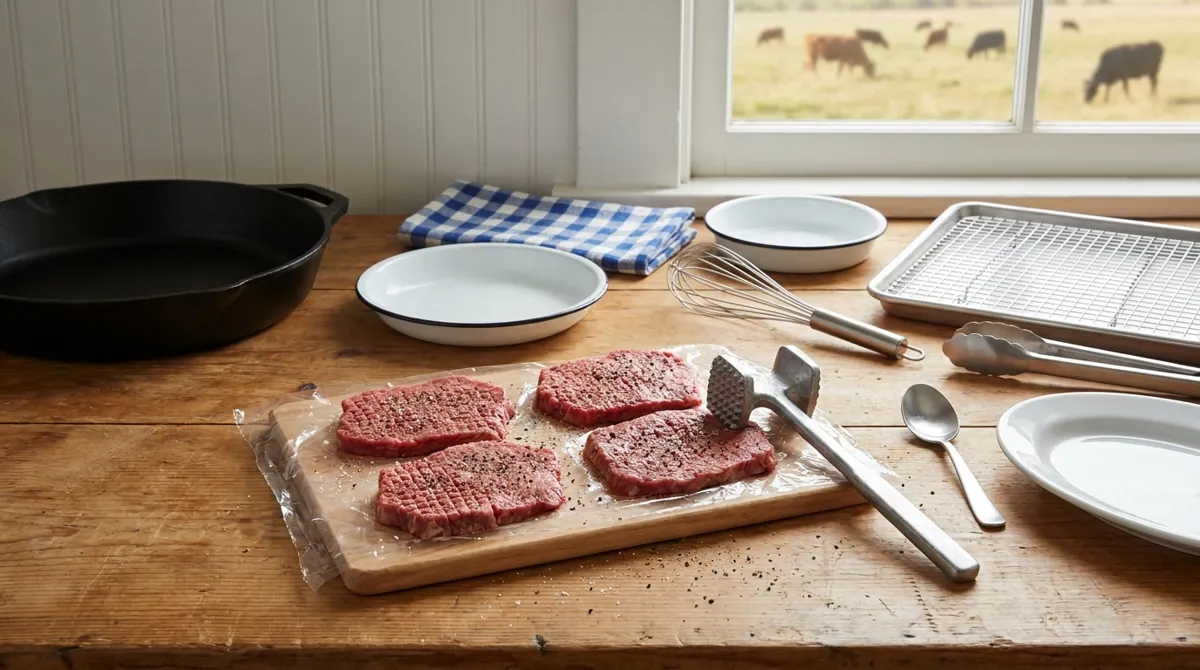
Lay the cube steaks between sheets of plastic wrap and pound them with a meat mallet to an even 1/4 to 1/3 inch. Pat them dry and season both sides with the salt and pepper.
- Step 2
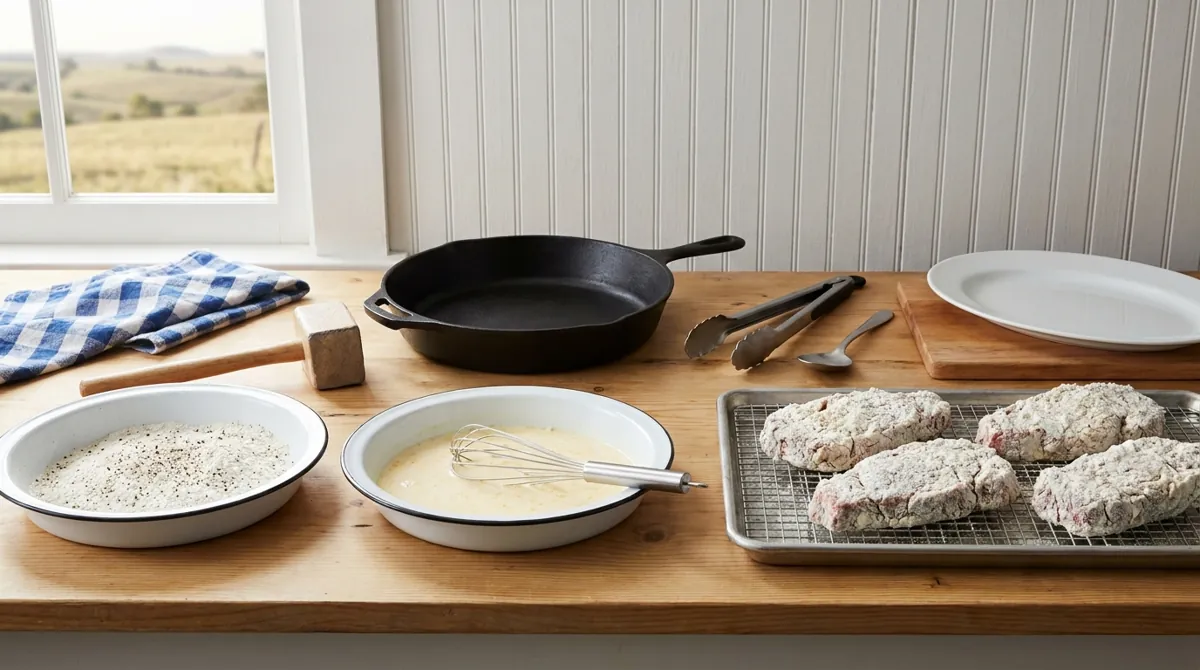
Whisk the flour, salt, pepper, garlic powder, baking powder and cayenne in a shallow dish. Whisk the buttermilk and egg in a second shallow dish. Dredge each steak in flour, dip it in the buttermilk wash, then press it firmly into the flour again so the coating is thick and shaggy. Set the steaks on a wire rack and let them rest 10 minutes so the coating sets.
- Step 3
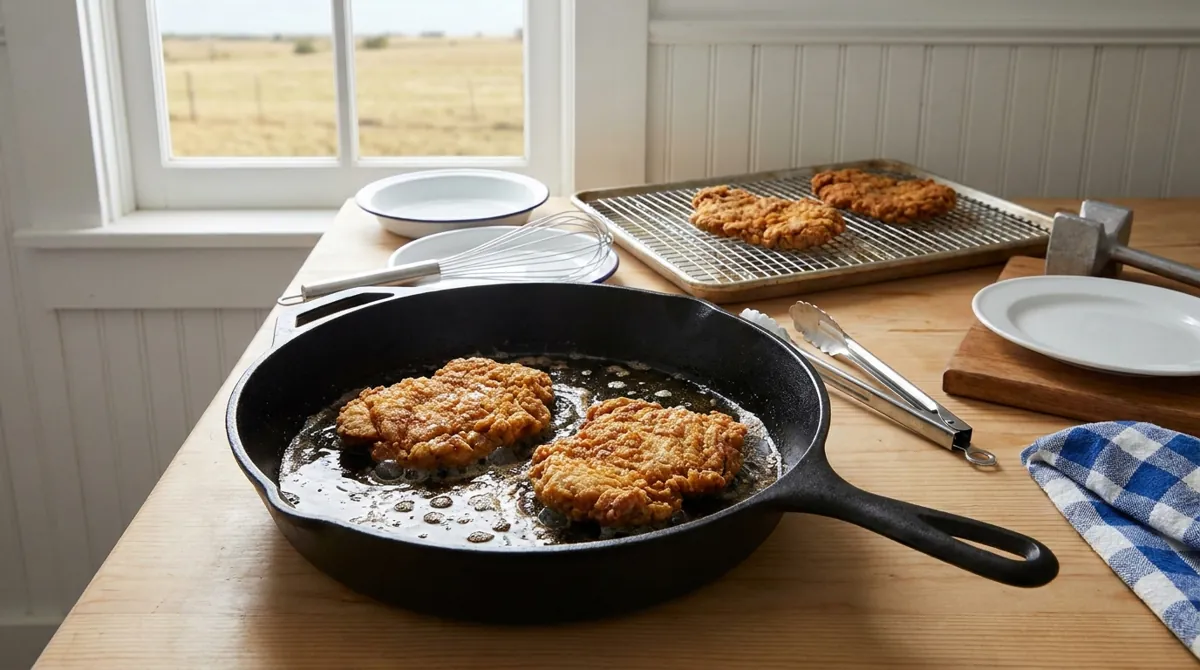
Heat the oven to 200°F and set a wire rack in a rimmed baking sheet. Heat 1/2 inch of oil in a 12 inch cast iron skillet to 350°F. Fry 2 steaks at a time, 3 to 4 minutes per side, until deep golden brown and crisp, letting the oil come back to 350°F between batches. Drain them on the rack and keep them warm in the oven.
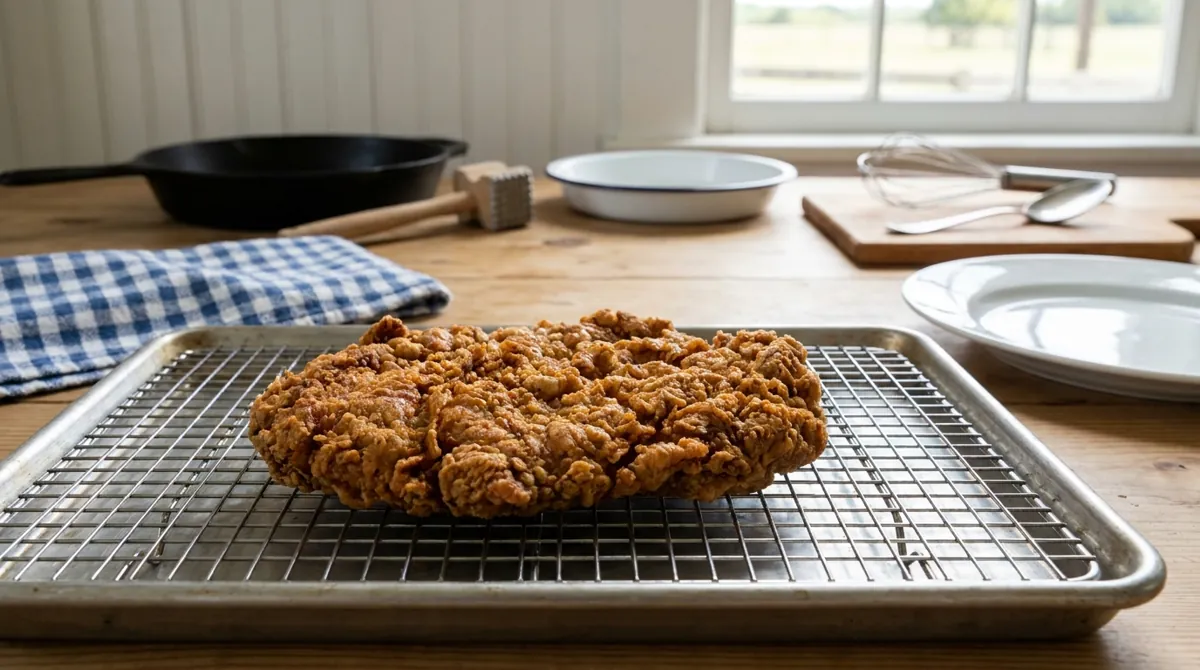
✓ What it should look like - Step 4
Carefully pour off all but 1/4 cup of the oil, keeping the browned bits in the skillet. Over medium heat, whisk in the 1/4 cup flour and cook, whisking, 1 to 2 minutes, until it smells toasty and turns pale blond. Whisk in the milk gradually, scraping the bottom, and simmer 3 to 5 minutes, whisking, until the gravy coats a spoon but still flows. Season with salt and plenty of pepper. It thickens as it stands.
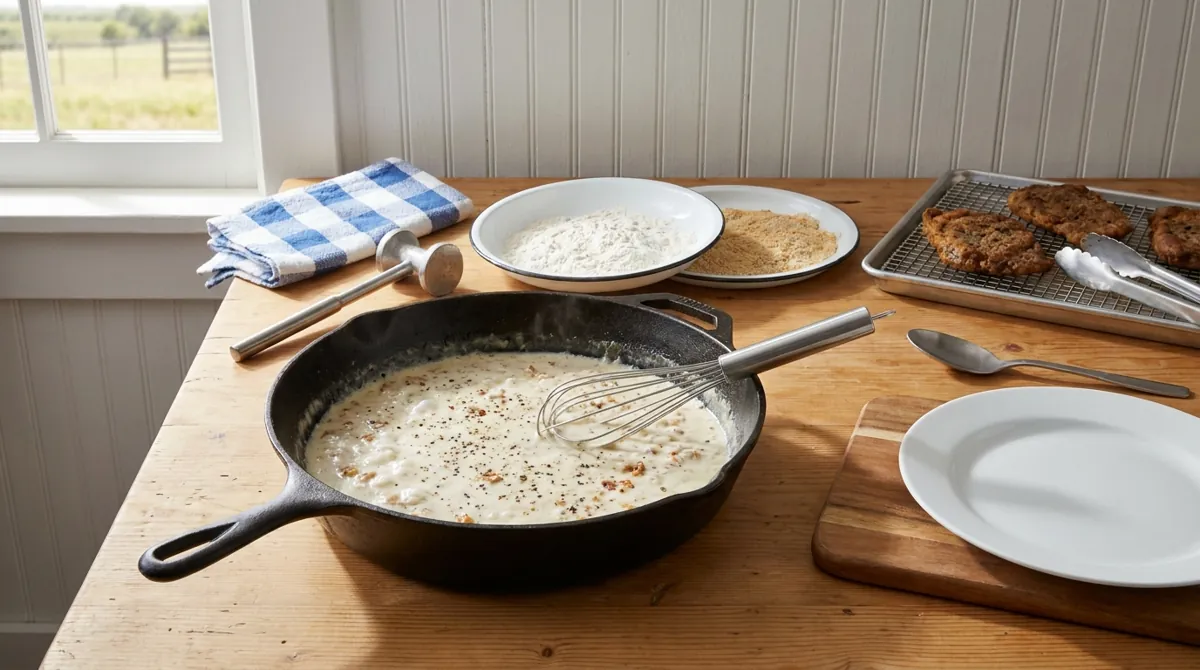
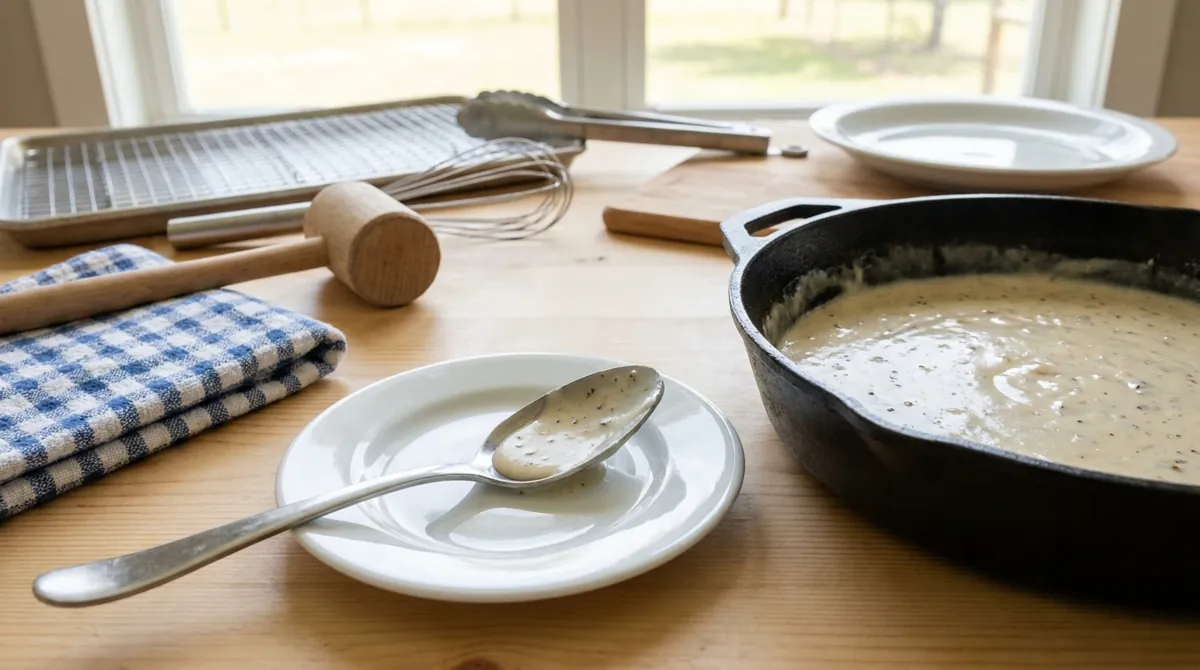
✓ What it should look like - Step 5
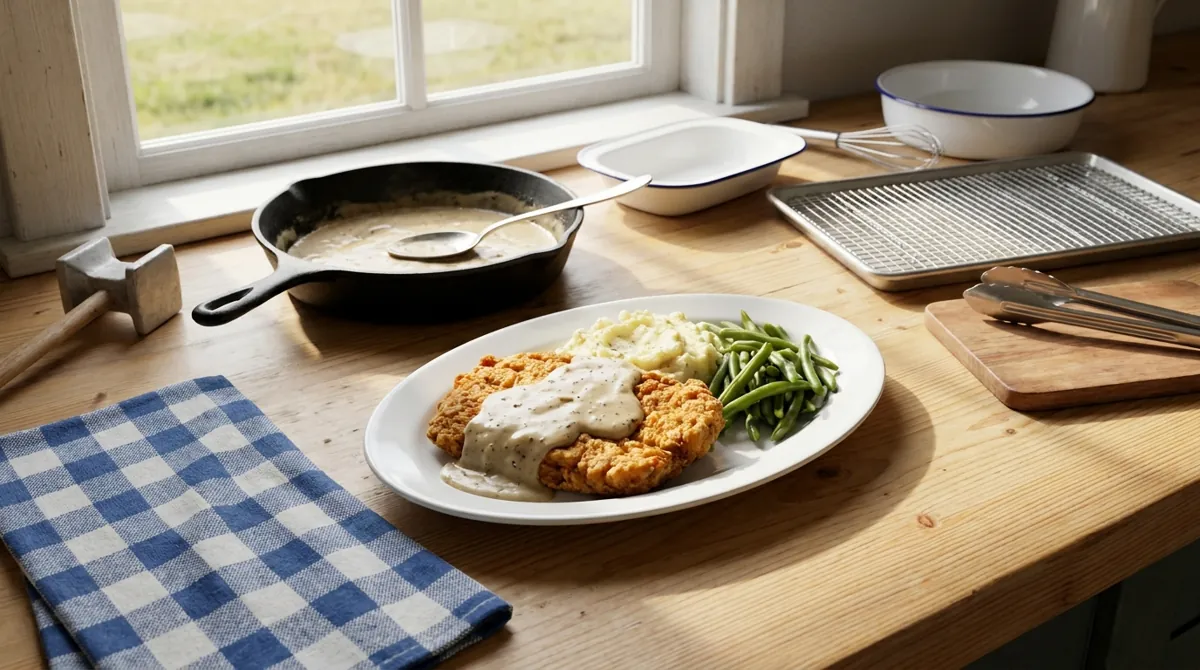
Serve the steaks right away with the cream gravy spooned over, and mashed potatoes and green beans on the side.
Chicken Fried Steak
Serves 4 · 4 steaks with about 2 1/2 cups gravy · 55 min total
Steaks
- 4 beef cube steaks, about 5 oz each (1 1/4 lb, 567 g)
- 1 tsp fine salt and 1/2 tsp black pepper, for seasoning the meat
Seasoned flour
- 2 cups all-purpose flour (250 g), about a third of it ends up on the steaks
- 2 tsp fine salt
- 2 tsp freshly ground black pepper
- 1 tsp garlic powder
- 1 tsp baking powder (4 g)
- 1/4 tsp cayenne pepper
Buttermilk wash
- 1 cup buttermilk (245 g)
- 1 large egg (50 g)
For frying
- About 3 cups vegetable or canola oil, enough for 1/2 inch in the skillet
Cream gravy
- 1/4 cup of the frying oil, with the browned bits
- 1/4 cup all-purpose flour (31 g)
- 2 1/2 cups whole milk (610 g), at room temperature
- 1/2 tsp fine salt and 1 tsp coarsely ground black pepper, or more to taste
Equipment: Oven, Rimmed baking sheet, Wire rack, Cast-iron skillet, Deep-fry or candy thermometer, Chef's knife and cutting board, Measuring cups and spoons, Whisk, Plastic wrap
Method
- Lay the cube steaks between sheets of plastic wrap and pound them with a meat mallet to an even 1/4 to 1/3 inch. Pat them dry and season both sides with the salt and pepper.
- Whisk the flour, salt, pepper, garlic powder, baking powder and cayenne in a shallow dish. Whisk the buttermilk and egg in a second shallow dish. Dredge each steak in flour, dip it in the buttermilk wash, then press it firmly into the flour again so the coating is thick and shaggy. Set the steaks on a wire rack and let them rest 10 minutes so the coating sets.
- Heat the oven to 200°F and set a wire rack in a rimmed baking sheet. Heat 1/2 inch of oil in a 12 inch cast iron skillet to 350°F. Fry 2 steaks at a time, 3 to 4 minutes per side, until deep golden brown and crisp, letting the oil come back to 350°F between batches. Drain them on the rack and keep them warm in the oven.
- Carefully pour off all but 1/4 cup of the oil, keeping the browned bits in the skillet. Over medium heat, whisk in the 1/4 cup flour and cook, whisking, 1 to 2 minutes, until it smells toasty and turns pale blond. Whisk in the milk gradually, scraping the bottom, and simmer 3 to 5 minutes, whisking, until the gravy coats a spoon but still flows. Season with salt and plenty of pepper. It thickens as it stands.
- Serve the steaks right away with the cream gravy spooned over, and mashed potatoes and green beans on the side.
Americanized house recipe, written for this site. History: Wikipedia, "Chicken-fried steak" (German and Austrian immigrants to Texas and Wiener schnitzel, the Lamesa birthplace claim, Mary Randolph's 1838 Virginia Housewife, the OED's 1914 Colorado Springs Gazette citation, a 1943 wartime cookbook's Wiener schnitzel with white cream gravy, Oklahoma's state meal in 1988, chicken fried versus country fried, cube steak, chuck and round); Texas State Historical Association, Handbook of Texas, "Chicken-Fried Steak" (historians disagree on origin, the 1924 Los Angeles Times, 1936 Winnipeg Free Press and 1949 Household Searchlight recipes, early 1800s Southern batter-fried steaks, the Jimmy Don Perkins legend of 1911, the 2011 Lamesa centennial, the Pig Stand's 1921 Dallas start and its sandwich, Robb Walsh's East, Central and West Texas styles and his three common mistakes, cream gravy from the skillet drippings, cast iron). Technique: America's Test Kitchen, "Chicken-Fried Steak" (cube steaks pounded to 1/3 inch, seasoned flour with cayenne, a buttermilk and egg wash with baking powder and baking soda, double dredge, oil at 375°F that drops to about 335°F, about 5 minutes per batch, steaks kept warm on a rack in a 200°F oven, gravy from 2 tablespoons of the frying oil and the browned bits, flour cooked 1 minute, milk whisked in, simmered to a loose consistency that thickens as it cools). en.wikipedia.org. Ingredient list follows the source; the method is in our own words.
All sources (3)
Tips
- No cube steak? Use 1 1/4 lb top round, cut into 4 pieces and pounded thin, or ask the butcher to run it through the cuber.
- Fry in a heavy cast iron skillet so the oil temperature stays steady. A deep-fry thermometer helps.
- For country fried steak, the brown gravy cousin, make the roux darker and use beef broth for half the milk.
- Leftover steaks reheat best on a rack at 400°F for about 10 minutes; the microwave makes the crust soft.
The rules people argue about
What the sources agree on, what they don't, and what is just a good story.
- German immigrants created it from Wiener schnitzel. Disputed: many sources credit 19th century German and Austrian Texans, but the Handbook of Texas notes that historians disagree and some point to batter-fried steaks in Southern cookbooks of the early 1800s.
- It was invented in Lamesa in 1911. Folklore: the Jimmy Don Perkins story is a legend (Handbook of Texas), and the OED's first printed use of the name is 1914, in Colorado.
- Chicken fried and country fried are the same thing. Disputed: Wikipedia says deep-fried versions are chicken fried and usually get cream gravy, while pan-fried versions are country fried with brown gravy. Many cooks and menus use the names interchangeably.
Meatballs of the World

Italian-American Meatballs
Big, tender meatballs braised for an hour in red sauce over spaghetti. The one most Americans grew up with.

Pallottine (Abruzzo Meatballs)
Tiny meatballs, smaller than a marble, tossed right through square spaghetti alla chitarra. No bread at all.

Swedish Meatballs (Köttbullar)
Small, soft meatballs browned in butter, in a cream sauce made from the same pan, with lingonberry jam on the plate.

Danish Frikadeller
Pork meatballs shaped with a spoon and fried slowly in butter, crusty outside and soft in the middle.

Königsberger Klopse
German meatballs that are never fried: poached, then served in a creamy white sauce with capers.

Spanish Albóndigas in Almond Saffron Sauce
The tapas bar classic: small meatballs in a golden sauce thickened with fried almonds and bread.

Mexican Albóndigas with Chipotle and Mint
Soft meatballs with rice and fresh mint inside, simmered in a smoky tomato and chipotle broth.

Izgara Köfte (Turkish Grilled Meatballs)
Small, flat meatballs kneaded hard, rested cold, and charred on a hot grill pan.

Lion's Head Meatballs
Big, soft pork meatballs, stirred into a sticky paste, fried to set, then braised in a savory sauce.

Chicken Tsukune
Japan's chicken meatball: kneaded sticky, grilled on skewers, glazed with sweet soy tare, dipped in egg yolk.