
Creme Brulee
A cold, silky vanilla custard under a thin sheet of caramel you crack with a spoon: five ingredients, a water bath and a kitchen torch.
🍳Cook alongOne move at a time, with real timers
 Edited by JP Lambiase
Change the estimate
Swaps change the price only: cook any meat to its own safe temperature. Where these numbers come from
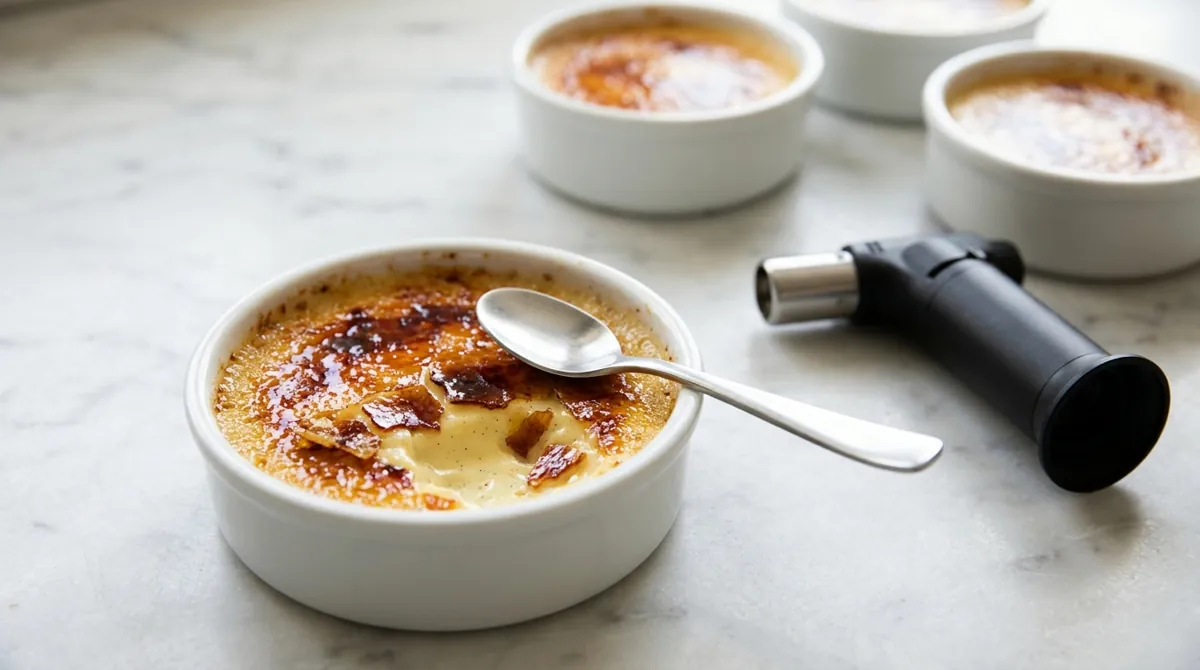
Creme brulee means "burnt cream," and the earliest known recipe for a dessert of that name is in François Massialot's Cuisinier royal et bourgeois of 1691. The English translation printed it as "burnt cream" in 1702. Where the idea really began is not settled: Catalonia has crema catalana, a stovetop custard under burnt sugar, and England has Trinity College, Cambridge, which served a "Trinity cream" or "Cambridge burnt cream" in the 1800s, with the college crest branded into the sugar.
For most of the 19th and 20th centuries it was rare in cookbooks. It became a restaurant fad in the 1980s, and Sirio Maccioni of Le Cirque in New York is the name usually credited with spreading it, though Wikipedia presents that as probable and not proven.
Why it works the kitchen science
Yolks and cream only
No whites and no milk, so the custard is dense, rich and smooth.
Tempering the cream into the yolks slowly
It warms them without scrambling.
The water bath
It keeps the oven heat gentle and even so the custard sets without curdling or cracking.
Pulling it while the center still wobbles
The custard keeps setting as it cools; baking it firm gives a grainy, eggy texture.
Chilling fully and blotting the surface
A cold, dry top lets the sugar caramelize before the custard underneath warms up.
🧰 You'll need 10 items
Everything the steps call for. Tick off what you have before you start.
Appliances
Pans and pots
Tools
Supplies
Step by step
- Step 1
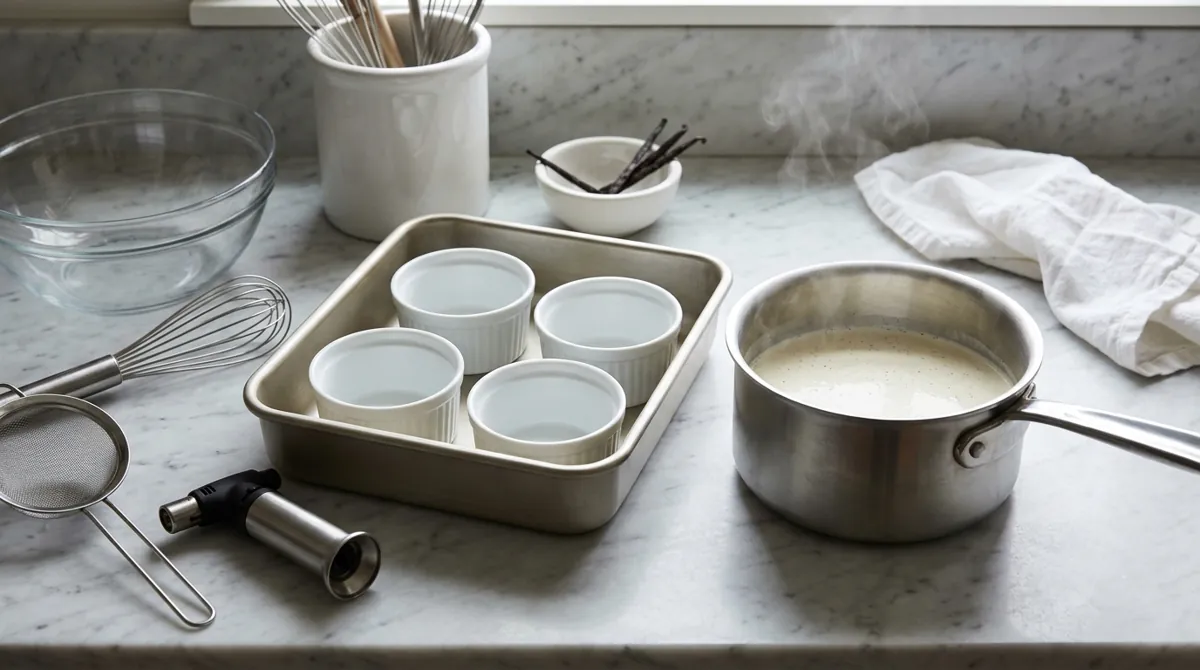
Heat the oven to 300°F with a rack in the middle. Set four 6 ounce ramekins in a deep roasting pan and boil a kettle of water.
- Step 2
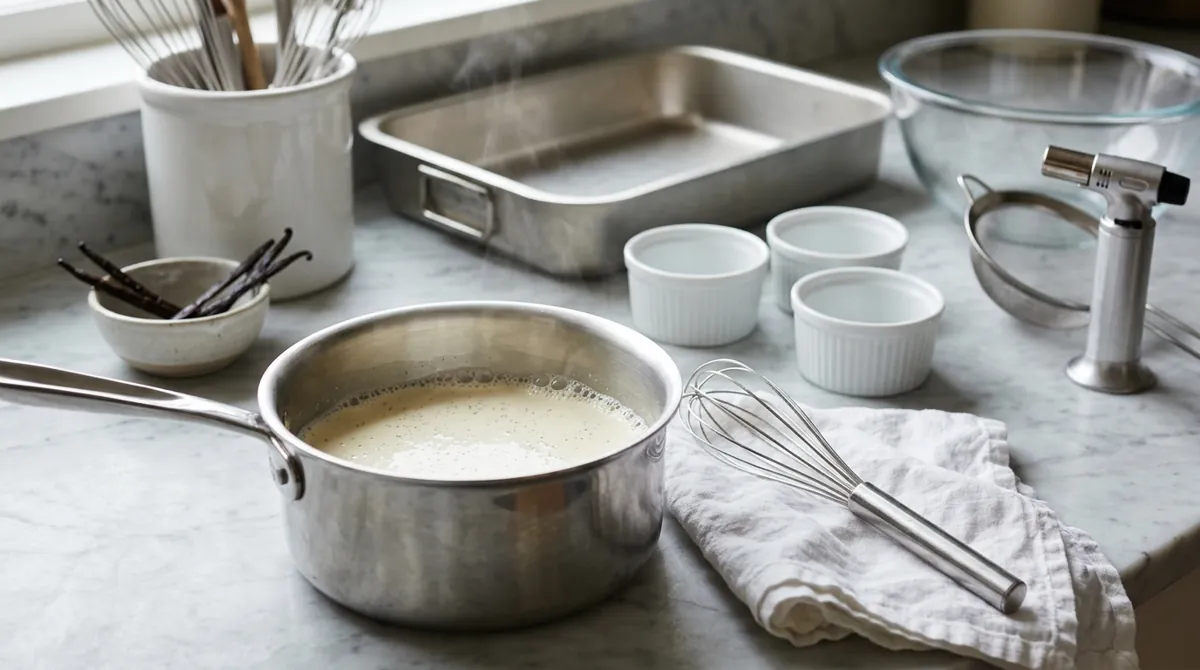
Heat the cream, salt and vanilla in a saucepan over medium heat until it steams and tiny bubbles show at the edge, but do not boil. Take it off the heat and let it steep 10 minutes.
- Step 3
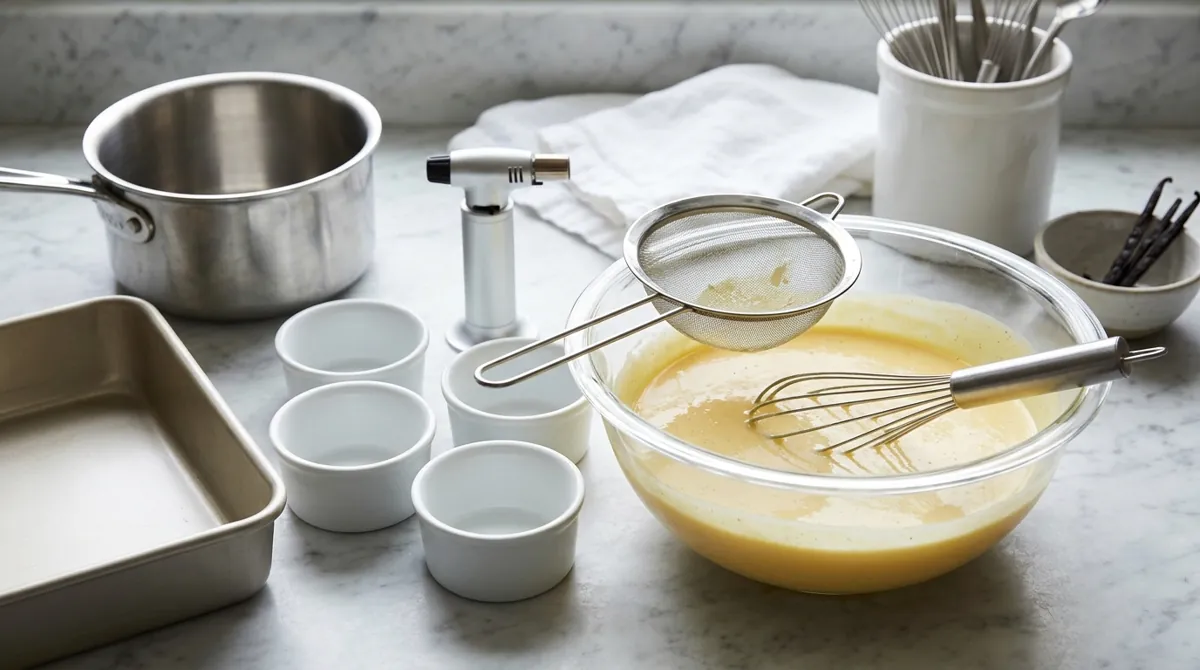
Whisk the yolks and sugar in a bowl for about a minute, until pale and thick. Whisk in the warm cream a little at a time so the yolks do not scramble, then strain the mix through a fine mesh strainer.
- Step 4
Divide the custard among the ramekins and skim off any bubbles. Add hot water to the pan until it comes halfway up the ramekins. Bake 35 to 45 minutes, until the edges are set and the centers still wobble like gelatin when you nudge the pan (about 170°F in the middle).
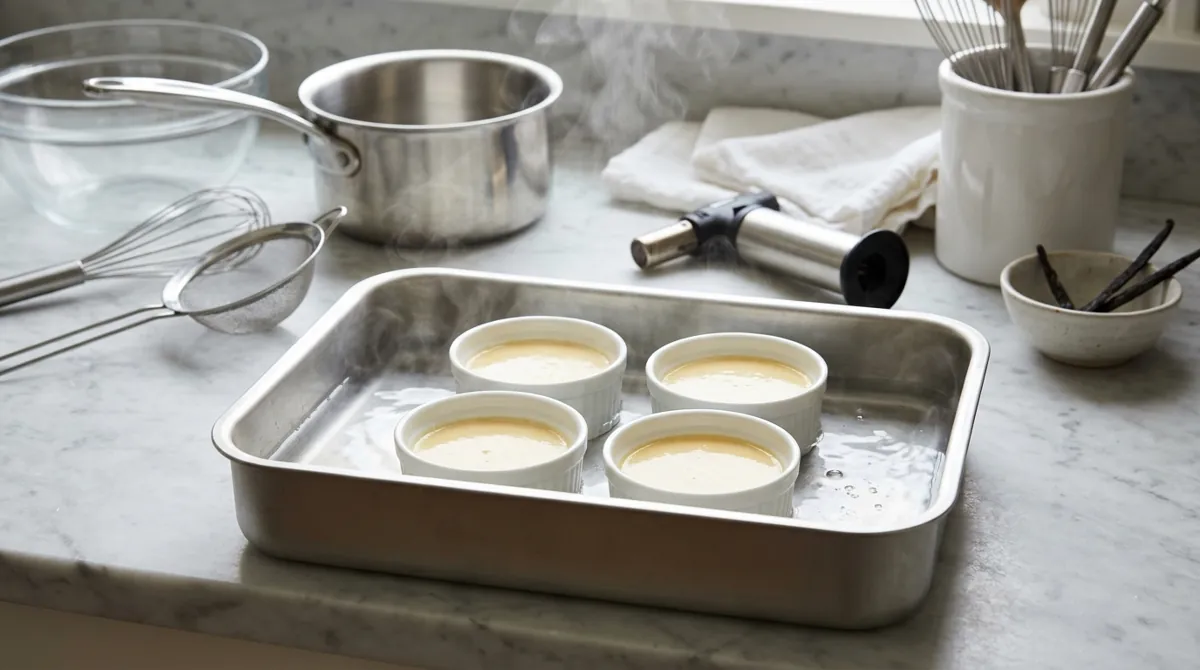
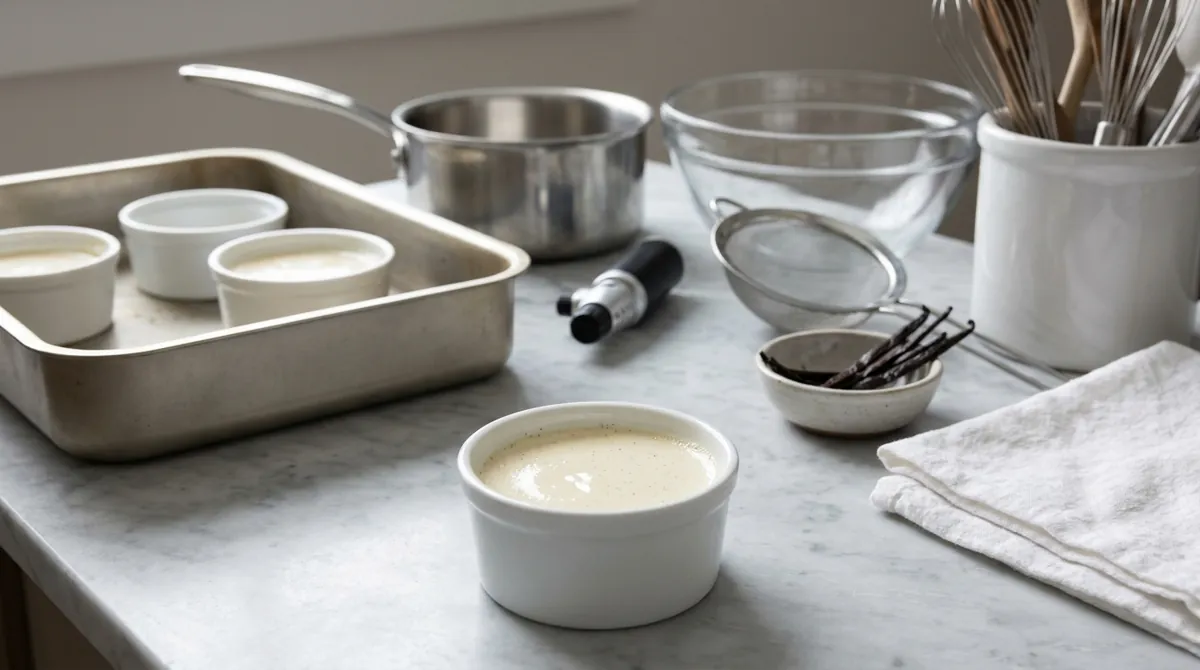
✓ What it should look like - Step 5
Cool the ramekins in the water 15 minutes, then lift them out, cover and chill at least 4 hours, or overnight.
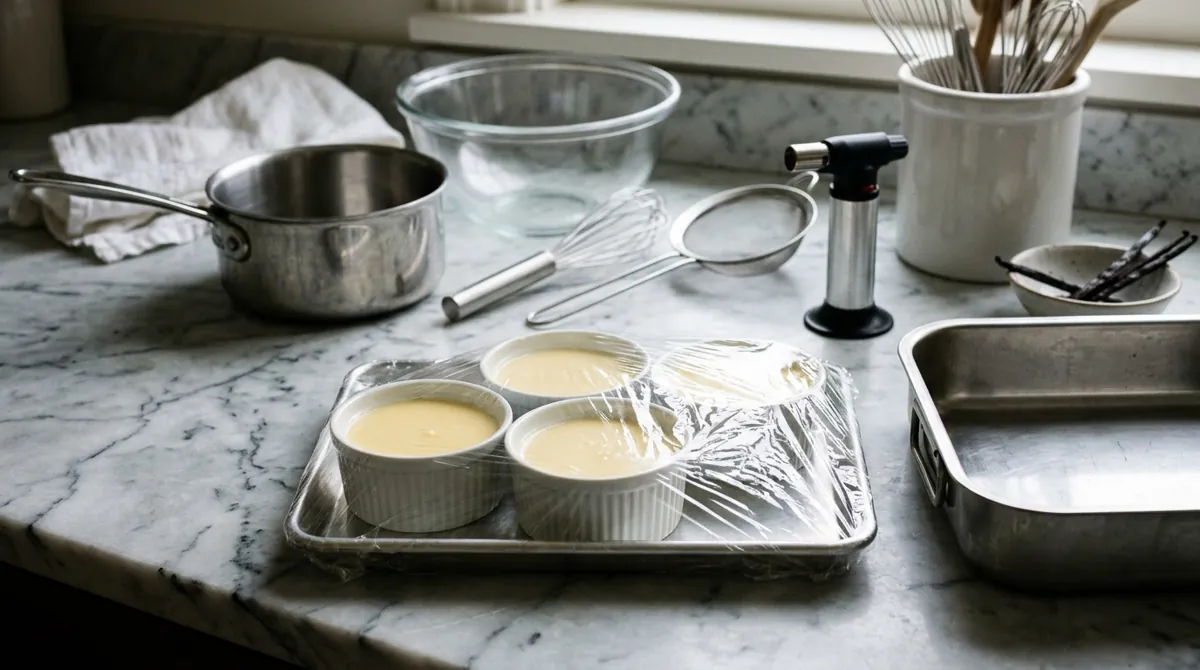
- Step 6
Blot any moisture off the top with a paper towel. Sprinkle 2 tsp sugar over each in a thin, even layer and torch it until deep amber, then leave 2 minutes for the caramel to harden before serving.
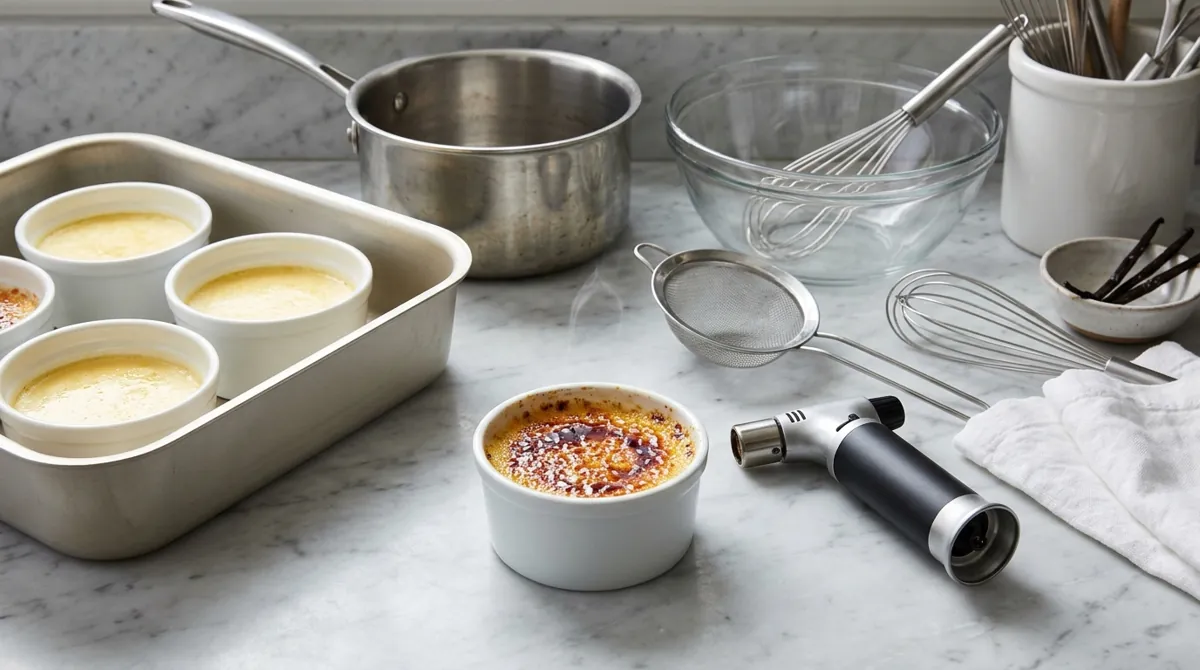
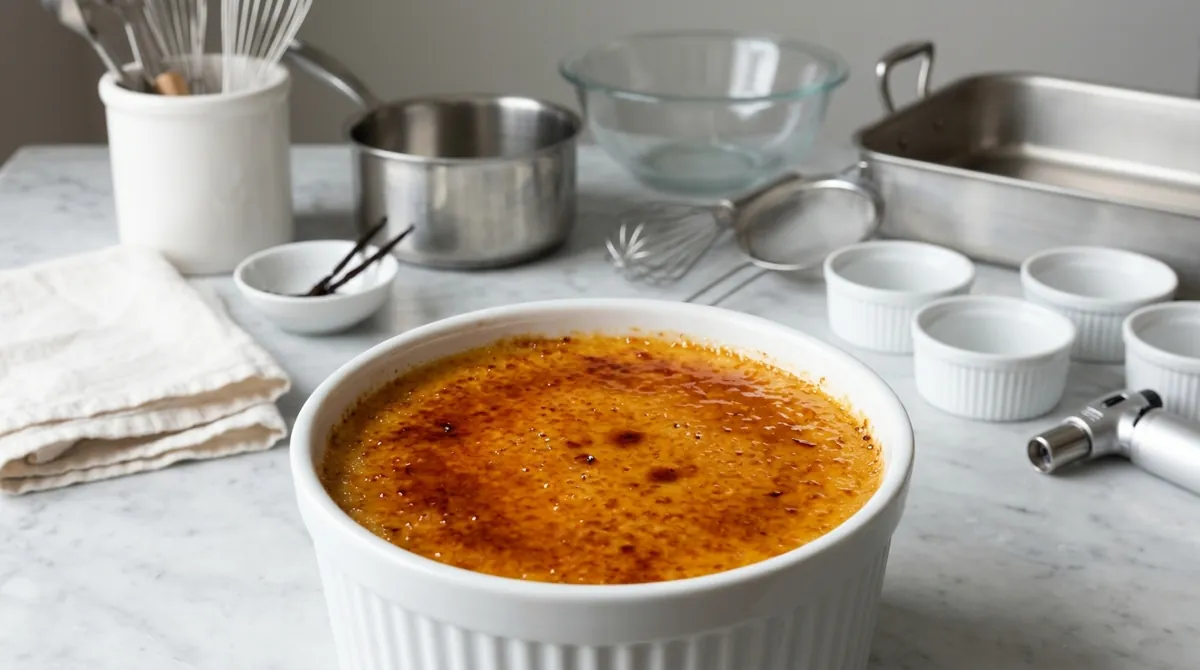
✓ What it should look like
Creme Brulee
Serves 4 · four 6 ounce ramekins · 5 hr total
Custard
- 2 cups heavy cream (480 ml, about 476 g)
- 1/4 tsp fine salt
- 2 tsp vanilla extract, or 1 vanilla bean, split and scraped
- 5 large egg yolks (about 85 g)
- 1/3 cup granulated sugar (67 g)
Topping
- 8 tsp granulated or turbinado sugar (about 32 g), 2 tsp per ramekin
Also
- Very hot water for the water bath
Equipment: Oven, Roasting pan, Saucepan, Instant-read thermometer, Measuring cups and spoons, Mixing bowls, Whisk, Fine-mesh strainer, Kitchen torch, Paper towels
Method
- Heat the oven to 300°F with a rack in the middle. Set four 6 ounce ramekins in a deep roasting pan and boil a kettle of water.
- Heat the cream, salt and vanilla in a saucepan over medium heat until it steams and tiny bubbles show at the edge, but do not boil. Take it off the heat and let it steep 10 minutes.
- Whisk the yolks and sugar in a bowl for about a minute, until pale and thick. Whisk in the warm cream a little at a time so the yolks do not scramble, then strain the mix through a fine mesh strainer.
- Divide the custard among the ramekins and skim off any bubbles. Add hot water to the pan until it comes halfway up the ramekins. Bake 35 to 45 minutes, until the edges are set and the centers still wobble like gelatin when you nudge the pan (about 170°F in the middle).
- Cool the ramekins in the water 15 minutes, then lift them out, cover and chill at least 4 hours, or overnight.
- Blot any moisture off the top with a paper towel. Sprinkle 2 tsp sugar over each in a thin, even layer and torch it until deep amber, then leave 2 minutes for the caramel to harden before serving.
Americanized house recipe, written for this site, within the usual ratios of home and test-kitchen recipes (about 1 cup cream to 2 to 3 yolks, a 300°F oven, a water bath). History: Wikipedia, "Creme brulee" (Massialot 1691, "burnt cream" 1702, Cambridge 1879, the 1980s revival). those pages were not fetched. en.wikipedia.org. Ingredient list follows the source; the method is in our own words.
All sources (2)
Tips
- No torch? Broil on the top rack, 4 inches from the element, for 1 to 3 minutes, with the ramekins sitting in a pan of ice. Watch closely.
- Shallow ramekins give more crunchy caramel per spoonful; deep ones give more custard.
- Chill the custard up to 3 days, covered, but caramelize only just before serving: the sugar goes soft within an hour or two.
- Save the whites for angel food cake.
- Flavor the cream with a strip of orange zest, coffee beans or a spoonful of espresso powder instead of the vanilla for a twist.
The rules people argue about
What the sources agree on, what they don't, and what is just a good story.
- Creme brulee is French. Disputed: Massialot's 1691 recipe is the earliest known with that name, but crema catalana (Catalonia) and Cambridge burnt cream (England) both claim older or parallel roots, and Wikipedia calls the origin contested.
- Massialot's recipe is the first. Disputed: it is the earliest known recipe by that name, not a proven first; a Spanish text may describe a similar dish earlier, but its date is given inconsistently (1622 or 1662).
- Creme brulee was a 1980s invention. Folklore: the dish is centuries old, but it became a fad in the 1980s; the Le Cirque credit is probable and not proven.
Meatballs of the World

Italian-American Meatballs
Big, tender meatballs braised for an hour in red sauce over spaghetti. The one most Americans grew up with.

Pallottine (Abruzzo Meatballs)
Tiny meatballs, smaller than a marble, tossed right through square spaghetti alla chitarra. No bread at all.

Swedish Meatballs (Köttbullar)
Small, soft meatballs browned in butter, in a cream sauce made from the same pan, with lingonberry jam on the plate.

Danish Frikadeller
Pork meatballs shaped with a spoon and fried slowly in butter, crusty outside and soft in the middle.

Königsberger Klopse
German meatballs that are never fried: poached, then served in a creamy white sauce with capers.

Spanish Albóndigas in Almond Saffron Sauce
The tapas bar classic: small meatballs in a golden sauce thickened with fried almonds and bread.

Mexican Albóndigas with Chipotle and Mint
Soft meatballs with rice and fresh mint inside, simmered in a smoky tomato and chipotle broth.

Izgara Köfte (Turkish Grilled Meatballs)
Small, flat meatballs kneaded hard, rested cold, and charred on a hot grill pan.

Lion's Head Meatballs
Big, soft pork meatballs, stirred into a sticky paste, fried to set, then braised in a savory sauce.

Chicken Tsukune
Japan's chicken meatball: kneaded sticky, grilled on skewers, glazed with sweet soy tare, dipped in egg yolk.