
Crepes
Paper-thin French pancakes from a rested batter of flour, eggs, milk and melted butter, swirled in a hot pan and folded around butter, sugar and lemon: Brittany's everyday food that America turned into a 1970s brunch craze.
🍳Cook alongOne move at a time, with real timers
 Edited by JP Lambiase
Change the estimate
Swaps change the price only: cook any meat to its own safe temperature. Where these numbers come from
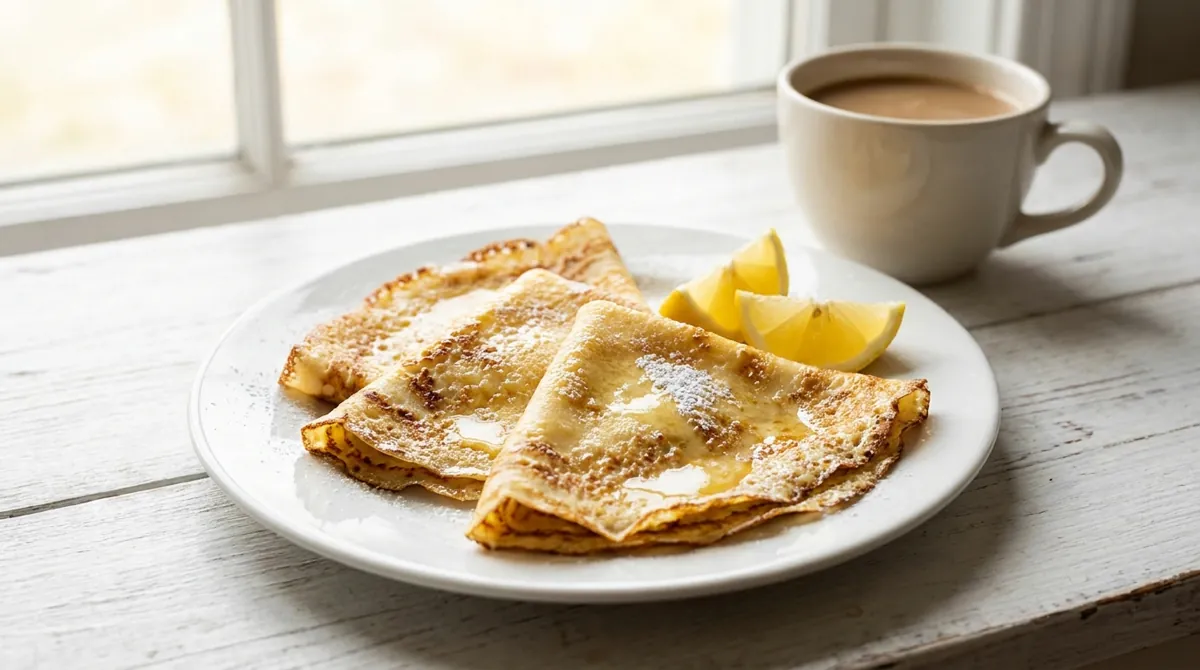
A crepe is a thin pancake of unleavened batter, and the word comes from the Latin crispus, "curled" or "wrinkled", for its lacy, rippled edge. France eats them everywhere, and on Candlemas, 2 February, families flip crepes for luck, by one custom with a coin held in the other hand.
The region most tied to them is Brittany, and its own tradition is buckwheat. Buckwheat arrived there as a food crop in the 15th century by the regional cultural database Bécédia (other sources say earlier or later), and because it grows in poor soil it fed Bretons for centuries. Buckwheat has no gluten and could not make bread, so it was cooked as porridge and as galettes on a cast-iron griddle the Bretons call a billig. A 1499 Breton dictionary already has a word for the crepe. Today crêperies usually call the savory buckwheat kind a galette (the "complète" with ham, cheese and egg is the classic) and the sweet wheat-flour kind a crepe.
America met crepes as a fancy brunch. The Magic Pan opened in San Francisco in 1965, named for a motorized carousel of eight crepe pans its owner designed. Quaker Oats bought it in 1970 and took it into shopping malls, peaking at about 110 restaurants in the US and Canada, and rolled crepes filled with chicken, spinach or strawberries and cream became a 1970s craze.
Why it works the kitchen science
A thin, pourable batter and quick tilting are what make a crepe a crepe
Thicker batter makes a pancake.
🧰 You'll need 8 items
Everything the steps call for. Tick off what you have before you start.
Appliances
Pans and pots
Tools
Supplies
Step by step
- Step 1
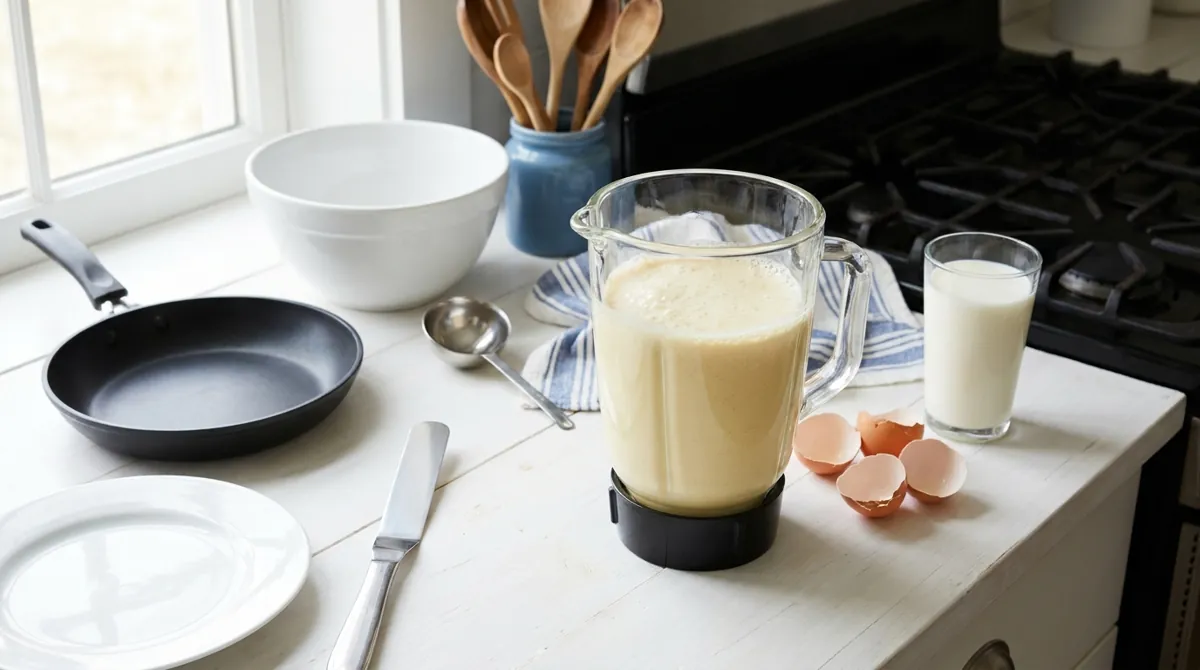
Put the flour, sugar, salt and eggs in a blender (or a large bowl) with half the milk and blend or whisk to a smooth, thick paste. Add the rest of the milk, the water and the melted butter and blend until smooth.
- Step 2
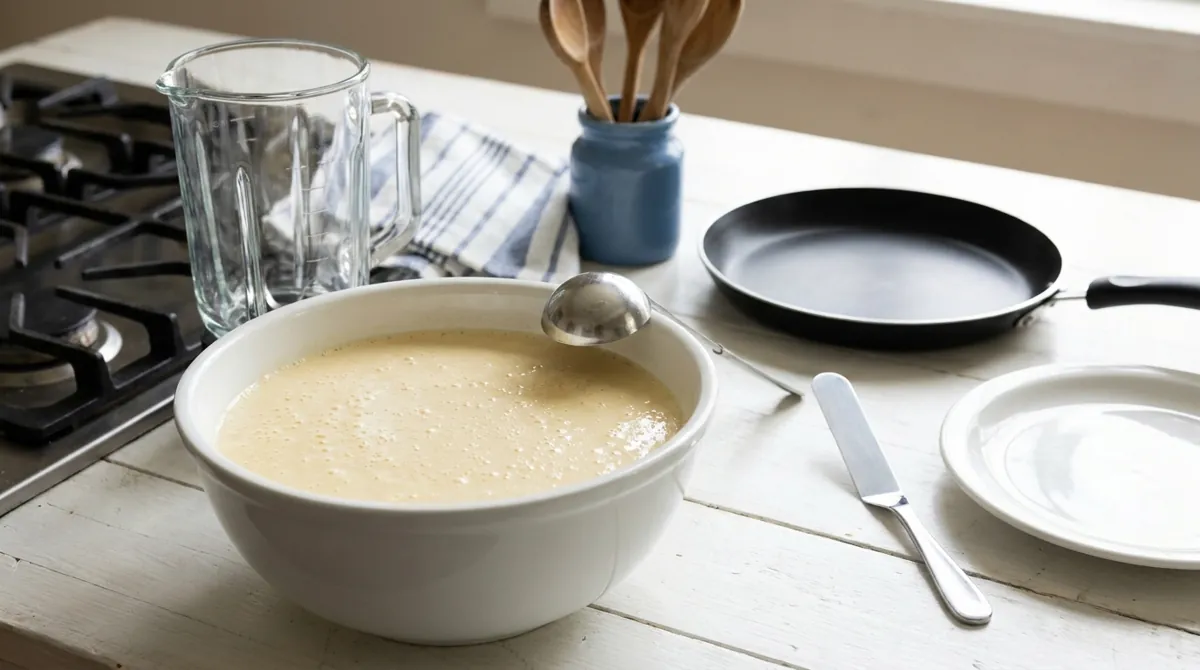
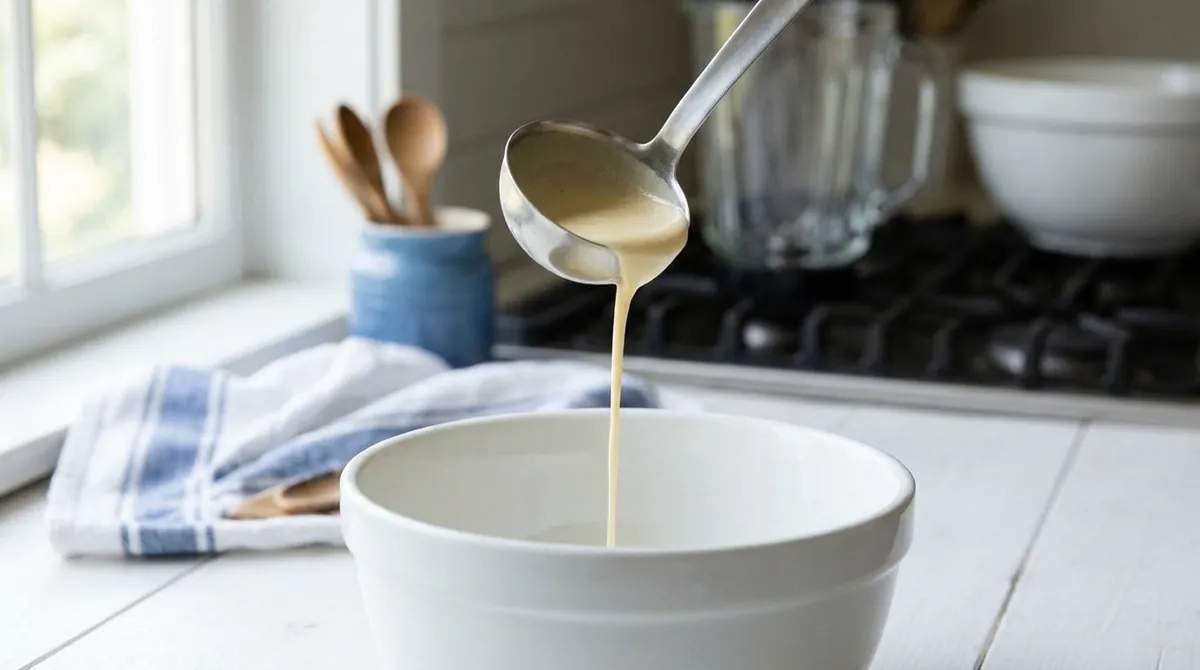
Cover and let the batter rest at least 30 minutes at room temperature, or up to a day in the fridge. Stir it before using: it should be about as thin as heavy cream. If it is thicker, whisk in a spoonful of water.
✓ What it should look like - Step 3
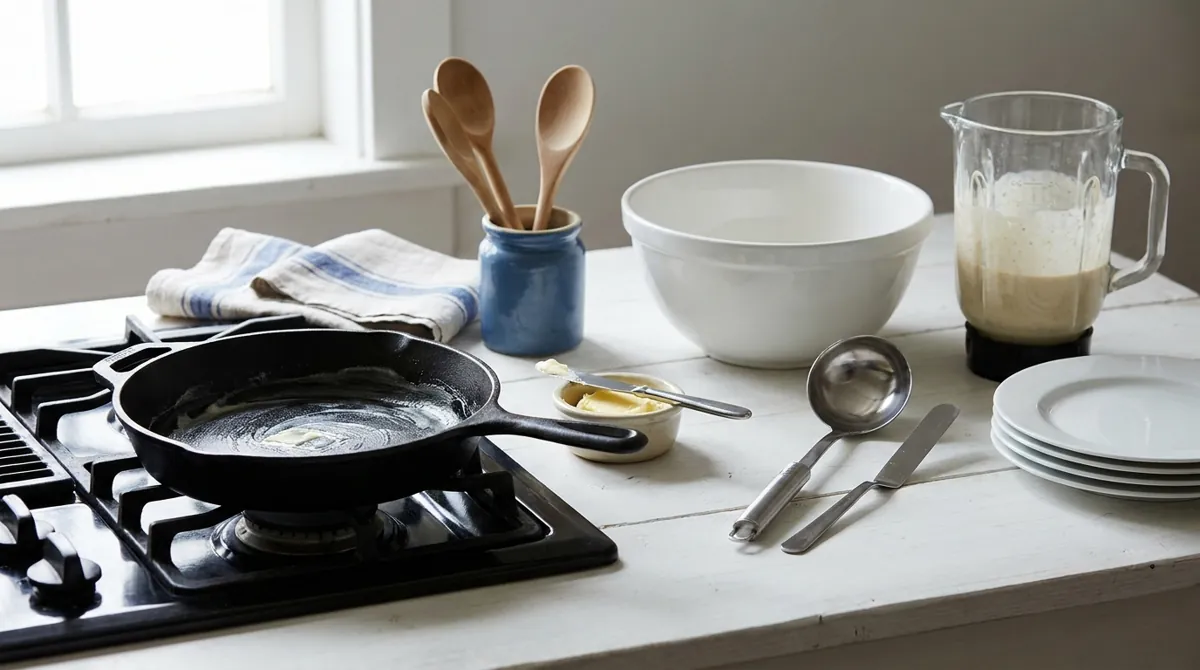
Heat a 10 inch nonstick skillet over medium heat for 2 minutes and wipe it with a little butter on a folded paper towel.
- Step 4
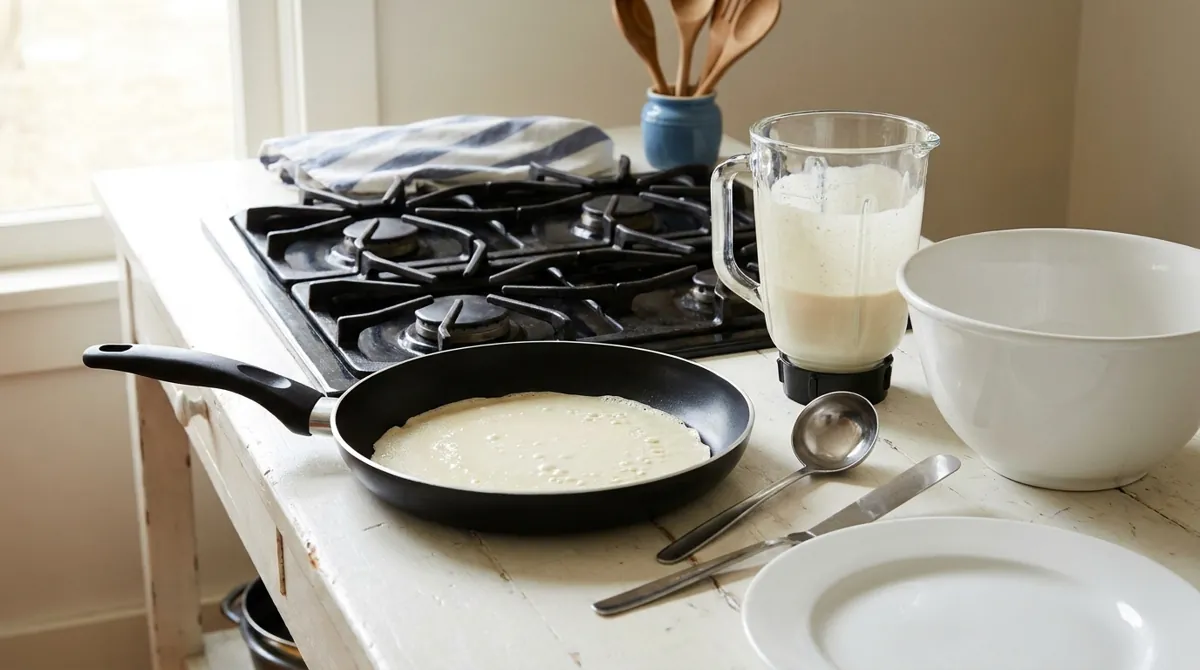
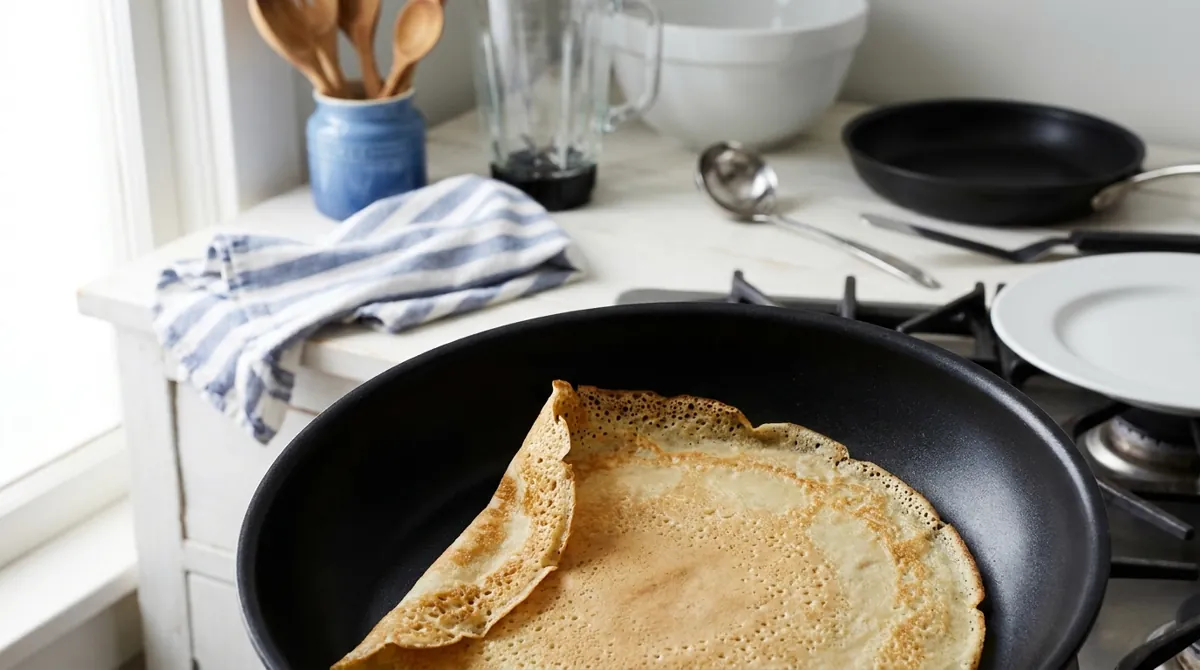
Pour in 1/4 cup of batter (one small ladle), lifting and tilting the pan at once so it coats the bottom in a thin, even layer. Cook 60 to 90 seconds, until the top looks dry, the edges are lacy and lifting, and the underside is light golden with brown freckles.
✓ What it should look like - Step 5
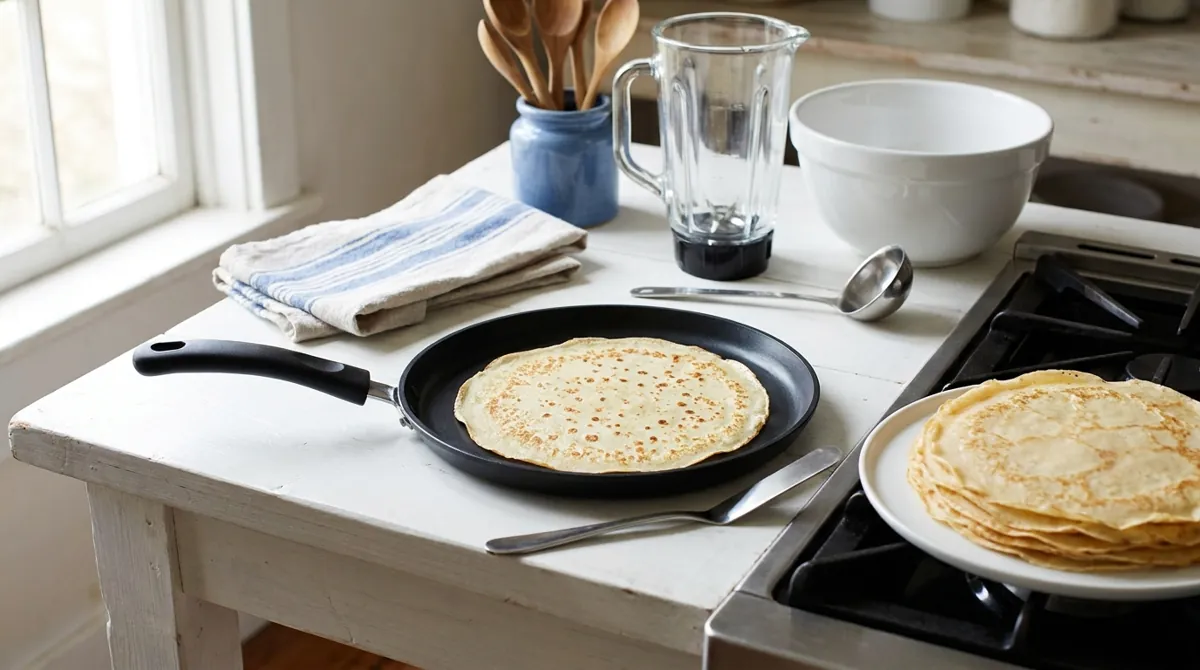
Loosen an edge with a thin spatula, flip, and cook the second side 20 to 30 seconds. Slide it onto a plate. The first crepe is often a test; adjust the heat and carry on, buttering the pan every two or three crepes and stacking them as you go.
- Step 6
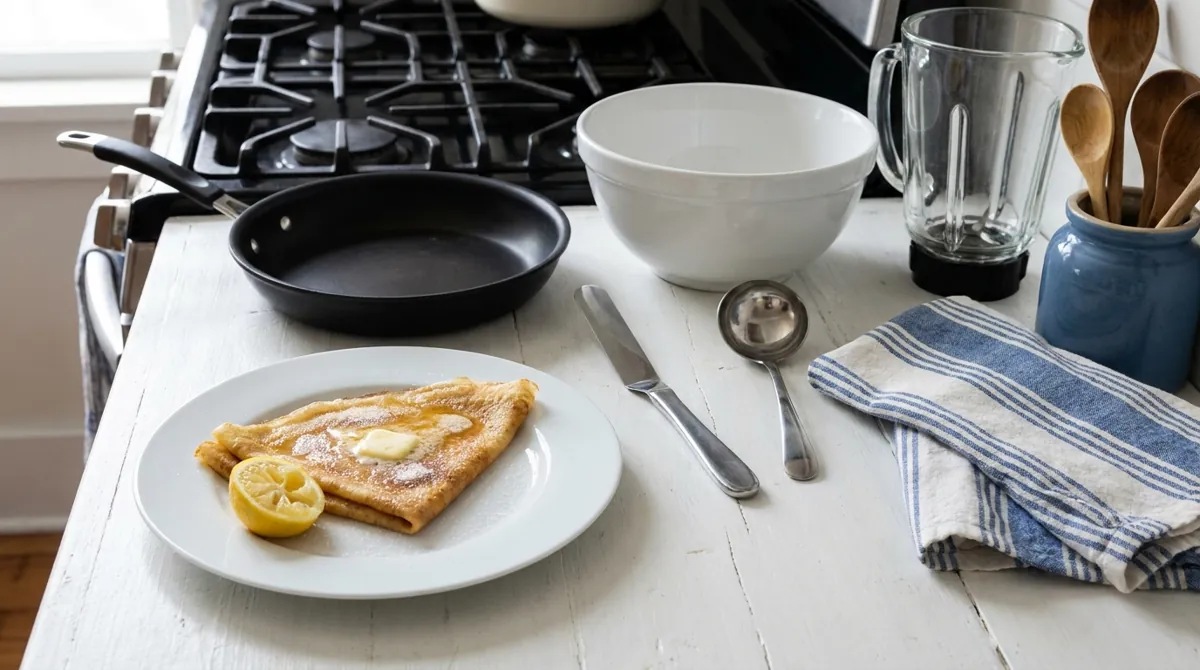
To serve, spread a crepe with soft butter, sprinkle with sugar and a squeeze of lemon, and fold it in half, then in half again into a triangle. Serve warm.
Crepes
Serves 4 to 6 · about 12 crepes, 8 inches across · 1 hr 5 min total
Batter
- 1 cup all-purpose flour (125 g)
- 1 tbsp granulated sugar (12 g), leave out for savory fillings
- 1/4 tsp fine salt
- 3 large eggs
- 1 1/4 cups whole milk (300 g)
- 1/4 cup water (60 g)
- 3 tbsp unsalted butter (42 g), melted, plus about 1 tbsp more for the pan
To serve
- Soft butter, granulated sugar and lemon wedges, or jam, or chocolate hazelnut spread
Equipment: Blender, Nonstick skillet, Measuring cups and spoons, Mixing bowls, Whisk, Spatula, Ladle, Paper towels
Method
- Put the flour, sugar, salt and eggs in a blender (or a large bowl) with half the milk and blend or whisk to a smooth, thick paste. Add the rest of the milk, the water and the melted butter and blend until smooth.
- Cover and let the batter rest at least 30 minutes at room temperature, or up to a day in the fridge. Stir it before using: it should be about as thin as heavy cream. If it is thicker, whisk in a spoonful of water.
- Heat a 10 inch nonstick skillet over medium heat for 2 minutes and wipe it with a little butter on a folded paper towel.
- Pour in 1/4 cup of batter (one small ladle), lifting and tilting the pan at once so it coats the bottom in a thin, even layer. Cook 60 to 90 seconds, until the top looks dry, the edges are lacy and lifting, and the underside is light golden with brown freckles.
- Loosen an edge with a thin spatula, flip, and cook the second side 20 to 30 seconds. Slide it onto a plate. The first crepe is often a test; adjust the heat and carry on, buttering the pan every two or three crepes and stacking them as you go.
- To serve, spread a crepe with soft butter, sprinkle with sugar and a squeeze of lemon, and fold it in half, then in half again into a triangle. Serve warm.
Americanized house recipe, written for this site: a classic French wheat-flour crepe batter. History: Wikipedia, "Crêpe" (crispus, Candlemas customs, flour, eggs, milk, butter, buckwheat galettes); Wikipedia, "Galette" (galette complète, galette and crepe naming); Bécédia, "Did the Bretons Invent the Crêpe?" (15th-century buckwheat, no gluten, billig, 1499 Catholicon, first crêperie in Rennes); Wikipedia, "The Magic Pan" (1965 Fillmore Street, Laszlo and Eva Fono, eight-pan carousel, Quaker Oats 1970, 110 locations, sold 1982). en.wikipedia.org. Ingredient list follows the source; the method is in our own words.
All sources (4)
Tips
- Stack cooked crepes on a plate; they stay soft and peel apart easily. Refrigerate, wrapped, up to 3 days, or freeze with parchment between them.
- For a Breton-style galette, use buckwheat flour for half or all of the flour, leave out the sugar, and fill with ham, grated Gruyere and an egg cooked on the crepe.
- If the batter will not spread, the pan is too hot or the batter too thick.
The rules people argue about
What the sources agree on, what they don't, and what is just a good story.
- Crepes were invented in Brittany. Disputed: Brittany is the region most tied to them and has documented crepes since at least 1499, but thin pancakes are old and widespread across Europe, and nobody can prove a first.
Meatballs of the World

Italian-American Meatballs
Big, tender meatballs braised for an hour in red sauce over spaghetti. The one most Americans grew up with.

Pallottine (Abruzzo Meatballs)
Tiny meatballs, smaller than a marble, tossed right through square spaghetti alla chitarra. No bread at all.

Swedish Meatballs (Köttbullar)
Small, soft meatballs browned in butter, in a cream sauce made from the same pan, with lingonberry jam on the plate.

Danish Frikadeller
Pork meatballs shaped with a spoon and fried slowly in butter, crusty outside and soft in the middle.

Königsberger Klopse
German meatballs that are never fried: poached, then served in a creamy white sauce with capers.

Spanish Albóndigas in Almond Saffron Sauce
The tapas bar classic: small meatballs in a golden sauce thickened with fried almonds and bread.

Mexican Albóndigas with Chipotle and Mint
Soft meatballs with rice and fresh mint inside, simmered in a smoky tomato and chipotle broth.

Izgara Köfte (Turkish Grilled Meatballs)
Small, flat meatballs kneaded hard, rested cold, and charred on a hot grill pan.

Lion's Head Meatballs
Big, soft pork meatballs, stirred into a sticky paste, fried to set, then braised in a savory sauce.

Chicken Tsukune
Japan's chicken meatball: kneaded sticky, grilled on skewers, glazed with sweet soy tare, dipped in egg yolk.