
Croissants
Shatteringly crisp, deeply golden crescents with a honeycomb of buttery layers inside: a weekend project with a Viennese ancestor and a very French finish.
🍳Cook alongOne move at a time, with real timers
 Edited by JP Lambiase
Change the estimate
Swaps change the price only: cook any meat to its own safe temperature. Where these numbers come from
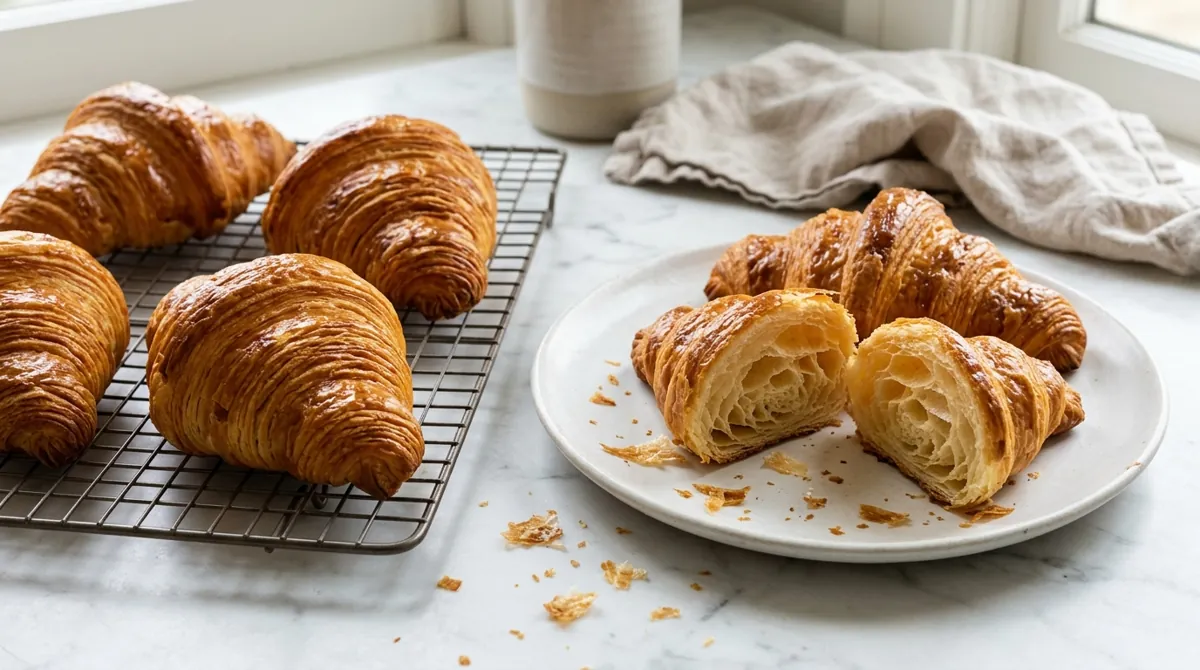
The croissant is French by finish and Austrian by ancestry. Its ancestor is the kipferl, a crescent-shaped Austrian pastry that Wikipedia traces to at least the 13th century. The modern croissant came in the early 20th century, when French bakers swapped the kipferl's brioche-type dough for a yeast dough layered with butter, rolled and folded again and again. A bakery selling Viennese bread and kipferl opened in Paris in the late 1830s (the Boulangerie Viennoise of August Zang, dated 1838, 1839 or about 1840 depending on the source), and it started the French habit of "viennoiserie." The name "croissant" turns up among French breads by 1853, and the first printed recipe for the laminated croissant we know is dated 1905 or 1906, depending on the source.
You will also hear that a Viennese baker invented the crescent in 1683 to celebrate the defeat of the Ottoman siege, shaped like the Turkish flag's moon. It is a myth: no source from the time mentions it, and the versions disagree on the city and the year.
Why it works the kitchen science
Butter layered into the dough
Each fold multiplies the thin alternating layers of dough and butter, and the butter's water turns to steam in the oven and puffs them apart into a honeycomb. Wikipedia notes croissant dough is typically laminated to 16 to 50 fat layers.
Cold butter and cold dough
Butter melts at a low temperature (about 90°F), so if it warms and leaks, the layers fuse and the croissant turns bready instead of flaky.
Long proof at room temperature
The yeast needs time to puff the layers; too warm a spot makes the butter run out.
Egg wash
It browns the top into a glossy, deep golden shell.
🧰 You'll need 8 items
Everything the steps call for. Tick off what you have before you start.
Appliances
Pans and pots
Tools
Supplies
Step by step
- Step 1
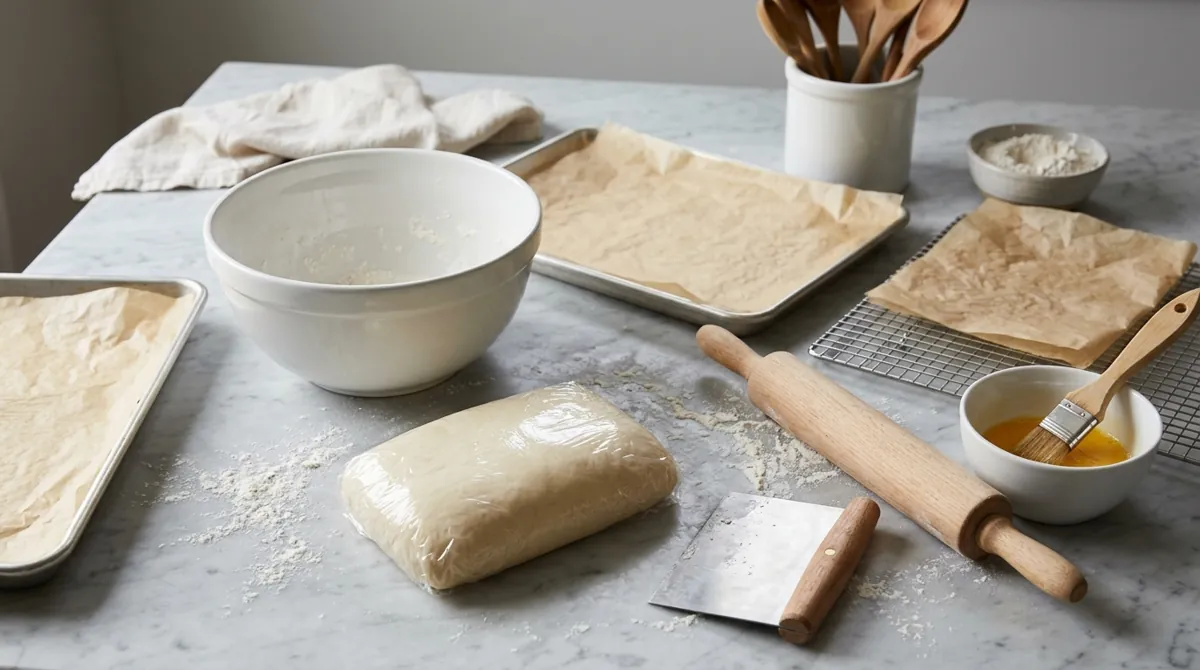
Mix the flour, sugar, salt and yeast in a large bowl. Add the water, milk and softened butter and knead 5 minutes until smooth. Shape into a rectangle, wrap tightly and refrigerate at least 1 hour, or overnight.
- Step 2
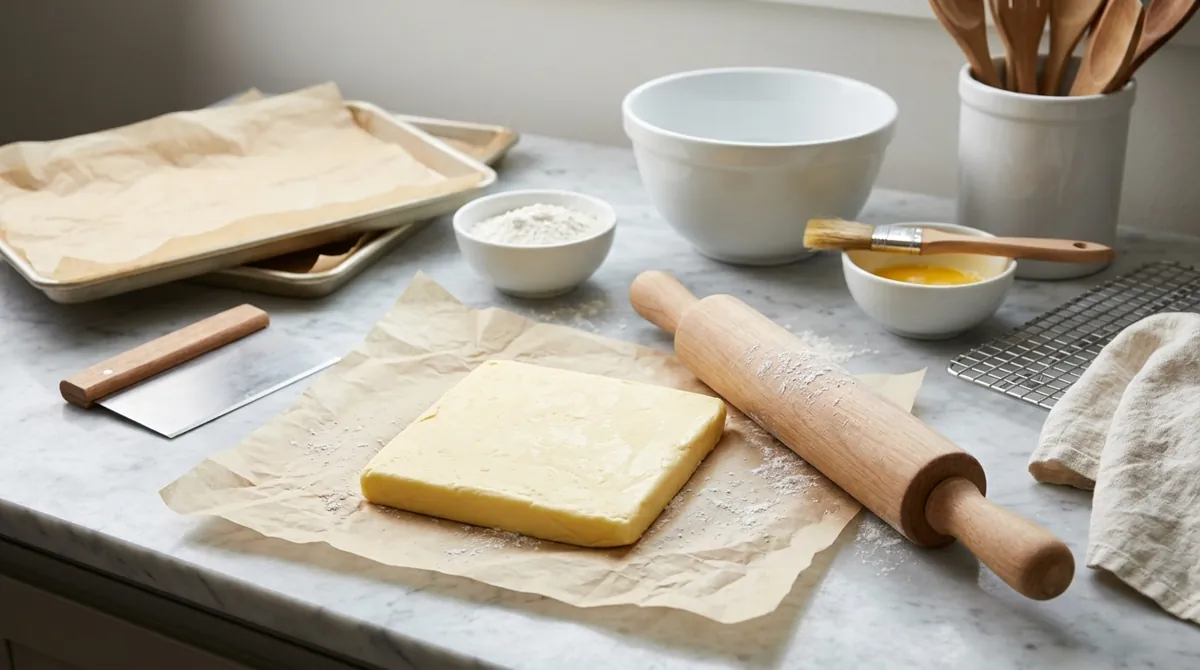
Pound the cold butter between two sheets of parchment into a 7 inch square about 1/2 inch thick. Chill until firm but still pliable, about 30 minutes.
- Step 3
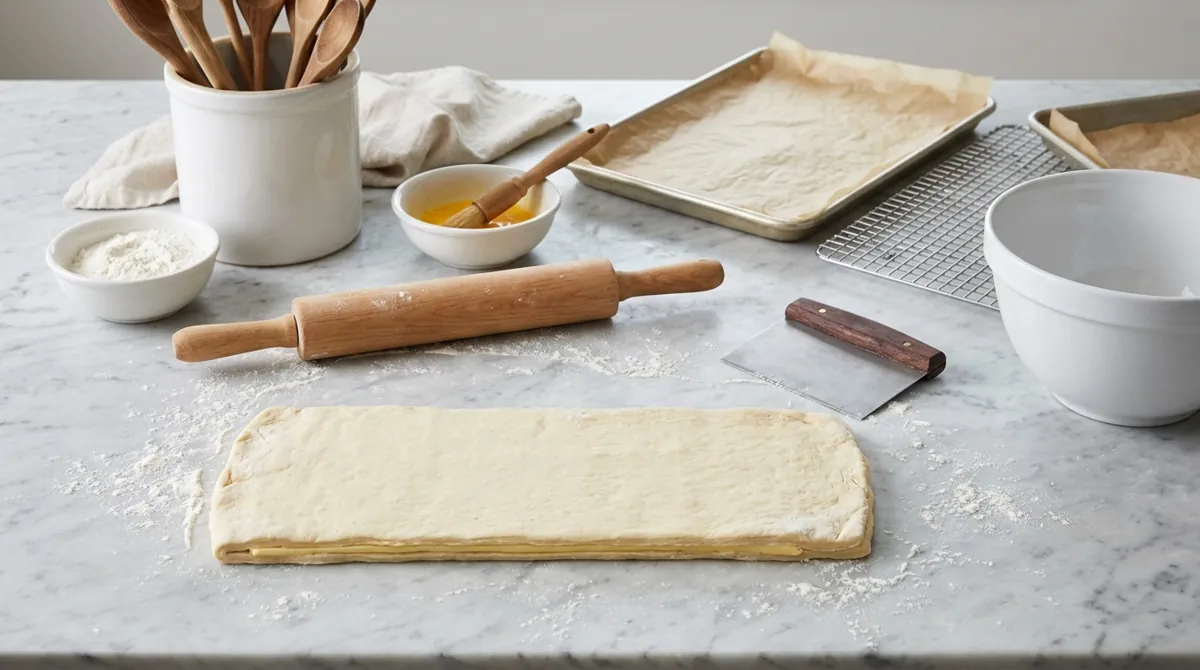
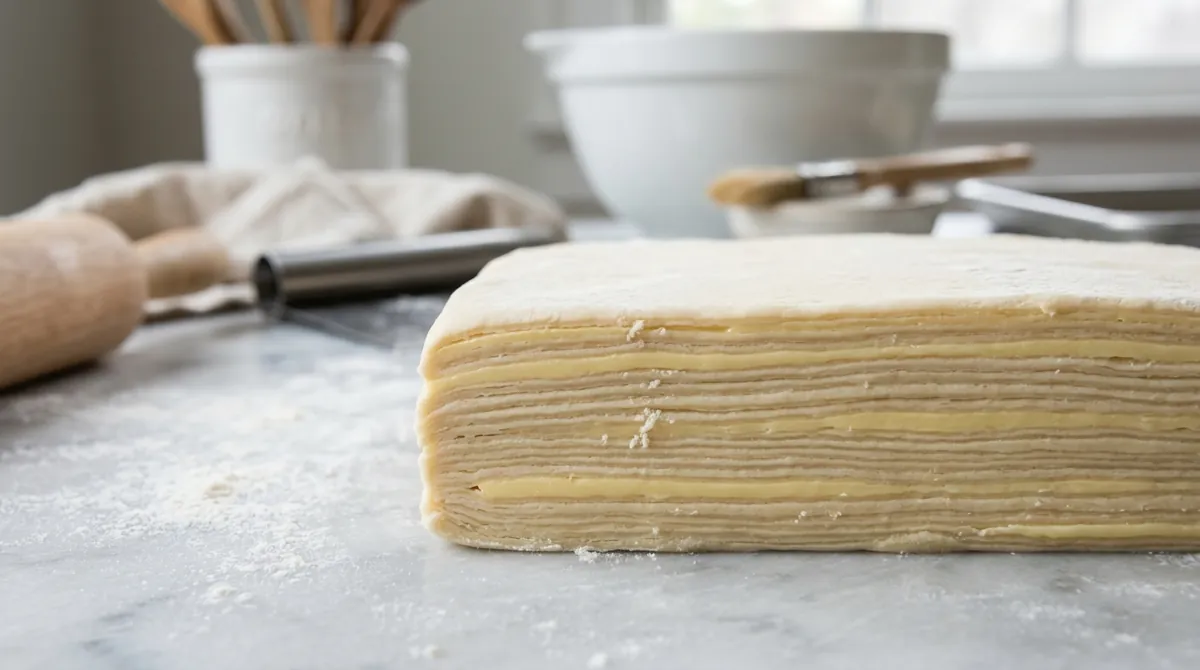
Roll the cold dough to a 14 inch square. Set the butter square in the middle, turned like a diamond, and bring the dough corners over it to meet in the center, pinching the seams closed. Roll the package out to an 8 by 24 inch rectangle, make a letter fold (a third over, then a third over that), wrap and chill 30 minutes. Repeat the roll, fold and 30 minute chill two more times, three folds in all, chilling the last one 1 hour.
✓ What it should look like - Step 4
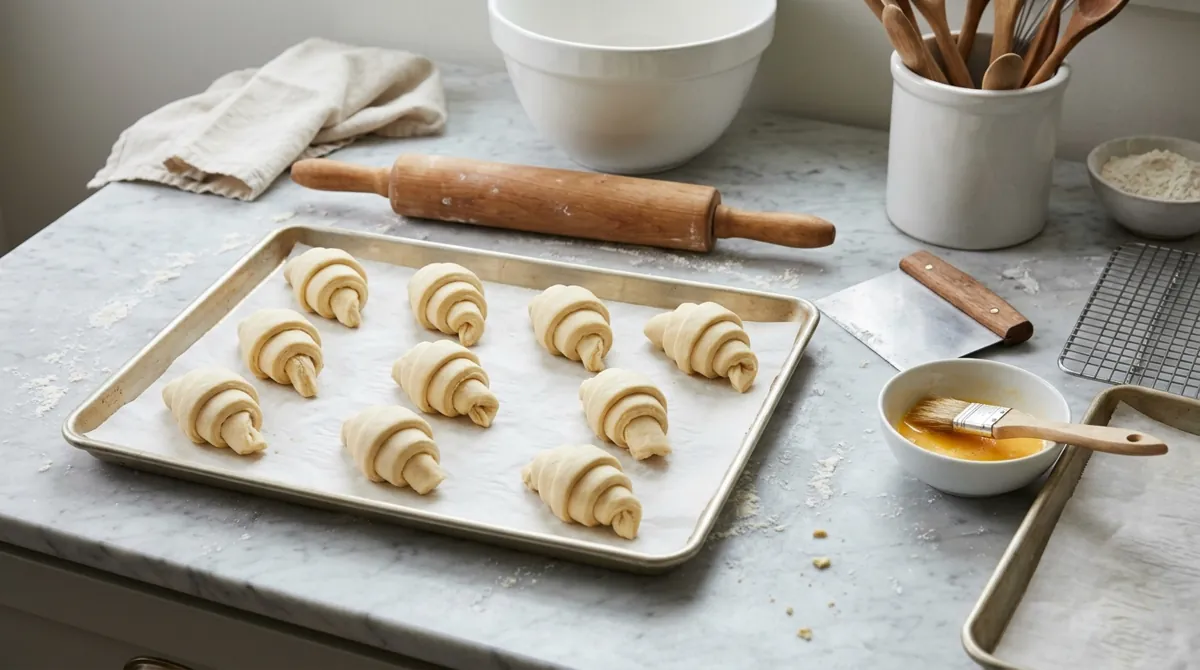
Roll the dough to about 12 by 36 inches and 1/4 inch thick, trimming the edges straight. Cut 12 long triangles, each about 4 inches wide at the base and 8 inches tall, make a small notch in each base, and roll each up from the base to the tip, tip tucked underneath, on two parchment-lined sheet pans.
- Step 5
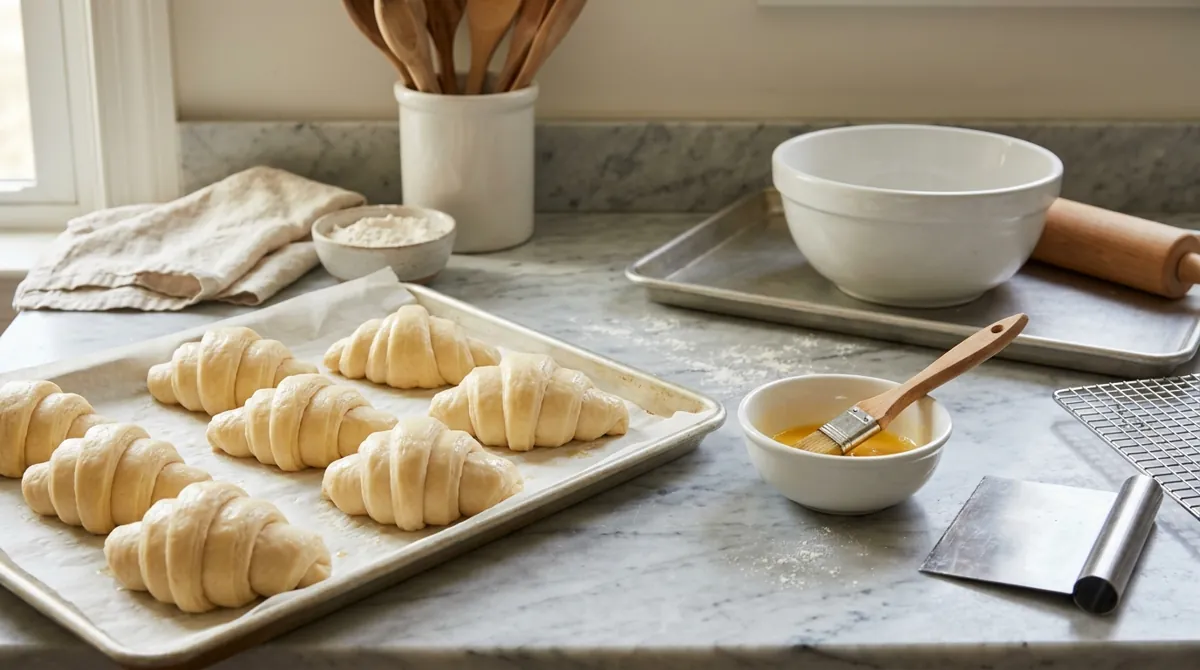
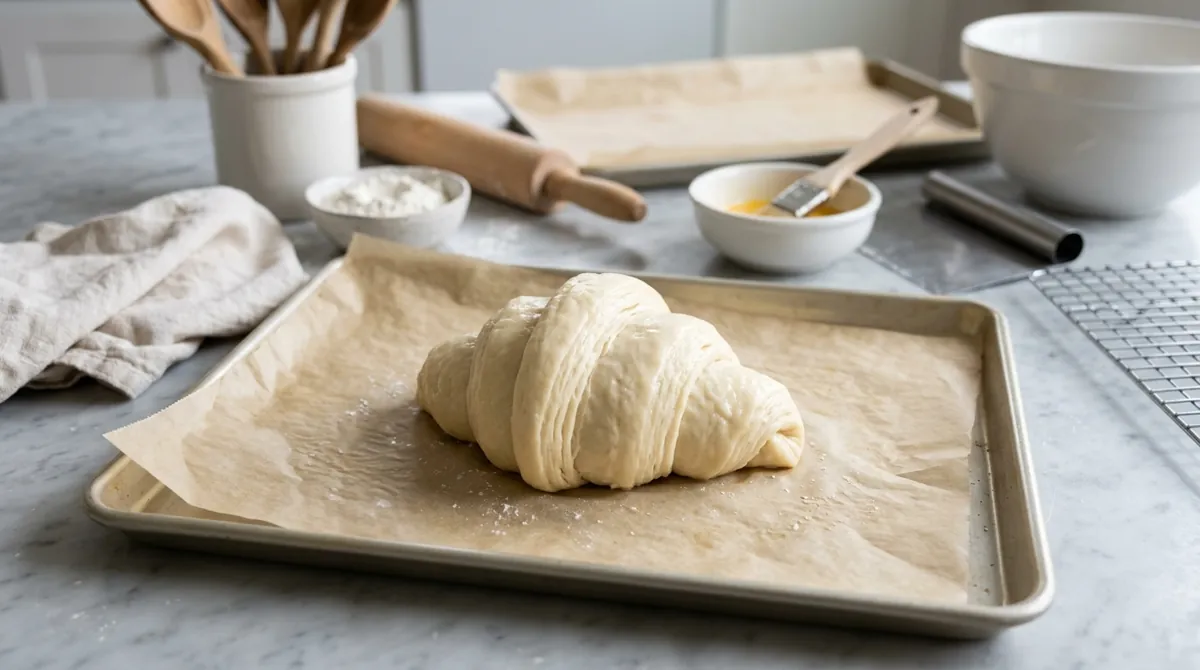
Cover loosely and proof at 75°F for 2 to 2 1/2 hours, until puffy, nearly doubled and wobbly when the pan is nudged. Do not rush it with heat or the butter melts out.
✓ What it should look like - Step 6
Heat the oven to 400°F. Beat the egg with the milk, brush it over the croissants and bake 18 to 22 minutes, until deep golden brown and the sides feel light. Cool on a rack for at least 15 minutes.
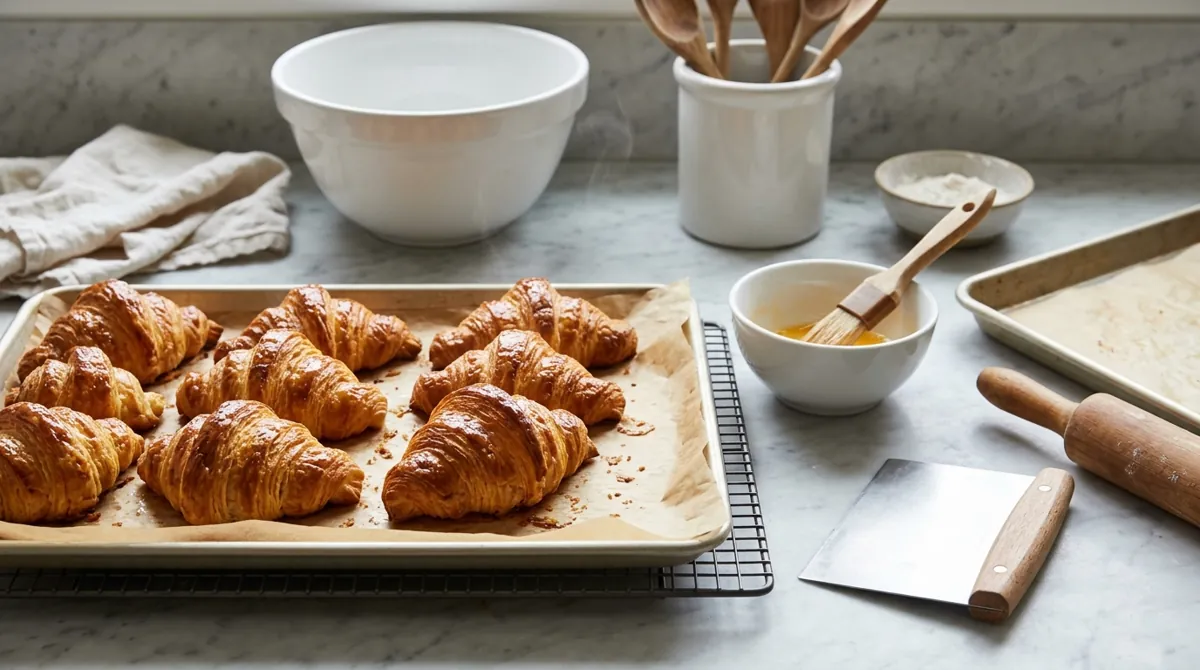
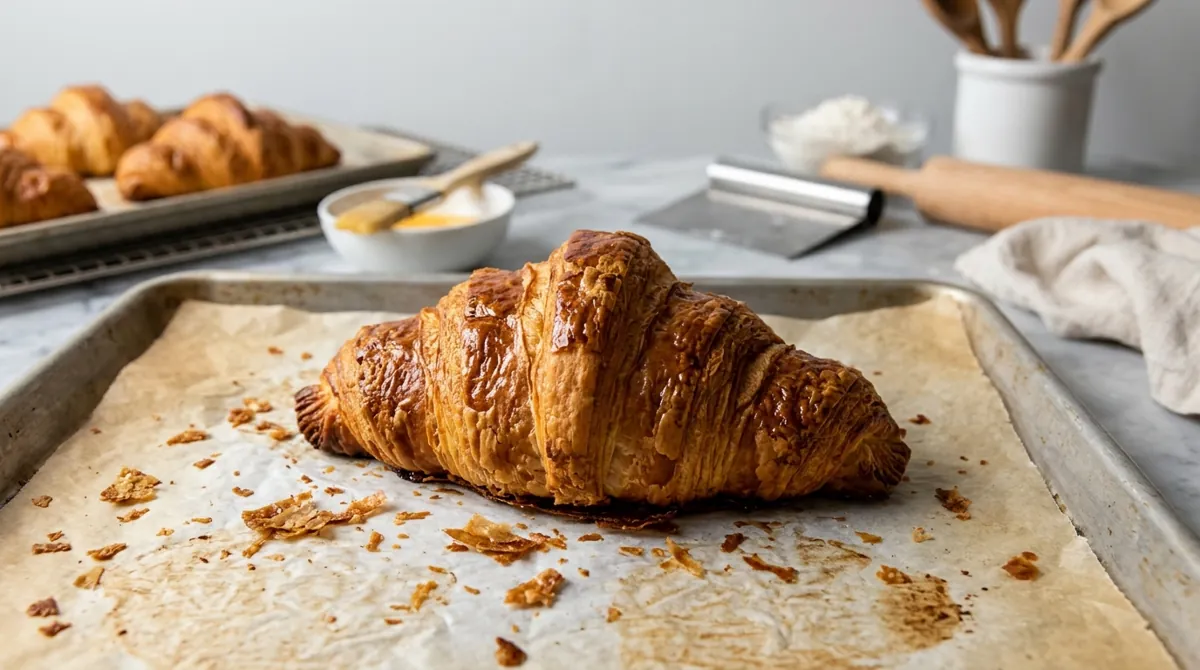
✓ What it should look like
Croissants
Serves 12 croissants · 12 croissants on two sheet pans · 8 hr total
Dough
- 4 cups all-purpose flour (500 g), plus more for rolling
- 1/4 cup granulated sugar (55 g)
- 2 tsp fine salt (10 g)
- 1 tbsp instant yeast (10 g)
- 2/3 cup cold water (140 g)
- 2/3 cup cold whole milk (140 g)
- 3 tbsp unsalted butter (40 g), softened
Butter block
- 1 1/4 cups cold unsalted butter (280 g), European-style with higher fat if you can find it
Egg wash
- 1 large egg (50 g)
- 1 tbsp whole milk (15 g)
Equipment: Oven, Rimmed baking sheet, Chef's knife and cutting board, Measuring cups and spoons, Mixing bowls, Rolling pin, Pastry brush, Parchment paper
Method
- Mix the flour, sugar, salt and yeast in a large bowl. Add the water, milk and softened butter and knead 5 minutes until smooth. Shape into a rectangle, wrap tightly and refrigerate at least 1 hour, or overnight.
- Pound the cold butter between two sheets of parchment into a 7 inch square about 1/2 inch thick. Chill until firm but still pliable, about 30 minutes.
- Roll the cold dough to a 14 inch square. Set the butter square in the middle, turned like a diamond, and bring the dough corners over it to meet in the center, pinching the seams closed. Roll the package out to an 8 by 24 inch rectangle, make a letter fold (a third over, then a third over that), wrap and chill 30 minutes. Repeat the roll, fold and 30 minute chill two more times, three folds in all, chilling the last one 1 hour.
- Roll the dough to about 12 by 36 inches and 1/4 inch thick, trimming the edges straight. Cut 12 long triangles, each about 4 inches wide at the base and 8 inches tall, make a small notch in each base, and roll each up from the base to the tip, tip tucked underneath, on two parchment-lined sheet pans.
- Cover loosely and proof at 75°F for 2 to 2 1/2 hours, until puffy, nearly doubled and wobbly when the pan is nudged. Do not rush it with heat or the butter melts out.
- Heat the oven to 400°F. Beat the egg with the milk, brush it over the croissants and bake 18 to 22 minutes, until deep golden brown and the sides feel light. Cool on a rack for at least 15 minutes.
Americanized house recipe, written for this site, within the common ratios of home laminated croissants (about 500 g flour, 55 g sugar, 10 g salt, 10 g instant yeast, 280 g butter for the block, three letter folds). King Arthur Baking's classic croissants, could not be fetched. History: Wikipedia, "Croissant" (kipferl, the 1683 legend with no contemporary sources, Zang's bakery, the 1905 and 1906 recipes). King Arthur Baking. Ingredient list follows the source; the method is in our own words.
All sources (2)
Tips
- If the butter gets soft or shiny at any point, slide the dough onto a sheet pan and chill it 15 to 20 minutes before going on.
- Baked croissants keep 1 day at room temperature and re-crisp in a 350°F oven for 5 minutes. Unbaked shaped ones freeze 1 month.
- A properly proofed croissant jiggles when you nudge the pan; if it does not, give it 30 more minutes.
- For pain au chocolat, roll a rectangle of dough around two chocolate batons instead of cutting triangles.
The rules people argue about
What the sources agree on, what they don't, and what is just a good story.
- The croissant is Austrian. Disputed: the crescent kipferl is Austrian and old, but the butter-laminated croissant is a French development of the early 1900s.
- When Zang opened his Paris bakery. Disputed: 1838, 1839 and about 1840 all appear in sources.
- First croissant recipe. Disputed: 1905 or 1906 is cited, and some credit a 1915 book for the first full recipe.
Meatballs of the World

Italian-American Meatballs
Big, tender meatballs braised for an hour in red sauce over spaghetti. The one most Americans grew up with.

Pallottine (Abruzzo Meatballs)
Tiny meatballs, smaller than a marble, tossed right through square spaghetti alla chitarra. No bread at all.

Swedish Meatballs (Köttbullar)
Small, soft meatballs browned in butter, in a cream sauce made from the same pan, with lingonberry jam on the plate.

Danish Frikadeller
Pork meatballs shaped with a spoon and fried slowly in butter, crusty outside and soft in the middle.

Königsberger Klopse
German meatballs that are never fried: poached, then served in a creamy white sauce with capers.

Spanish Albóndigas in Almond Saffron Sauce
The tapas bar classic: small meatballs in a golden sauce thickened with fried almonds and bread.

Mexican Albóndigas with Chipotle and Mint
Soft meatballs with rice and fresh mint inside, simmered in a smoky tomato and chipotle broth.

Izgara Köfte (Turkish Grilled Meatballs)
Small, flat meatballs kneaded hard, rested cold, and charred on a hot grill pan.

Lion's Head Meatballs
Big, soft pork meatballs, stirred into a sticky paste, fried to set, then braised in a savory sauce.

Chicken Tsukune
Japan's chicken meatball: kneaded sticky, grilled on skewers, glazed with sweet soy tare, dipped in egg yolk.