
Eggs Benedict
A toasted English muffin, a slice of browned Canadian bacon and a soft poached egg under a blanket of warm, lemony hollandaise: the Gilded Age New York breakfast two famous restaurants still argue over.
🍳Cook alongOne move at a time, with real timers
 Edited by JP Lambiase
Change the estimate
Swaps change the price only: cook any meat to its own safe temperature. Where these numbers come from
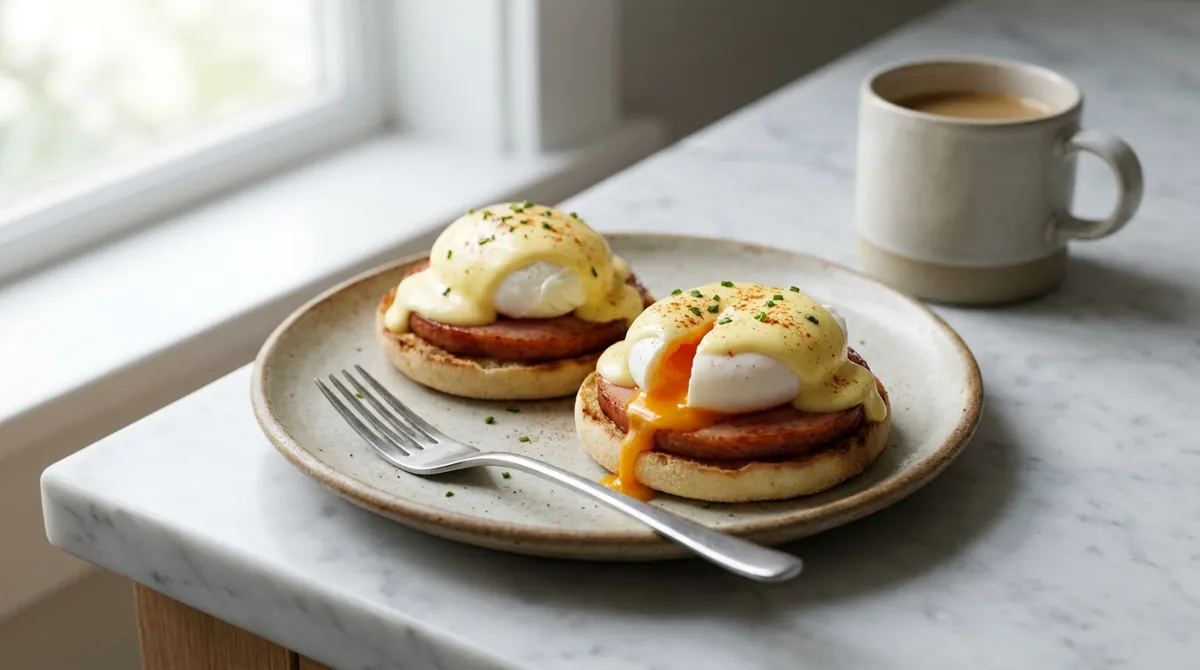
Eggs Benedict is a New York dish with two birth certificates. Delmonico's, the grand restaurant in Lower Manhattan, says on its menu that the dish "was first created in our ovens in 1860", and the usual story is that a regular, Mrs. LeGrand Benedict, asked for something new. Delmonico's chef Charles Ranhofer printed "Eggs à la Benedick" in The Epicurean, his 1894 book of the restaurant's cooking: toasted muffins, rounds of ham, poached eggs and hollandaise. The phrase "eggs a la Benedict" also turns up in a New York Daily Tribune story in January 1894.
The other claim belongs to Lemuel Benedict, a retired Wall Street stockbroker. In 1942, the year before he died, he told The New Yorker that in 1894 he had walked into the Waldorf Hotel looking for a hangover cure and ordered "buttered toast, poached eggs, crisp bacon, and a hooker of hollandaise". The maître d', Oscar Tschirky, liked it enough to put it on the menu, swapping in ham and an English muffin. Oscar's own authorized biography, which credits him with the Waldorf salad, says nothing about it.
A third claim arrived in 1967, when a letter to The New York Times credited a Commodore E. C. Benedict. Many historians suspect both restaurants served something similar at about the same time, and that the first one is lost.
Why it works the kitchen science
A gentle double boiler
Egg yolks thicken around 160°F and scramble not far above it, so they cook over steam, never on direct heat.
Hot butter added slowly
The yolks can only take in fat a little at a time; poured too fast, the sauce breaks into greasy yolk and butter.
Draining the eggs
The thin outer white is what makes ragged wisps in the pot. Strained out, the eggs poach into neat, tight ovals.
A bare simmer
A rolling boil tears the whites apart; small bubbles cook them gently.
🧰 You'll need 9 items
Everything the steps call for. Tick off what you have before you start.
Pans and pots
Tools
Supplies
Step by step
- Step 1
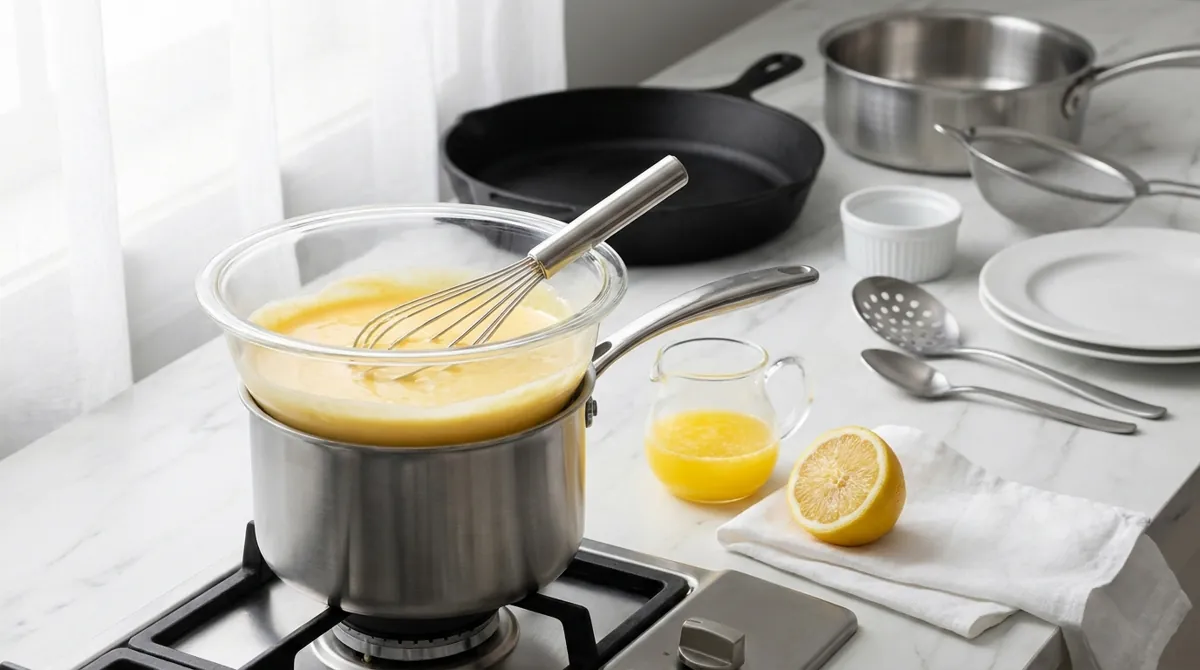
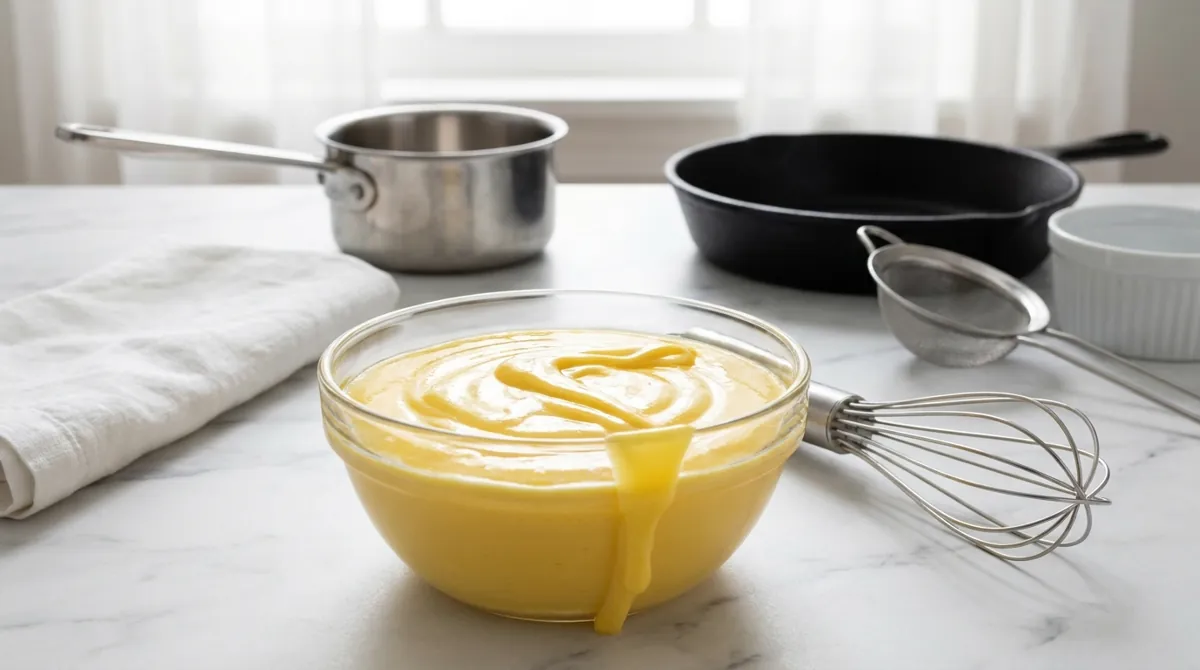
Make the hollandaise: bring an inch of water to a bare simmer in a small saucepan. In a heatproof glass bowl that sits over the pan without touching the water, whisk the yolks, lemon juice and water until frothy, then set it over the pan and whisk constantly 2 to 3 minutes, until the yolks are pale, thick and leave a trail. Take the bowl off the heat and whisk in the hot butter a little at a time until thick and glossy. Season with the salt and cayenne. Set the bowl over the pan, off the heat, to keep warm, and whisk in a teaspoon of warm water if it gets too thick.
✓ What it should look like - Step 2
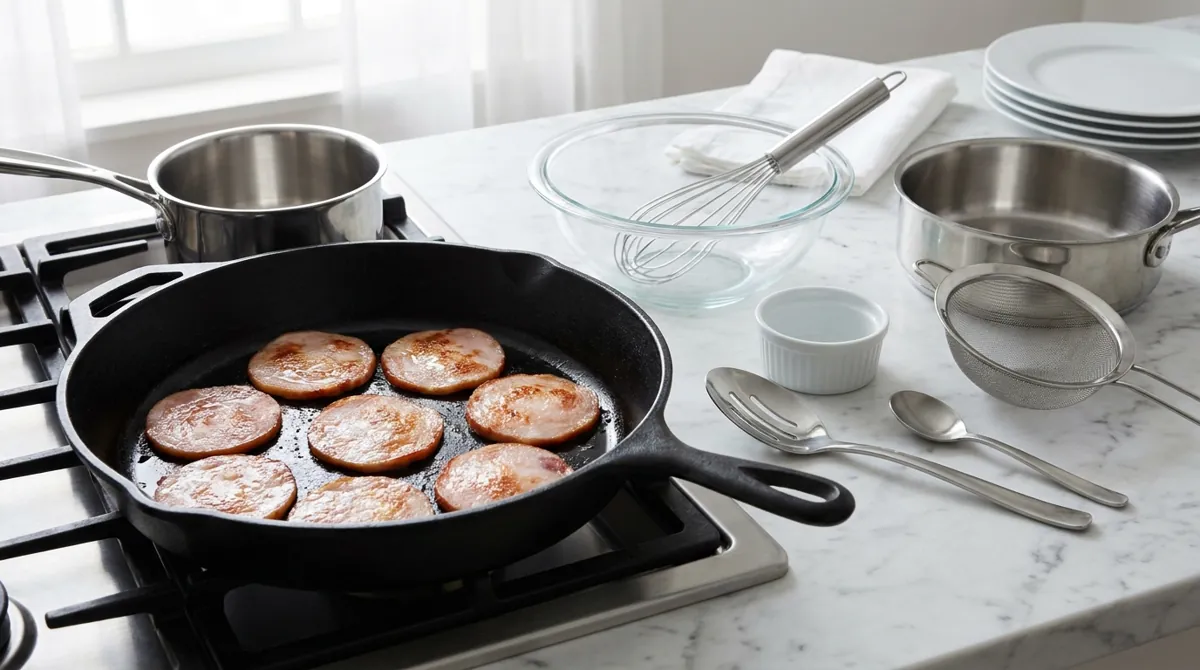
Brown the Canadian bacon in a large skillet over medium heat, 1 to 2 minutes a side, and keep it warm on a plate.
- Step 3
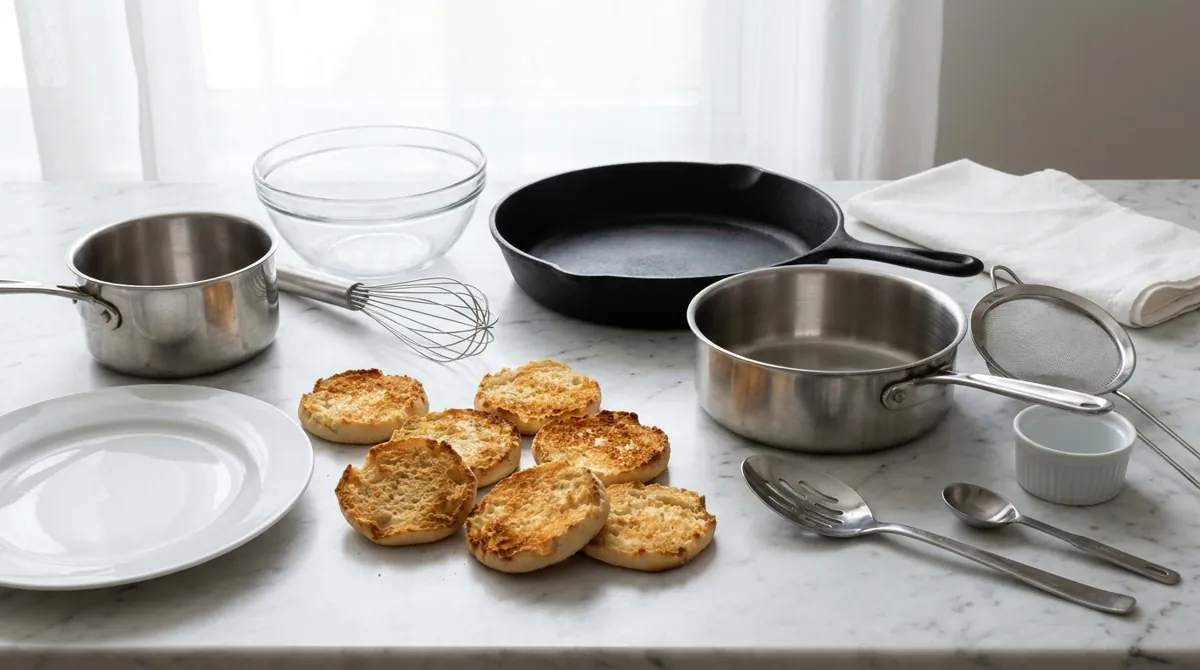
Toast the English muffin halves until golden and crisp at the edges.
- Step 4
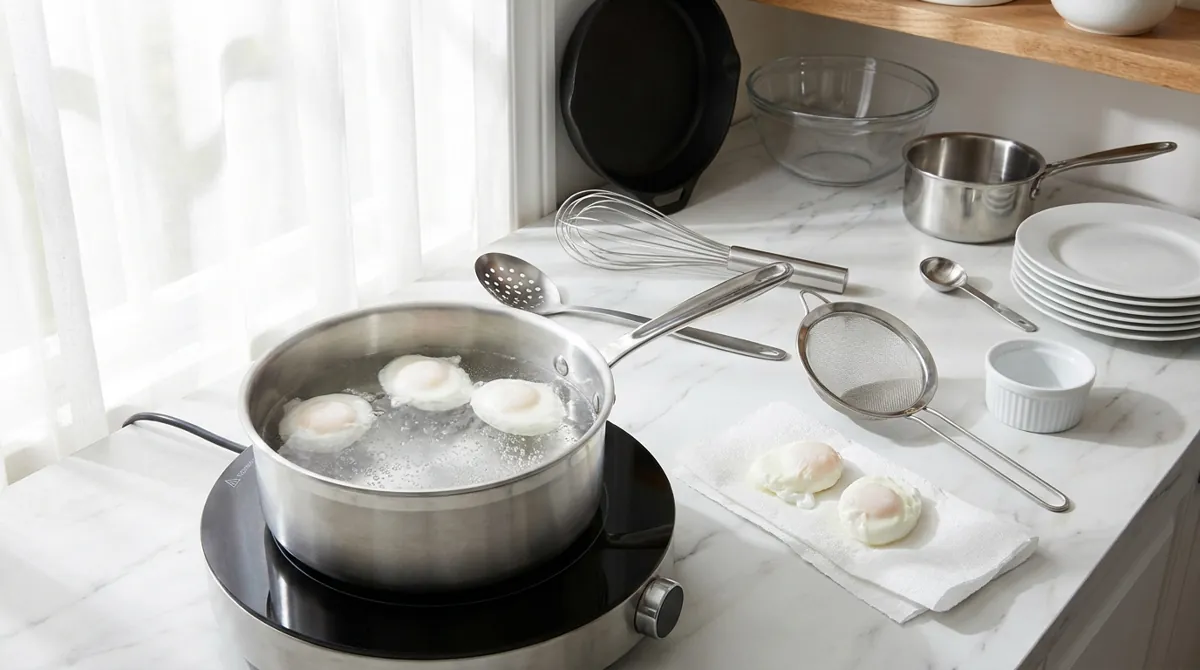
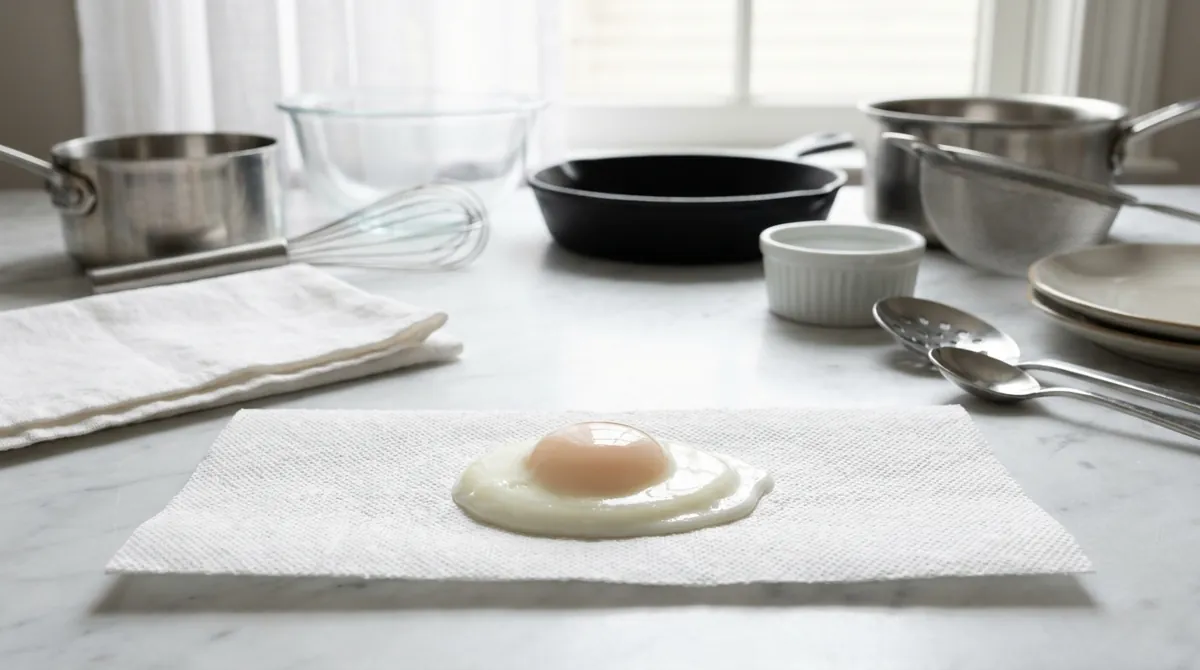
Poach the eggs: fill a wide saucepan with 3 inches of water, add the vinegar and bring to a bare simmer, small bubbles only. Crack each egg into a fine-mesh strainer for a few seconds to drain the thin, watery white, then tip it into a small cup and slide it gently into the water. Cook 4 at a time, 3 to 4 minutes, until the whites are set and the yolks still soft. Lift them out with a slotted spoon onto a paper towel.
✓ What it should look like - Step 5
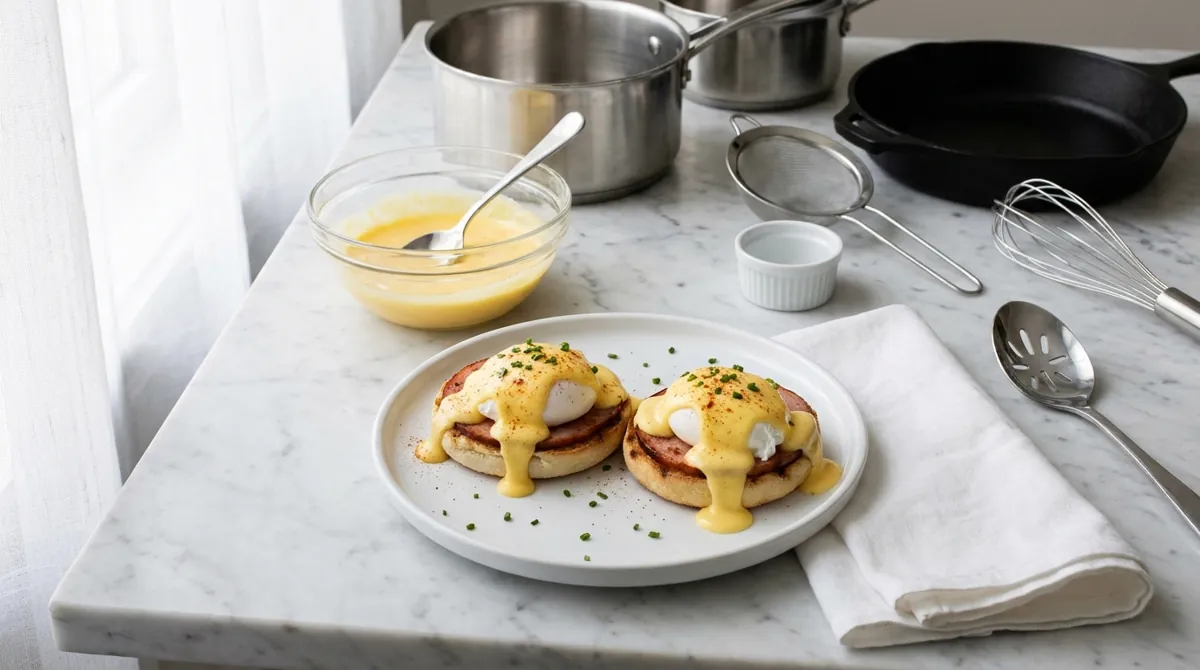
Assemble: put 2 muffin halves on each plate, top each with a slice of Canadian bacon and a poached egg, spoon over plenty of hollandaise and finish with a pinch of cayenne and some chives.
Eggs Benedict
Serves 4 · 8 halves, 2 per person · 35 min total
Hollandaise
- 3 large egg yolks (51 g)
- 1 tbsp fresh lemon juice (15 g)
- 1 tbsp water
- 1/2 cup unsalted butter (113 g), melted and hot
- 1/4 tsp fine salt
- Pinch of cayenne pepper, plus more to finish
To assemble
- 4 English muffins, split with a fork (228 g)
- 8 slices Canadian bacon (180 g)
- 8 large eggs, very fresh (400 g)
- 1 tbsp distilled white vinegar
- Chopped chives, optional
Equipment: Small saucepan, Large skillet, Chef's knife and cutting board, Measuring cups and spoons, Mixing bowls, Whisk, Slotted spoon or spider, Fine-mesh strainer, Paper towels
Method
- Make the hollandaise: bring an inch of water to a bare simmer in a small saucepan. In a heatproof glass bowl that sits over the pan without touching the water, whisk the yolks, lemon juice and water until frothy, then set it over the pan and whisk constantly 2 to 3 minutes, until the yolks are pale, thick and leave a trail. Take the bowl off the heat and whisk in the hot butter a little at a time until thick and glossy. Season with the salt and cayenne. Set the bowl over the pan, off the heat, to keep warm, and whisk in a teaspoon of warm water if it gets too thick.
- Brown the Canadian bacon in a large skillet over medium heat, 1 to 2 minutes a side, and keep it warm on a plate.
- Toast the English muffin halves until golden and crisp at the edges.
- Poach the eggs: fill a wide saucepan with 3 inches of water, add the vinegar and bring to a bare simmer, small bubbles only. Crack each egg into a fine-mesh strainer for a few seconds to drain the thin, watery white, then tip it into a small cup and slide it gently into the water. Cook 4 at a time, 3 to 4 minutes, until the whites are set and the yolks still soft. Lift them out with a slotted spoon onto a paper towel.
- Assemble: put 2 muffin halves on each plate, top each with a slice of Canadian bacon and a poached egg, spoon over plenty of hollandaise and finish with a pinch of cayenne and some chives.
Americanized house recipe, written for this site. History: Wikipedia, "Eggs Benedict" (Delmonico's 1860 menu claim, Ranhofer's "Eggs à la Benedick" in The Epicurean, Lemuel Benedict's 1942 New Yorker interview about the Waldorf in 1894 and the quote, Oscar Tschirky's ham and English muffin swap, the 1967 Commodore E. C. Benedict letter to Craig Claiborne, the modern components); Barry Popik, "Eggs Benedict" (the 7 January 1894 Daily Tribune citation, The Epicurean 1894, Fannie Farmer's 1896 "Eggs a la Benedict", no early source for the Mrs. LeGrand Benedict story); Chowhound, "The Warring Theories About How Eggs Benedict Was Invented" (Mrs. LeGrand Benedict at Delmonico's; Oscar's biography silent on the dish). Hollandaise: America's Test Kitchen on why hollandaise is finicky (an emulsion of butter and egg yolks). en.wikipedia.org. Ingredient list follows the source; the method is in our own words.
Tips
- If the hollandaise breaks, whisk a teaspoon of hot water in a clean bowl and slowly whisk the broken sauce into it.
- Poach the eggs up to a day ahead, chill them in ice water, and rewarm them in hot water for 1 minute.
- Swap the Canadian bacon for smoked salmon (eggs Royale) or wilted spinach (eggs Florentine).
- Split English muffins with a fork, not a knife, for more crisp edges.
The rules people argue about
What the sources agree on, what they don't, and what is just a good story.
- Eggs Benedict was invented at Delmonico's for Mrs. LeGrand Benedict. Disputed: Delmonico's chef printed the first known recipe in 1894, but the earliest source found for the Mrs. Benedict story is much later.
- It was invented at the Waldorf in 1894 as Lemuel Benedict's hangover cure. Disputed: it rests on his own 1942 interview, and Oscar Tschirky's biography does not mention it.
Meatballs of the World

Italian-American Meatballs
Big, tender meatballs braised for an hour in red sauce over spaghetti. The one most Americans grew up with.

Pallottine (Abruzzo Meatballs)
Tiny meatballs, smaller than a marble, tossed right through square spaghetti alla chitarra. No bread at all.

Swedish Meatballs (Köttbullar)
Small, soft meatballs browned in butter, in a cream sauce made from the same pan, with lingonberry jam on the plate.

Danish Frikadeller
Pork meatballs shaped with a spoon and fried slowly in butter, crusty outside and soft in the middle.

Königsberger Klopse
German meatballs that are never fried: poached, then served in a creamy white sauce with capers.

Spanish Albóndigas in Almond Saffron Sauce
The tapas bar classic: small meatballs in a golden sauce thickened with fried almonds and bread.

Mexican Albóndigas with Chipotle and Mint
Soft meatballs with rice and fresh mint inside, simmered in a smoky tomato and chipotle broth.

Izgara Köfte (Turkish Grilled Meatballs)
Small, flat meatballs kneaded hard, rested cold, and charred on a hot grill pan.

Lion's Head Meatballs
Big, soft pork meatballs, stirred into a sticky paste, fried to set, then braised in a savory sauce.

Chicken Tsukune
Japan's chicken meatball: kneaded sticky, grilled on skewers, glazed with sweet soy tare, dipped in egg yolk.