
French Onion Soup
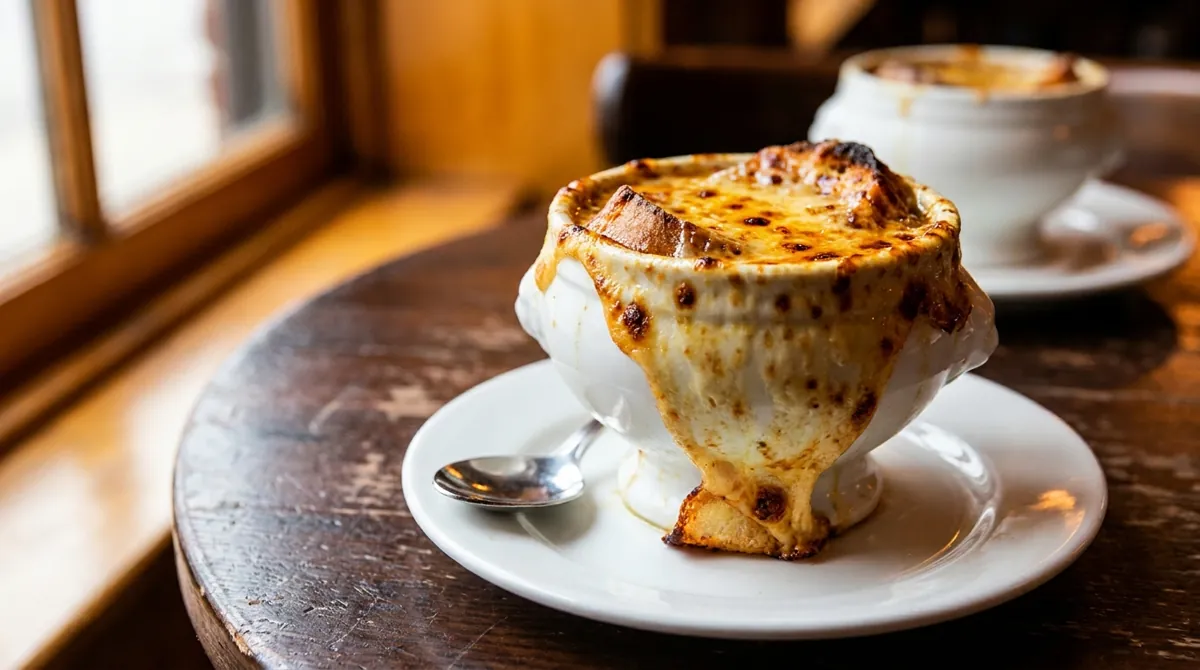
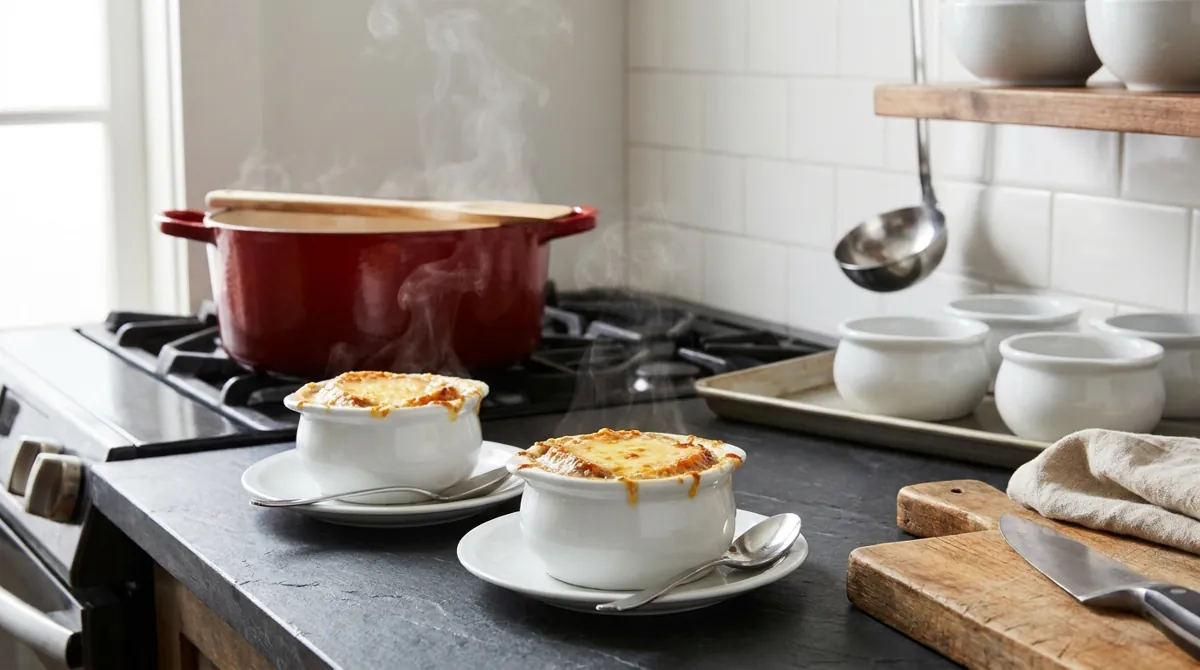
Four pounds of onions cooked down slowly to a deep caramel brown, simmered in beef broth with wine and thyme, then baked in crocks under toasted baguette and a bubbling lid of Gruyere: the Paris market soup that became an American steakhouse standard.
🍳Cook alongOne move at a time, with real timers
 Edited by JP Lambiase
Change the estimate
Swaps change the price only: cook any meat to its own safe temperature. Where these numbers come from
Onion soup is old and humble, made wherever onions, bread and broth were cheap. The French versions have a long paper trail: a recipe in the Paris household book Le Menagier de Paris of 1393 used ginger and saffron, which made it a rich household's dish, and La Varenne's Le cuisinier francois in the 17th century gives two onion soups. A favorite story says the soup reached Versailles after Louis XV's father-in-law, Stanislas, tasted it at an inn; that comes from Alexandre Dumas in 1873, and other tellings credit Louis XV himself.
The soup Americans know, gratinee, baked under bread and cheese, took shape in the mid-19th century around Les Halles, the giant central food market of Paris, where it was breakfast for the forts des Halles, the porters who hauled the goods, and a late-night bowl for party-goers leaving the cabarets, at restaurants such as La Poule au Pot.
It crossed the Atlantic early: Henri Mouquin's restaurant in New York served it from 1861. In 1961 Mastering the Art of French Cooking by Beck, Bertholle and Child called for beef stock, and in America that became the standard: dark beef broth in a thick white crock, a raft of toast and a lid of melted cheese running down the sides. Not everyone was a fan; the English food writer Elizabeth David called it in 1960 "a good deal overrated and rather indigestible."
This is the American crock version, with the onions taken properly dark.
Why it works the kitchen science
Salt, sugar and a lid
Salt draws water out of the onions, the lid traps steam so they soften fast, and the sugar helps them brown once the lid comes off (Cook's Country's method).
Scraping the fond
The brown crust on the bottom of the pot is where most of the flavor is, so it gets scraped back into the onions again and again, then lifted off with the wine.
Beef broth
The most common choice, for a darker, meatier soup; some cooks use chicken or veal stock or plain water.
Cheese under the bread as well as on top
The first layer of Gruyere seals the toast from the soup, so it softens without turning to mush.
Toast first
Dry, crisp bread holds up under the cheese instead of dissolving.
🧰 You'll need 7 items
Everything the steps call for. Tick off what you have before you start.
Appliances
Pans and pots
Tools
Step by step
- Step 1
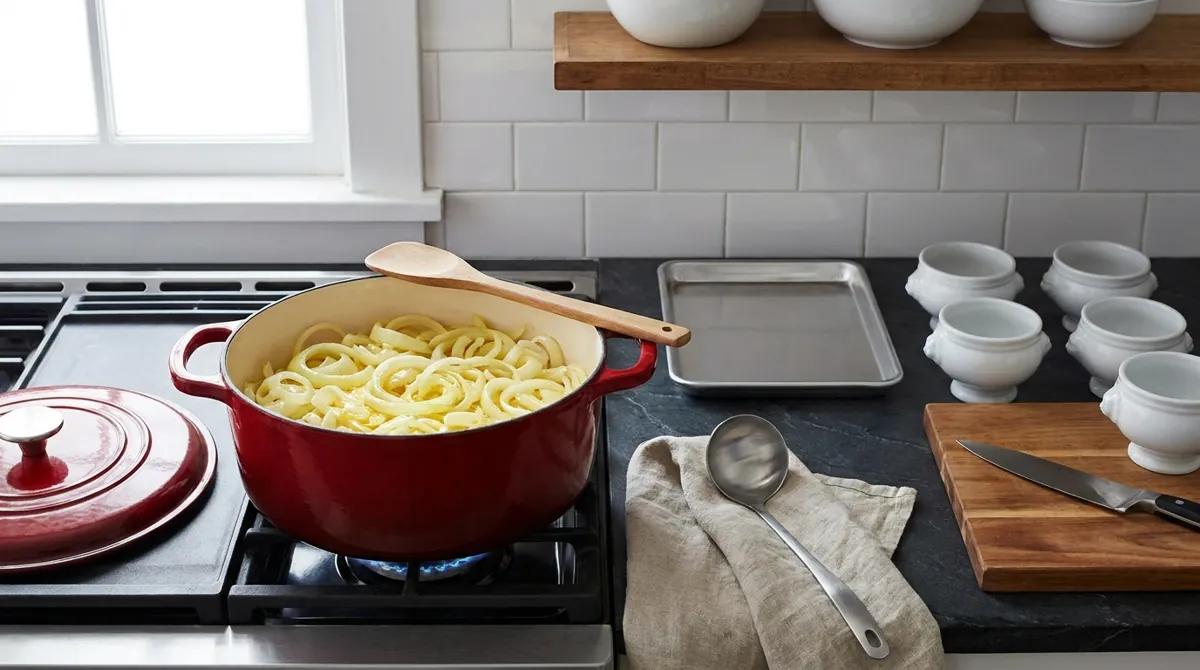
Melt the butter in a large Dutch oven over medium-high heat. Add the onions, 1 tsp salt and the sugar, stir to coat, cover and cook 20 minutes, stirring now and then, until the onions are wet, soft and translucent.
- Step 2
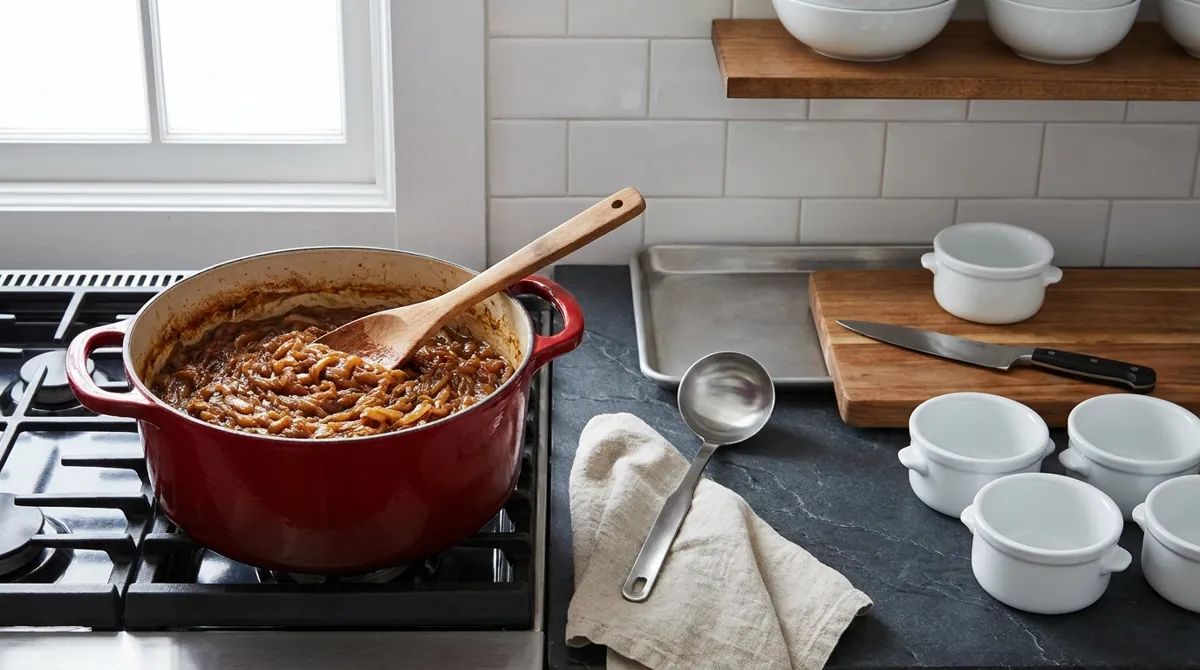
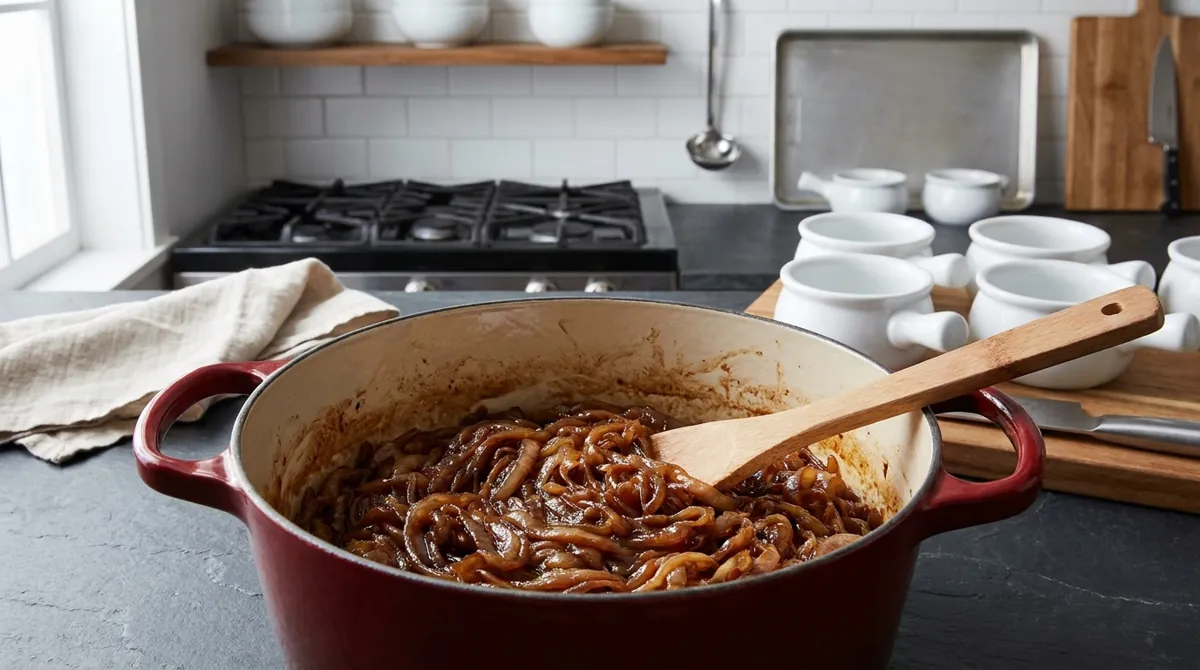
Uncover and cook 5 to 10 minutes, until the liquid has cooked off and brown bits form on the bottom of the pot. Turn the heat to medium and keep cooking 30 to 40 minutes, stirring and scraping up the brown bits every few minutes, until the onions are soft, jammy and a deep caramel brown. If they start to scorch, turn the heat down and add a splash of water.
✓ What it should look like - Step 3
Add the wine and scrape the bottom clean; cook about 1 minute, until almost gone. Add the broth, thyme, bay leaves, 1/2 tsp pepper and 1/2 tsp salt. Bring to a boil, then simmer uncovered on medium-low for 30 minutes.
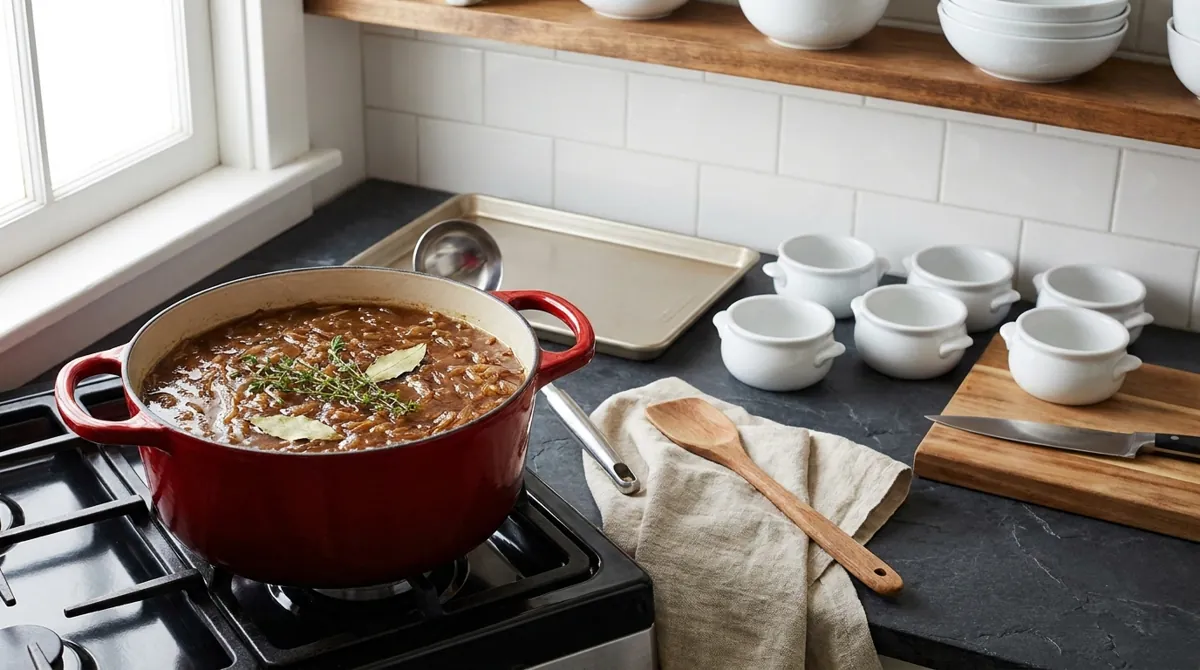
- Step 4
While it simmers, heat the oven to 350°F. Brush the baguette slices with the olive oil, season with the last 1/4 tsp salt and 1/4 tsp pepper and bake on a baking sheet 15 to 18 minutes, until crisp and golden. Raise the oven to 500°F.
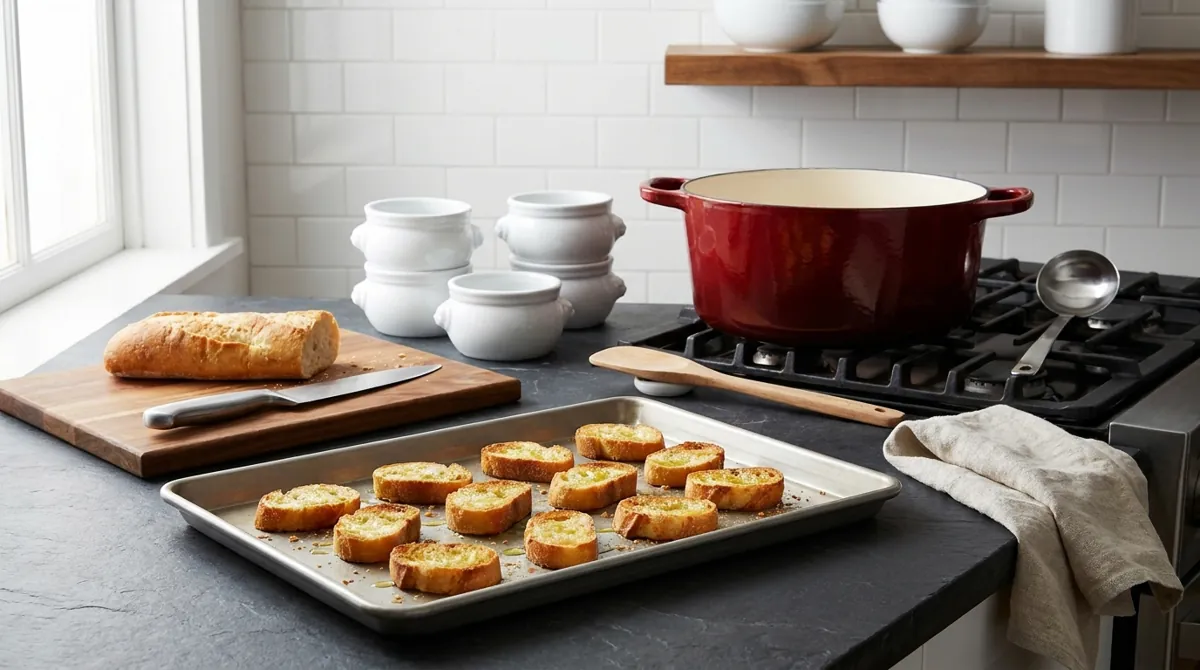
- Step 5
Fish out the thyme stems and bay leaves and taste for salt. Set six ovenproof crocks on a rimmed baking sheet and ladle about 1 1/2 cups soup into each. Sprinkle half the Gruyere over the soup, lay 2 toasts in each crock, and cover them with the rest of the Gruyere and the Parmesan, letting some hang over the edges. Bake 5 to 7 minutes (or broil 2 to 4 minutes), until the cheese is melted, bubbling and browned in spots.
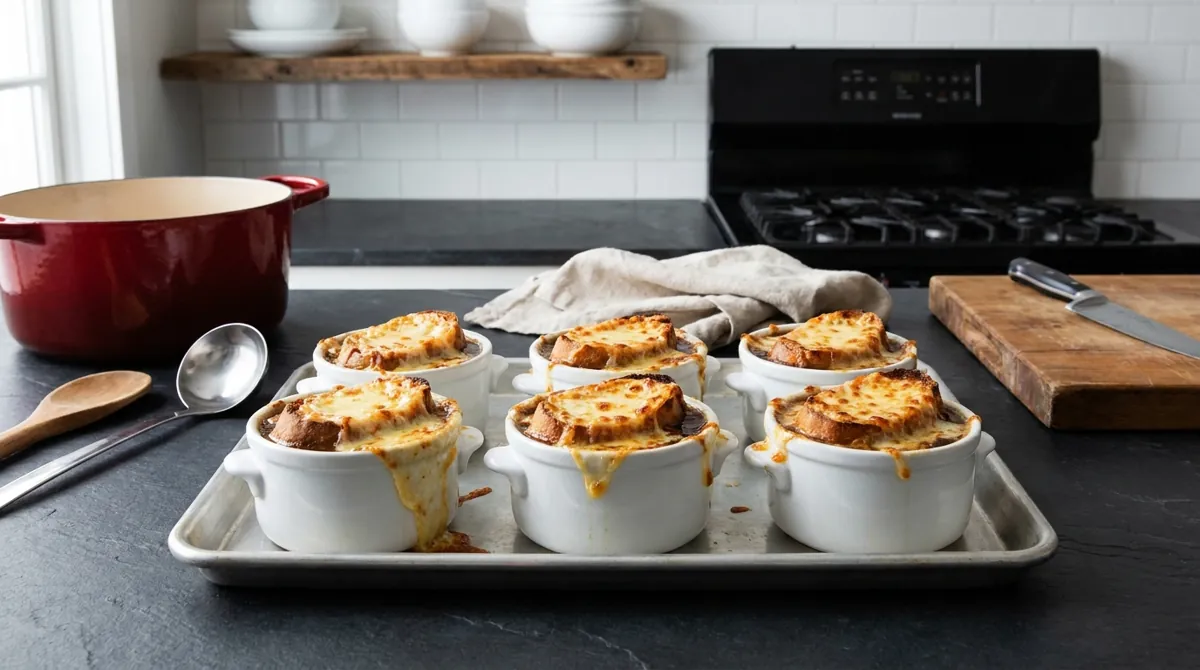
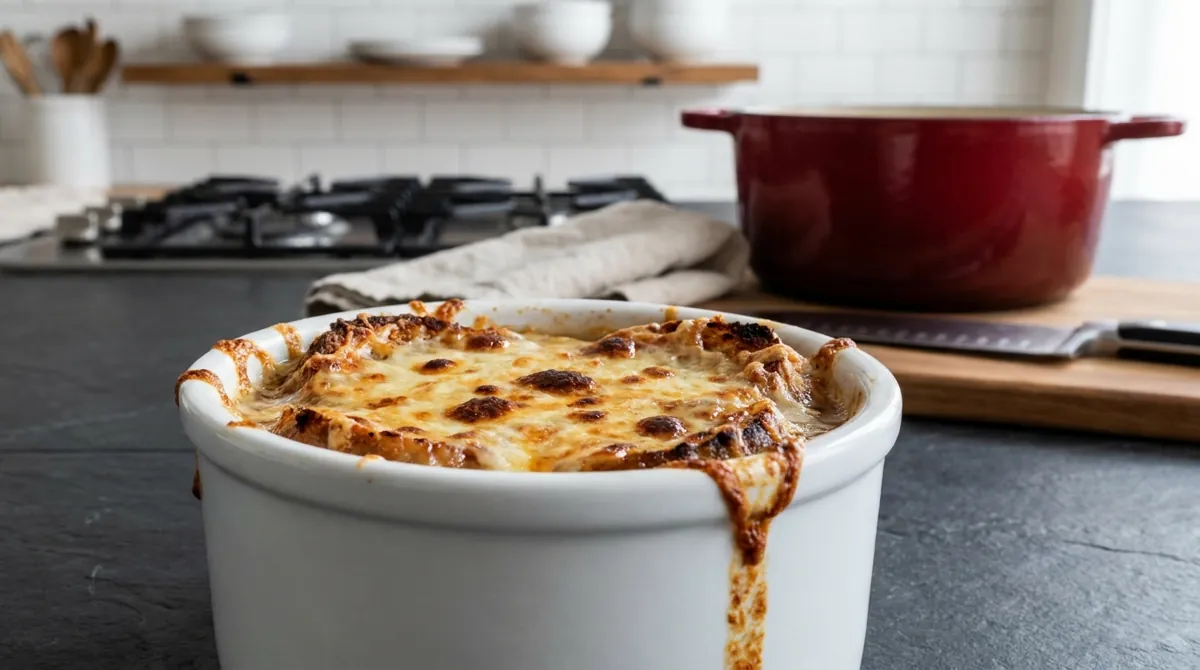
✓ What it should look like - Step 6
Let the crocks cool 5 minutes on the baking sheet before serving; they stay very hot.
French Onion Soup
Serves 6 · six 12 ounce ovenproof crocks · 2 hr 15 min total
Soup
- 4 tbsp unsalted butter (57 g)
- 4 lb yellow onions (1814 g), halved and thinly sliced pole to pole
- 1 3/4 tsp fine salt, divided
- 1 tsp granulated sugar (4 g)
- 1 cup dry white wine (236 g)
- 8 cups beef broth (1900 g)
- 4 sprigs fresh thyme
- 2 bay leaves
- 3/4 tsp black pepper, divided
Topping
- 12 slices baguette, about 1/2 inch thick (6 oz, 170 g)
- 2 tbsp olive oil (27 g)
- 8 oz Gruyere cheese, shredded (227 g, about 2 cups)
- 1 1/2 oz Parmesan cheese, finely grated (43 g, about 1/2 cup)
Equipment: Oven, Rimmed baking sheet, Dutch oven, Chef's knife and cutting board, Measuring cups and spoons, Ladle, Pastry brush
Method
- Melt the butter in a large Dutch oven over medium-high heat. Add the onions, 1 tsp salt and the sugar, stir to coat, cover and cook 20 minutes, stirring now and then, until the onions are wet, soft and translucent.
- Uncover and cook 5 to 10 minutes, until the liquid has cooked off and brown bits form on the bottom of the pot. Turn the heat to medium and keep cooking 30 to 40 minutes, stirring and scraping up the brown bits every few minutes, until the onions are soft, jammy and a deep caramel brown. If they start to scorch, turn the heat down and add a splash of water.
- Add the wine and scrape the bottom clean; cook about 1 minute, until almost gone. Add the broth, thyme, bay leaves, 1/2 tsp pepper and 1/2 tsp salt. Bring to a boil, then simmer uncovered on medium-low for 30 minutes.
- While it simmers, heat the oven to 350°F. Brush the baguette slices with the olive oil, season with the last 1/4 tsp salt and 1/4 tsp pepper and bake on a baking sheet 15 to 18 minutes, until crisp and golden. Raise the oven to 500°F.
- Fish out the thyme stems and bay leaves and taste for salt. Set six ovenproof crocks on a rimmed baking sheet and ladle about 1 1/2 cups soup into each. Sprinkle half the Gruyere over the soup, lay 2 toasts in each crock, and cover them with the rest of the Gruyere and the Parmesan, letting some hang over the edges. Bake 5 to 7 minutes (or broil 2 to 4 minutes), until the cheese is melted, bubbling and browned in spots.
- Let the crocks cool 5 minutes on the baking sheet before serving; they stay very hot.
Americanized house recipe, written for this site. History: Wikipedia, "French onion soup" (onion soups said to go back to Roman times, Le Menagier de Paris 1393 with ginger and saffron, La Varenne's two recipes, the Dumas 1873 Stanislas story and the Louis XV variant, the 1810s Diner de la soupe a l'oignon club, Les Halles, its porters and late-night cabaret crowds, La Poule au Pot, beef stock most common with chicken, veal or water and white wine, cider, Calvados or brandy as options, Henri Mouquin in New York in 1861, 1880s British "French onion soup" without cheese, Elizabeth David's 1960 verdict, Mastering the Art of French Cooking 1961 and beef stock, Waverley Root on Alsace). Technique: Cook's Country (America's Test Kitchen), "French Onion Soup" (4 lb onions with salt and sugar, covered 20 minutes then uncovered until caramel colored, scraping the fond, wine to deglaze, 8 cups beef broth, thyme and bay, a 30 minute simmer, toasted baguette, a layer of Gruyere under the bread to keep it from going soggy, Parmesan on top, 500°F oven or broiler). en.wikipedia.org. Ingredient list follows the source; the method is in our own words.
All sources (2)
Tips
- Cut the onions pole to pole, not across, so the slices hold their shape through the long cook.
- Make the soup a day ahead; it tastes better. Reheat it, then do the bread and cheese just before serving.
- No crocks? Pile the cheese on the toasts on a baking sheet, broil until bubbling and float them on bowls of hot soup.
- Swap the white wine for dry cider, add a splash of brandy or Calvados at the end, or use red wine as Cook's Country does.
The rules people argue about
What the sources agree on, what they don't, and what is just a good story.
- Louis XV (or his father-in-law Stanislas) brought it to Versailles. Folklore: the story rests on Alexandre Dumas in 1873, and the tellings do not agree on which king.
- Real French onion soup uses beef broth. Disputed: beef stock is the most common and Mastering the Art of French Cooking calls for it, but some cooks specify chicken or veal stock or plain water.
Meatballs of the World

Italian-American Meatballs
Big, tender meatballs braised for an hour in red sauce over spaghetti. The one most Americans grew up with.

Pallottine (Abruzzo Meatballs)
Tiny meatballs, smaller than a marble, tossed right through square spaghetti alla chitarra. No bread at all.

Swedish Meatballs (Köttbullar)
Small, soft meatballs browned in butter, in a cream sauce made from the same pan, with lingonberry jam on the plate.

Danish Frikadeller
Pork meatballs shaped with a spoon and fried slowly in butter, crusty outside and soft in the middle.

Königsberger Klopse
German meatballs that are never fried: poached, then served in a creamy white sauce with capers.

Spanish Albóndigas in Almond Saffron Sauce
The tapas bar classic: small meatballs in a golden sauce thickened with fried almonds and bread.

Mexican Albóndigas with Chipotle and Mint
Soft meatballs with rice and fresh mint inside, simmered in a smoky tomato and chipotle broth.

Izgara Köfte (Turkish Grilled Meatballs)
Small, flat meatballs kneaded hard, rested cold, and charred on a hot grill pan.

Lion's Head Meatballs
Big, soft pork meatballs, stirred into a sticky paste, fried to set, then braised in a savory sauce.

Chicken Tsukune
Japan's chicken meatball: kneaded sticky, grilled on skewers, glazed with sweet soy tare, dipped in egg yolk.