
Hummus
Canned chickpeas simmered soft with a pinch of baking soda, whipped for minutes in a food processor with garlic, lemon, plenty of tahini and ice water, then spread in a swirl under olive oil: the silky Levantine hummus bi tahina that went from a quarter of American refrigerators to a billion-dollar dip.
🍳Cook alongOne move at a time, with real timers
 Edited by JP Lambiase
Change the estimate
Swaps change the price only: cook any meat to its own safe temperature. Where these numbers come from
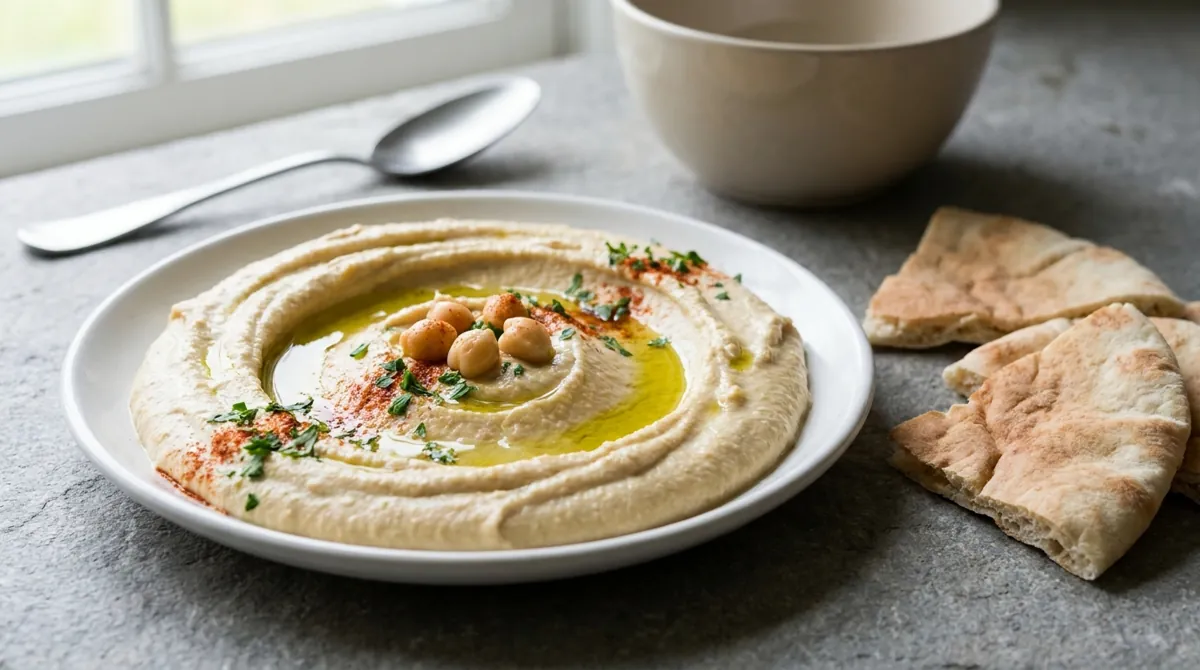
Hummus is Arabic for chickpeas, and the full name of the dish, hummus bi tahina, means chickpeas with tahini. Nobody can say who made it first. The earliest dish that looks like it is in a 13th-century cookbook attributed to Ibn al-Adim of Aleppo, Syria: chickpeas with lemon, sesame and olive oil, but no garlic. 14th-century Cairo cookbooks have a cold chickpea purée sharpened with vinegar and pickled lemons, without tahini or garlic. The food historian Nawal Nasrallah notes that no hummus recipes are recorded after the 14th century until an 1885 Lebanese cookbook, by which time garlic was standard. Wikipedia sums it up plainly: the evidence is insufficient to say exactly where or when hummus was invented. The historian Charles Perry, speaking to the BBC, called Damascus the more probable home, with Beirut his second choice.
That uncertainty became a fight. In 2008 the Association of Lebanese Industrialists asked the European Commission to protect hummus as a Lebanese food, and Lebanon and Israel traded the Guinness record for the largest plate of hummus between 2008 and 2010, ending with a Lebanese dish of about 10,450 kg made near Beirut by some 300 cooks. Meanwhile America adopted it: hummus was in 12% of US households in 2006 and about 25% by 2016, when Sabra held 62% of US hummus sales.
This is a home version in the modern Levantine style: very soft chickpeas, a lot of tahini and a long blend, so it comes out whipped, not pasty.
Why it works the kitchen science
Baking soda
Raising the pH of the cooking water loosens the skins and softens the chickpeas further, so they purée smooth instead of grainy.
Very soft, peeled chickpeas
The skins are what make hummus gritty; removing even some of them makes it noticeably silkier.
A long blend with ice water
Minutes, not seconds, in the processor, and cold water whips the tahini into a light, airy emulsion.
Garlic resting in lemon and salt
A short soak takes the harsh edge off raw garlic.
🧰 You'll need 6 items
Everything the steps call for. Tick off what you have before you start.
Appliances
Pans and pots
Tools
Step by step
- Step 1
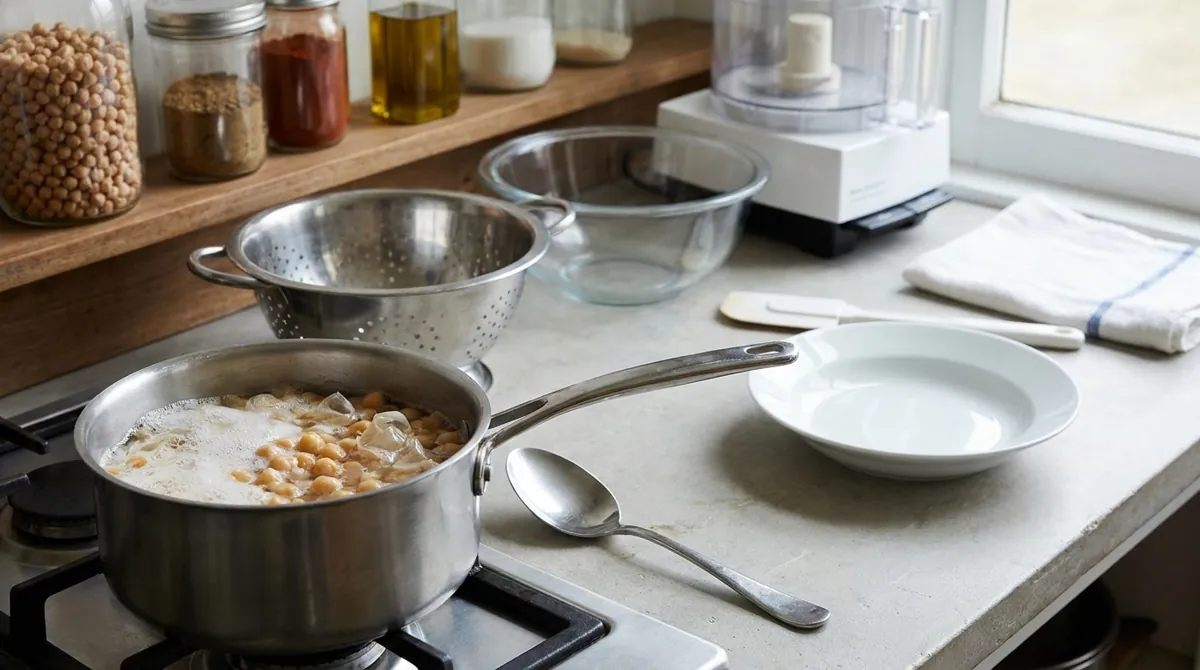
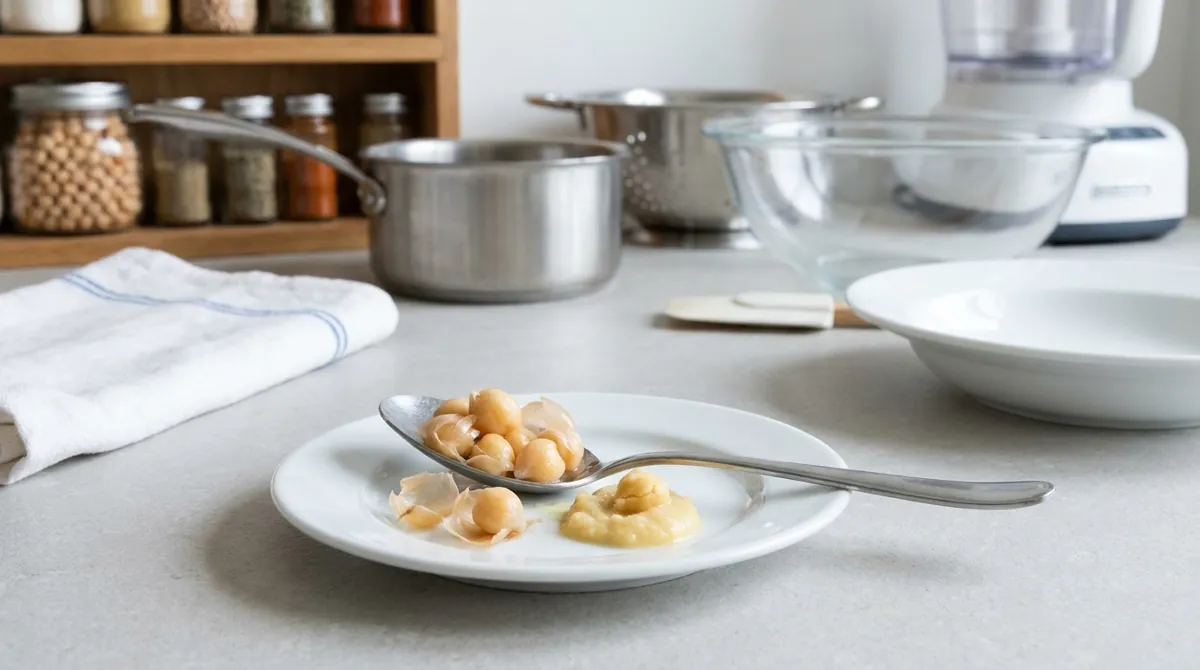
Put the chickpeas and baking soda in a medium saucepan, cover with water by 2 inches and bring to a boil. Simmer 20 minutes, skimming off the foam, until the chickpeas are very soft, crush with no resistance and many skins have floated free.
✓ What it should look like - Step 2
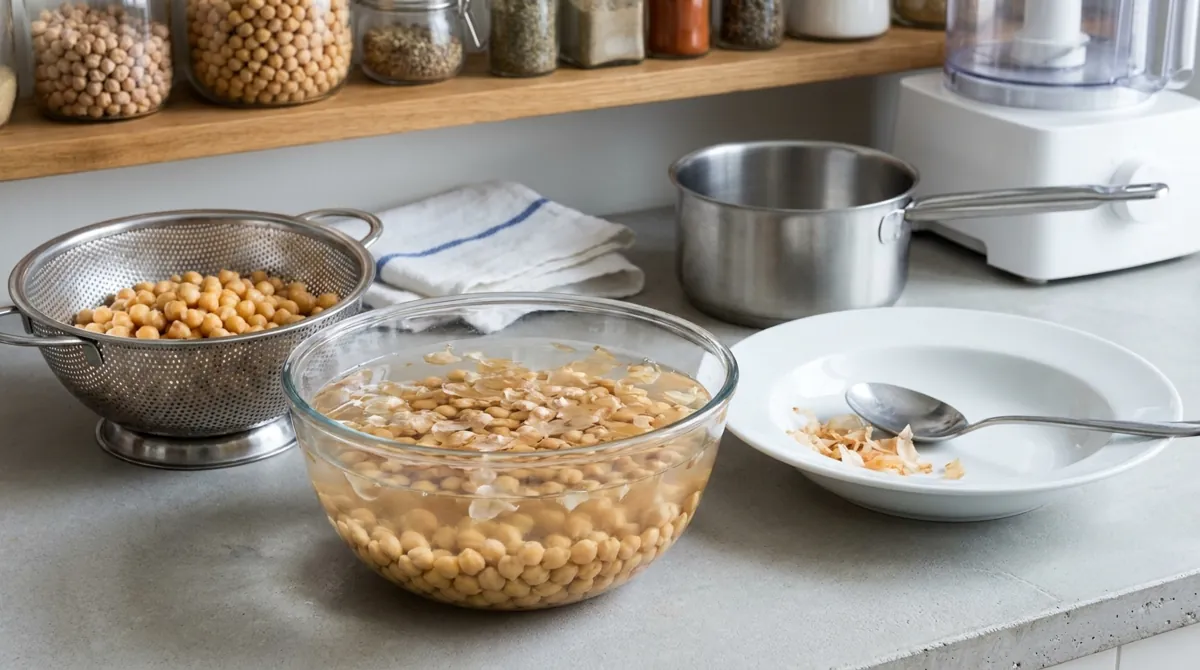
Drain in a colander, run cold water over them and rub them gently between your palms in a bowl of cold water; skim off the skins that float up. Set aside 2 tablespoons of whole chickpeas for the top.
- Step 3
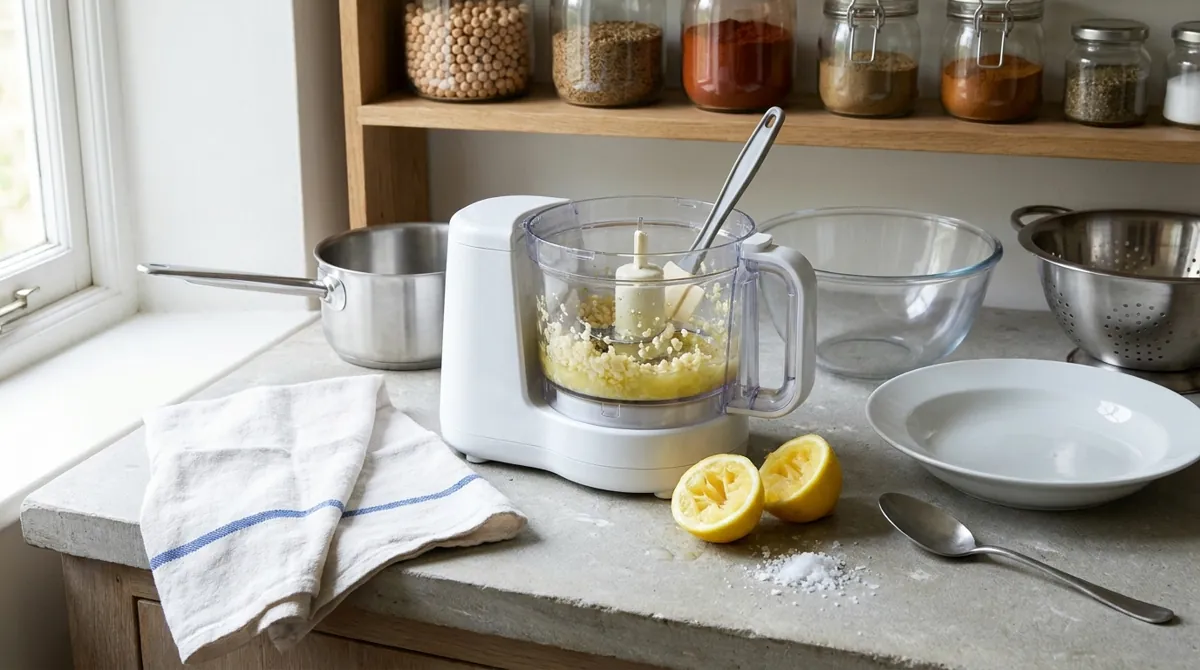
Blend the garlic, lemon juice and salt in the food processor until the garlic is finely chopped, then let it stand 10 minutes.
- Step 4
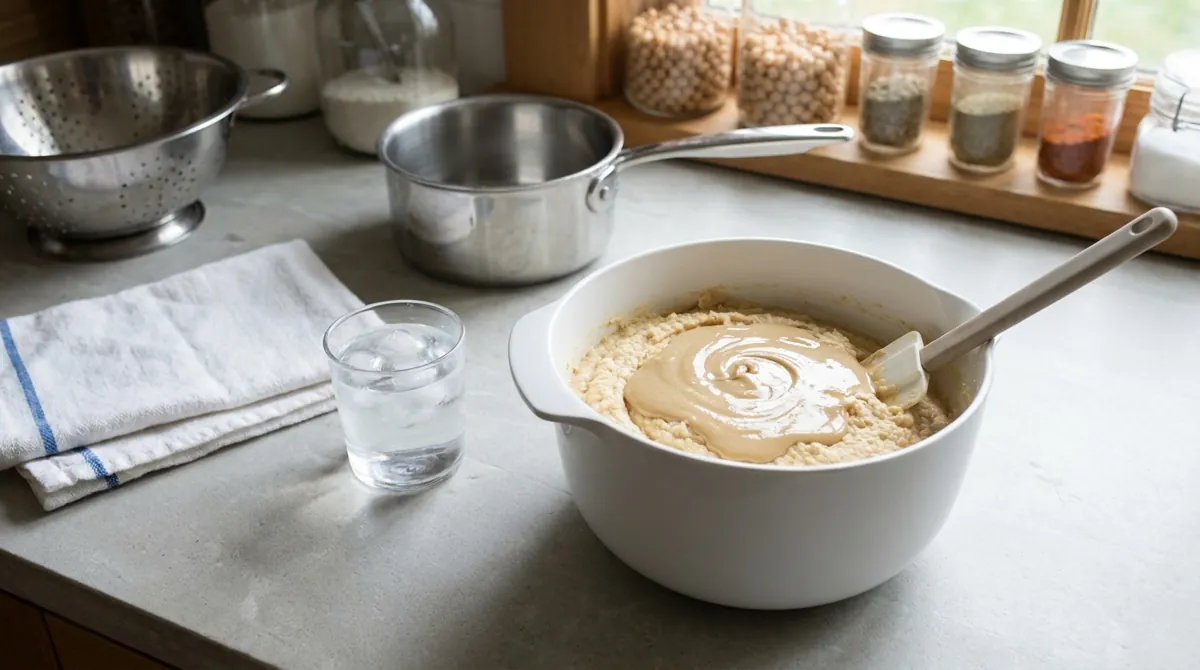
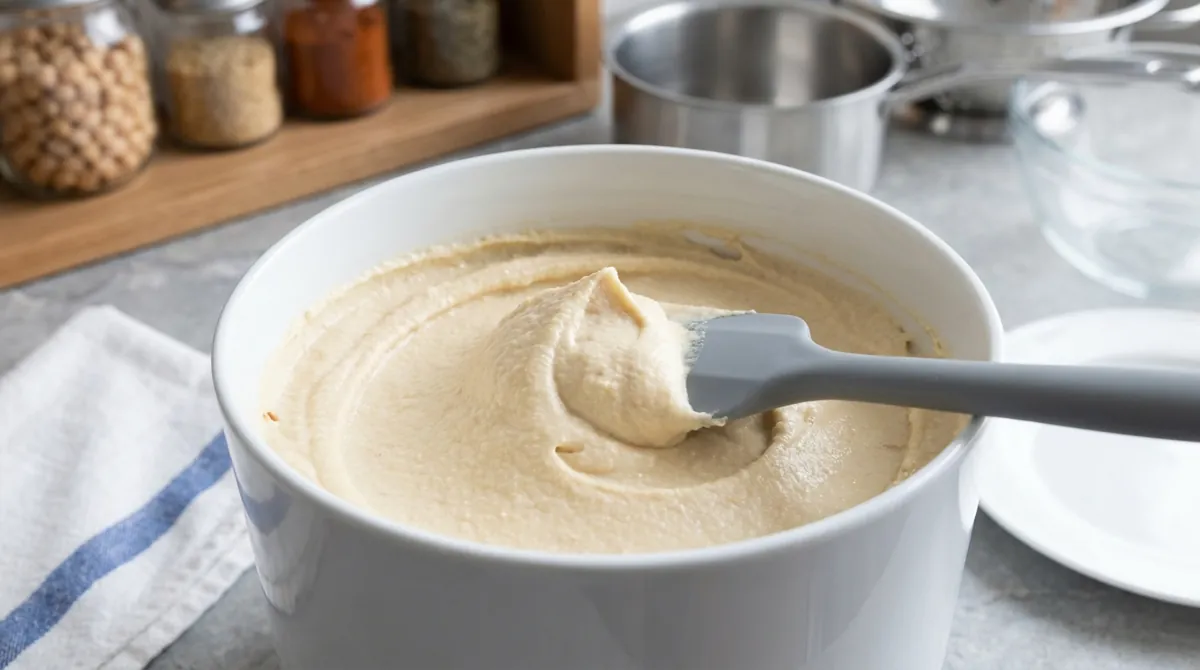
Add the chickpeas and process 2 minutes, scraping down once. Add the tahini and cumin and process 1 minute, then pour in the ice water with the motor running and keep blending 2 to 3 minutes more, until the hummus is pale, very smooth and fluffy. If it is stiff, add more ice water a tablespoon at a time.
✓ What it should look like - Step 5
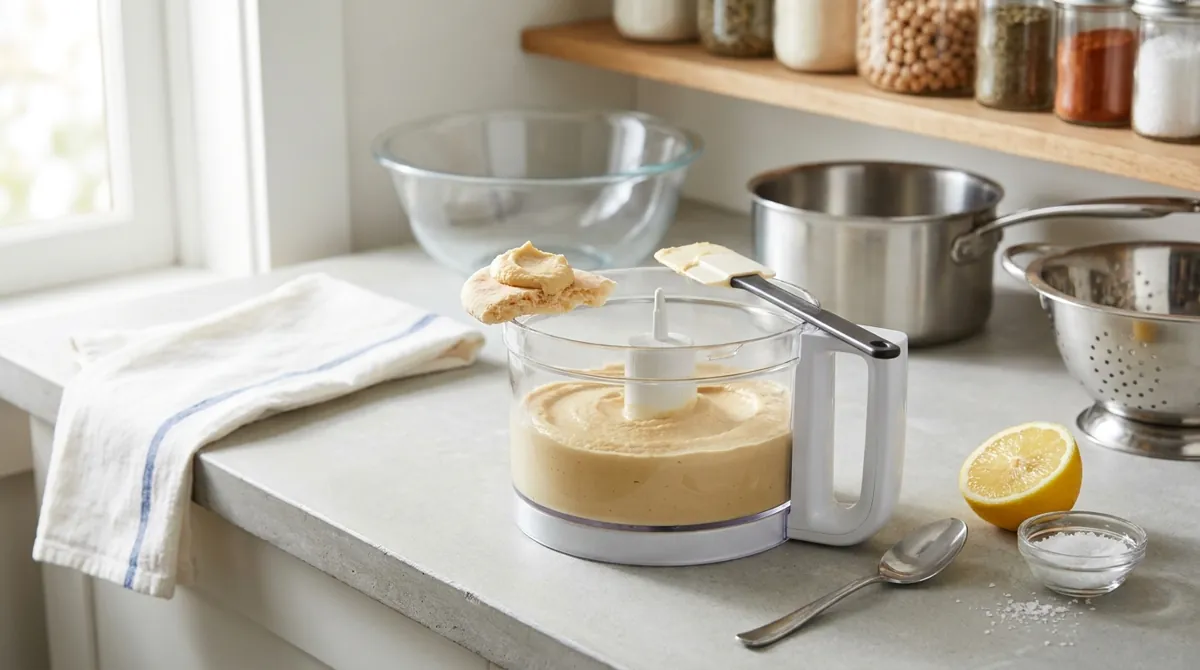
Taste on a piece of pita and adjust with more salt or lemon.
- Step 6
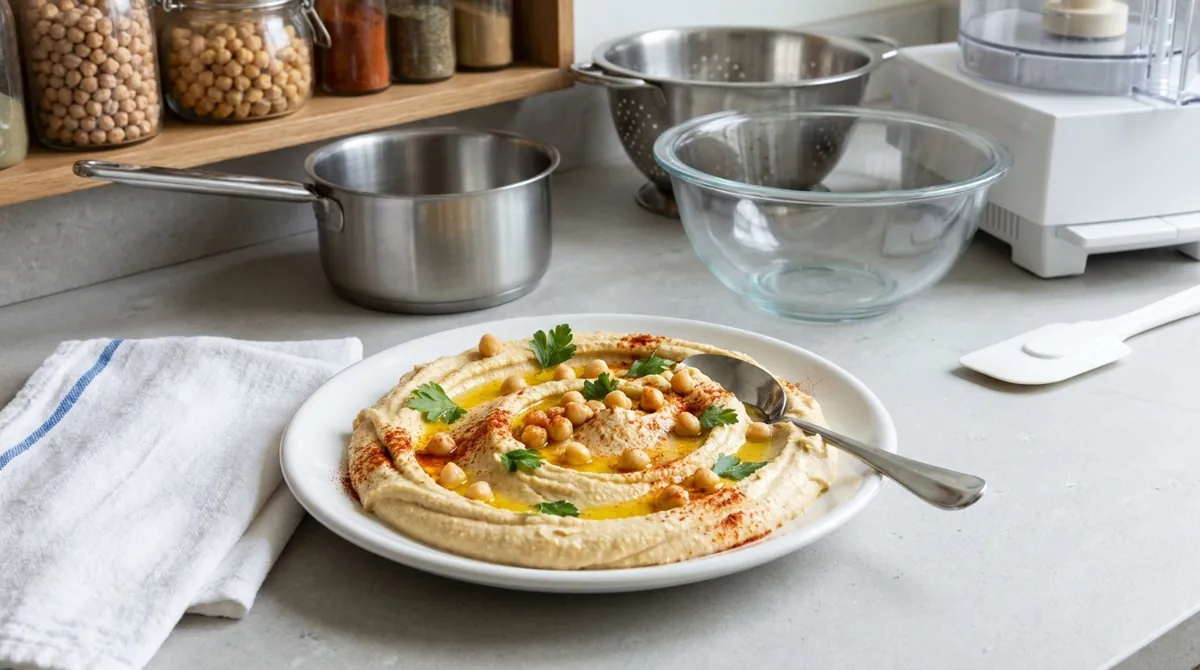
Spread it on a wide shallow plate, make a swirl with the back of a spoon, fill the groove with olive oil, and finish with the reserved chickpeas, paprika and parsley. Serve with warm pita.
Hummus
Serves 6 as a dip · about 3 cups · 45 min total
Chickpeas
- 2 cans (15 oz each) chickpeas, drained and rinsed (about 480 g drained)
- 1/2 tsp baking soda
Hummus
- 2 garlic cloves, peeled (8 g)
- 1/4 cup fresh lemon juice (60 g), from about 2 lemons, plus more to taste
- 1 tsp kosher salt, plus more to taste
- 1/2 cup well-stirred tahini (120 g)
- 1/2 tsp ground cumin, optional
- 1/4 cup ice water (60 g), plus more as needed
To serve
- 2 tbsp extra-virgin olive oil (27 g)
- 1 tsp sweet paprika or sumac (2 g)
- 1 tbsp chopped fresh parsley (4 g)
- Warm pita
Equipment: Food processor, Medium saucepan, Chef's knife and cutting board, Measuring cups and spoons, Mixing bowls, Colander
Method
- Put the chickpeas and baking soda in a medium saucepan, cover with water by 2 inches and bring to a boil. Simmer 20 minutes, skimming off the foam, until the chickpeas are very soft, crush with no resistance and many skins have floated free.
- Drain in a colander, run cold water over them and rub them gently between your palms in a bowl of cold water; skim off the skins that float up. Set aside 2 tablespoons of whole chickpeas for the top.
- Blend the garlic, lemon juice and salt in the food processor until the garlic is finely chopped, then let it stand 10 minutes.
- Add the chickpeas and process 2 minutes, scraping down once. Add the tahini and cumin and process 1 minute, then pour in the ice water with the motor running and keep blending 2 to 3 minutes more, until the hummus is pale, very smooth and fluffy. If it is stiff, add more ice water a tablespoon at a time.
- Taste on a piece of pita and adjust with more salt or lemon.
- Spread it on a wide shallow plate, make a swirl with the back of a spoon, fill the groove with olive oil, and finish with the reserved chickpeas, paprika and parsley. Serve with warm pita.
Americanized house recipe, written for this site. History: Wikipedia, "Hummus" (hummus bi tahina, the 13th-century Ibn al-Adim recipe from Syria without garlic, the 14th-century Cairo purée with vinegar and pickled lemon, al-Baghdadi's hummus kasa, Nawal Nasrallah on the gap until an 1885 Lebanese cookbook, "evidence is insufficient", the 2008 Lebanese industrialists' EU request, the Guinness records of 2008 to 2010, US household figures and Sabra's 62% share in 2016); Mashed, "The Untold Truth Of Hummus", summarizing BBC Travel (Charles Perry on Damascus and Beirut, the Hebrew Bible claim, "claimed by all and owned by none"), original at bbc.com (not read directly). Technique: Reem Assil's hummus for Sunset (baking soda with dried chickpeas, peeling the skins, blending 5 minutes with ice water before drizzling in tahini, an airy texture that holds peaks). Baking soda with canned chickpeas is common practice in modern recipes. en.wikipedia.org. Ingredient list follows the source; the method is in our own words.
All sources (4)
Tips
- Use good, runny tahini and stir the jar well; tahini that is stiff or bitter makes stiff, bitter hummus.
- Starting from dried chickpeas: soak 3/4 lb (340 g) overnight and simmer with the baking soda until very soft, 30 to 60 minutes.
- Covered, it keeps 3 to 4 days in the refrigerator. Let it sit out 15 minutes and stir before serving.
- For a meal, top it with spiced browned ground lamb or beef and toasted pine nuts.
The rules people argue about
What the sources agree on, what they don't, and what is just a good story.
- Hummus comes from one country. Disputed: the oldest similar recipes are from Syria and Egypt, Charles Perry favors Damascus then Beirut, and Lebanon, Israel and Palestine all claim it. Wikipedia says the evidence cannot settle it.
- You must peel the chickpeas. Disputed: Reem Assil rubs off the skins for every batch; many cooks rely on baking soda and a long blend instead. Peeling helps, but it is not required.
- Canned chickpeas are cheating. Disputed: dried, soaked and well cooked chickpeas taste better to many cooks, but soft-cooked canned ones make very good hummus.
Meatballs of the World

Italian-American Meatballs
Big, tender meatballs braised for an hour in red sauce over spaghetti. The one most Americans grew up with.

Pallottine (Abruzzo Meatballs)
Tiny meatballs, smaller than a marble, tossed right through square spaghetti alla chitarra. No bread at all.

Swedish Meatballs (Köttbullar)
Small, soft meatballs browned in butter, in a cream sauce made from the same pan, with lingonberry jam on the plate.

Danish Frikadeller
Pork meatballs shaped with a spoon and fried slowly in butter, crusty outside and soft in the middle.

Königsberger Klopse
German meatballs that are never fried: poached, then served in a creamy white sauce with capers.

Spanish Albóndigas in Almond Saffron Sauce
The tapas bar classic: small meatballs in a golden sauce thickened with fried almonds and bread.

Mexican Albóndigas with Chipotle and Mint
Soft meatballs with rice and fresh mint inside, simmered in a smoky tomato and chipotle broth.

Izgara Köfte (Turkish Grilled Meatballs)
Small, flat meatballs kneaded hard, rested cold, and charred on a hot grill pan.

Lion's Head Meatballs
Big, soft pork meatballs, stirred into a sticky paste, fried to set, then braised in a savory sauce.

Chicken Tsukune
Japan's chicken meatball: kneaded sticky, grilled on skewers, glazed with sweet soy tare, dipped in egg yolk.