
Hush Puppies
Golden fried cornmeal balls with a crisp shell and a tender, onion-flecked center: the Southern fish fry side dish.
🍳Cook alongOne move at a time, with real timers
 Edited by JP Lambiase
Change the estimate
Swaps change the price only: cook any meat to its own safe temperature. Where these numbers come from
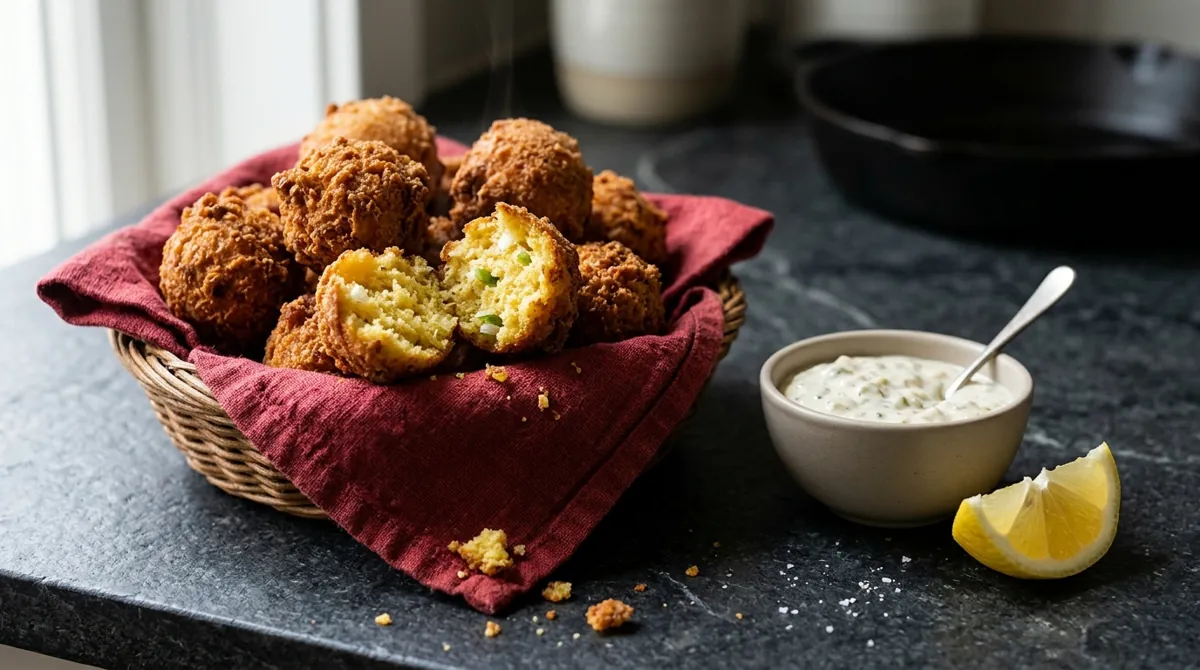
Hush puppies are small spoonfuls of cornmeal batter fried in hot oil, the traditional partner to fried catfish and other fish at Southern fish fries. Wikipedia traces the documented origin to Romeo Govan (about 1845 to 1915), a Black caterer and cook born into slavery in South Carolina, who ran a popular fish-fry spot near Bamberg in the 1870s and sold "Red Horse Bread", a cornmeal batter fried in lard beside river fish. An 1903 Augusta Chronicle profile credited him with creating and popularizing it.
The name's first recorded use dates to 1899, and its origin is not known. The famous story says cooks tossed fried batter scraps to barking dogs to "hush the puppies"; Wikipedia presents it as folklore. By the 1920s and 1930s fish fries across Georgia and Florida were serving "hushpuppies", and standard recipes followed.
Why it works the kitchen science
Cornmeal plus a little flour
Cornmeal gives the flavor and crunch; the flour keeps the center tender instead of gritty.
Baking powder and baking soda with buttermilk
They puff the balls so they are light inside, with a tang that balances the fry.
Grated onion
It melts into the batter, adding moisture and flavor all through instead of chunks.
Oil at 350 to 375°f
Hot enough to crisp the outside before the oil soaks in; too cool and they turn greasy.
Frying in small batches
Too many at once drops the oil temperature.
🧰 You'll need 8 items
Everything the steps call for. Tick off what you have before you start.
Pans and pots
Tools
Supplies
Step by step
- Step 1
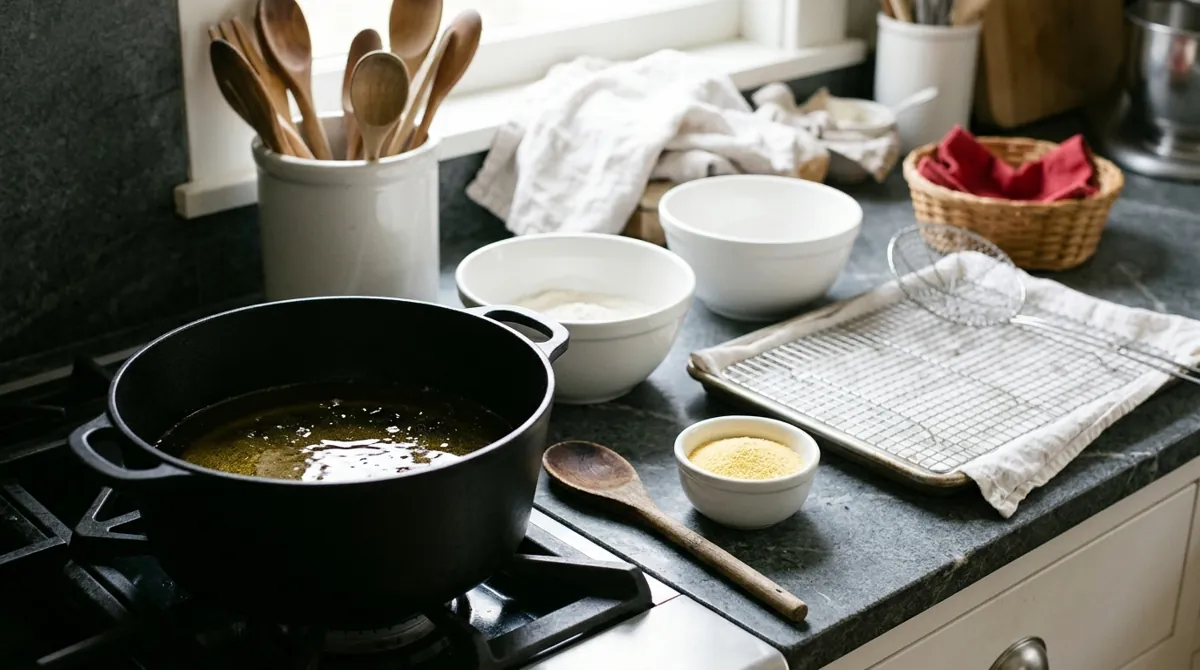
Pour 2 inches of oil into a heavy Dutch oven and heat it over medium heat to 350 to 375°F, clipping a thermometer to the side.
- Step 2
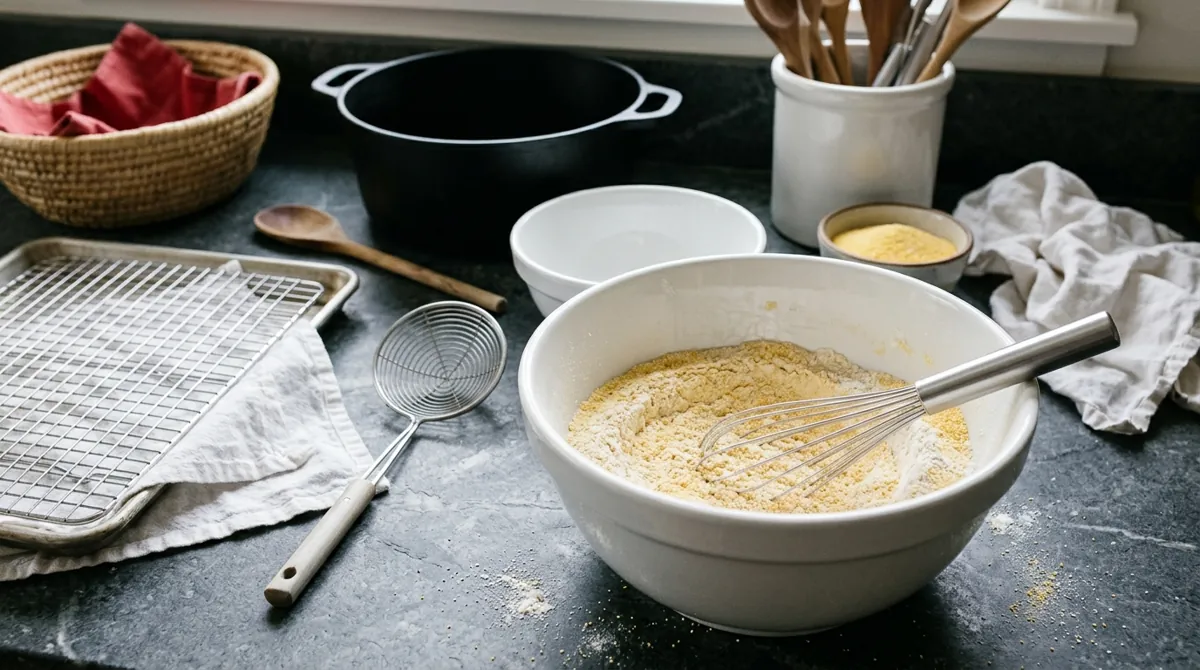
Whisk the cornmeal, flour, sugar, baking powder, baking soda and salt in a large bowl.
- Step 3
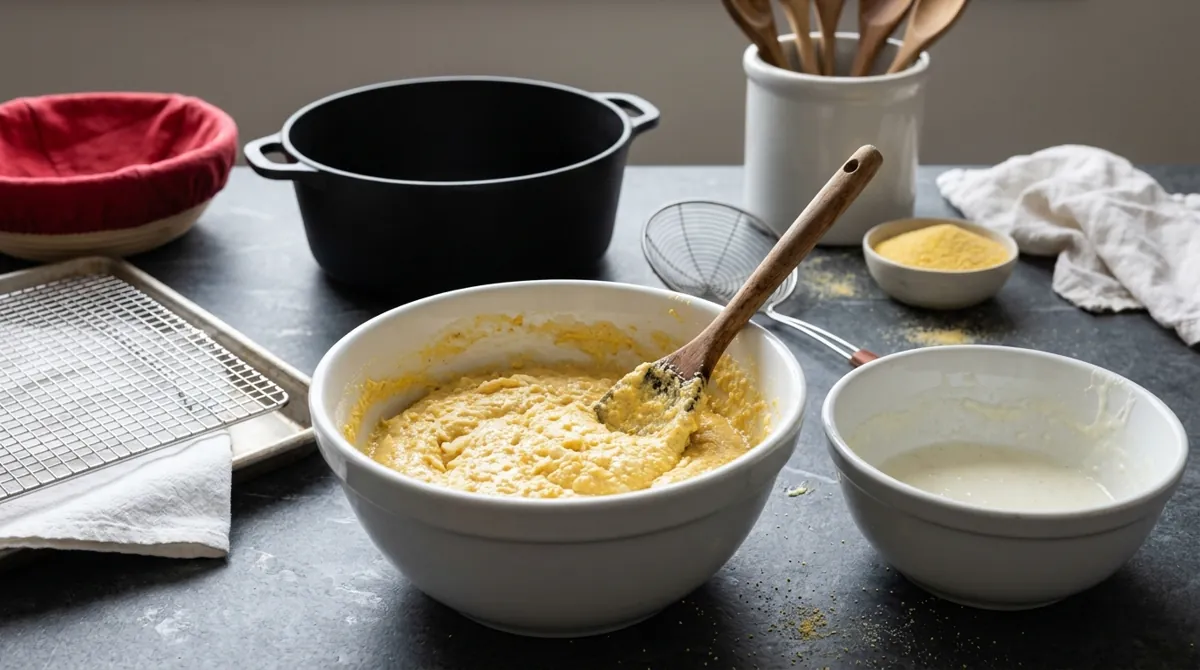
Whisk the egg and buttermilk in a second bowl, add the grated onion, then mix the wet into the dry just until combined. The batter should be thick and scoopable. Rest 5 minutes. Check that it falls in a thick mound from a spoon, not a runny stream.
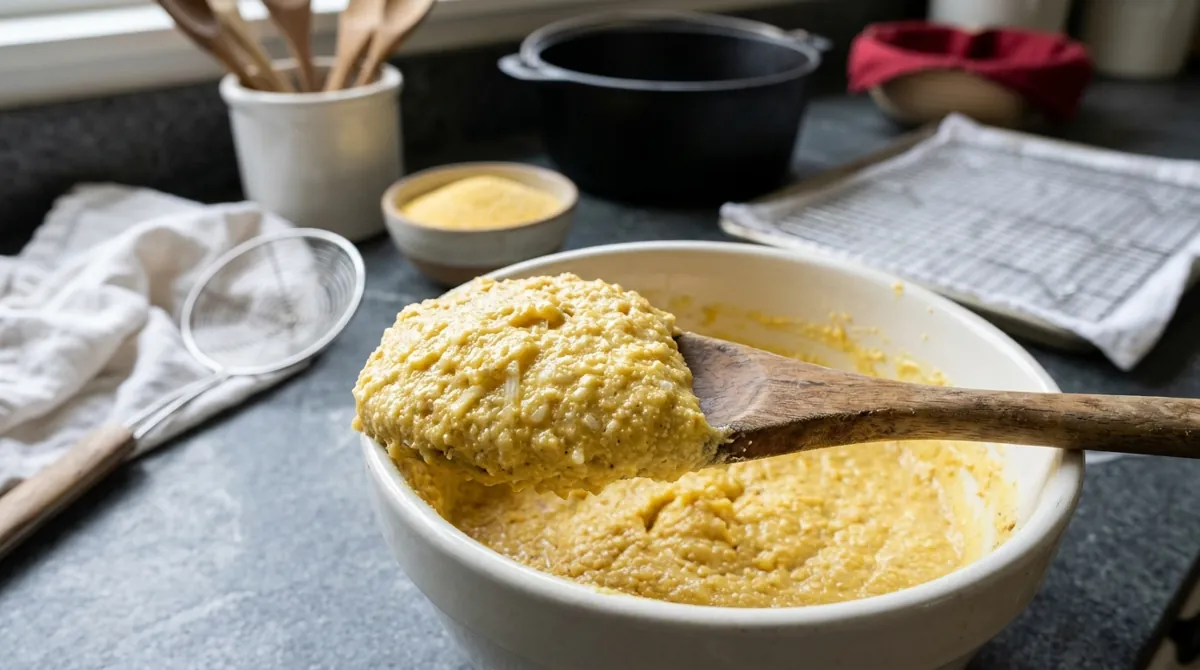
✓ What it should look like - Step 4
Drop rounded tablespoons of batter into the hot oil, 5 or 6 at a time. Fry 2 to 3 minutes, turning once, until deep golden brown all over and cooked through, and keep the oil near 350°F.
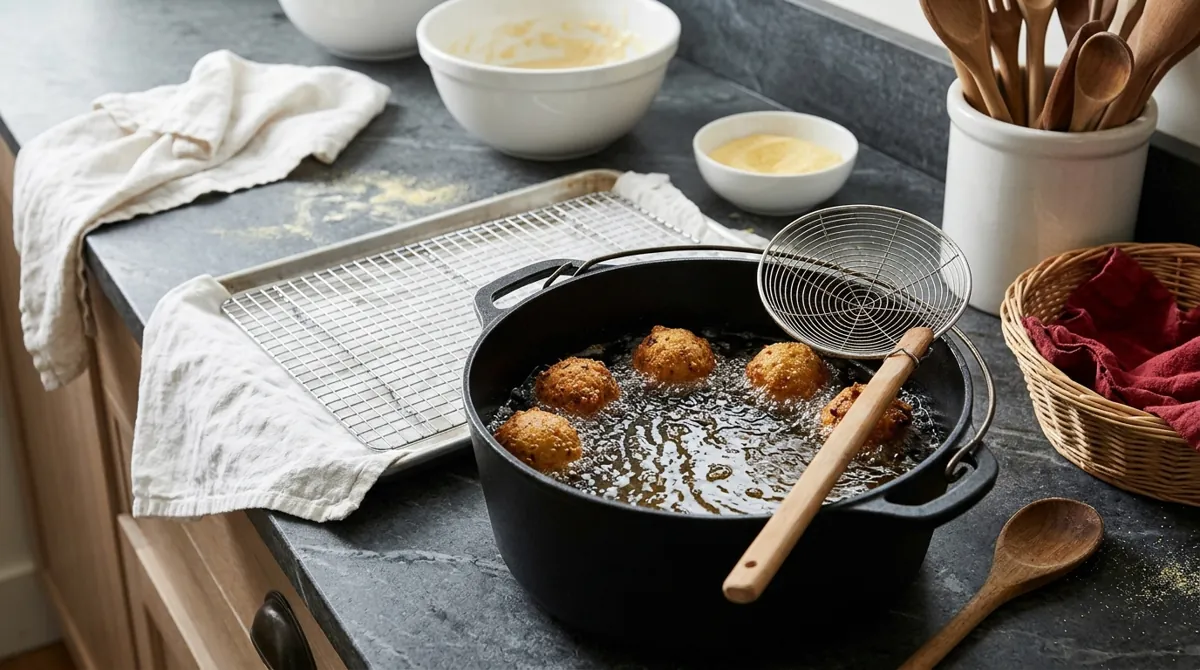
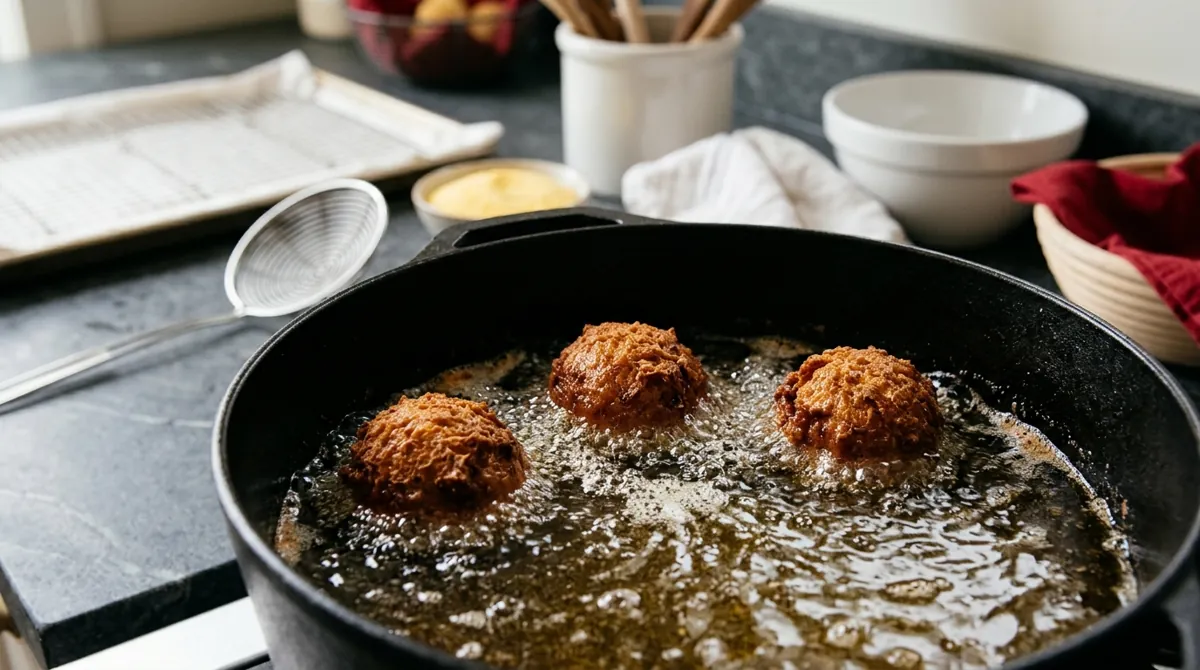
✓ What it should look like - Step 5
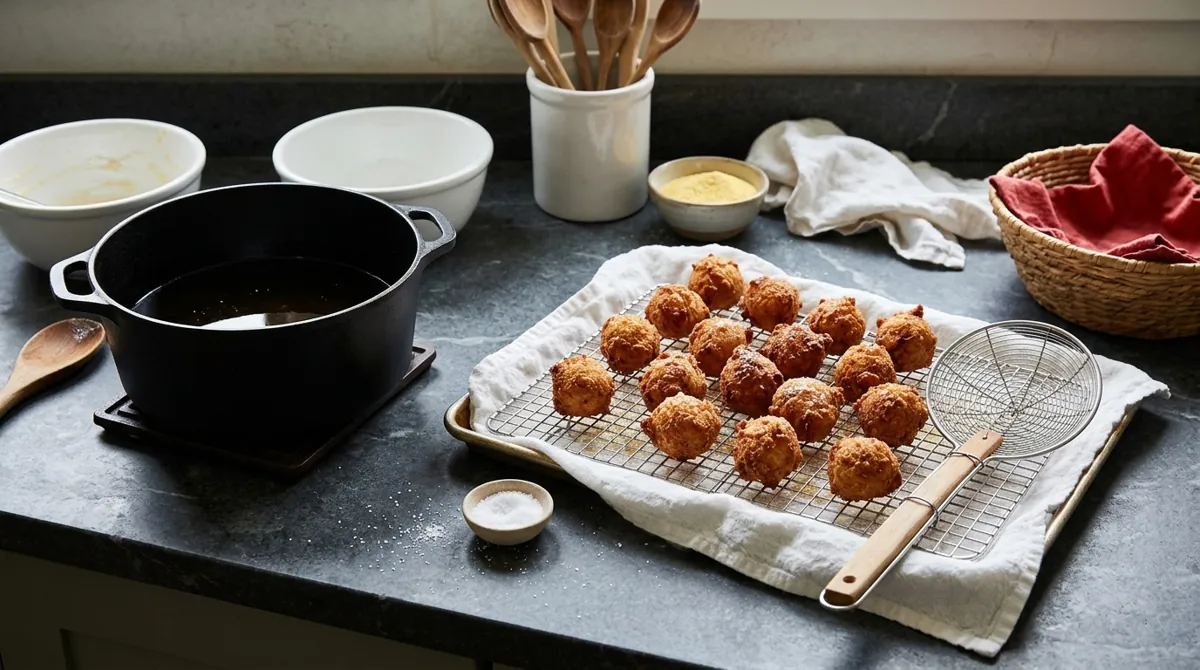
Move the hush puppies to a wire rack set over paper towels, and sprinkle with salt right away.
- Step 6
Serve hot, while the shells are still crisp.
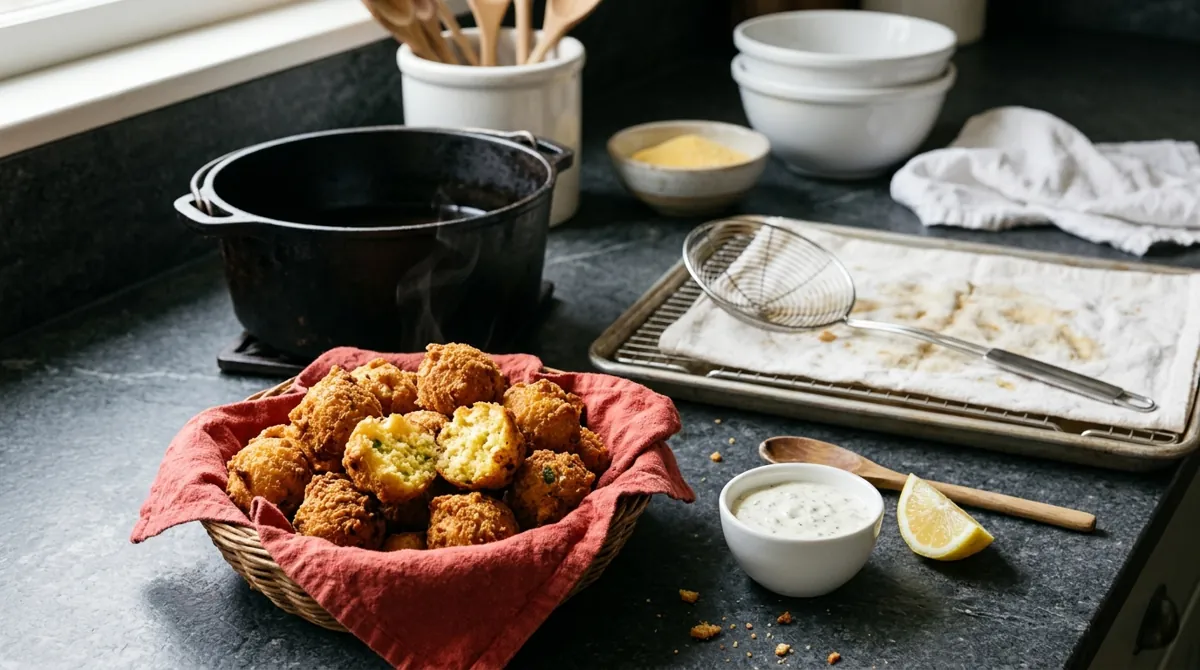
Hush Puppies
Serves 6 · about 18 hush puppies · 35 min total
Dry
- 1 cup yellow cornmeal (140 g)
- 1/2 cup all-purpose flour (65 g)
- 1 tbsp granulated sugar (12 g)
- 1 1/2 tsp baking powder
- 1/2 tsp baking soda
- 1/2 tsp fine salt
Wet
- 1 large egg (50 g)
- 3/4 cup buttermilk (183 g)
- 1/4 cup grated yellow onion (40 g)
For frying
- About 2 quarts peanut or vegetable oil (enough for 2 inches in a Dutch oven)
- Fine salt, for sprinkling
Equipment: Wire rack, Dutch oven, Instant-read thermometer, Deep-fry or candy thermometer, Measuring cups and spoons, Mixing bowls, Whisk, Paper towels
Method
- Pour 2 inches of oil into a heavy Dutch oven and heat it over medium heat to 350 to 375°F, clipping a thermometer to the side.
- Whisk the cornmeal, flour, sugar, baking powder, baking soda and salt in a large bowl.
- Whisk the egg and buttermilk in a second bowl, add the grated onion, then mix the wet into the dry just until combined. The batter should be thick and scoopable. Rest 5 minutes. Check that it falls in a thick mound from a spoon, not a runny stream.
- Drop rounded tablespoons of batter into the hot oil, 5 or 6 at a time. Fry 2 to 3 minutes, turning once, until deep golden brown all over and cooked through, and keep the oil near 350°F.
- Move the hush puppies to a wire rack set over paper towels, and sprinkle with salt right away.
- Serve hot, while the shells are still crisp.
Americanized house recipe, written for this site, within the common ratios of Southern recipes (about 1 cup cornmeal to 3/4 cup buttermilk, a small grated onion, 350 to 375°F oil, 2 to 3 minutes a batch), as compared across Once Upon a Chef, and Martha White. History: Wikipedia, "Hushpuppy" (Romeo Govan, Red Horse Bread, the 1899 first use, the dog folklore). onceuponachef.com. Ingredient list follows the source; the method is in our own words.
All sources (3)
Tips
- Test the oil with a drop of batter: it should sizzle and float right away.
- Salt the moment they come out; it sticks to the hot oil.
- Add a handful of corn kernels, minced jalapeno or chopped scallions to the batter if you like.
- No buttermilk? Use 3/4 cup milk with 2 teaspoons of lemon juice, rested 5 minutes.
- They are best within 20 minutes. Reheat leftovers in a 400°F oven to re-crisp.
The rules people argue about
What the sources agree on, what they don't, and what is just a good story.
- Hush puppies were invented to quiet dogs. Folklore: the story is told widely, but the first printed use of the name dates only to 1899 and the origin is unverified.
- Romeo Govan invented them. Disputed: he is the best-documented early source, with an 1903 newspaper profile, but it credits his "Red Horse Bread" and the cornmeal fry is likely older.
- Only cornmeal, no flour. Disputed: some cooks use cornmeal, egg and water; others add flour for tenderness. Too much cornmeal turns them gritty and heavy.
Meatballs of the World

Italian-American Meatballs
Big, tender meatballs braised for an hour in red sauce over spaghetti. The one most Americans grew up with.

Pallottine (Abruzzo Meatballs)
Tiny meatballs, smaller than a marble, tossed right through square spaghetti alla chitarra. No bread at all.

Swedish Meatballs (Köttbullar)
Small, soft meatballs browned in butter, in a cream sauce made from the same pan, with lingonberry jam on the plate.

Danish Frikadeller
Pork meatballs shaped with a spoon and fried slowly in butter, crusty outside and soft in the middle.

Königsberger Klopse
German meatballs that are never fried: poached, then served in a creamy white sauce with capers.

Spanish Albóndigas in Almond Saffron Sauce
The tapas bar classic: small meatballs in a golden sauce thickened with fried almonds and bread.

Mexican Albóndigas with Chipotle and Mint
Soft meatballs with rice and fresh mint inside, simmered in a smoky tomato and chipotle broth.

Izgara Köfte (Turkish Grilled Meatballs)
Small, flat meatballs kneaded hard, rested cold, and charred on a hot grill pan.

Lion's Head Meatballs
Big, soft pork meatballs, stirred into a sticky paste, fried to set, then braised in a savory sauce.

Chicken Tsukune
Japan's chicken meatball: kneaded sticky, grilled on skewers, glazed with sweet soy tare, dipped in egg yolk.