
Okonomiyaki
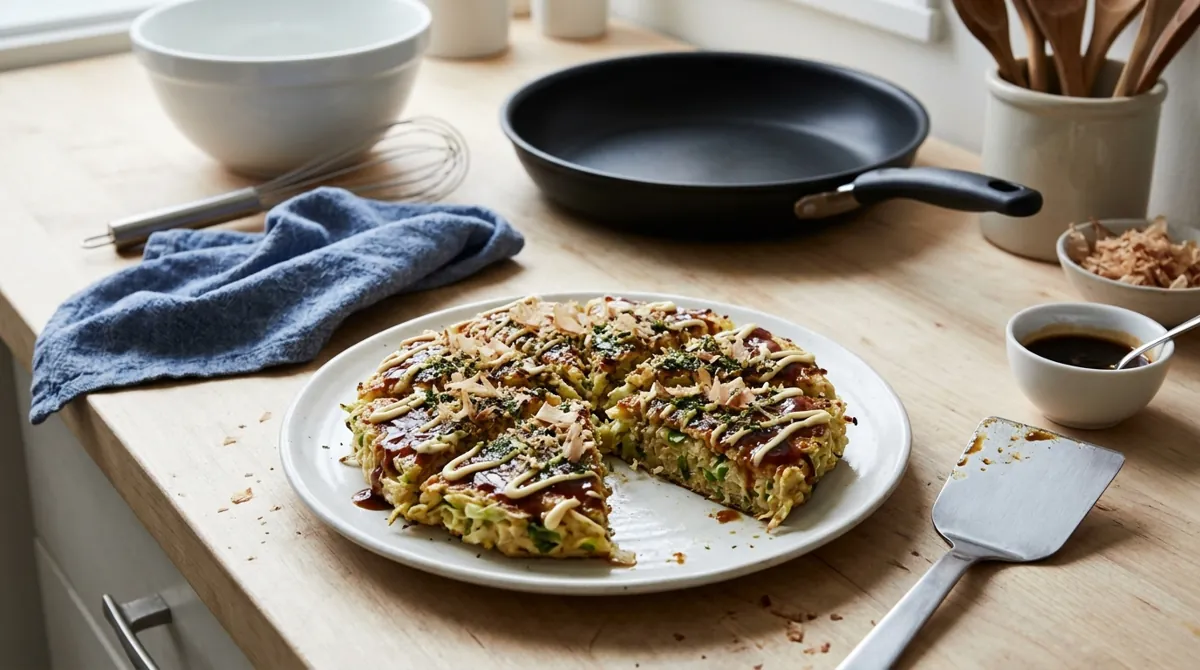
A thick, savory pancake packed with shredded cabbage and crispy pork belly, then striped with sweet-tangy sauce, mayonnaise, seaweed and dancing bonito flakes.
🍳Cook alongOne move at a time, with real timers
 Edited by JP Lambiase
Change the estimate
Swaps change the price only: cook any meat to its own safe temperature. Where these numbers come from
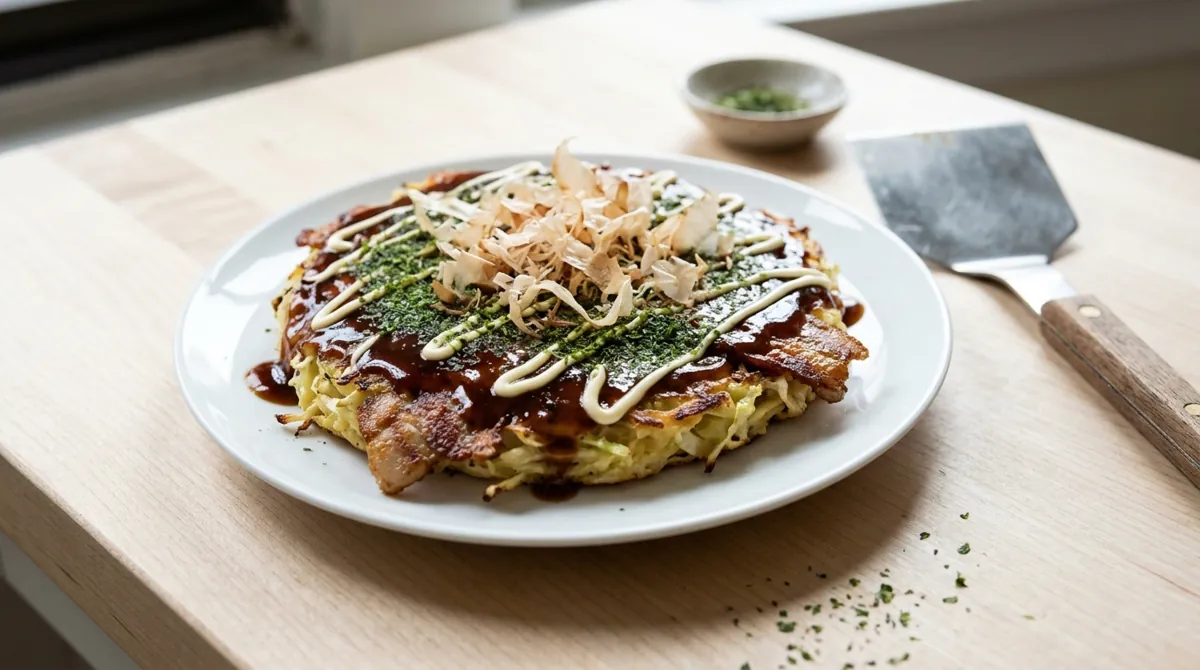
Okonomiyaki means roughly "grilled as you like it," and the dish has two famous regional versions. In Osaka and the Kansai region, the batter, cabbage and fillings are mixed together and pan-fried on both sides. In Hiroshima, the ingredients are layered on the griddle instead, with about three to four times as much cabbage, usually with yakisoba or udon noodles in the middle. Which city is "the home" of okonomiyaki is a friendly argument, not a settled fact.
The ancestors are thin batter cakes. A sweet crepe called funoyaki is recorded in the 16th century, and monjayaki, a runnier batter drawn on a griddle, was a children's snack in the Meiji era (1868 to 1912). A savory form with Worcestershire sauce and scallion may have appeared in Kyoto in the Taisho period (1912 to 1926). The word "okonomiyaki" itself first appears at an Osaka shop in the 1930s. After World War II, when rice was scarce, the cheap, filling, cabbage-heavy pancake boomed, and in Hiroshima, vendors made it from whatever they could find after the August 1945 bombing.
Why it works the kitchen science
A lot of cabbage and little batter
The cabbage steams inside the pancake and keeps it moist and sweet, so the pancake is tender and not bready.
Dashi in the batter
It gives a savory, seafood depth that water cannot.
Pork belly on top, then flipped
The fat renders into the pancake and the slices crisp against the pan.
Medium heat and a thick pancake
The outside browns while the inside has time to cook through.
Sauce, mayo, seaweed and bonito
The sweet tang, creamy richness, ocean flavor and smoky umami finish the dish.
🧰 You'll need 6 items
Everything the steps call for. Tick off what you have before you start.
Pans and pots
Tools
Step by step
- Step 1
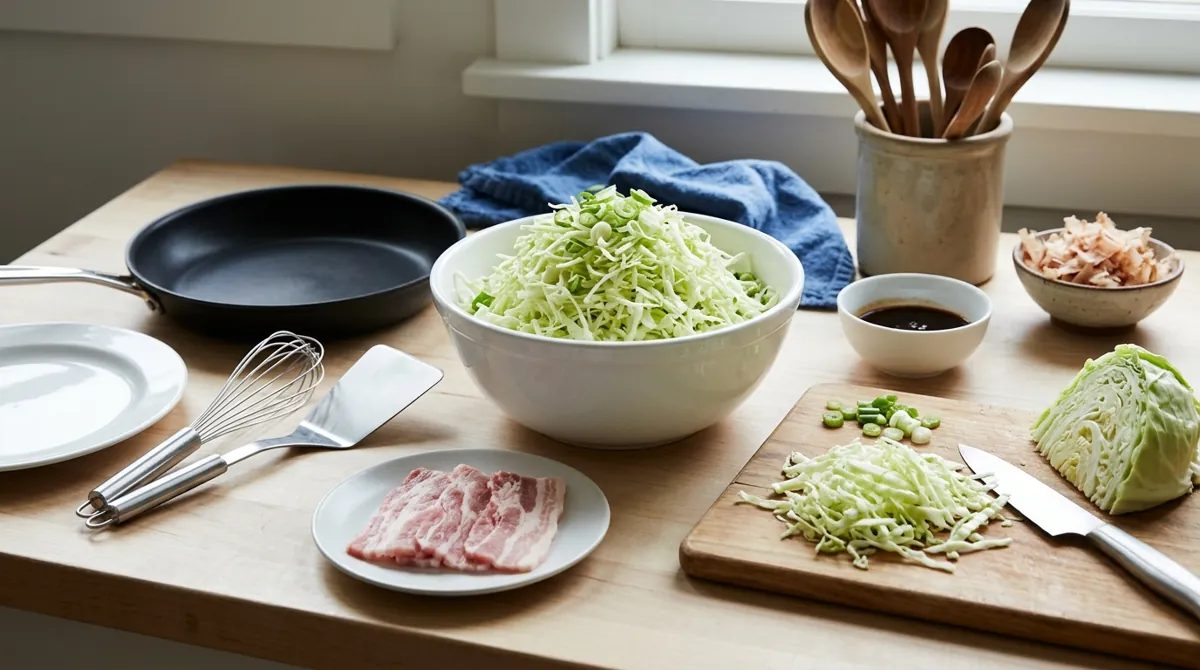
Shred the cabbage as finely as you can with a knife and slice the scallions. Cut the pork belly slices in half.
- Step 2
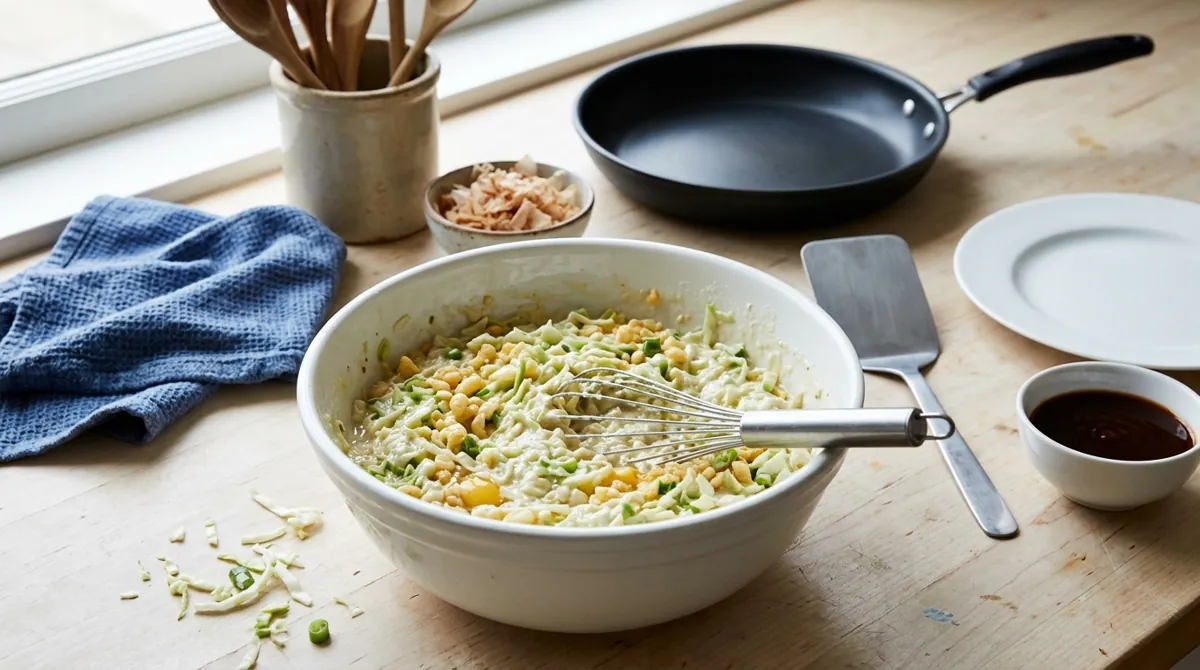
Whisk the flour, baking powder and salt in a large bowl. Add the dashi and eggs and mix to a thick, smooth batter, then stir in the cabbage, scallions and tenkasu until the cabbage is coated. It should look like cabbage held together with a little batter.
- Step 3
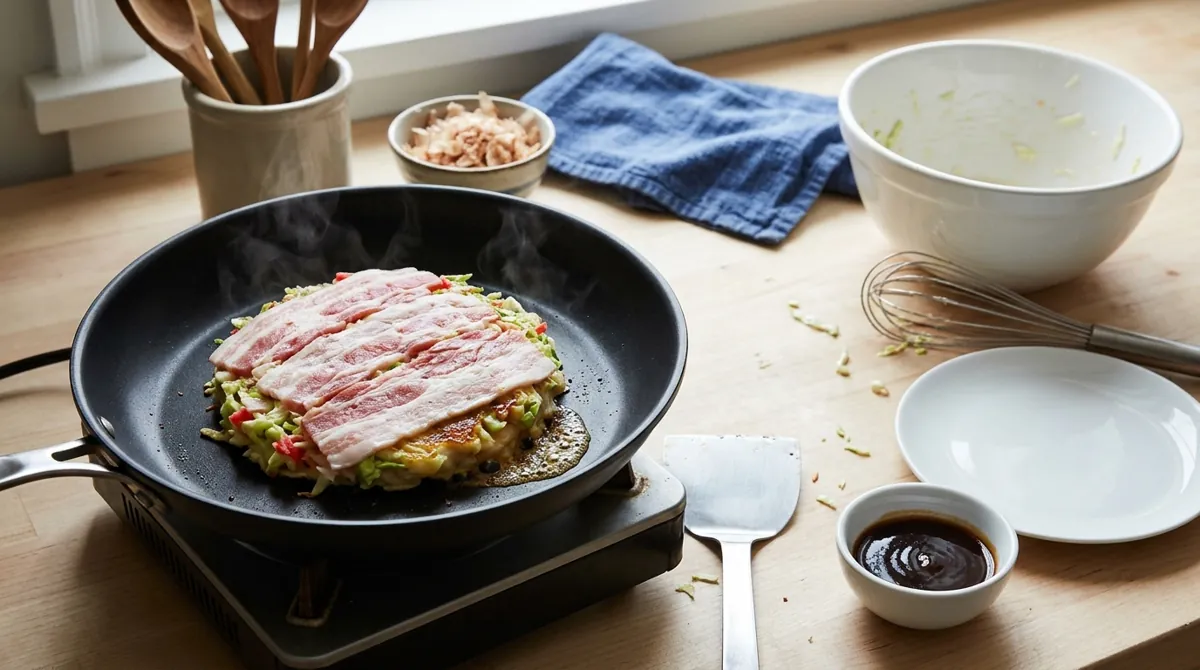
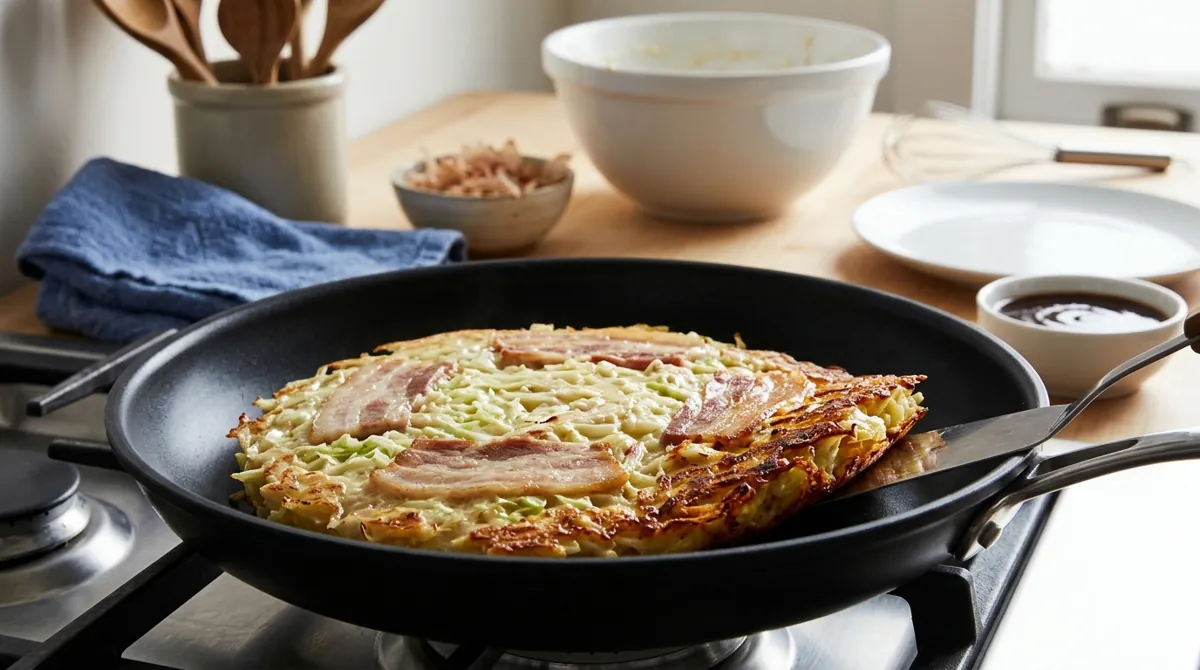
Heat the oil in a 12 inch nonstick skillet over medium heat. Spoon in half the batter and pat it into a thick disc about 6 inches wide. Lay half the pork slices over the top. Cook 4 to 5 minutes, until the underside is deep golden and the edges are firm.
✓ What it should look like - Step 4
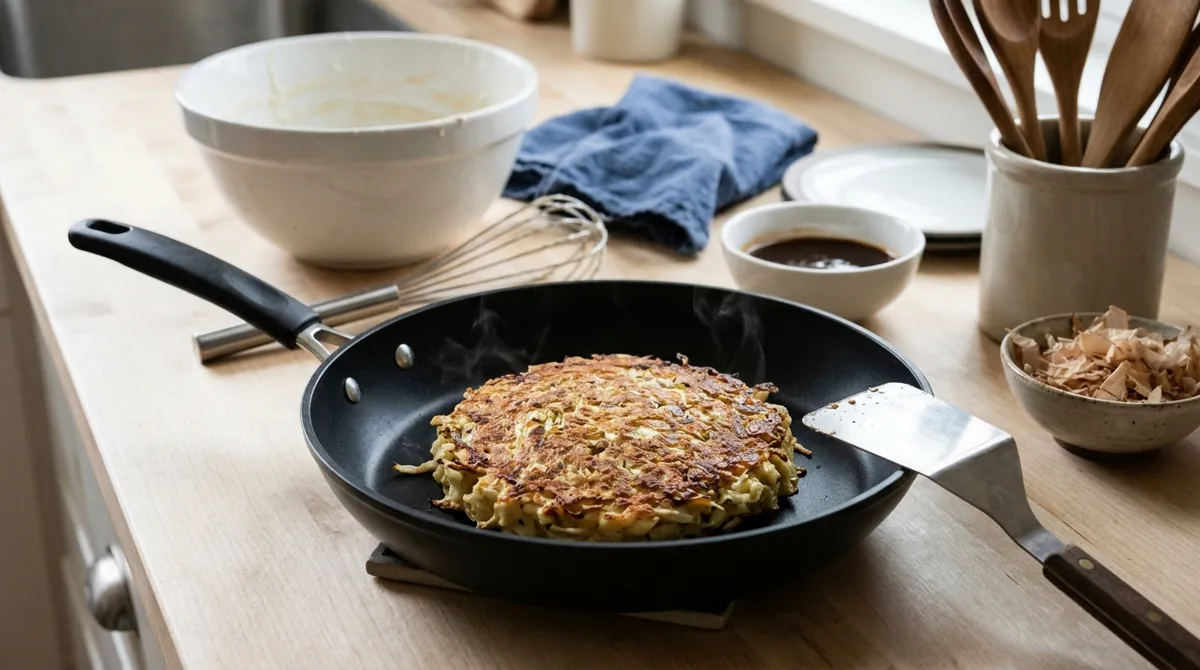
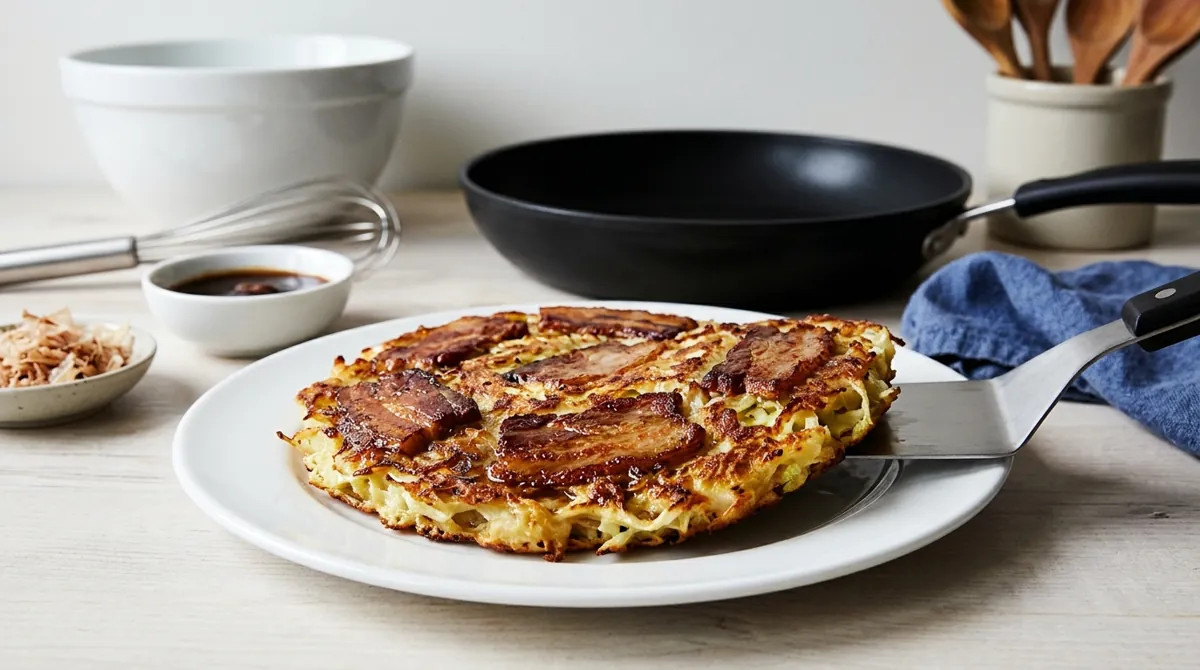
Flip the pancake pork side down and cook 4 to 5 minutes more, until the pork is browned and crisp and the middle is cooked through (about 165°F). Repeat with the second pancake.
✓ What it should look like - Step 5
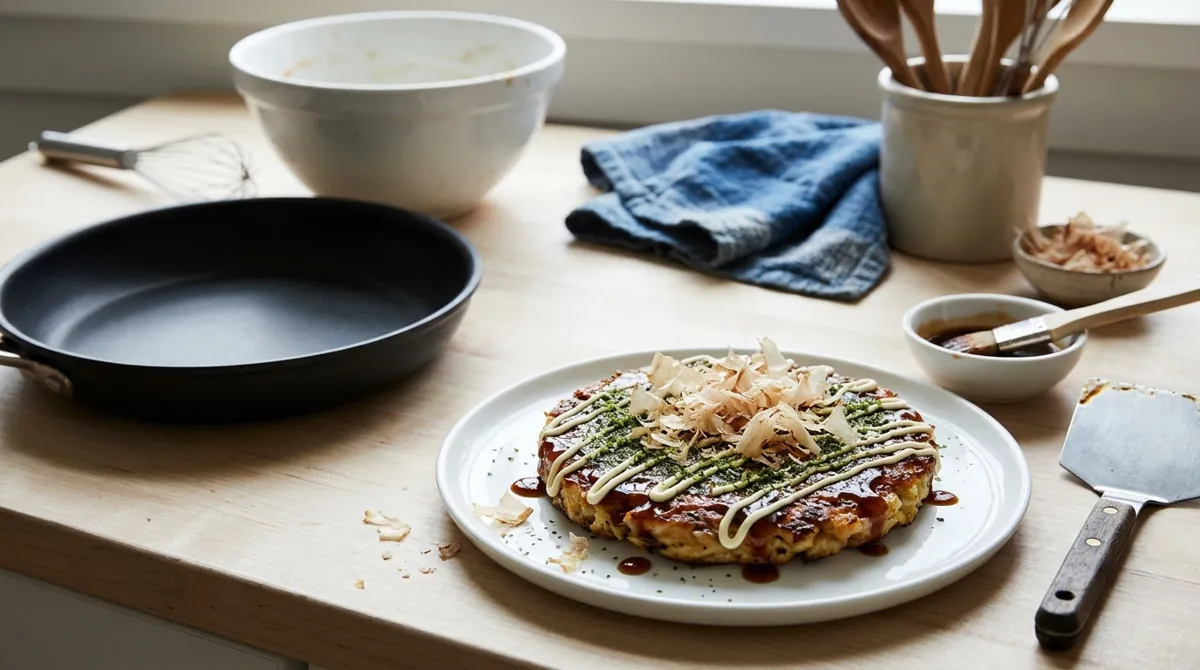
Slide the pancake onto a plate, pork side up. Brush with the sauce, then zigzag the mayonnaise over it and scatter with aonori, katsuobushi and red ginger.
- Step 6
Serve at once, cut into wedges, while the bonito flakes still sway in the heat.
Okonomiyaki
Serves 2 · two 6 inch pancakes · 35 min total
Pancakes
- 1 cup all-purpose flour (125 g)
- 1/2 tsp baking powder
- 1/4 tsp fine salt
- 2/3 cup dashi (160 ml), cold; or water with 1/2 tsp dashi powder
- 2 large eggs (about 100 g)
- 4 cups finely shredded green cabbage (about 300 g)
- 2 scallions (30 g), thinly sliced
- 2 tbsp tenkasu (tempura scraps), optional
- 4 oz thinly sliced pork belly (115 g)
- 1 tbsp neutral oil, for the pan
Toppings
- 4 tbsp okonomiyaki sauce (or 2 tbsp ketchup, 1 tbsp Worcestershire sauce, 1 tbsp oyster sauce and 1 tsp sugar mixed)
- 2 tbsp Japanese mayonnaise (about 28 g)
- Aonori (dried green seaweed flakes) and katsuobushi (bonito flakes), to taste
- Beni shoga (pickled red ginger), optional
Equipment: Nonstick skillet, Chef's knife and cutting board, Measuring cups and spoons, Mixing bowls, Whisk, Pastry brush
Method
- Shred the cabbage as finely as you can with a knife and slice the scallions. Cut the pork belly slices in half.
- Whisk the flour, baking powder and salt in a large bowl. Add the dashi and eggs and mix to a thick, smooth batter, then stir in the cabbage, scallions and tenkasu until the cabbage is coated. It should look like cabbage held together with a little batter.
- Heat the oil in a 12 inch nonstick skillet over medium heat. Spoon in half the batter and pat it into a thick disc about 6 inches wide. Lay half the pork slices over the top. Cook 4 to 5 minutes, until the underside is deep golden and the edges are firm.
- Flip the pancake pork side down and cook 4 to 5 minutes more, until the pork is browned and crisp and the middle is cooked through (about 165°F). Repeat with the second pancake.
- Slide the pancake onto a plate, pork side up. Brush with the sauce, then zigzag the mayonnaise over it and scatter with aonori, katsuobushi and red ginger.
- Serve at once, cut into wedges, while the bonito flakes still sway in the heat.
Americanized house recipe, written for this site, for an Osaka-style okonomiyaki within the usual ratios of Japanese home recipes (about 1 cup flour to 2/3 cup dashi, 2 eggs and a generous half head of cabbage for 2 pancakes). History: Wikipedia, "Okonomiyaki" (funoyaki, monjayaki, Osaka and Hiroshima styles, the 1930s Osaka shop, the post-war boom). that page was not fetched. en.wikipedia.org. Ingredient list follows the source; the method is in our own words.
All sources (2)
Tips
- Do not press the pancake down with the spatula after flipping: it squeezes out air and makes it dense.
- Add shrimp, squid, cheese, kimchi or sliced mochi in place of or along with the pork.
- For a Hiroshima style, cook a thin crepe, pile on a mound of cabbage, bean sprouts and pork, top with fried yakisoba noodles and a fried egg, and press it all together.
- Short on okonomiyaki sauce? Mix 3 tbsp ketchup, 2 tbsp Worcestershire sauce, 1 tbsp oyster sauce and 1 tsp sugar.
- Use a lid for the first side if the cabbage is thick, to steam it through.
- Best eaten right away; reheat leftovers in a dry skillet to re-crisp the outside.
The rules people argue about
What the sources agree on, what they don't, and what is just a good story.
- Okonomiyaki is from Osaka. Disputed: Osaka and Hiroshima both claim it; the dish has two main versions, and Wikipedia describes the earliest origins as uncertain.
- The word "okonomiyaki" came from the 1930s in Osaka. Documented, but a first use only: it is the earliest recorded appearance of the word in a shop, not proof of the dish's invention.
- "Hiroshima-yaki" is the right name. Disputed: a 2016 report described NHK correcting a broadcast over that label; the style is simply called Hiroshima-style okonomiyaki.
Meatballs of the World

Italian-American Meatballs
Big, tender meatballs braised for an hour in red sauce over spaghetti. The one most Americans grew up with.

Pallottine (Abruzzo Meatballs)
Tiny meatballs, smaller than a marble, tossed right through square spaghetti alla chitarra. No bread at all.

Swedish Meatballs (Köttbullar)
Small, soft meatballs browned in butter, in a cream sauce made from the same pan, with lingonberry jam on the plate.

Danish Frikadeller
Pork meatballs shaped with a spoon and fried slowly in butter, crusty outside and soft in the middle.

Königsberger Klopse
German meatballs that are never fried: poached, then served in a creamy white sauce with capers.

Spanish Albóndigas in Almond Saffron Sauce
The tapas bar classic: small meatballs in a golden sauce thickened with fried almonds and bread.

Mexican Albóndigas with Chipotle and Mint
Soft meatballs with rice and fresh mint inside, simmered in a smoky tomato and chipotle broth.

Izgara Köfte (Turkish Grilled Meatballs)
Small, flat meatballs kneaded hard, rested cold, and charred on a hot grill pan.

Lion's Head Meatballs
Big, soft pork meatballs, stirred into a sticky paste, fried to set, then braised in a savory sauce.

Chicken Tsukune
Japan's chicken meatball: kneaded sticky, grilled on skewers, glazed with sweet soy tare, dipped in egg yolk.