
Paella
Chicken, rabbit, flat green beans and butter beans under a thin layer of saffron rice cooked unstirred in a wide pan until a crackling crust forms on the bottom: the Valencian original, before the seafood and chorizo versions the rest of the world calls paella.
 Edited by JP Lambiase
Change the estimate
Swaps change the price only: cook any meat to its own safe temperature. Where these numbers come from
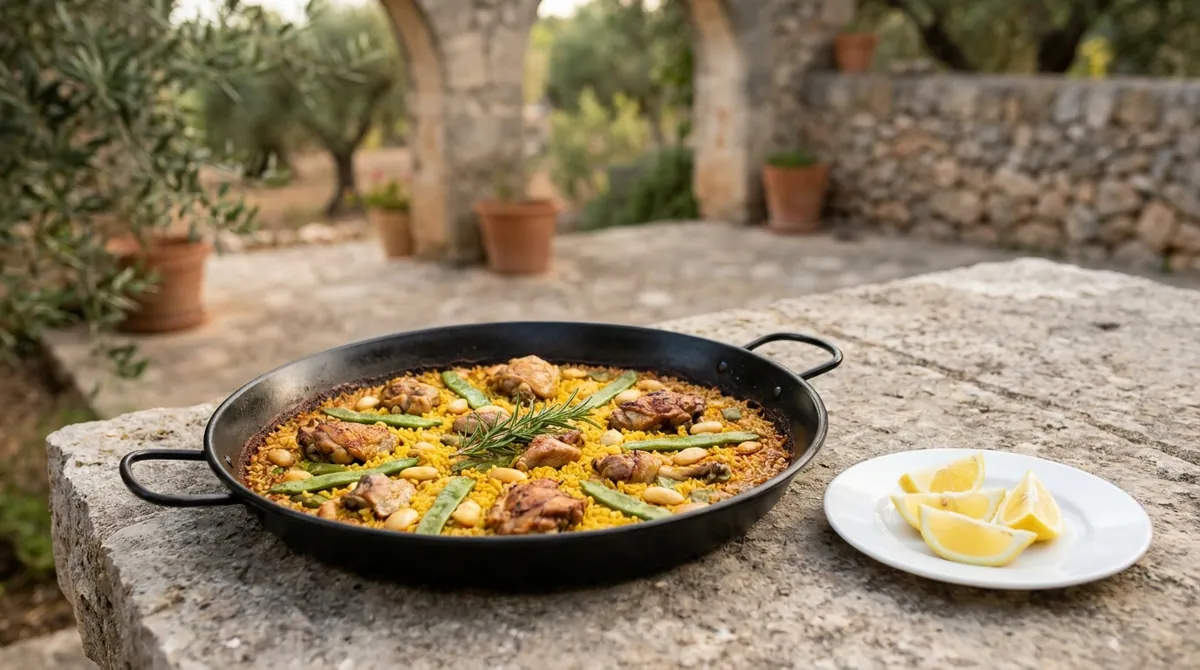
Paella is named after its pan. "Paella" is the Valencian word for a frying pan, from Old French paelle and Latin patella; in much of Spain the pan is called a paellera and "paella" means the dish. Rice came to Spain with the Moors, who were growing it in Al-Andalus by around the 10th century, and by the 15th century it was a staple. A likely theory is that rice farmers around the Albufera lagoon, just south of Valencia, made the first paellas as a one-pot field meal of rice, snails, water birds and green beans cooked over a wood fire. The modern dish is traced to the mid-19th century in that same countryside, and one food historian dates the first use of the word for the recipe, rather than the pan, to a Valencian newspaper in 1840.
What Valencians mean by paella is specific. A 2022 study of home cooks in all 277 towns of Valencia Province found ten basic ingredients: olive oil, saffron or a coloring, tomato, chicken, flat green beans, lima beans, rabbit, rice, salt and water, with rabbit in 89 percent of them. No seafood, no chorizo, no onion.
The world met a different paella. After Ernest Hemingway wrote about it following a 1959 visit to Valencia, it became Spain's best-known dish abroad, usually as seafood paella or a "mixed" paella of meat and shellfish. When Jamie Oliver published a paella with chorizo in 2014, Spaniards tore into it online; Valencians have a dismissive name for that kind of dish, arroz con cosas, "rice with things."
This is the Valencian version, with a chicken-only option if you cannot find rabbit.
Why it works the kitchen science
A wide, shallow pan
The rice cooks in a layer about a finger deep, so every grain gets equal heat and the liquid evaporates evenly instead of steaming a deep pot of rice.
Broth made in the pan
Browning the meat, the tomato and the paprika in the same pan and then simmering them in water builds the stock, so no carton broth is needed.
Short-grain spanish rice
Bomba absorbs a lot of liquid and stays separate rather than creamy.
No stirring
Stirring releases starch and turns it into risotto; leaving it alone keeps the grains loose and lets the bottom crust form.
Socarrat
The last minute or two of high heat toasts the bottom layer, and the rest under a towel lets it release.
🧰 You'll need 3 items
Everything the steps call for. Tick off what you have before you start.
Appliances
Tools
Step by step
- Step 1
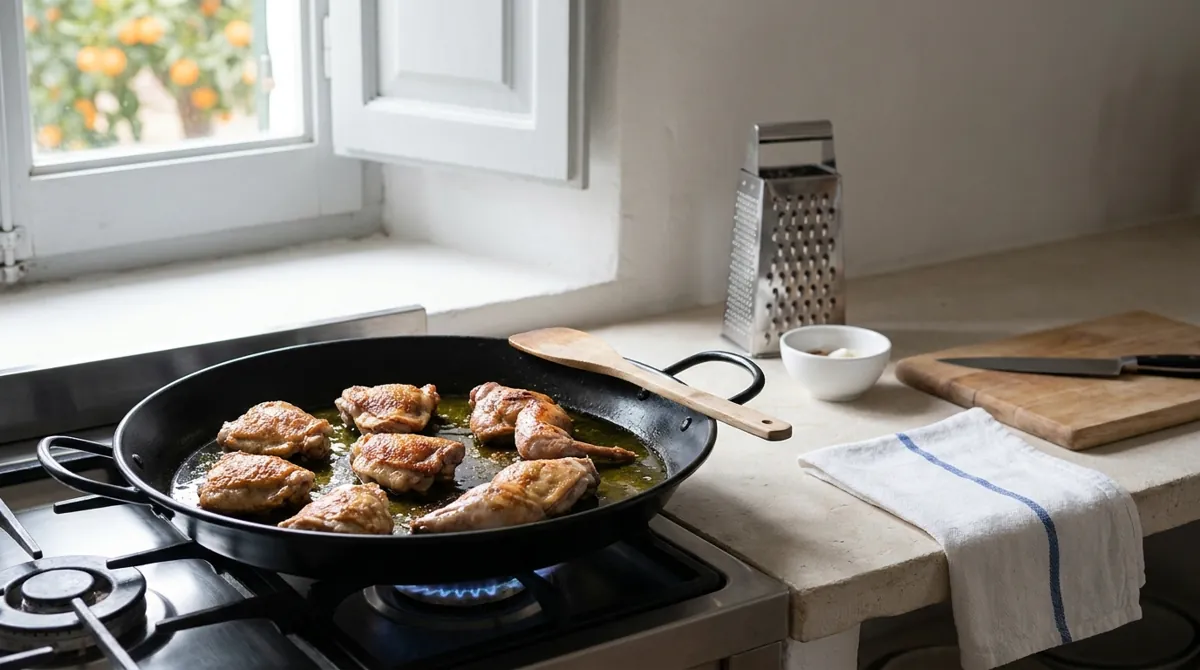
Season the chicken and rabbit with 1 tsp salt. Set the paella pan over two burners (or a large grill) on medium-high, add the olive oil and brown the meat well on all sides, 12 to 15 minutes, turning it a few times. Push it to the outer edge of the pan.
- Step 2
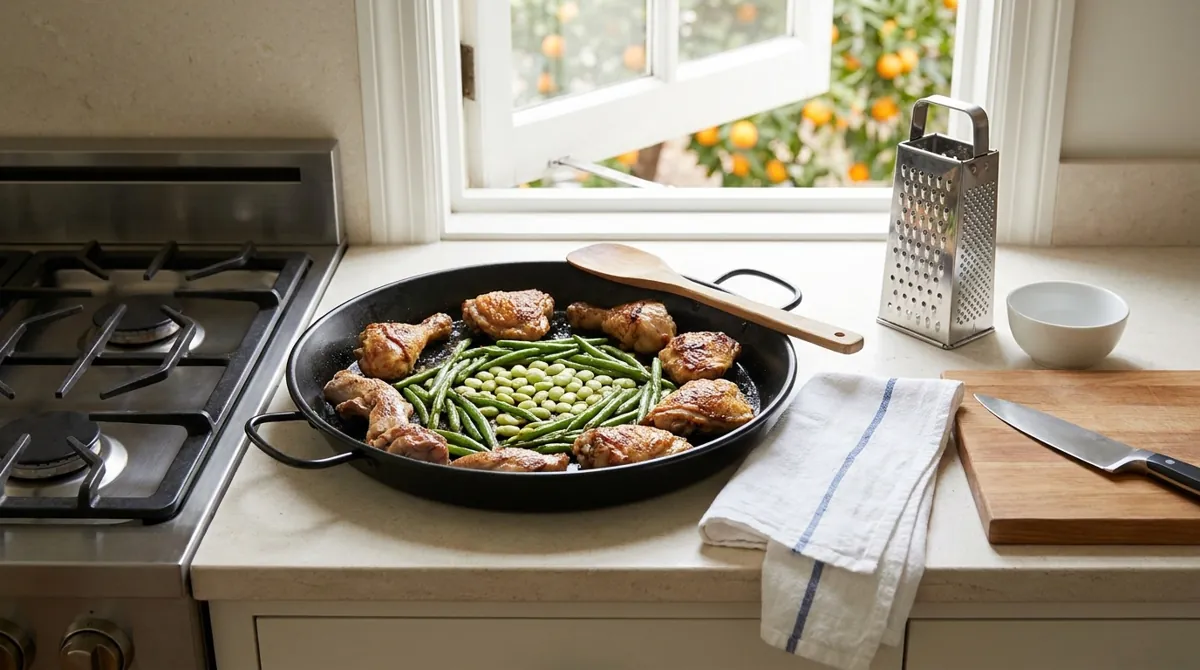
Add the green beans and lima beans to the center and cook, stirring, 3 to 4 minutes, until the green beans are bright and blistered in spots.
- Step 3
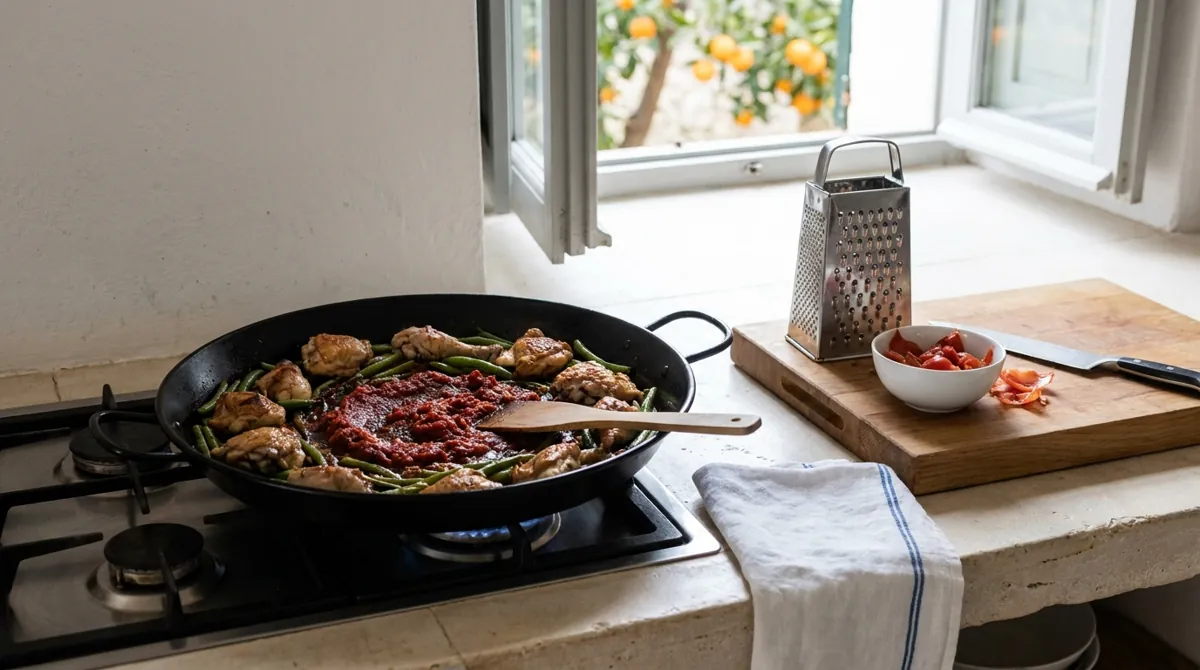
Clear a space in the center, add the grated tomato and cook 4 to 5 minutes, until it darkens and turns jammy. Stir in the paprika for only 10 seconds so it does not scorch, then stir everything together.
- Step 4
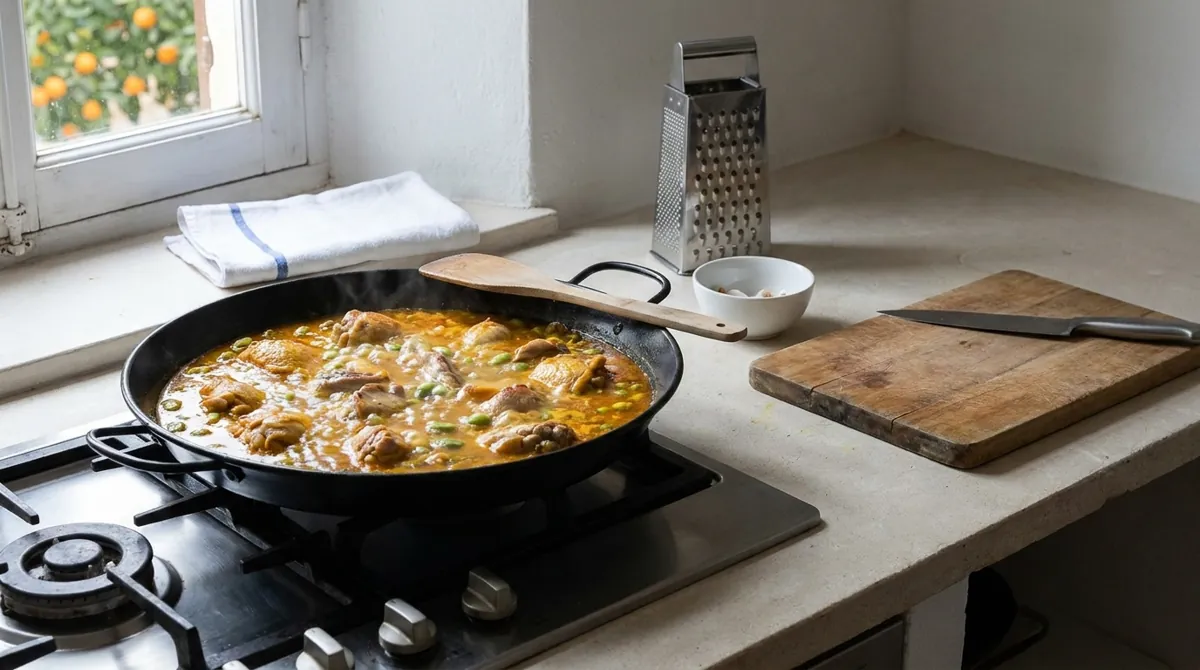
Add the water, the remaining 1 1/2 tsp salt and the saffron. Bring to a boil and simmer briskly 20 minutes to make a quick broth. Taste it: it should be a little saltier than soup.
- Step 5
Scatter the rice evenly across the whole pan and nudge it under the broth with the spoon once. From now on do not stir. Boil on high 8 to 10 minutes, then turn the heat to medium-low and cook 8 to 10 minutes more, until the broth is absorbed and the grains are tender with a slight bite. Lay the rosemary sprig on top for the last few minutes, if using.
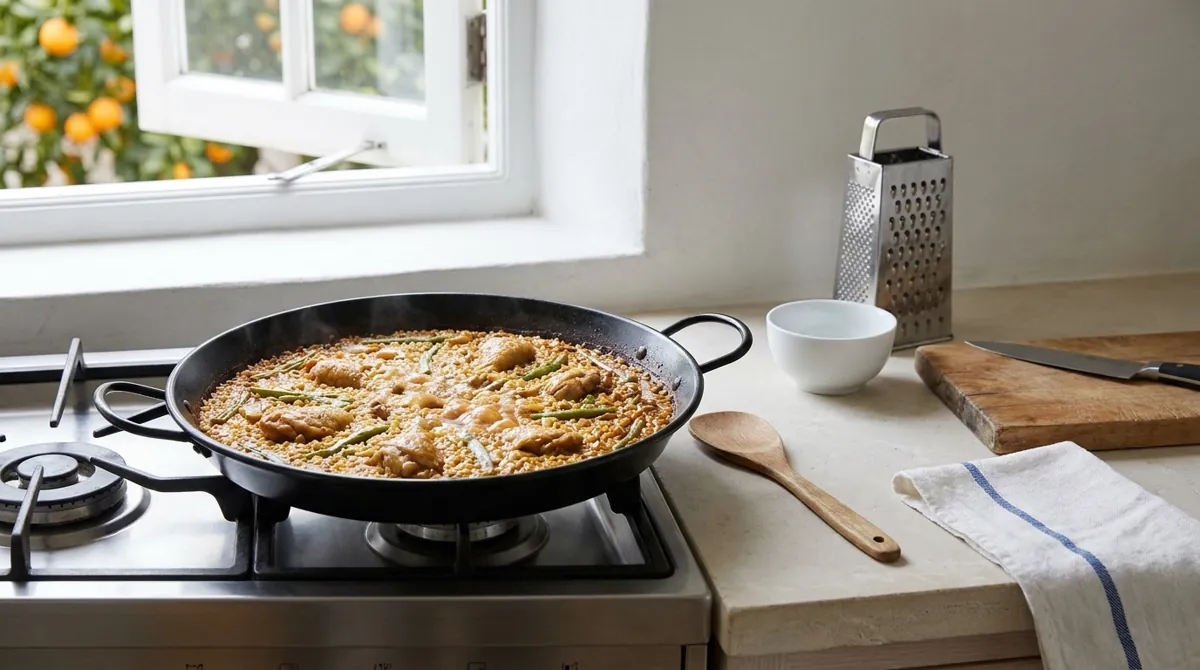
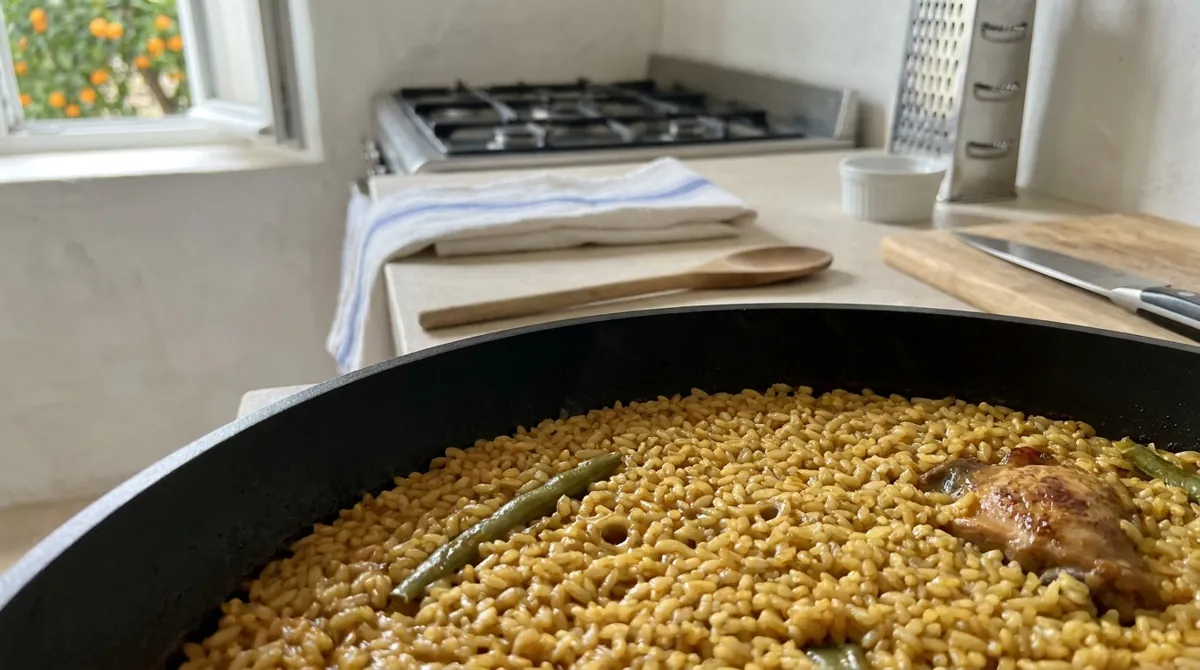
✓ What it should look like - Step 6
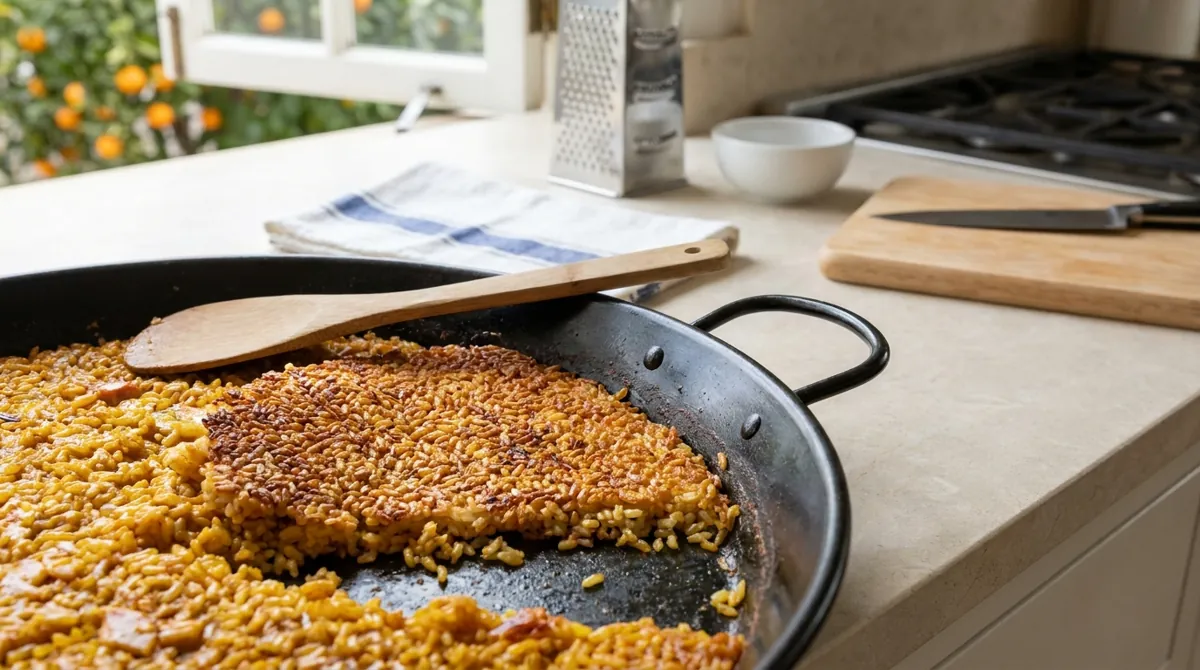
For the socarrat, raise the heat to high for 1 to 2 minutes, turning the pan so every part gets heat, until the rice crackles and smells toasty, not burnt. Check one spot at the edge with the spoon: the bottom should be a golden-brown crust.
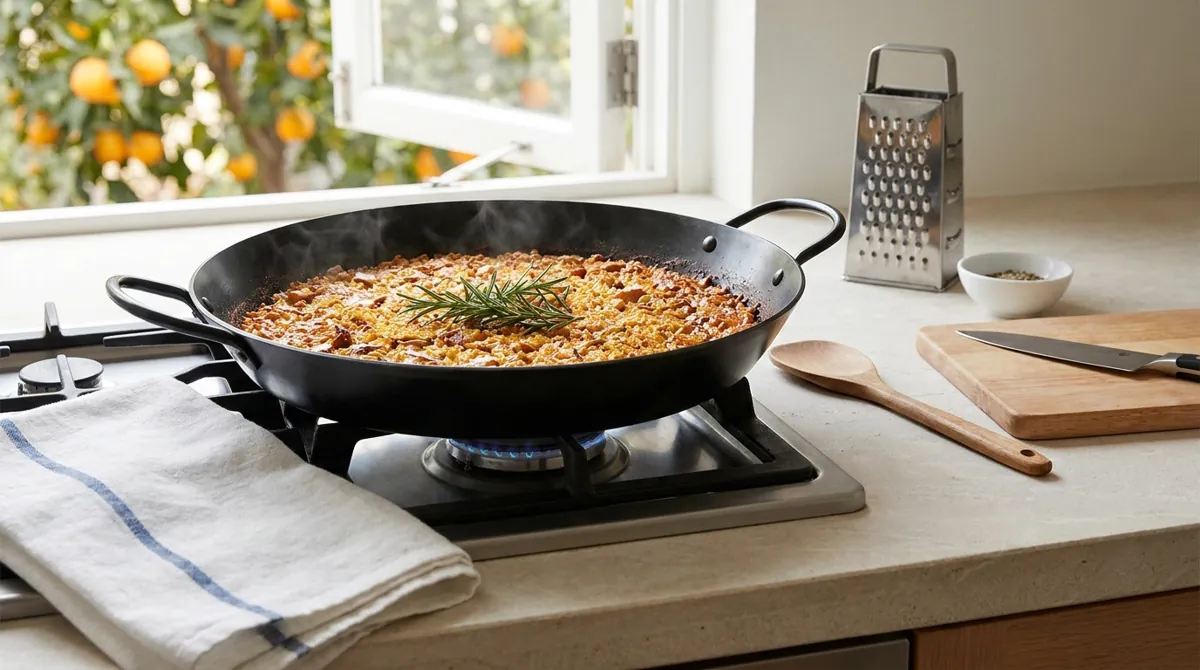
✓ What it should look like - Step 7
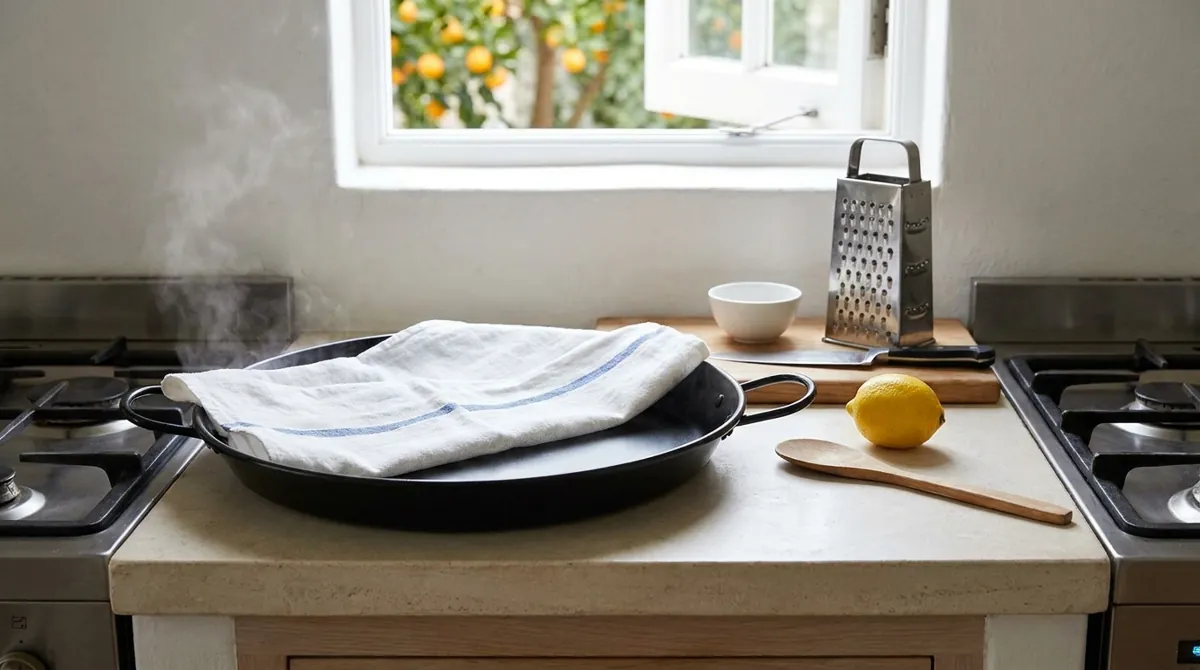
Take the pan off the heat, cover it with a clean kitchen towel and rest 5 minutes. Serve straight from the pan.
Paella
Serves 6 · one 15 inch paella pan · 1 hr 25 min total
Meat and vegetables
- 1/4 cup extra-virgin olive oil (54 g)
- 1 1/2 lb boneless, skinless chicken thighs (680 g), cut into 2 inch pieces
- 1 lb rabbit, cut into small bone-in pieces (454 g), or another 1 lb chicken thighs
- 2 1/2 tsp fine salt, divided
- 8 oz flat green beans (Romano beans), trimmed and cut into 2 inch pieces (225 g)
- 6 oz frozen baby lima beans (170 g), thawed, standing in for Valencian garrofo beans
- 1 large ripe tomato, halved and grated on a box grater, skin discarded (about 3/4 cup pulp, 200 g)
- 2 tsp sweet paprika (5 g), not smoked
Rice
- 6 cups water (1.4 L)
- 1 large pinch saffron threads (about 1/2 g), crumbled
- 2 cups bomba or other Spanish short-grain rice (400 g)
- 1 sprig fresh rosemary, optional
Equipment: Grill, Chef's knife and cutting board, Measuring cups and spoons
Method
- Season the chicken and rabbit with 1 tsp salt. Set the paella pan over two burners (or a large grill) on medium-high, add the olive oil and brown the meat well on all sides, 12 to 15 minutes, turning it a few times. Push it to the outer edge of the pan.
- Add the green beans and lima beans to the center and cook, stirring, 3 to 4 minutes, until the green beans are bright and blistered in spots.
- Clear a space in the center, add the grated tomato and cook 4 to 5 minutes, until it darkens and turns jammy. Stir in the paprika for only 10 seconds so it does not scorch, then stir everything together.
- Add the water, the remaining 1 1/2 tsp salt and the saffron. Bring to a boil and simmer briskly 20 minutes to make a quick broth. Taste it: it should be a little saltier than soup.
- Scatter the rice evenly across the whole pan and nudge it under the broth with the spoon once. From now on do not stir. Boil on high 8 to 10 minutes, then turn the heat to medium-low and cook 8 to 10 minutes more, until the broth is absorbed and the grains are tender with a slight bite. Lay the rosemary sprig on top for the last few minutes, if using.
- For the socarrat, raise the heat to high for 1 to 2 minutes, turning the pan so every part gets heat, until the rice crackles and smells toasty, not burnt. Check one spot at the edge with the spoon: the bottom should be a golden-brown crust.
- Take the pan off the heat, cover it with a clean kitchen towel and rest 5 minutes. Serve straight from the pan.
Americanized house recipe, written for this site. History: Wikipedia, "Paella" (the pan and the Latin patella, rice in Al-Andalus by the 10th century and a staple by the 15th, the Albufera farmers theory, the mid-19th-century modern dish, Lynne Olver on the 1840 newspaper, Hemingway in 1959, seafood and mixed paella, socarrat, the 2022 Vidal-González study of 277 towns and rabbit in 89 percent, the 2014 Jamie Oliver chorizo row and Ana Vega's 2016 El País counterpoint, arroz con cosas, the baqiyya theory and its problem). Technique: America's Test Kitchen, "Paella de Verduras" (bomba or Calasparra rice, the wide shallow pan, garrofon and butter beans as the stand-in, socarrat and a short rest to release it); America's Test Kitchen, "Paella" (the American mixed version with chorizo, shrimp and mussels, for comparison); Alex Molas, "Paella valenciana" (a Valencian home method: brown the meat, then the beans, tomato and paprika, boil the broth about 20 minutes before the rice, saffron with the rice, do not stir, rest under a cloth). en.wikipedia.org. Ingredient list follows the source; the method is in our own words.
Tips
- No rabbit? Use 2 1/2 lb chicken thighs in all, or bone-in thighs chopped into pieces for more flavor.
- No paella pan? Use the widest skillet you have, 12 inches or more, and cut the recipe by a third so the rice stays thin.
- Over a single burner, turn the pan a quarter turn every few minutes so the edges cook too.
- Paella is best right away. Leftovers reheat in a skillet with a splash of water.
The rules people argue about
What the sources agree on, what they don't, and what is just a good story.
- The name comes from the Arabic baqiyya, "leftovers." Folklore: the word is not recorded until six centuries after the Christian conquest of Valencia, and linguists trace it to Latin patella, a pan.
- Seafood paella is paella. Disputed: Spain and the world serve paella de marisco and paella mixta, but Valencians say fish and shellfish are out of the question for paella valenciana.
- Chorizo never belongs in paella. Disputed: Valencians reject it and the 2014 Jamie Oliver recipe was mocked for it, but food writer Ana Vega argued in El País in 2016 that old sources show chorizo in some Valencian paellas.
Meatballs of the World

Italian-American Meatballs
Big, tender meatballs braised for an hour in red sauce over spaghetti. The one most Americans grew up with.

Pallottine (Abruzzo Meatballs)
Tiny meatballs, smaller than a marble, tossed right through square spaghetti alla chitarra. No bread at all.

Swedish Meatballs (Köttbullar)
Small, soft meatballs browned in butter, in a cream sauce made from the same pan, with lingonberry jam on the plate.

Danish Frikadeller
Pork meatballs shaped with a spoon and fried slowly in butter, crusty outside and soft in the middle.

Königsberger Klopse
German meatballs that are never fried: poached, then served in a creamy white sauce with capers.

Spanish Albóndigas in Almond Saffron Sauce
The tapas bar classic: small meatballs in a golden sauce thickened with fried almonds and bread.

Mexican Albóndigas with Chipotle and Mint
Soft meatballs with rice and fresh mint inside, simmered in a smoky tomato and chipotle broth.

Izgara Köfte (Turkish Grilled Meatballs)
Small, flat meatballs kneaded hard, rested cold, and charred on a hot grill pan.

Lion's Head Meatballs
Big, soft pork meatballs, stirred into a sticky paste, fried to set, then braised in a savory sauce.

Chicken Tsukune
Japan's chicken meatball: kneaded sticky, grilled on skewers, glazed with sweet soy tare, dipped in egg yolk.