
Ratatouille
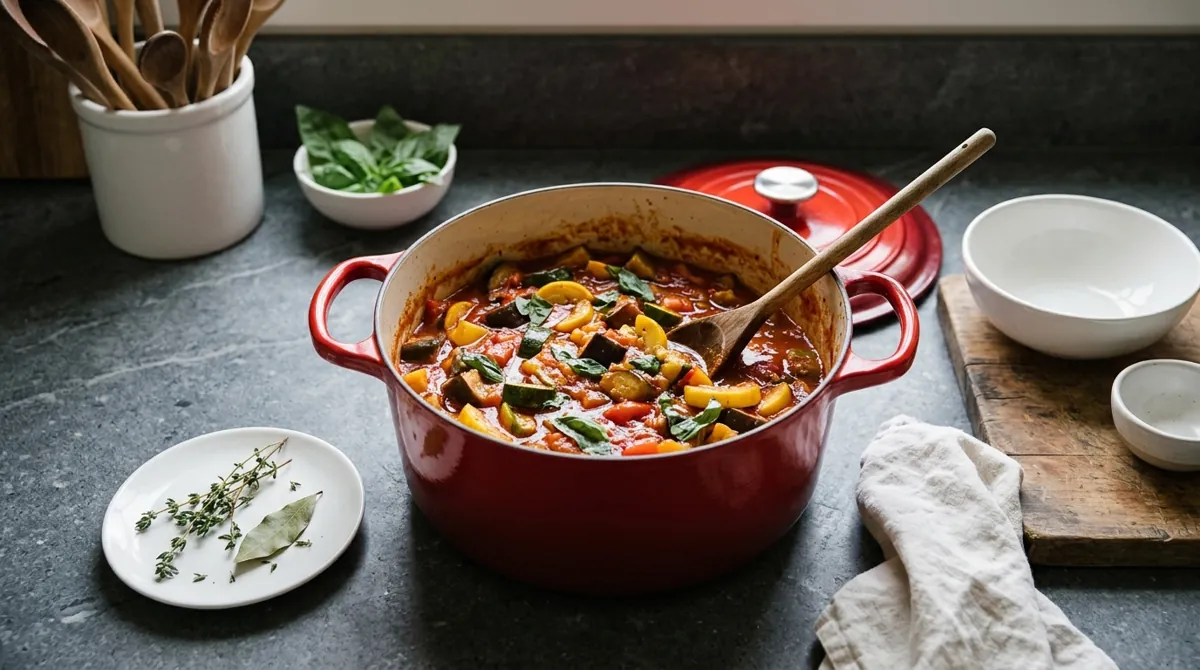
Eggplant, zucchini, peppers and tomatoes browned separately, then simmered together in olive oil with garlic and thyme: the Provencal summer vegetable stew, best the next day.
🍳Cook alongOne move at a time, with real timers
 Edited by JP Lambiase
Change the estimate
Swaps change the price only: cook any meat to its own safe temperature. Where these numbers come from
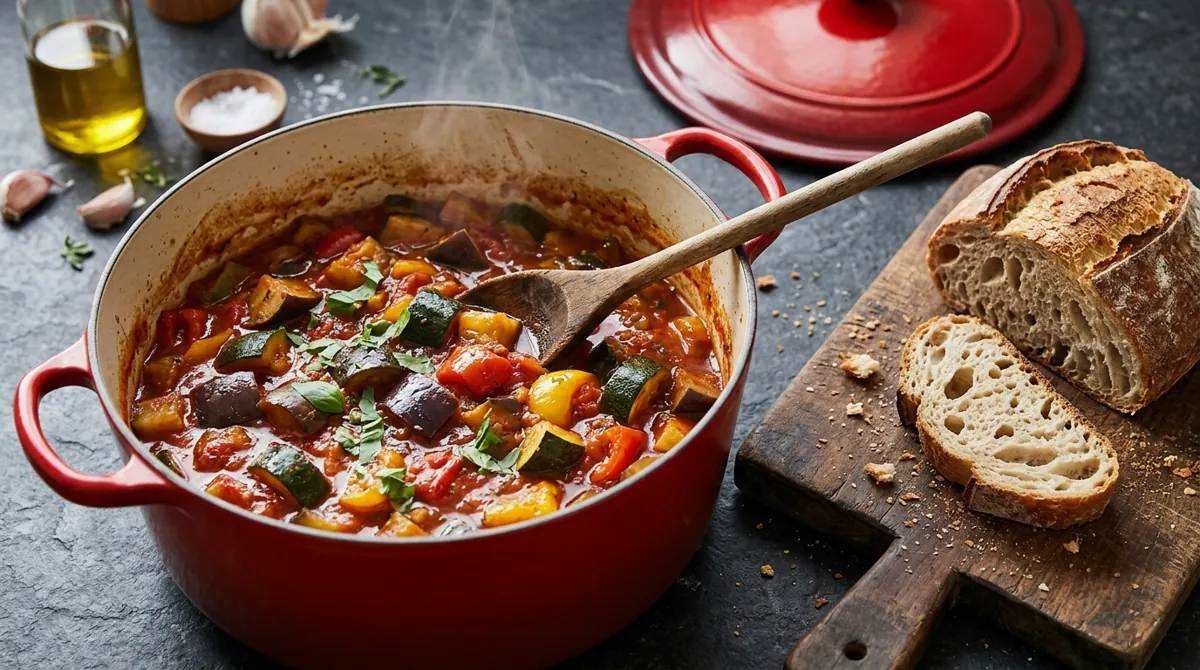
Ratatouille is a peasant dish from Provence, and Nice in particular, built to use up the glut of summer vegetables. The name comes from Occitan and the French verb touiller, "to stir or toss", and in the early 19th century it meant a coarse, chunky stew of almost any kind, not a recipe. Tomatoes, peppers and squash reached France from the Americas but were not widely eaten until the 18th and 19th centuries, so the dish as we know it is younger than it looks. Wikipedia says a modern version does not show up in print until about 1930; Larousse Gastronomique described it in 1938, and Elizabeth David helped introduce it to English readers in 1950.
In 1986 the chef Michel Guerard published a refined version, confit byaldi, with thin layered slices baked in a spiral; the 2007 Pixar film made it famous again. The home dish is the rustic one: chunky, glossy and soft.
Why it works the kitchen science
Browning each vegetable separately
Eggplant, zucchini and peppers cook at different speeds, and browning them one at a time keeps each one from steaming into mush.
A tomato base built first
The vegetables finish simmering in sauce, so they absorb flavor instead of watering it down.
Covered, then uncovered
The lid softens everything evenly, then the open pot reduces the juices to a glaze.
Resting
The flavors settle and it is better after 10 minutes, and better again the next day.
🧰 You'll need 4 items
Everything the steps call for. Tick off what you have before you start.
Pans and pots
Tools
Step by step
- Step 1
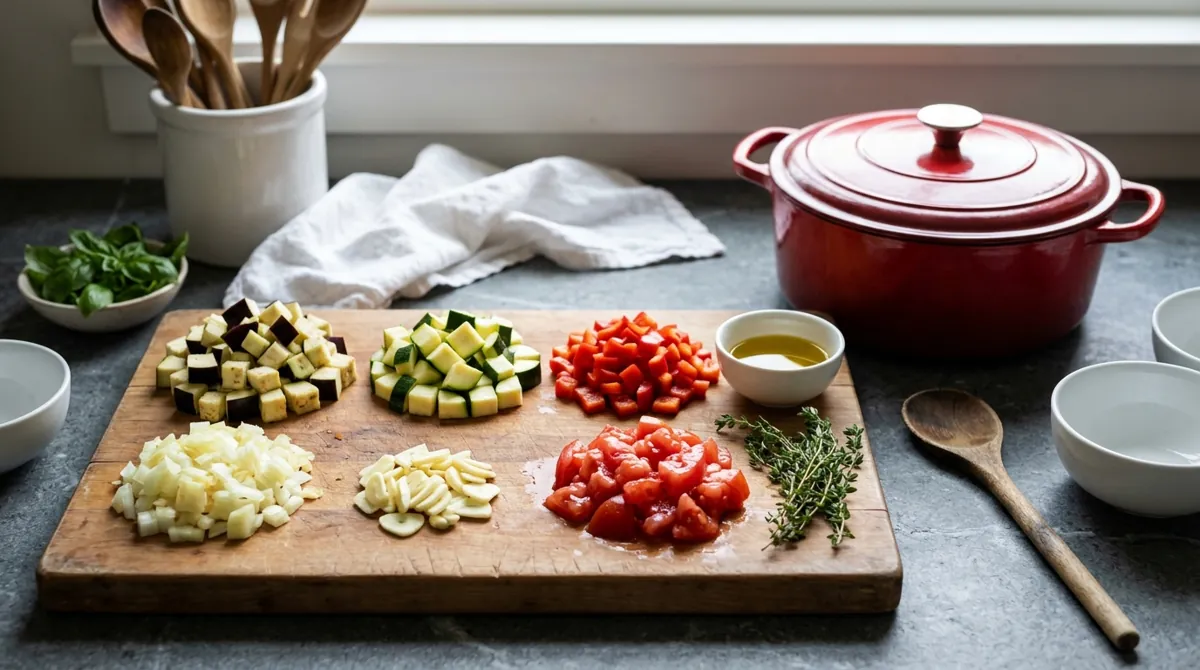
Cut the eggplant, zucchini, peppers and onion into 3/4 inch pieces and chop the tomatoes, keeping each vegetable in its own pile.
- Step 2
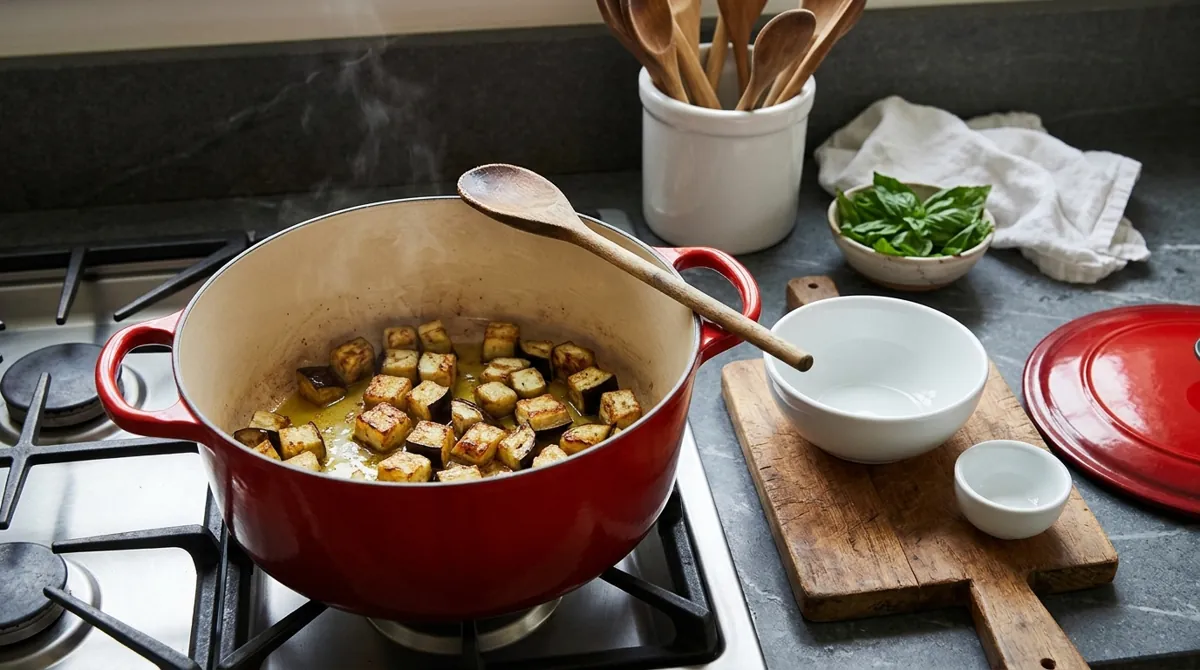
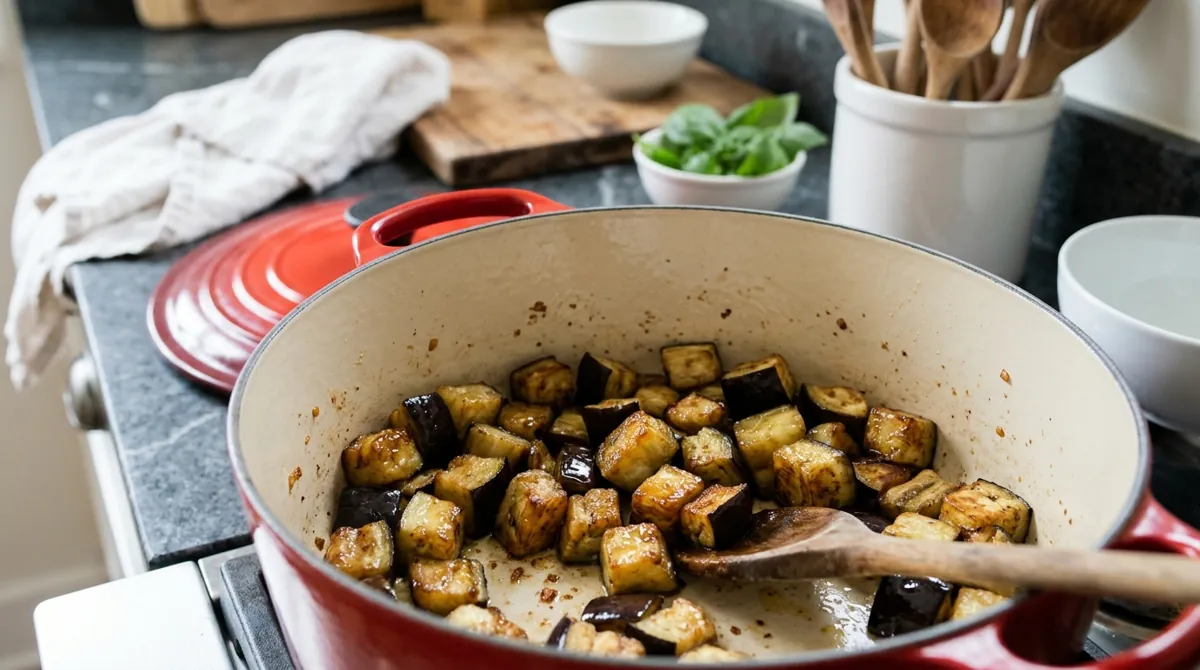
Heat 2 tablespoons of the olive oil in a large Dutch oven over medium-high heat. Brown the eggplant in two batches, 6 to 8 minutes each, adding a little oil as needed, until golden on the edges. Move it to a bowl.
✓ What it should look like - Step 3
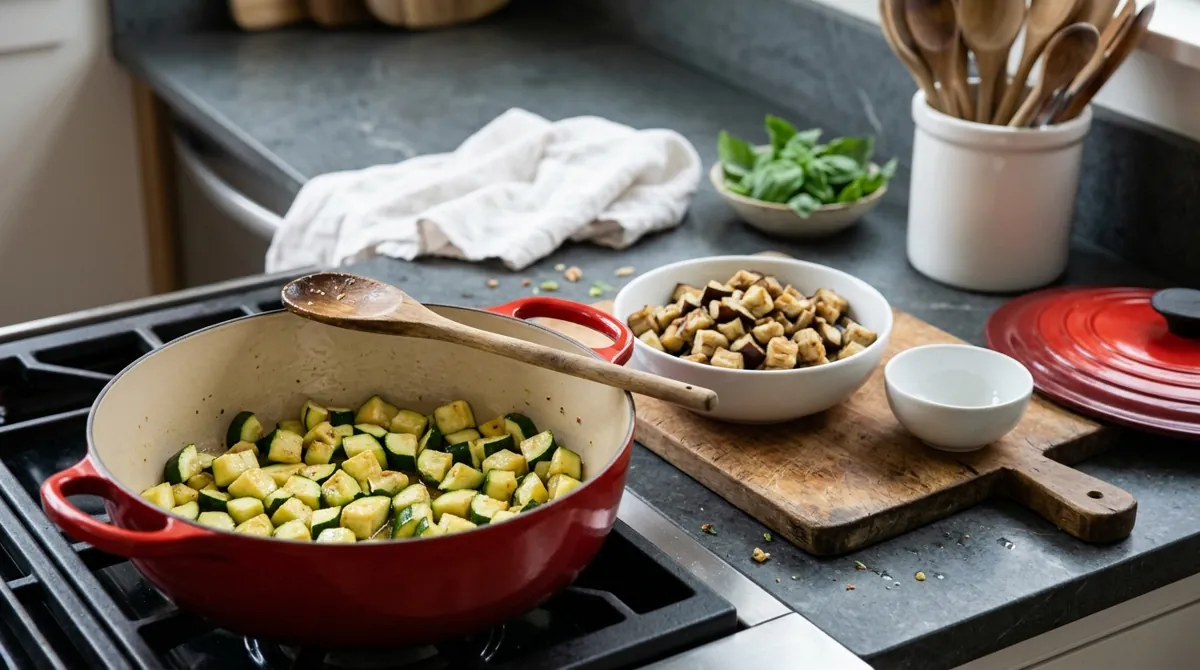
Brown the zucchini in the same pot, 3 to 4 minutes, until lightly golden but still firm, and move it to the bowl.
- Step 4
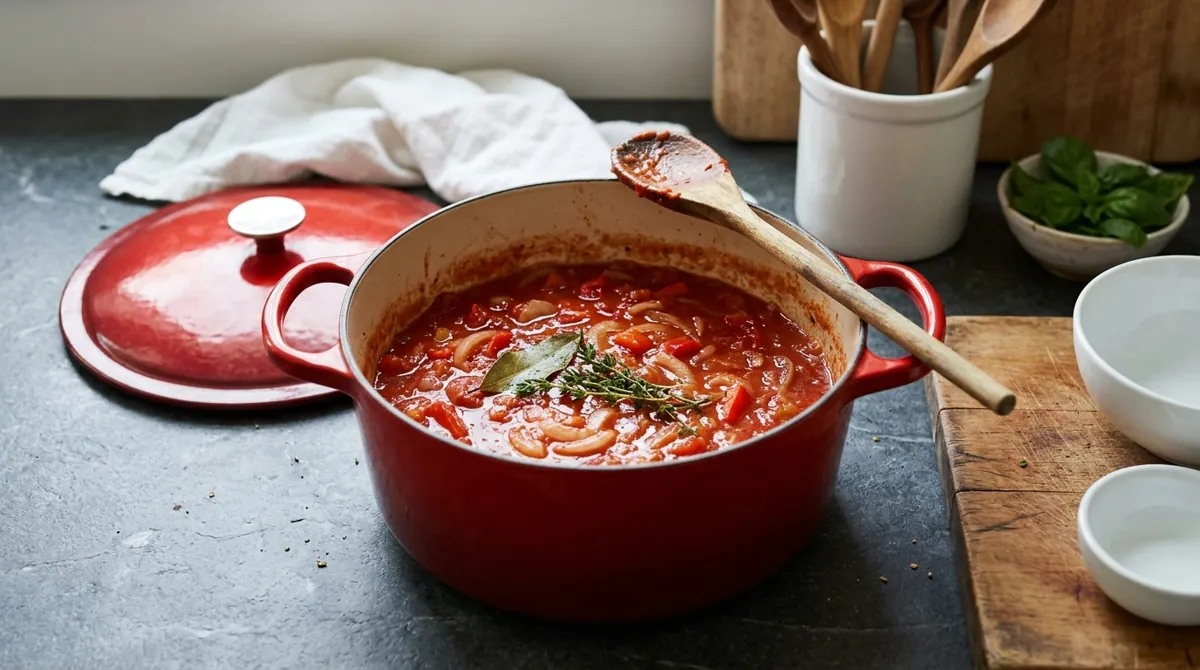
Add a little more oil, then cook the onion and peppers over medium heat 8 minutes until soft. Add the garlic for 1 minute, then the tomatoes, thyme, bay leaf and salt. Simmer 10 minutes until the tomatoes break down into a sauce.
- Step 5
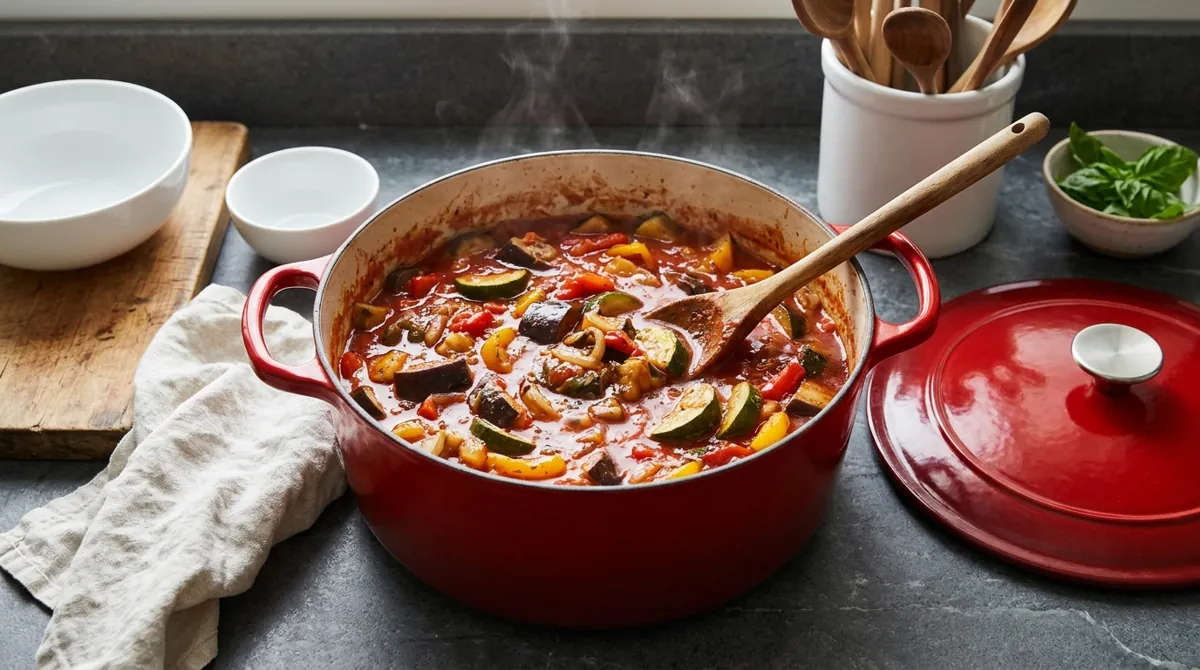
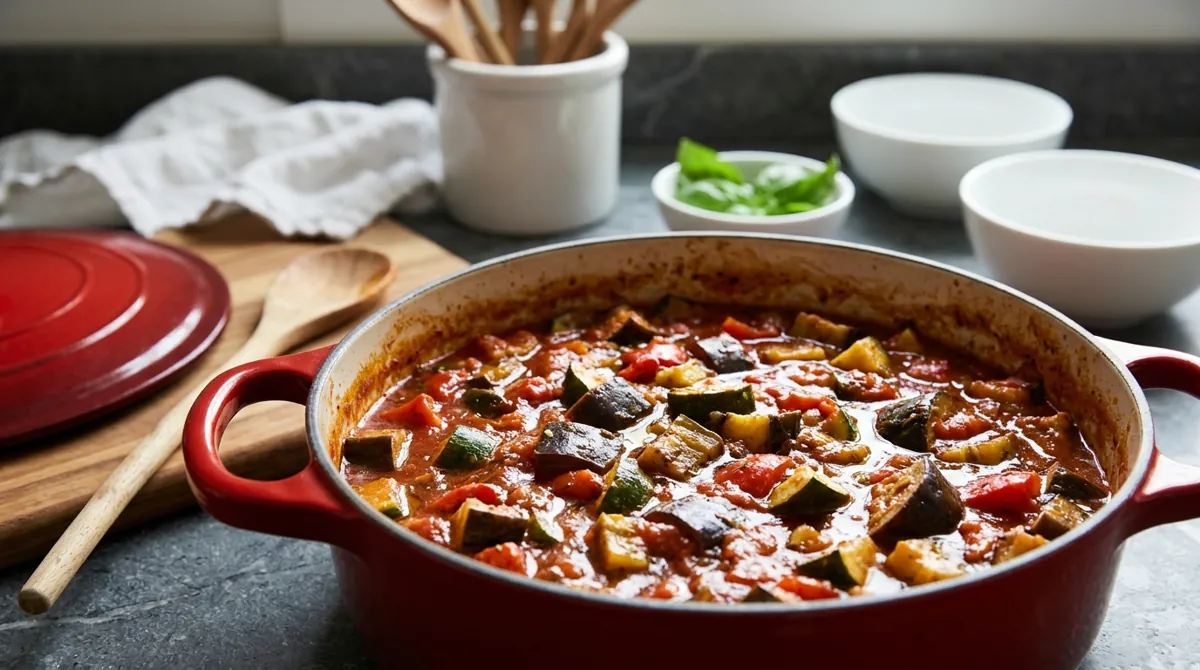
Return the eggplant and zucchini to the pot. Cover and simmer on low 20 minutes, then uncover and simmer 10 minutes more, until the vegetables are tender but still distinct and the juices have thickened into a glossy sauce.
✓ What it should look like - Step 6
Take out the thyme stems and bay leaf. Rest 10 minutes, then fold in the basil and taste for salt. Serve warm or at room temperature.
Ratatouille
Serves 4 · one large Dutch oven · 1 hr 25 min total
Vegetables
- 1 large eggplant (450 g), cut into 3/4 inch cubes
- 2 medium zucchini (400 g), cut into 3/4 inch cubes
- 2 red bell peppers (300 g), cut into 3/4 inch pieces
- 1 large yellow onion (200 g), diced
- 4 garlic cloves (12 g), sliced
- 1 1/2 pounds ripe tomatoes (680 g), chopped, or one 28 ounce can whole tomatoes, crushed
Everything else
- 1/3 cup extra virgin olive oil (about 70 g), divided
- 4 sprigs fresh thyme
- 1 bay leaf
- 1 tsp fine salt, plus more to taste
- 1/4 cup torn fresh basil leaves
Equipment: Dutch oven, Chef's knife and cutting board, Measuring cups and spoons, Mixing bowls
Method
- Cut the eggplant, zucchini, peppers and onion into 3/4 inch pieces and chop the tomatoes, keeping each vegetable in its own pile.
- Heat 2 tablespoons of the olive oil in a large Dutch oven over medium-high heat. Brown the eggplant in two batches, 6 to 8 minutes each, adding a little oil as needed, until golden on the edges. Move it to a bowl.
- Brown the zucchini in the same pot, 3 to 4 minutes, until lightly golden but still firm, and move it to the bowl.
- Add a little more oil, then cook the onion and peppers over medium heat 8 minutes until soft. Add the garlic for 1 minute, then the tomatoes, thyme, bay leaf and salt. Simmer 10 minutes until the tomatoes break down into a sauce.
- Return the eggplant and zucchini to the pot. Cover and simmer on low 20 minutes, then uncover and simmer 10 minutes more, until the vegetables are tender but still distinct and the juices have thickened into a glossy sauce.
- Take out the thyme stems and bay leaf. Rest 10 minutes, then fold in the basil and taste for salt. Serve warm or at room temperature.
Americanized house recipe, written for this site, within the common ratios of French and American home recipes (about equal weights of eggplant, zucchini and tomato, one pepper per two people, a generous 1/3 cup of olive oil, vegetables browned separately then simmered 30 to 45 minutes), as summarized from RecipeTin Eats, and Food Network's Ratatouille recipes. History and the purist method: Wikipedia, "Ratatouille" (Occitan name, 1930 print, 1938 Larousse, Guerard's 1986 confit byaldi). recipetineats.com. Ingredient list follows the source; the method is in our own words.
All sources (3)
Tips
- Eggplant soaks up oil. Do not add more than a tablespoon at a time; the pieces should brown, not turn greasy.
- Salting the cubed eggplant for 30 minutes was once standard to remove bitterness. Modern eggplants rarely need it.
- Keeps 4 days in the fridge and tastes better cold or reheated the next day. It freezes well for 3 months.
- Serve with crusty bread, over rice or pasta, with a fried egg, or as a side for roast chicken or fish.
The rules people argue about
What the sources agree on, what they don't, and what is just a good story.
- Each vegetable must be cooked separately. Disputed: Larousse Gastronomique (2008 edition cited by Wikipedia) describes the purist method as cooking each vegetable on its own, then combining and slow cooking; many cooks and some cookbooks use one pot and a set order instead.
- Zucchini and eggplant must be salted first. Disputed: older advice; most modern cooks skip it.
Meatballs of the World

Italian-American Meatballs
Big, tender meatballs braised for an hour in red sauce over spaghetti. The one most Americans grew up with.

Pallottine (Abruzzo Meatballs)
Tiny meatballs, smaller than a marble, tossed right through square spaghetti alla chitarra. No bread at all.

Swedish Meatballs (Köttbullar)
Small, soft meatballs browned in butter, in a cream sauce made from the same pan, with lingonberry jam on the plate.

Danish Frikadeller
Pork meatballs shaped with a spoon and fried slowly in butter, crusty outside and soft in the middle.

Königsberger Klopse
German meatballs that are never fried: poached, then served in a creamy white sauce with capers.

Spanish Albóndigas in Almond Saffron Sauce
The tapas bar classic: small meatballs in a golden sauce thickened with fried almonds and bread.

Mexican Albóndigas with Chipotle and Mint
Soft meatballs with rice and fresh mint inside, simmered in a smoky tomato and chipotle broth.

Izgara Köfte (Turkish Grilled Meatballs)
Small, flat meatballs kneaded hard, rested cold, and charred on a hot grill pan.

Lion's Head Meatballs
Big, soft pork meatballs, stirred into a sticky paste, fried to set, then braised in a savory sauce.

Chicken Tsukune
Japan's chicken meatball: kneaded sticky, grilled on skewers, glazed with sweet soy tare, dipped in egg yolk.