
Risotto
Short, starchy Italian rice toasted in butter, simmered with wine and hot broth added a ladle at a time, then beaten off the heat with cold butter and Parmigiano-Reggiano until it flows across the plate: the classic risotto bianco of northern Italy.
🍳Cook alongOne move at a time, with real timers
 Edited by JP Lambiase
Change the estimate
Swaps change the price only: cook any meat to its own safe temperature. Where these numbers come from
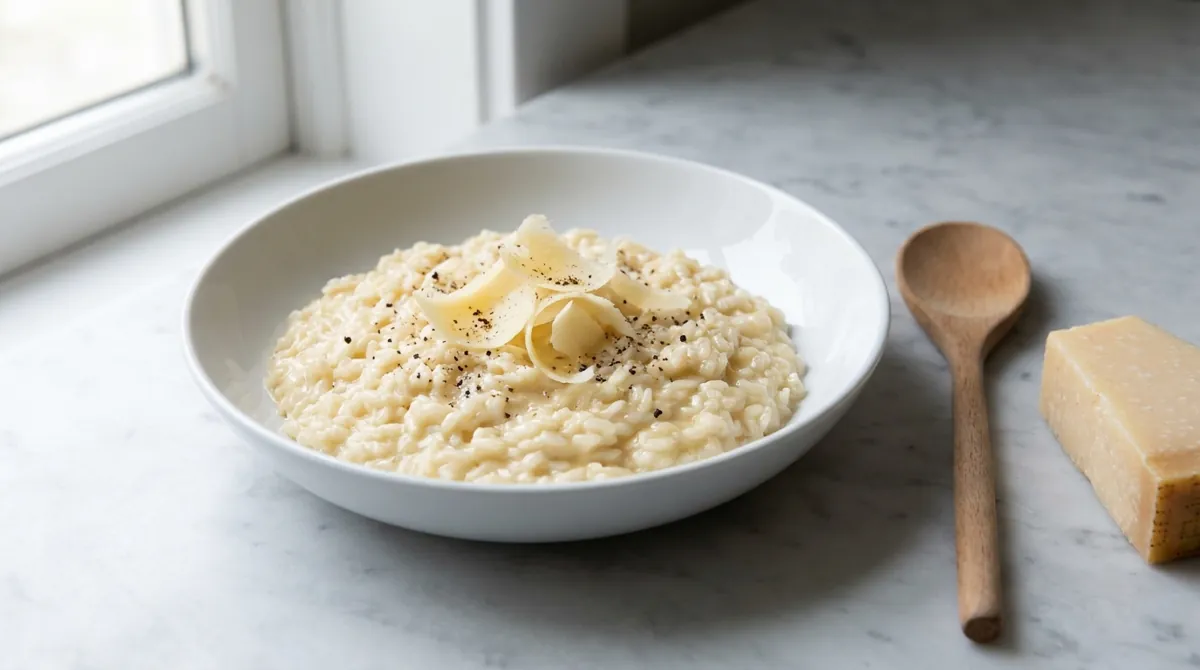
Risotto is a dish of the rice-growing north of Italy. Rice was grown in southern Italy for centuries before it moved north, where the marshy plains of the Po Valley suited it. Risotto is a way of cooking that rice rather than one fixed recipe: the grains are toasted in fat, then cooked with broth added a little at a time and stirred, so the starch on their surface turns the broth into a creamy sauce while the centers stay firm.
The first recipe that can be identified as risotto dates from 1809: rice sautéed in butter with sausage, bone marrow and onion, with saffron-colored broth added gradually. Giovanni Vialardi, an assistant chief cook to the kings of Savoy, printed one in his 1854 Trattato di cucina. Milan has a famous legend for its yellow saffron risotto: a Netherlandish glass painter called Valerio Profondavalle, working on the windows of Milan Cathedral, used saffron for his colors and supposedly added it to the rice at a wedding feast. Wikipedia notes that who invented it in Milan "cannot be stated with certainty."
The rice varieties now linked with risotto are modern. Breeding started in the 20th century, beginning with Maratelli in 1914, and Carnaroli, Vialone Nano and Maratelli are often considered the best. In the US the most common risotto rice is Arborio. This is the plain Parmesan risotto, risotto in bianco, the base for almost every other version.
Why it works the kitchen science
Starchy, short rice
Risotto rices carry loose starch on their surface, and stirring rubs it into the liquid. That is where the creaminess comes from, not from cream (Wikipedia).
No rinsing
Washing the rice would send the starch down the drain.
Toasting the grains
The tostatura heats and seals the outside of each grain so it absorbs broth evenly and keeps its shape.
Hot broth, a little at a time
Cold broth stalls the simmer, and adding it gradually keeps the grains rubbing together. America's Test Kitchen gets a similar result with less stirring by covering the pot and stirring hard only at the end.
Off the heat for the finish
Beating cold butter and cheese in off the heat emulsifies them into the starchy liquid instead of letting them split and turn greasy.
Serve at once
Risotto keeps absorbing liquid and tightens within minutes, so the plate should be waiting.
🧰 You'll need 5 items
Everything the steps call for. Tick off what you have before you start.
Pans and pots
Tools
Step by step
- Step 1
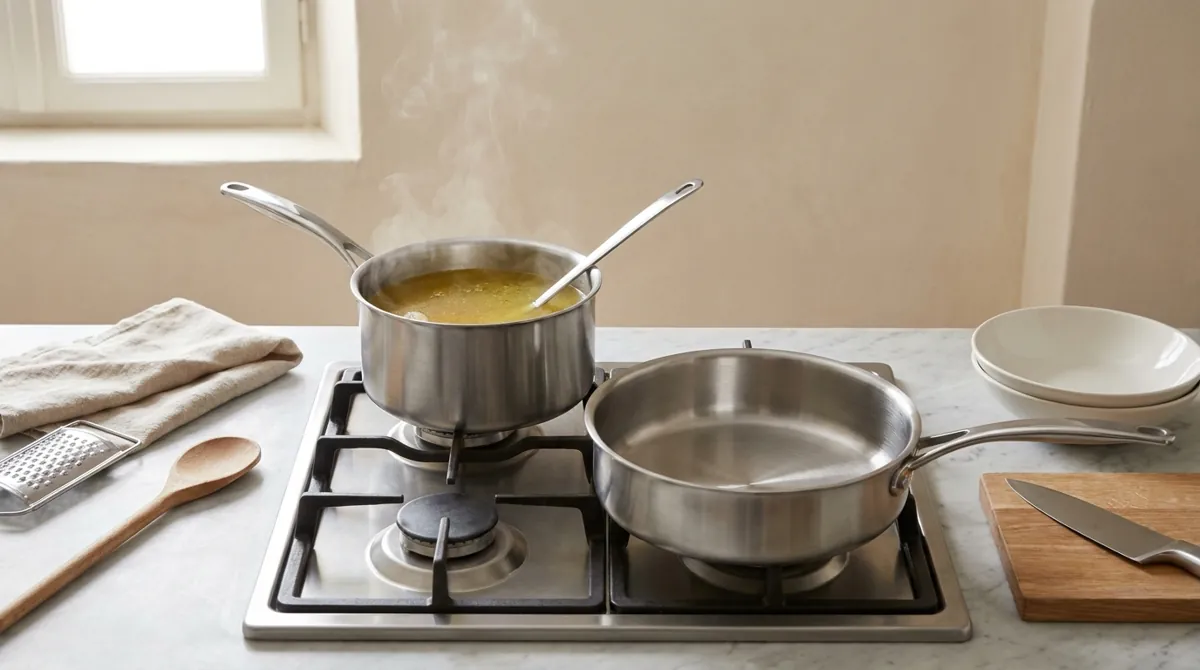
Bring the broth to a simmer in a medium saucepan, then turn it to the lowest heat and keep it hot, with a ladle in it.
- Step 2
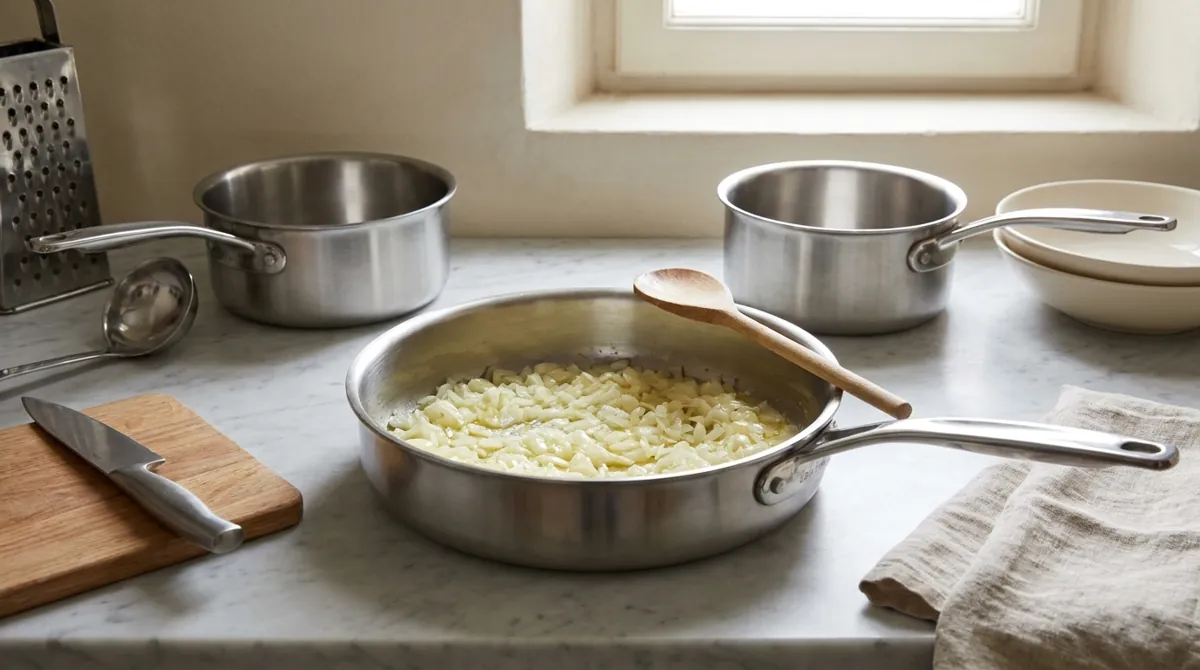
Melt 2 tbsp butter in a wide heavy-bottomed stainless steel saucepan over medium heat. Add the onion and the salt and cook, stirring now and then with a wooden spoon, 4 to 5 minutes, until soft and translucent but not browned.
- Step 3
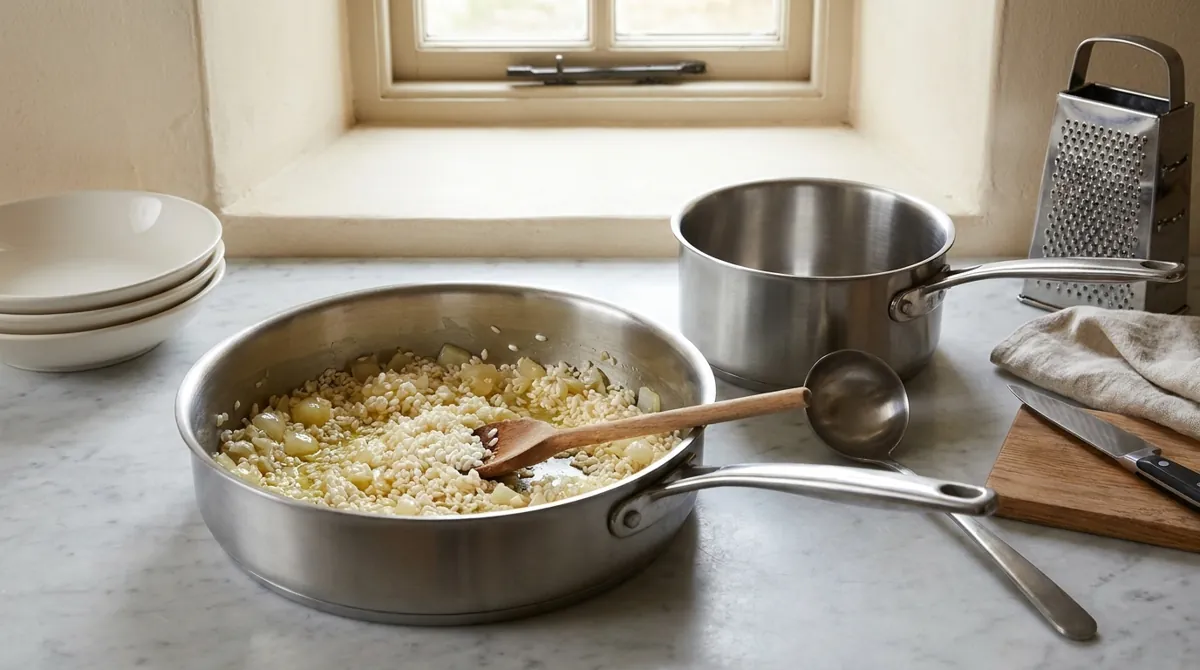
Add the rice and stir for 2 to 3 minutes, until the grains are coated, hot and glassy at the edges with a small white dot in the center. This is the tostatura.
- Step 4
Add the wine and stir until it is almost all absorbed, about 1 minute.
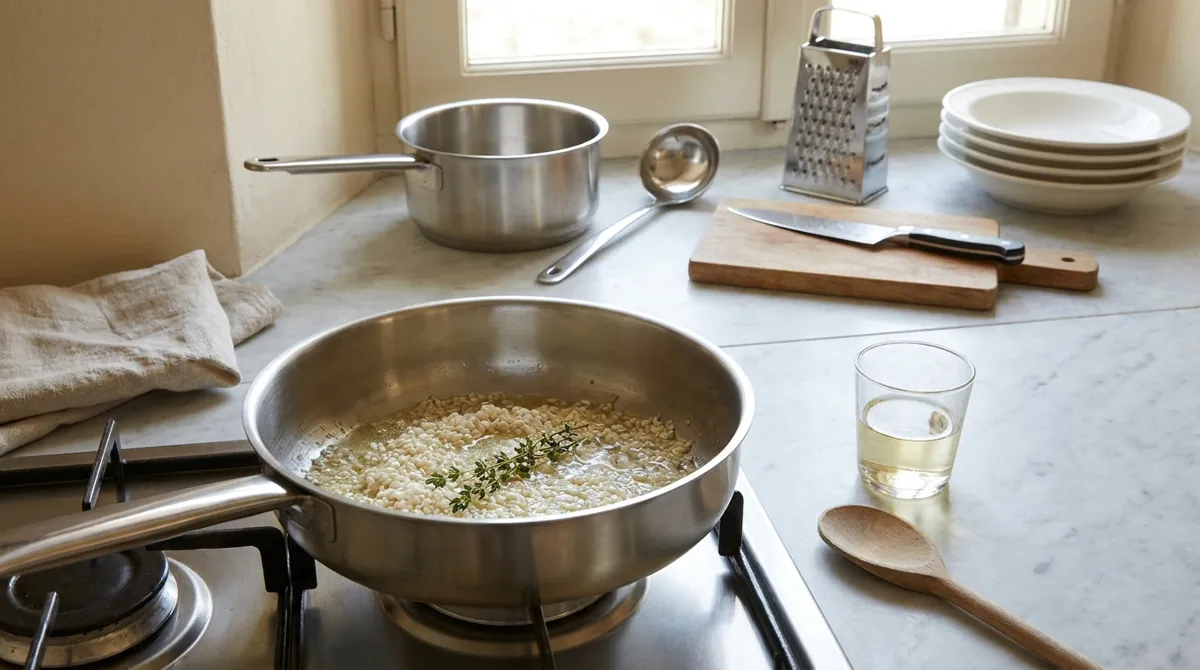
- Step 5
Add 1 ladle of hot broth (about 3/4 cup) and stir often, adjusting the heat to keep a lively simmer. When a spoon drawn through the rice leaves a path that closes slowly, add the next ladle. Keep going 16 to 20 minutes, until the rice is creamy and tender but still has a slight bite at the center; taste from about 15 minutes on.
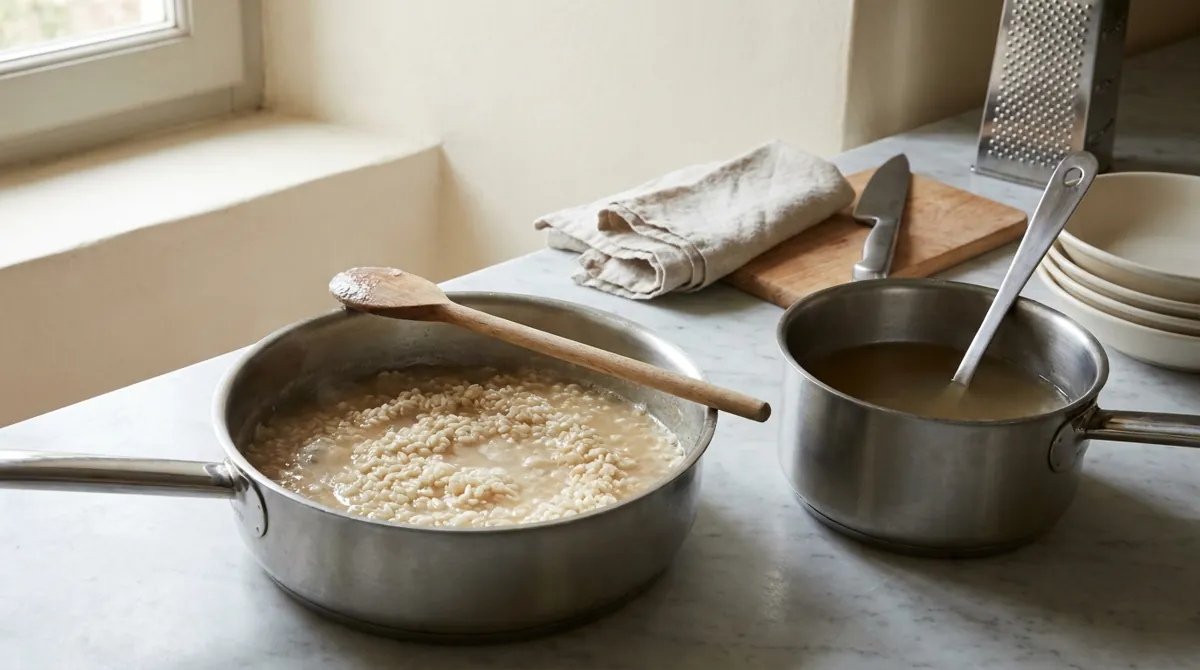
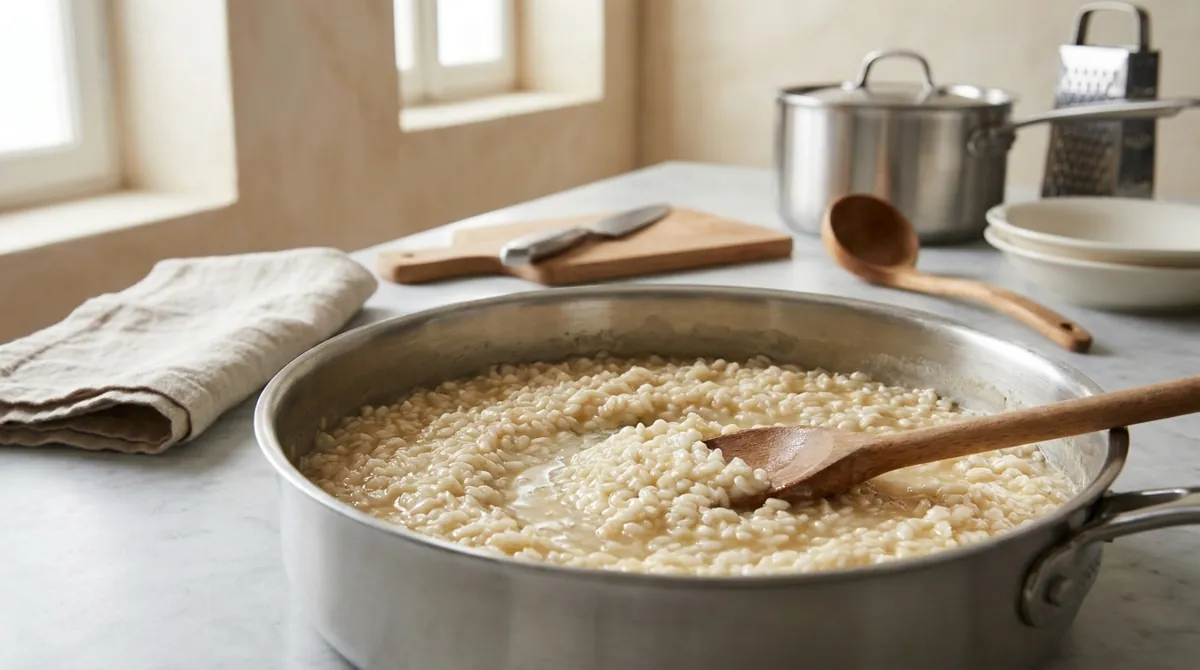
✓ What it should look like - Step 6
Take the pan off the heat. Add the cold butter and the Parmigiano and beat them in hard with the wooden spoon for about 1 minute (the mantecatura), adding a splash more broth if needed, until the risotto is glossy and loose enough to spread slowly across a plate. Season with salt and pepper, rest 1 minute and serve right away in warm shallow bowls, with more cheese at the table.
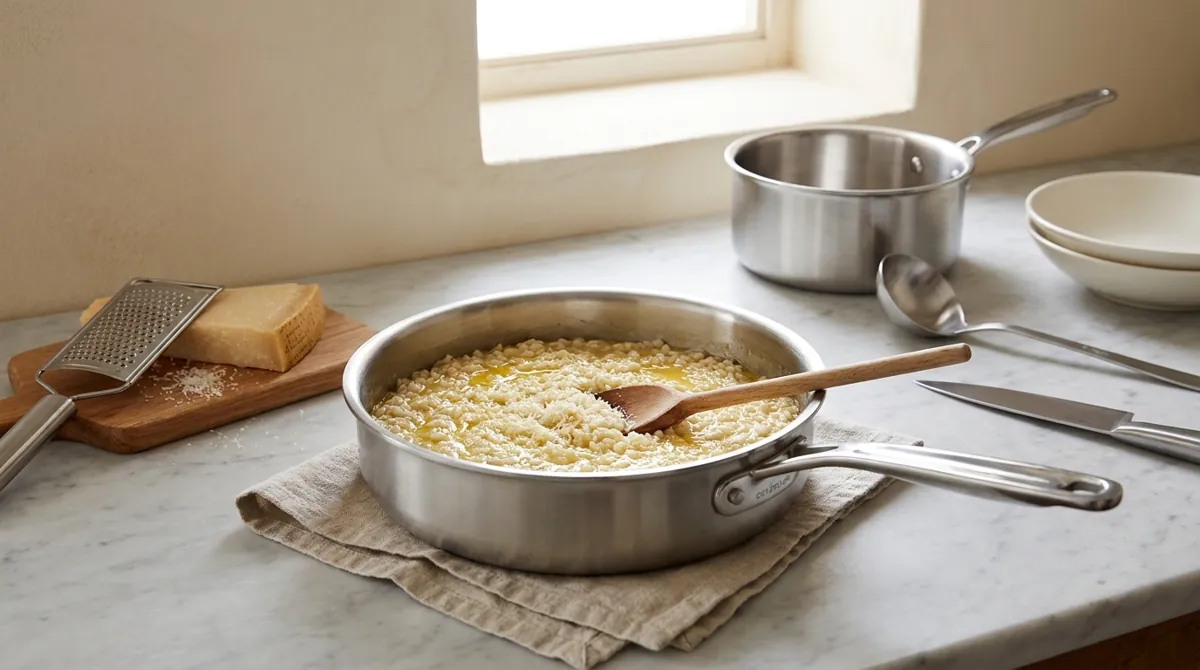
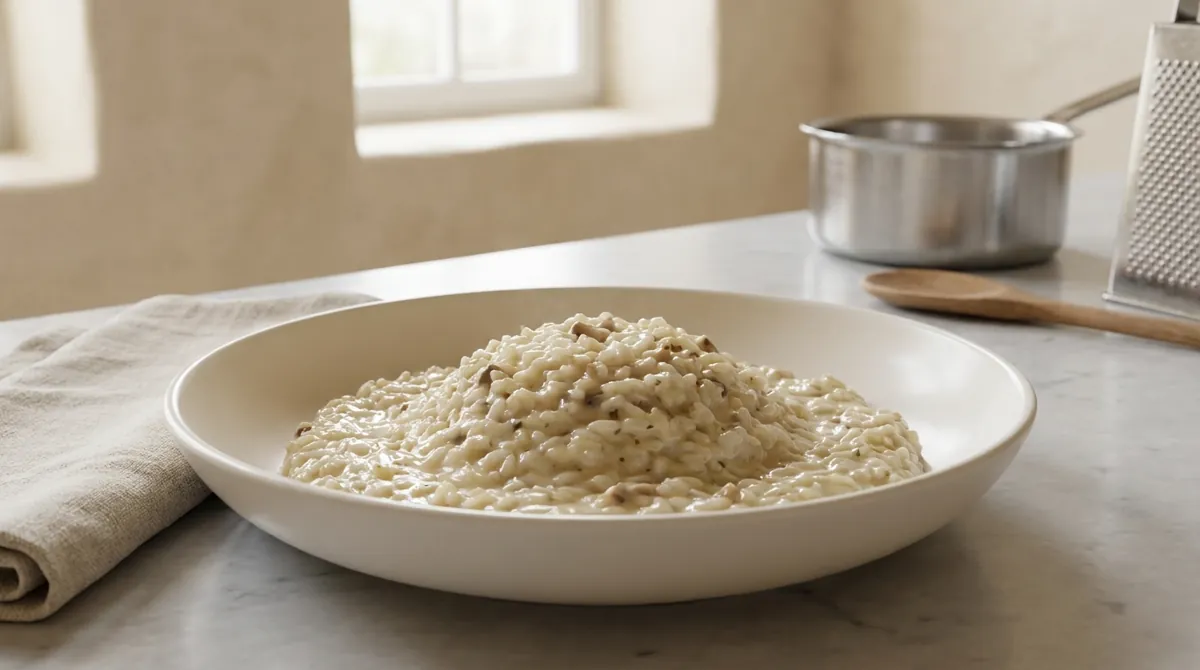
✓ What it should look like
Risotto
Serves 4 as a main, 6 as a first course · about 6 cups · 45 min total
- 6 cups low-sodium chicken broth or vegetable broth (1440 g); you may not need all of it
- 4 tbsp unsalted butter (57 g), divided, the last 2 tbsp cold and cubed
- 1 medium yellow onion, finely chopped (about 1 cup, 110 g)
- 1/2 tsp fine salt, plus more to taste
- 1 1/2 cups Carnaroli or Arborio rice (300 g); do not rinse it
- 1/2 cup dry white wine (118 g)
- 1 1/4 cups finely grated Parmigiano-Reggiano (70 g), plus more to serve
- Freshly ground black pepper
Equipment: Medium saucepan, Chef's knife and cutting board, Measuring cups and spoons, Mixing bowls, Ladle
Method
- Bring the broth to a simmer in a medium saucepan, then turn it to the lowest heat and keep it hot, with a ladle in it.
- Melt 2 tbsp butter in a wide heavy-bottomed stainless steel saucepan over medium heat. Add the onion and the salt and cook, stirring now and then with a wooden spoon, 4 to 5 minutes, until soft and translucent but not browned.
- Add the rice and stir for 2 to 3 minutes, until the grains are coated, hot and glassy at the edges with a small white dot in the center. This is the tostatura.
- Add the wine and stir until it is almost all absorbed, about 1 minute.
- Add 1 ladle of hot broth (about 3/4 cup) and stir often, adjusting the heat to keep a lively simmer. When a spoon drawn through the rice leaves a path that closes slowly, add the next ladle. Keep going 16 to 20 minutes, until the rice is creamy and tender but still has a slight bite at the center; taste from about 15 minutes on.
- Take the pan off the heat. Add the cold butter and the Parmigiano and beat them in hard with the wooden spoon for about 1 minute (the mantecatura), adding a splash more broth if needed, until the risotto is glossy and loose enough to spread slowly across a plate. Season with salt and pepper, rest 1 minute and serve right away in warm shallow bowls, with more cheese at the table.
Americanized house recipe, written for this site. History: Wikipedia, "Risotto" (rice in southern Italy before the Po Valley, Lombardy, the 1809 recipe with butter, sausage, bone marrow, onion and saffron broth, Giovanni Vialardi's 1854 Trattato di cucina, the Valerio Profondavalle saffron legend, Maratelli in 1914, Carnaroli, Vialone Nano, stirring to release starch, the mantecatura off the heat with butter and Parmesan). Technique: America's Test Kitchen, "Risotto Milanese" (onion softened in butter without browning, rice toasted about 2 minutes until the edges turn translucent, wine cooked until nearly absorbed, broth kept warm, a covered method stirred every 5 minutes then constantly at the end, cheese and butter stirred in, a somewhat loose finish that thickens as it sits, Carnaroli for a creamier result); America's Test Kitchen, "Almost Hands-Free Risotto with Parmesan and Herbs" (the low-stir method: covered pot, about 3 minutes of stirring at the end). en.wikipedia.org. Ingredient list follows the source; the method is in our own words.
Tips
- Vialone Nano, from the Veneto, gives a looser, wavier risotto; Carnaroli holds its shape best; Arborio is easiest to find and creamy but can turn soft if it overcooks.
- If you run out of broth, use hot water.
- For risotto alla milanese, add a big pinch of saffron threads to the hot broth in step 1.
- Leftovers will be stiff. Shape them into patties and pan-fry them in butter, or roll them around a cube of mozzarella, bread them and fry them as arancini.
The rules people argue about
What the sources agree on, what they don't, and what is just a good story.
- You must stir constantly. Disputed: Wikipedia says stirring releases the starch that makes risotto creamy, and the classic method is near-constant stirring, but America's Test Kitchen cooks it covered, stirring every few minutes and then hard at the end, with good results. Most cooks agree you need frequent stirring, not nonstop stirring.
- Carnaroli is the only true risotto rice. Disputed: Carnaroli, Vialone Nano and Maratelli are often called the best, and Arborio is the most common in the US. All of them work.
- The saffron glass painter invented risotto alla milanese. Folklore: it is the famous Milan story, but Wikipedia says who invented the dish "cannot be stated with certainty."
Meatballs of the World

Italian-American Meatballs
Big, tender meatballs braised for an hour in red sauce over spaghetti. The one most Americans grew up with.

Pallottine (Abruzzo Meatballs)
Tiny meatballs, smaller than a marble, tossed right through square spaghetti alla chitarra. No bread at all.

Swedish Meatballs (Köttbullar)
Small, soft meatballs browned in butter, in a cream sauce made from the same pan, with lingonberry jam on the plate.

Danish Frikadeller
Pork meatballs shaped with a spoon and fried slowly in butter, crusty outside and soft in the middle.

Königsberger Klopse
German meatballs that are never fried: poached, then served in a creamy white sauce with capers.

Spanish Albóndigas in Almond Saffron Sauce
The tapas bar classic: small meatballs in a golden sauce thickened with fried almonds and bread.

Mexican Albóndigas with Chipotle and Mint
Soft meatballs with rice and fresh mint inside, simmered in a smoky tomato and chipotle broth.

Izgara Köfte (Turkish Grilled Meatballs)
Small, flat meatballs kneaded hard, rested cold, and charred on a hot grill pan.

Lion's Head Meatballs
Big, soft pork meatballs, stirred into a sticky paste, fried to set, then braised in a savory sauce.

Chicken Tsukune
Japan's chicken meatball: kneaded sticky, grilled on skewers, glazed with sweet soy tare, dipped in egg yolk.