
Sourdough Bread
A crackling, deep brown crust and a chewy, tangy crumb from nothing but flour, water, salt and a wild-yeast starter: the oldest way to raise bread, made famous by San Francisco and revived by a whole country stuck at home in 2020.
🍳Cook alongOne move at a time, with real timers
 Edited by JP Lambiase
Change the estimate
Swaps change the price only: cook any meat to its own safe temperature. Where these numbers come from
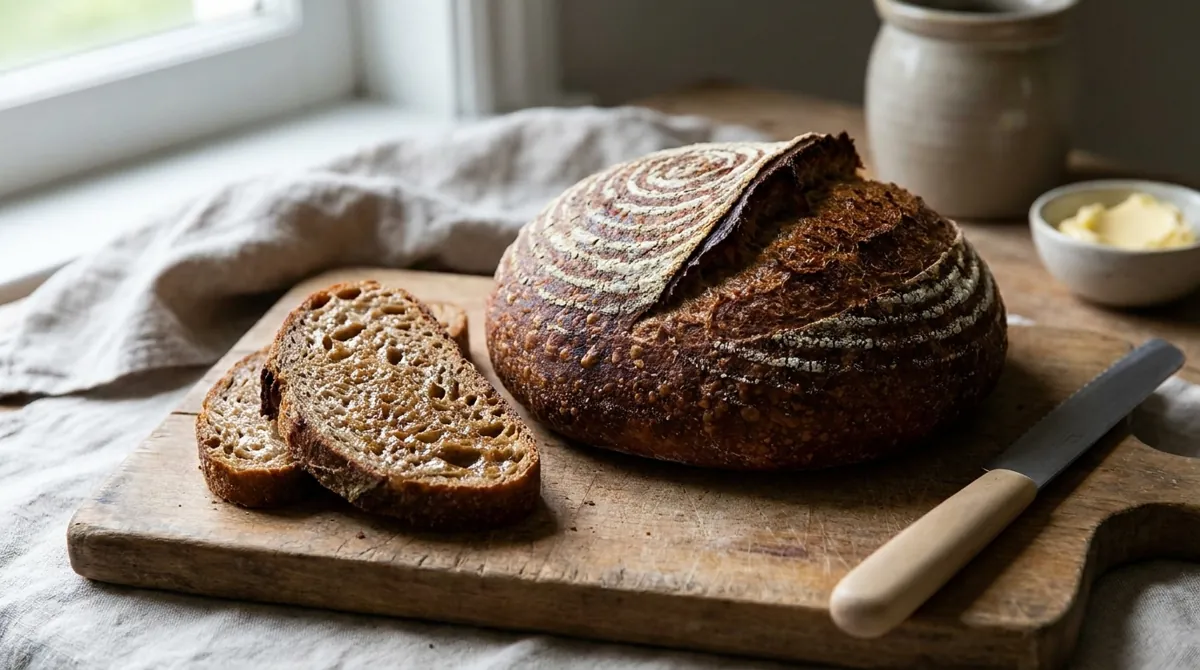
Before there was packaged yeast there was sourdough. Flour and water left to sit pick up wild yeasts and lactic acid bacteria, which together raise the dough and sour it. The Encyclopedia of Food Microbiology says the habit likely goes back to the beginnings of farming in the Fertile Crescent and Egypt, and one of the oldest sourdough loaves ever found, from about 3700 BC, was dug up in Switzerland. Pliny the Elder described several ways of leavening with sour dough.
In America the bread belongs to the West. French bakers brought their sourdough methods to Northern California in the Gold Rush, and San Francisco sourdough, a white bread with a pronounced sour tang, became the city's signature loaf. The bacteria in its starters was named Lactobacillus sanfranciscensis after the city, though it turns out to live in starters far beyond it. The romantic picture of the 1849 miner living on sourdough is shakier: Wikipedia says prospectors were more likely to use commercial yeast or baking soda. The tradition truly took hold in the 1898 Klondike Gold Rush, where prospectors carried pouches of starter and guarded them from the cold. Alaska and Yukon old-timers are still called "sourdoughs," and Robert Service's Songs of a Sourdough made the name stick.
Then came 2020. With baker's yeast gone from store shelves in the pandemic, home bakers grew their own starters from flour and water, and sourdough became the bread of lockdown.
This version is a plain country loaf: bread flour, an overnight rise in the fridge and a Dutch oven for the crust.
Why it works the kitchen science
The autolyse
Resting flour and water before the salt and starter go in lets the flour soak up the water and start building gluten, so the dough needs less work.
Stretch and folds
A few gentle folds build strength without kneading, enough to trap the gas the starter makes.
The cold proof
A night in the fridge slows the yeast while the bacteria keep making acid, so the bread is tangier, and cold dough is far easier to score.
The dutch oven
The lid traps the dough's own steam for the first 20 minutes, so the crust stays soft long enough for the loaf to spring open, then browns hard once the lid is off.
The long cool
The inside is still setting when it comes out; cut it hot and the crumb turns gummy.
🧰 You'll need 7 items
Everything the steps call for. Tick off what you have before you start.
Appliances
Pans and pots
Tools
Supplies
Step by step
- Step 1
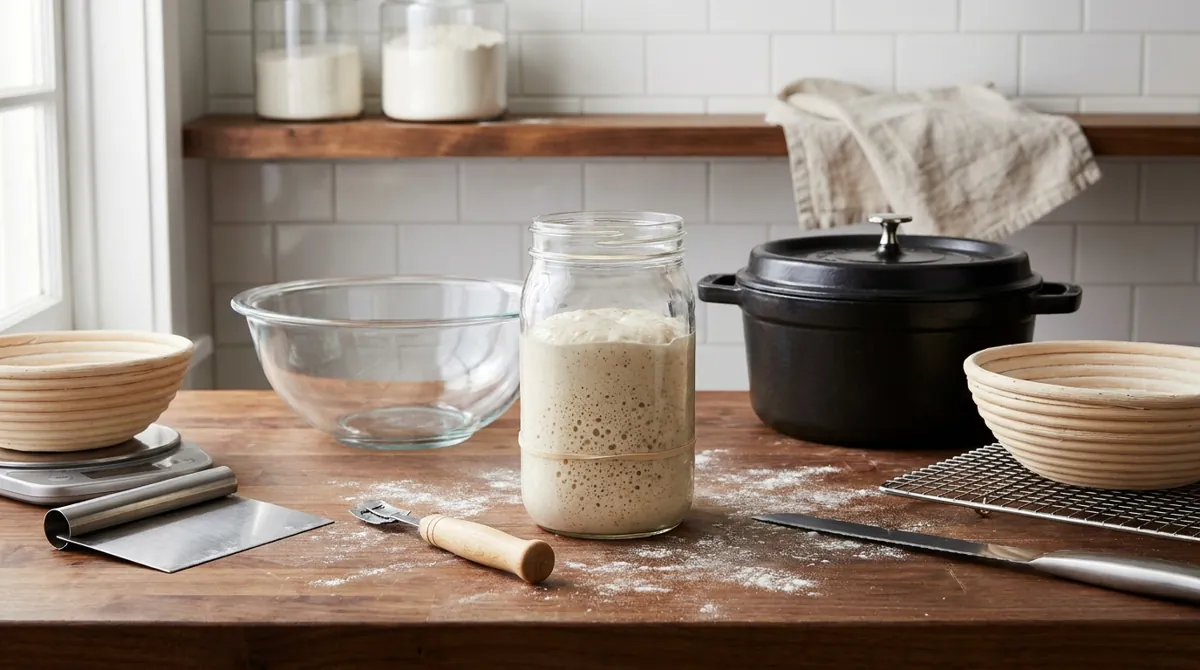
Feed your starter 4 to 8 hours ahead. It is ready when it has about doubled, is domed and full of bubbles and smells pleasantly sour.
- Step 2
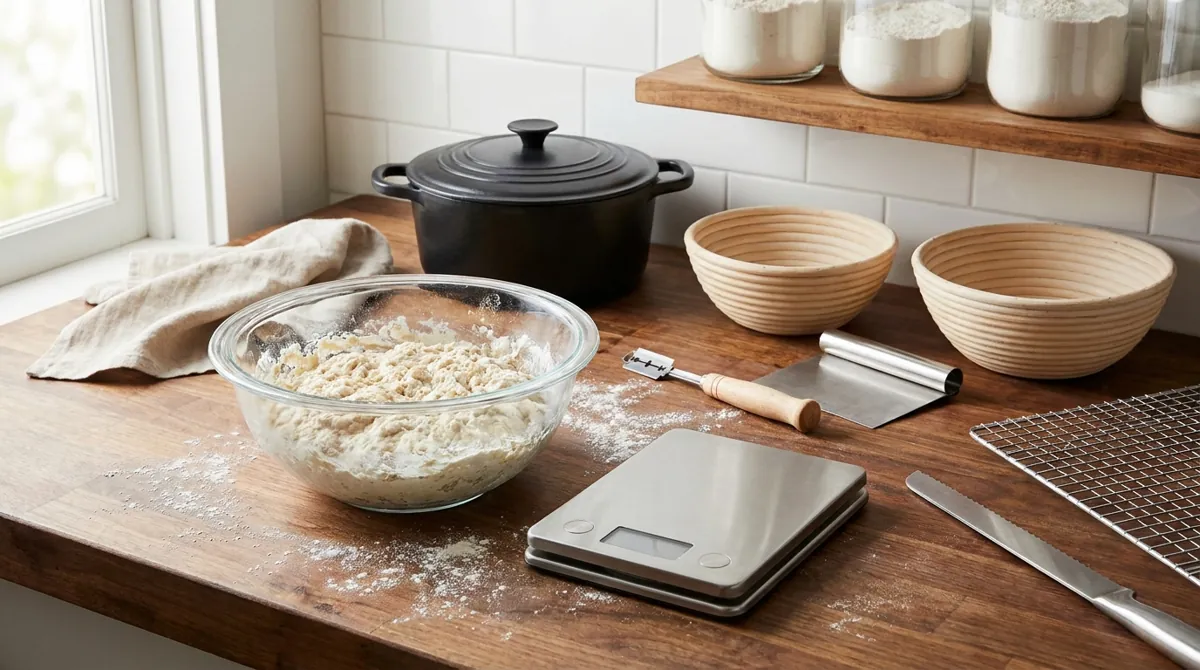
In a large bowl, mix the bread flour and 350 g water until no dry flour remains. Cover and rest 45 minutes (the autolyse).
- Step 3
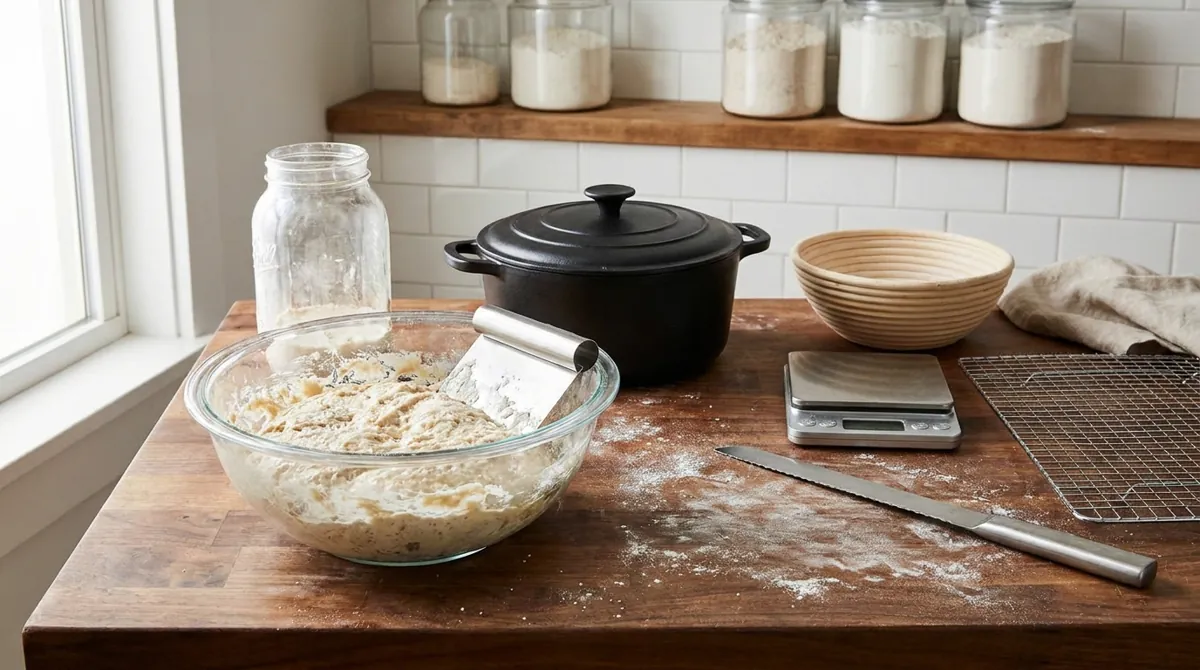
Add the 100 g starter, the salt and the last 25 g water. Squeeze and fold the dough with a wet hand until the starter and salt disappear, about 3 minutes.
- Step 4
Bulk rise: cover and leave in a warm spot, about 75°F, for 4 to 5 hours. In the first 2 hours, give it 4 sets of stretch and folds 30 minutes apart: with a wet hand, pull one side up and fold it over, turn the bowl and repeat four times. It is ready when it has grown 50 to 75 percent, is domed and jiggly, and shows bubbles on the top and sides.
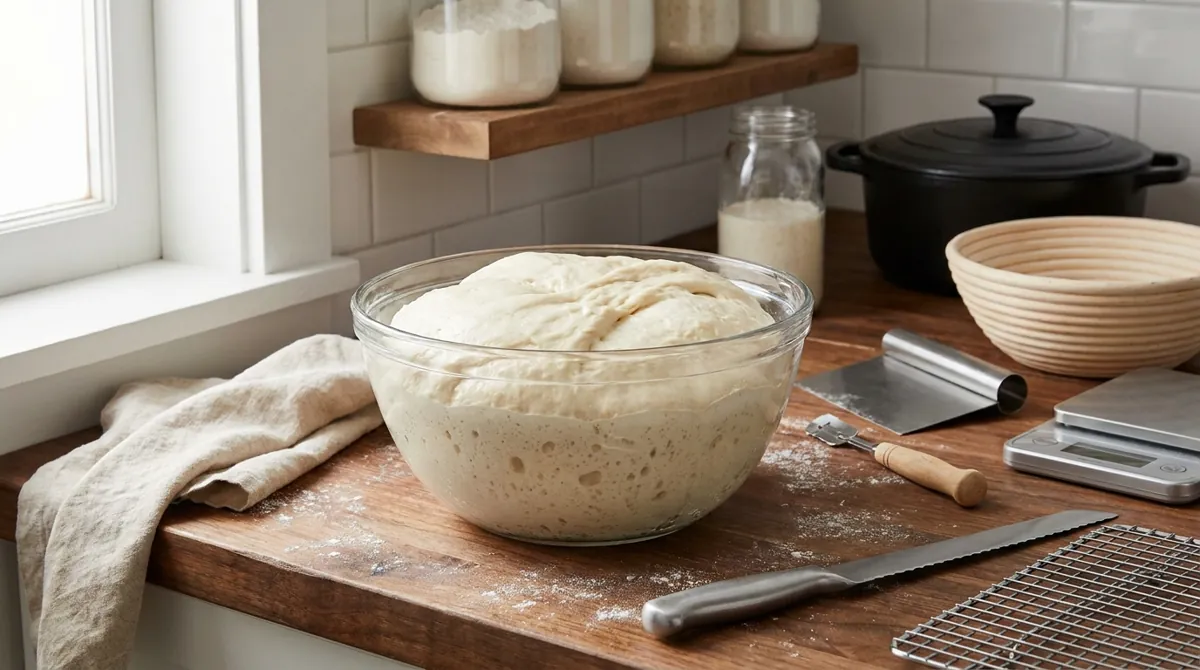
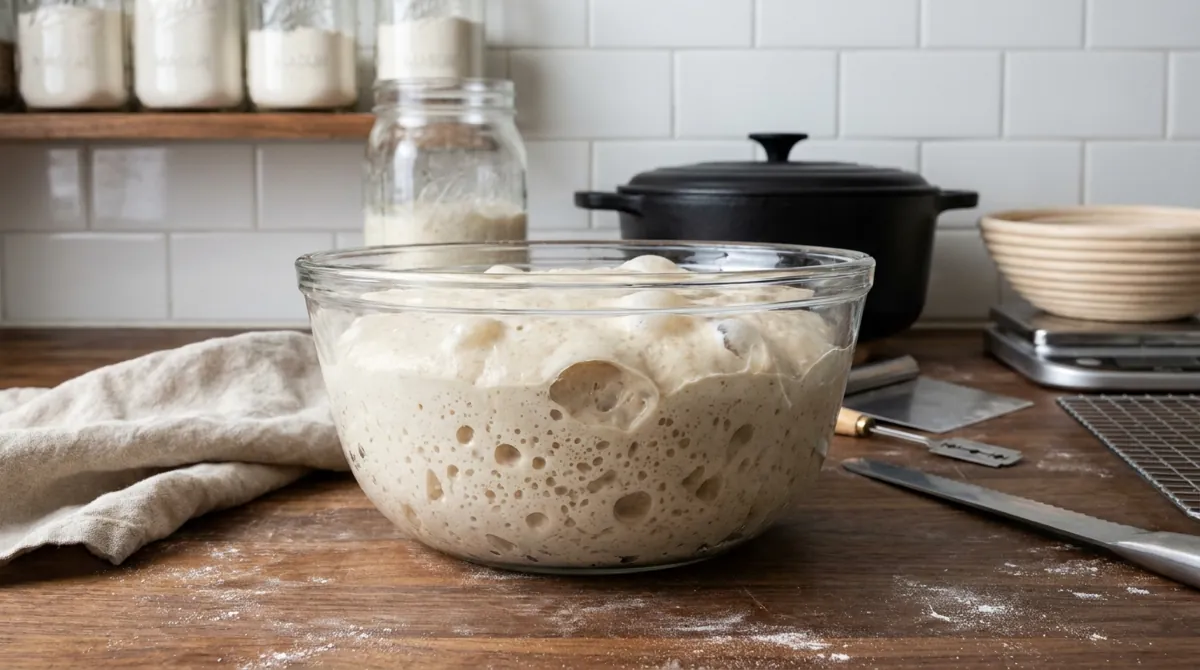
✓ What it should look like - Step 5
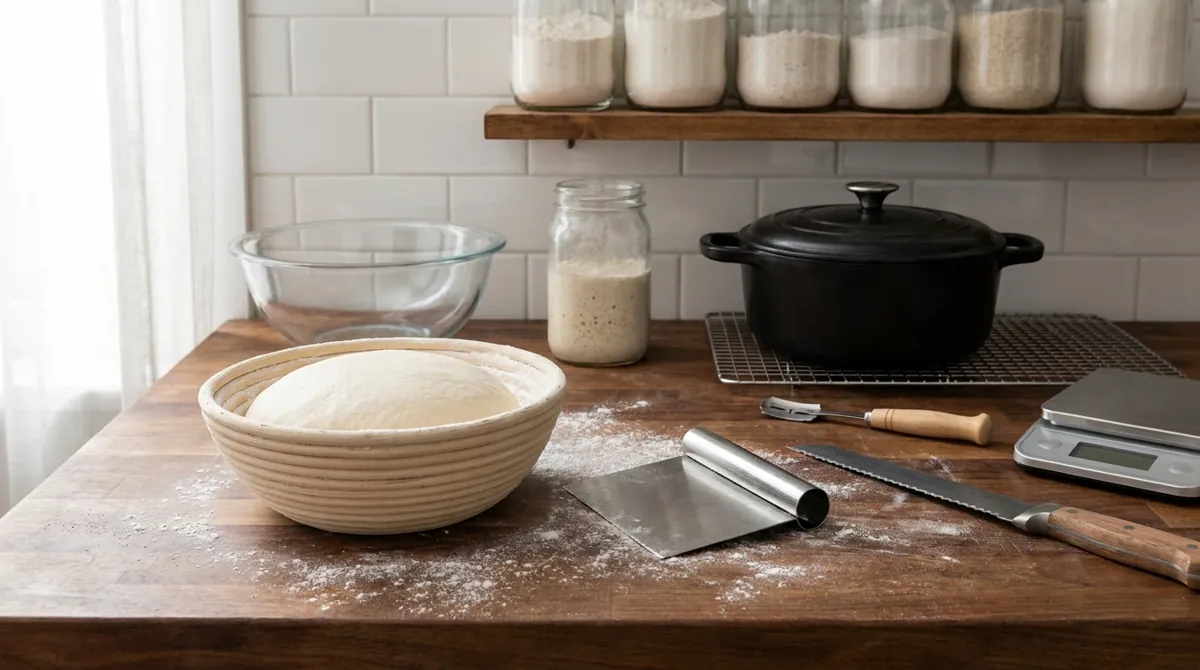
Turn the dough onto an unfloured counter, round it loosely with a bench scraper and rest 20 minutes. Dust the counter lightly, fold it into a tight round and set it seam side up in a 9 inch proofing basket (or a bowl lined with a towel) dusted with rice flour.
- Step 6
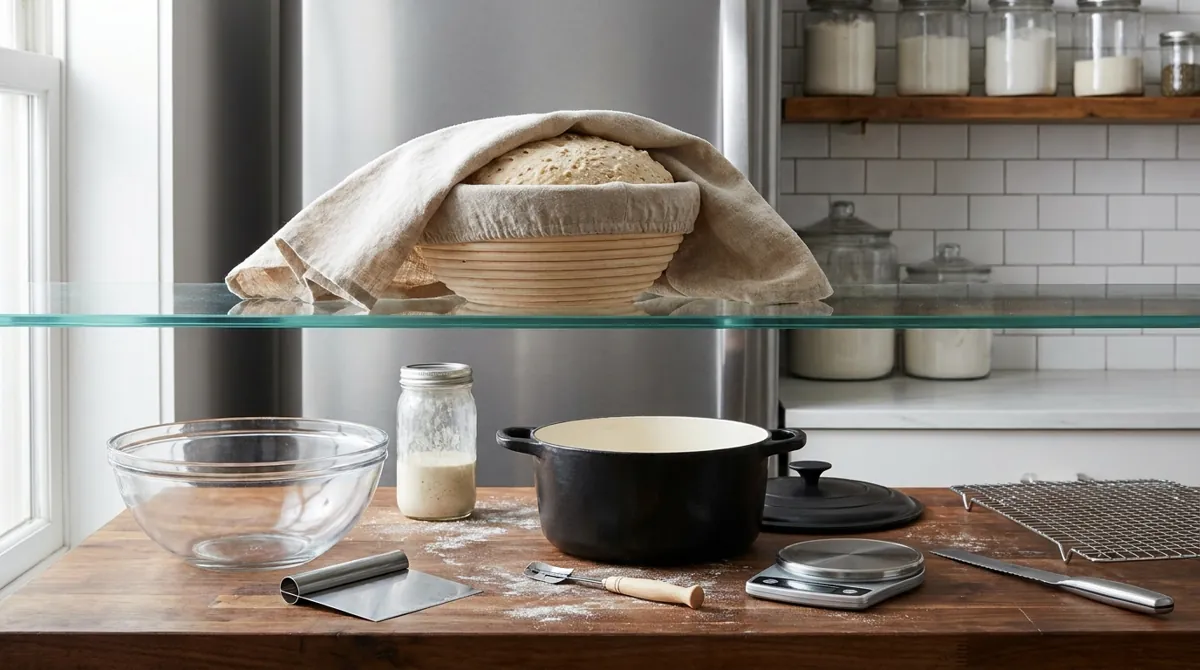
Cover and refrigerate 12 to 16 hours.
- Step 7
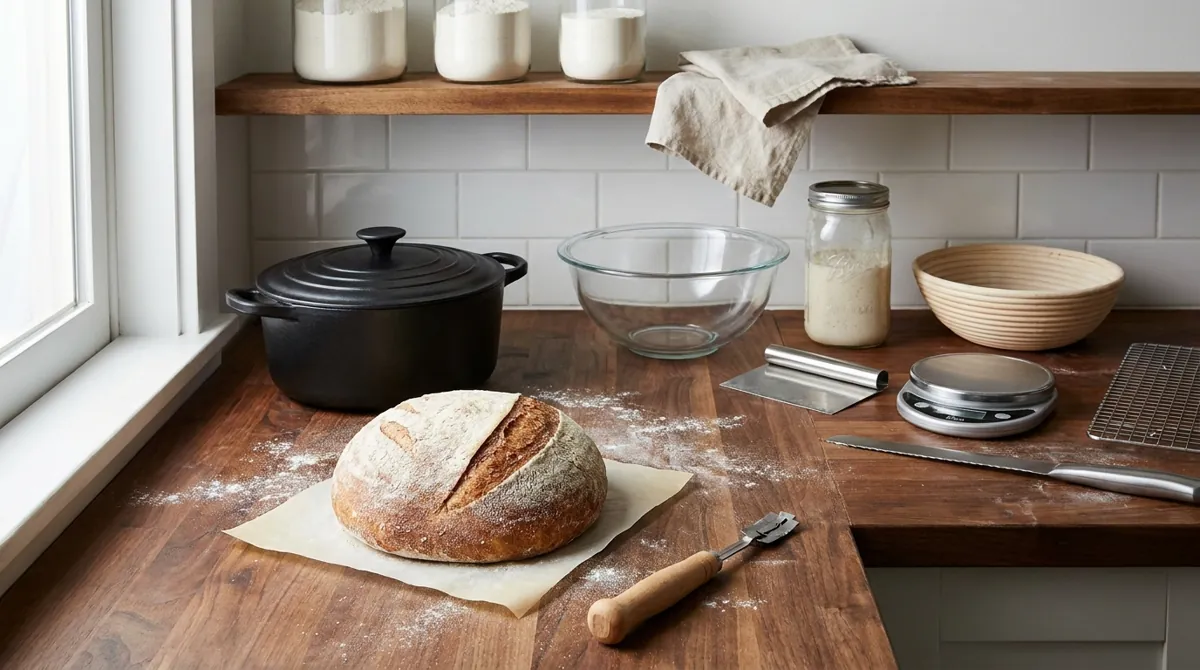
Put a 5 quart Dutch oven with its lid in the oven and heat to 500°F for 45 minutes. Turn the cold dough out onto a sheet of parchment and score it with one deep slash about 1/2 inch deep with a razor blade.
- Step 8
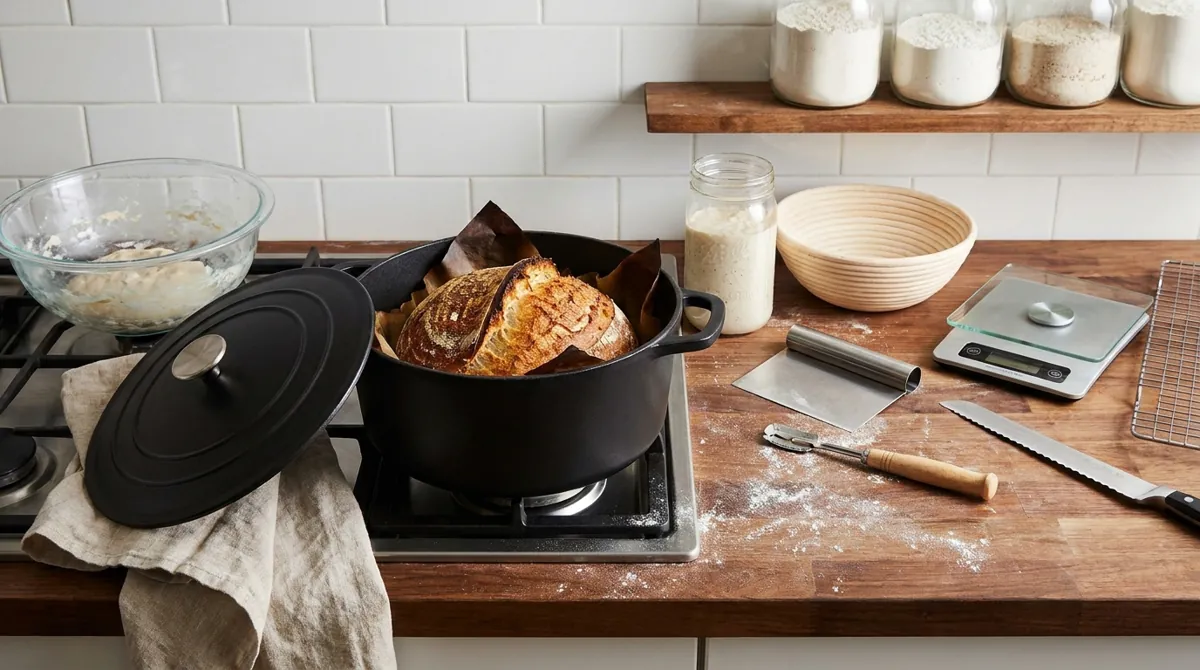
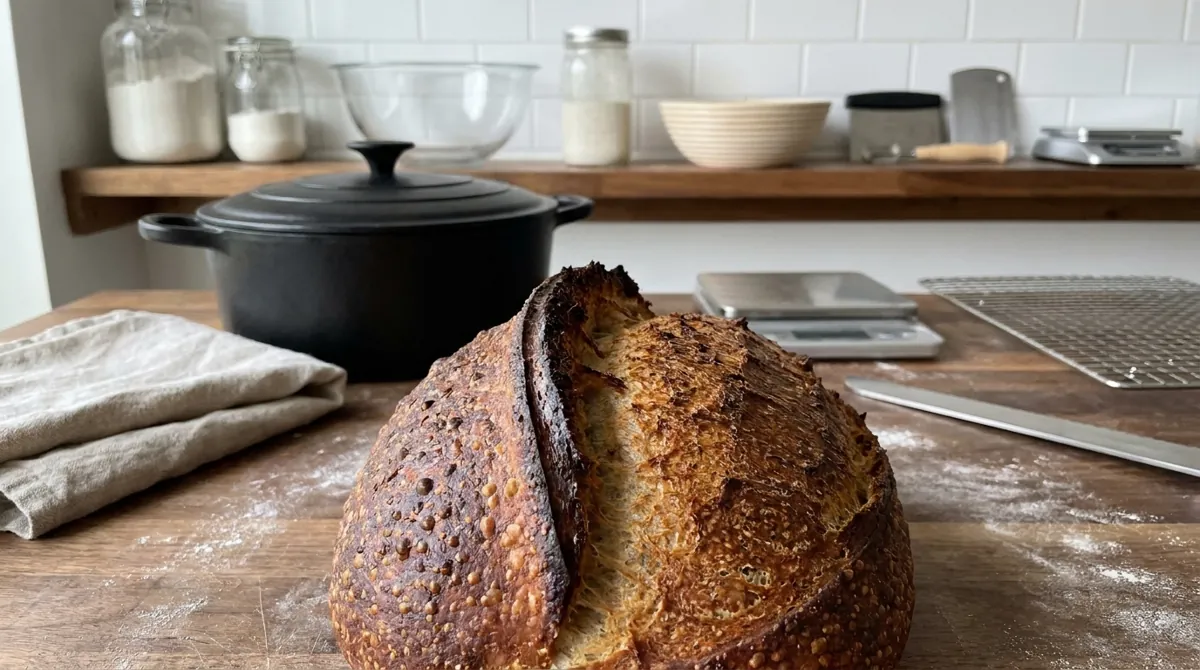
Lower the dough on its parchment into the hot pot, cover, and bake 20 minutes. Remove the lid, lower the heat to 450°F and bake 20 to 25 minutes more, until the crust is deep brown and the bread reads 205 to 210°F in the center.
✓ What it should look like - Step 9
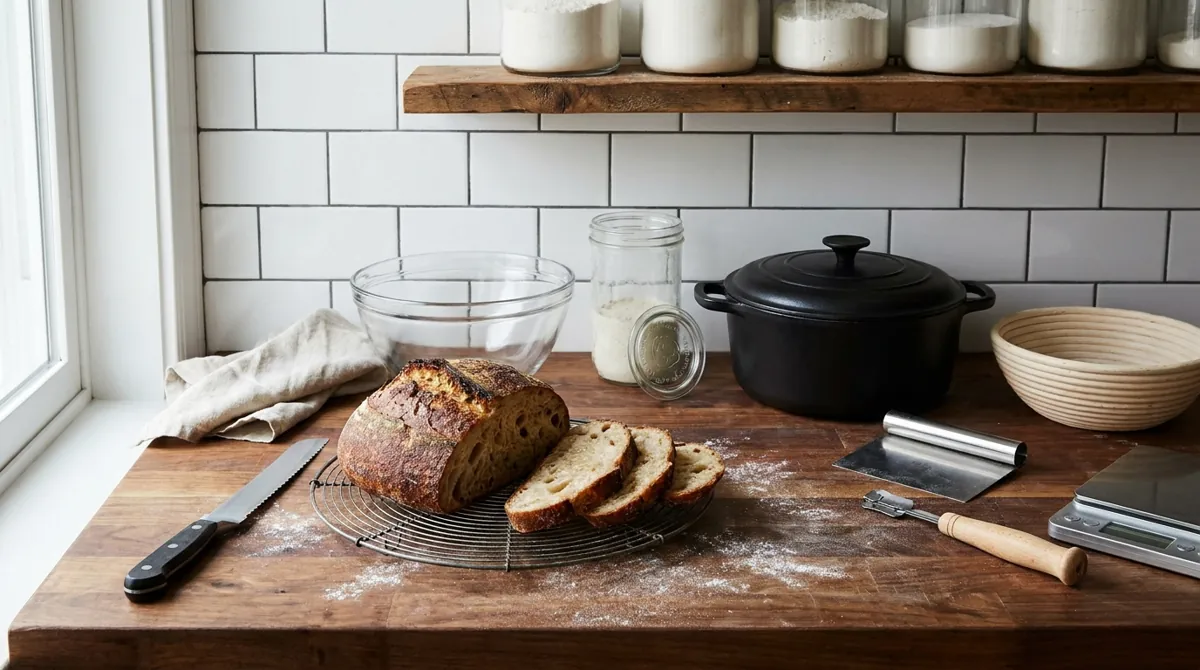
Cool on a wire rack at least 2 hours before slicing.
Sourdough Bread
Serves 8 · one round loaf, about 2 lb · 21 hr 15 min total
Starter
- 100 g ripe, active sourdough starter (fed equal weights of flour and water 4 to 8 hours before, bubbly and about doubled)
Dough
- 500 g bread flour (about 4 cups)
- 350 g lukewarm water (about 1 1/2 cups), plus 25 g more (about 2 tbsp)
- 10 g fine salt (about 1 3/4 tsp)
For shaping
- Rice flour or more bread flour, for dusting the basket
Equipment: Oven, Wire rack, 5-quart Dutch oven, Instant-read thermometer, Measuring cups and spoons, Mixing bowls, Parchment paper
Method
- Feed your starter 4 to 8 hours ahead. It is ready when it has about doubled, is domed and full of bubbles and smells pleasantly sour.
- In a large bowl, mix the bread flour and 350 g water until no dry flour remains. Cover and rest 45 minutes (the autolyse).
- Add the 100 g starter, the salt and the last 25 g water. Squeeze and fold the dough with a wet hand until the starter and salt disappear, about 3 minutes.
- Bulk rise: cover and leave in a warm spot, about 75°F, for 4 to 5 hours. In the first 2 hours, give it 4 sets of stretch and folds 30 minutes apart: with a wet hand, pull one side up and fold it over, turn the bowl and repeat four times. It is ready when it has grown 50 to 75 percent, is domed and jiggly, and shows bubbles on the top and sides.
- Turn the dough onto an unfloured counter, round it loosely with a bench scraper and rest 20 minutes. Dust the counter lightly, fold it into a tight round and set it seam side up in a 9 inch proofing basket (or a bowl lined with a towel) dusted with rice flour.
- Cover and refrigerate 12 to 16 hours.
- Put a 5 quart Dutch oven with its lid in the oven and heat to 500°F for 45 minutes. Turn the cold dough out onto a sheet of parchment and score it with one deep slash about 1/2 inch deep with a razor blade.
- Lower the dough on its parchment into the hot pot, cover, and bake 20 minutes. Remove the lid, lower the heat to 450°F and bake 20 to 25 minutes more, until the crust is deep brown and the bread reads 205 to 210°F in the center.
- Cool on a wire rack at least 2 hours before slicing.
Americanized house recipe, written for this site. History: Wikipedia, "Sourdough" (the Encyclopedia of Food Microbiology on origins likely tied to early farming in the Fertile Crescent and Egypt, the loaf from about 3700 BC excavated in Switzerland, Pliny the Elder, French bakers in the California Gold Rush, prospectors more likely using commercial yeast or baking soda, the 1898 Klondike, starter pouches, "sourdoughs" and Robert Service, Lactobacillus sanfranciscensis named for San Francisco but not endemic to it, the COVID-19 baking boom and yeast shortages). Technique: King Arthur Baking, "Naturally Leavened Sourdough Bread" (a ripe, active starter is essential when there is no commercial yeast; unbleached and whole wheat flour, water, salt); King Arthur Baking, "Rustic Sourdough Bread" (the beginner's loaf with added yeast as insurance, slashed loaves baked at 425°F until deep golden brown). en.wikipedia.org. Ingredient list follows the source; the method is in our own words.
All sources (3)
Tips
- No starter? Stir equal weights of flour and water in a jar and feed it daily; King Arthur says a homemade starter takes 5 to 7 days to be ready, or ask a baker friend for some.
- For a more open, wilder loaf, swap 50 g of the bread flour for whole wheat flour.
- For more sour, let the dough proof the full 16 hours or even 24; for less, shorten the cold proof and use a younger starter.
- If your kitchen is cool, the bulk rise can take 6 hours or more. Watch the dough, not the clock.
- Keep the loaf cut side down on a board for 2 days, then slice and freeze the rest.
The rules people argue about
What the sources agree on, what they don't, and what is just a good story.
- Sourdough was invented in ancient Egypt. Disputed: Egypt and the Fertile Crescent are the likely birthplace, but that is an inference; one of the oldest actual sourdough loaves found, from about 3700 BC, is from Switzerland.
- You can only make real San Francisco sourdough in San Francisco, because of the local bacteria. Disputed: Lactobacillus sanfranciscensis was named for the city's starters, but Wikipedia says it is not endemic to San Francisco; it lives in starters around the world.
- The 1849 miners lived on sourdough, which is why old-timers are called sourdoughs. Folklore for 1849: Wikipedia says the California prospectors were more likely to use commercial yeast or baking soda; the nickname comes from Alaska and the Yukon in the 1898 Klondike Gold Rush.
- A starter is ready when a spoonful floats in water. Disputed: many bakers use the float test, others call it unreliable and go by the starter doubling, doming and smelling sour, which is what this recipe uses.
- Sourdough is healthier and easier to digest than yeast bread. Disputed: the long fermentation does change the bread, but how much it helps digestion is still argued; treat health claims with care.
- Real sourdough never has commercial yeast. Disputed: purists say so, and this recipe has none, but King Arthur's own beginner loaf adds a little yeast as insurance.
Meatballs of the World

Italian-American Meatballs
Big, tender meatballs braised for an hour in red sauce over spaghetti. The one most Americans grew up with.

Pallottine (Abruzzo Meatballs)
Tiny meatballs, smaller than a marble, tossed right through square spaghetti alla chitarra. No bread at all.

Swedish Meatballs (Köttbullar)
Small, soft meatballs browned in butter, in a cream sauce made from the same pan, with lingonberry jam on the plate.

Danish Frikadeller
Pork meatballs shaped with a spoon and fried slowly in butter, crusty outside and soft in the middle.

Königsberger Klopse
German meatballs that are never fried: poached, then served in a creamy white sauce with capers.

Spanish Albóndigas in Almond Saffron Sauce
The tapas bar classic: small meatballs in a golden sauce thickened with fried almonds and bread.

Mexican Albóndigas with Chipotle and Mint
Soft meatballs with rice and fresh mint inside, simmered in a smoky tomato and chipotle broth.

Izgara Köfte (Turkish Grilled Meatballs)
Small, flat meatballs kneaded hard, rested cold, and charred on a hot grill pan.

Lion's Head Meatballs
Big, soft pork meatballs, stirred into a sticky paste, fried to set, then braised in a savory sauce.

Chicken Tsukune
Japan's chicken meatball: kneaded sticky, grilled on skewers, glazed with sweet soy tare, dipped in egg yolk.