
Tonkatsu
A thick pork loin cutlet in a shaggy panko crust, fried to a crackle and sliced over shredded cabbage with sweet-tangy tonkatsu sauce: Tokyo's best-loved Western-style dish.
🍳Cook alongOne move at a time, with real timers
 Edited by JP Lambiase
Change the estimate
Swaps change the price only: cook any meat to its own safe temperature. Where these numbers come from
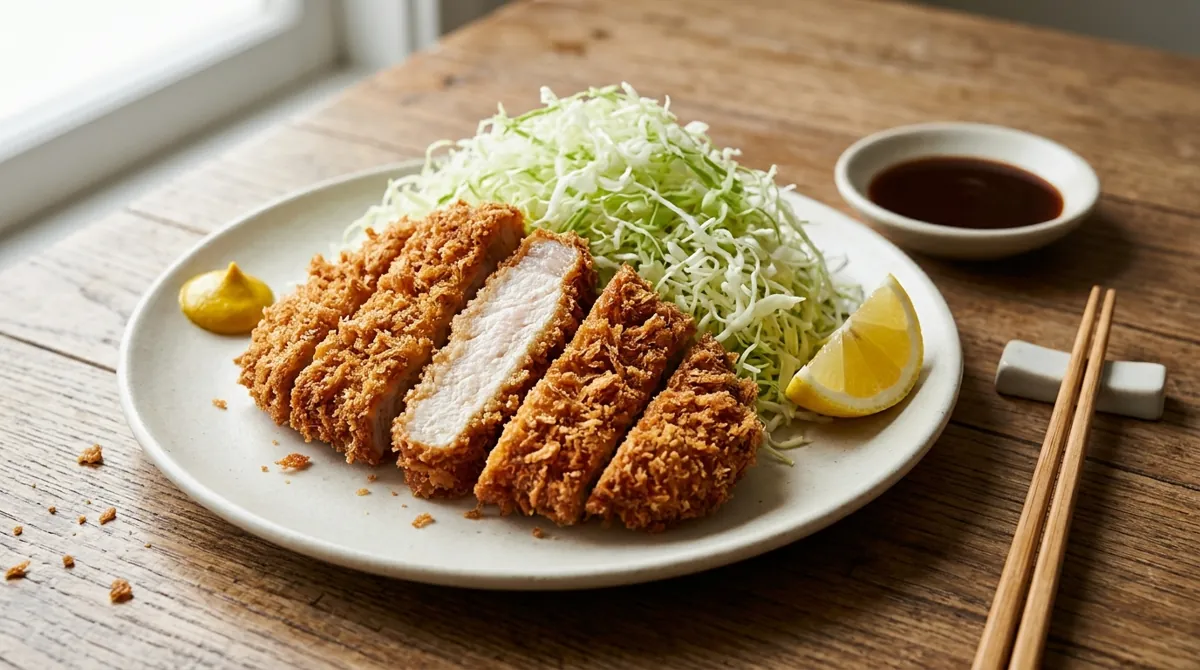
Tonkatsu is a Japanese pork cutlet, and it began as a French idea. It descends from the French côtelette de veau, a breaded veal cutlet that Japanese cooks reworked in the Meiji era into katsuretsu, the old Japanese rendering of "cutlet". Wikipedia dates the pork version to 1899 at Rengatei, a Western-style restaurant in Tokyo, and the thick-cut style most people know today to 1929, at a restaurant in Okachimachi, Ueno. The name is ton (pig) plus katsu, short for katsuretsu.
It is a yoshoku dish, Japanese cooking of Western food, and one of the "three great yoshoku" with curry rice and korokke (croquettes). The classic plate has the cutlet cut into strips, a heap of finely shredded cabbage, rice, miso soup and pickles, with a thick Worcestershire-style sauce and a dab of hot mustard.
Why it works the kitchen science
A thick cut
A 1 inch chop stays juicy inside while the crust browns, where a thin cutlet dries out.
Panko
The large, airy flakes fry up lighter and crunchier than fine breadcrumbs.
Slits in the fat band
The fat and connective tissue shrink in the heat, and cutting them keeps the cutlet flat.
Oil at 340°f
Hot enough to crisp the crust before the pork overcooks, and not so hot that the panko burns.
Resting on a rack
The crust stays crisp because steam can leave from the underside.
🧰 You'll need 7 items
Everything the steps call for. Tick off what you have before you start.
Pans and pots
Tools
Step by step
- Step 1
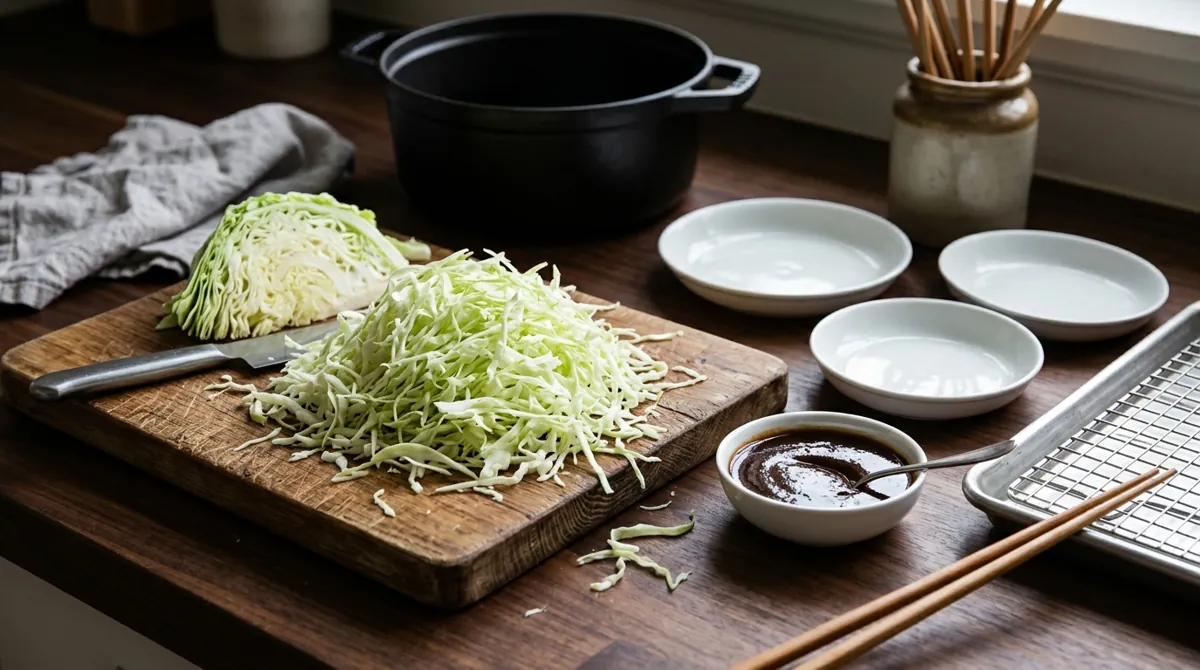
Shred the cabbage as finely as you can and chill it in cold water for 10 minutes, then drain and dry it. Stir the ketchup, Worcestershire, soy sauce and sugar together in a small bowl until the sugar dissolves.
- Step 2
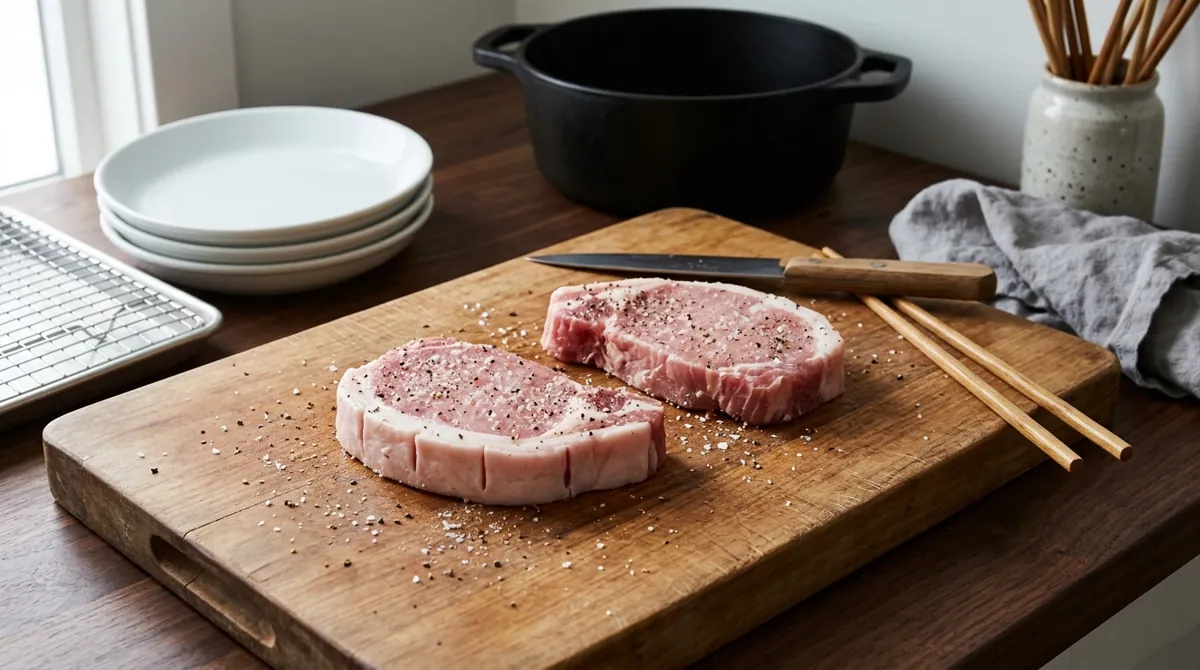
Cut four or five small slits through the white band of fat and silver skin on the edge of each chop so it will not curl. Pat the chops dry, then season both sides with salt and pepper.
- Step 3
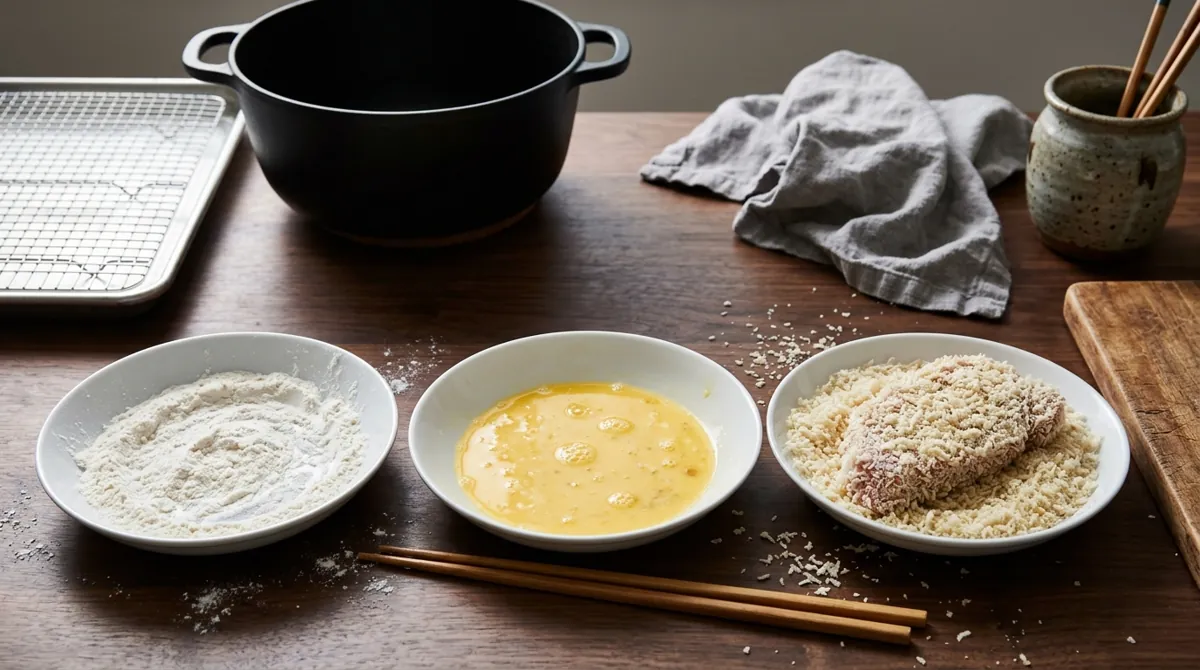
Set three shallow dishes in a row: flour, beaten egg, panko. Coat each chop in flour, shake off the extra, coat it in egg, then press it firmly into the panko on both sides until fully covered.
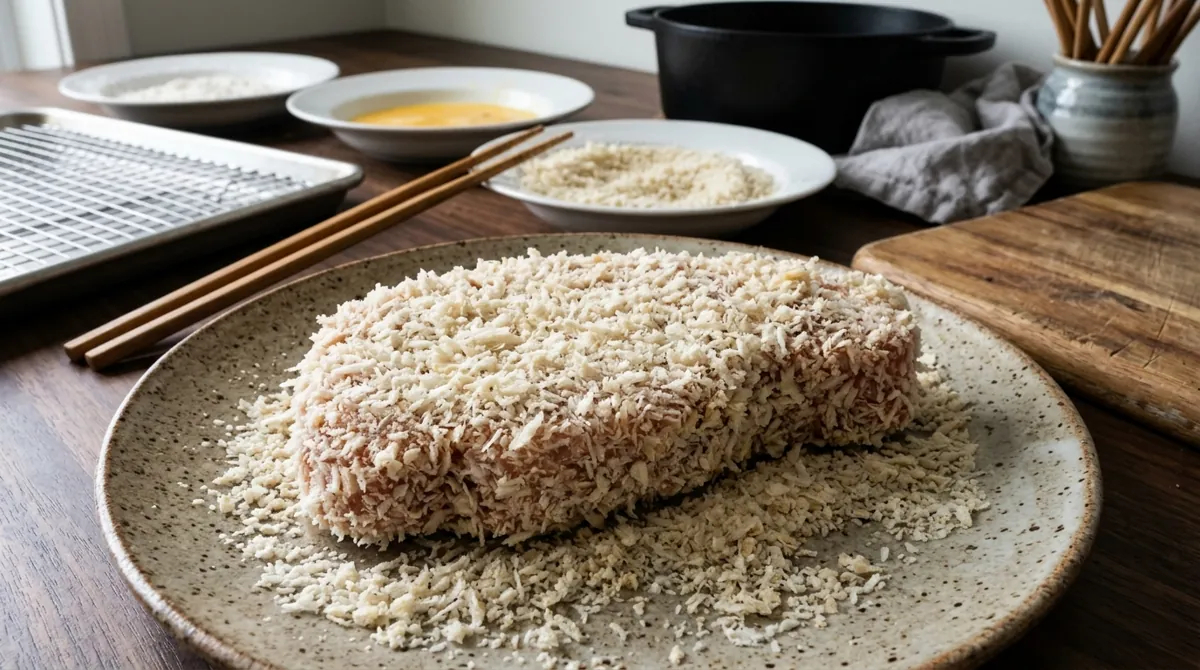
✓ What it should look like - Step 4
Pour the oil into a heavy Dutch oven to 1 1/2 inches and heat it to 340°F. A pinch of panko should sizzle and float up at once.
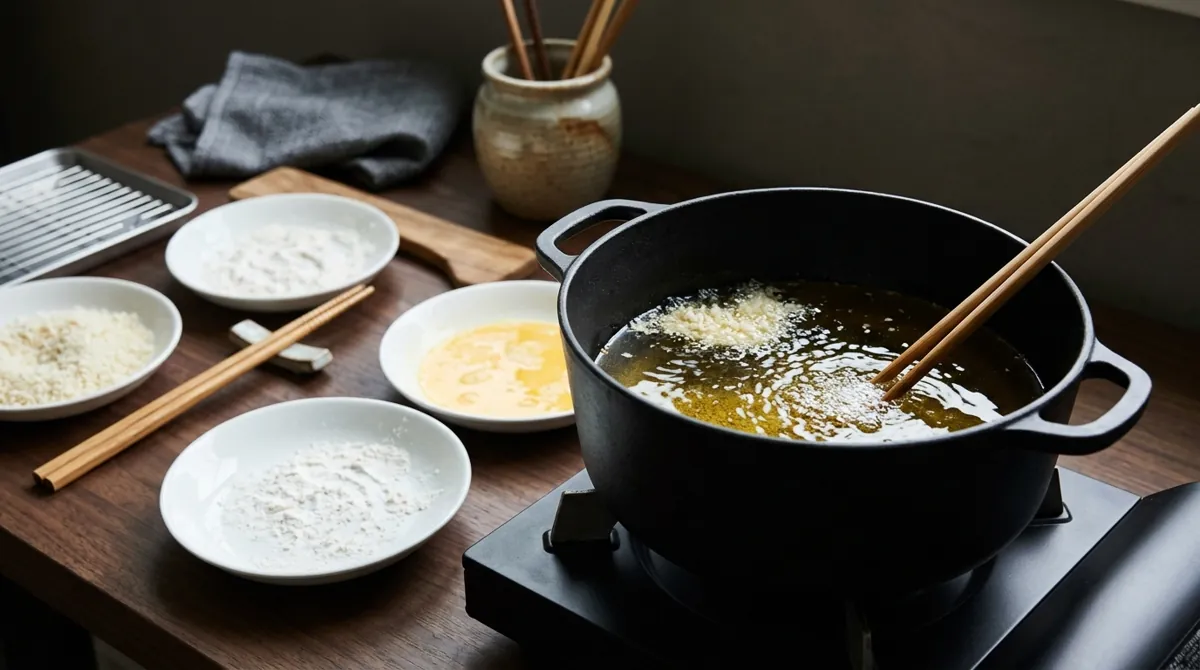
- Step 5
Fry the cutlets one at a time, 3 to 4 minutes a side, turning once, until deep golden and the pork reads 145°F in the center. Keep the oil near 340°F.
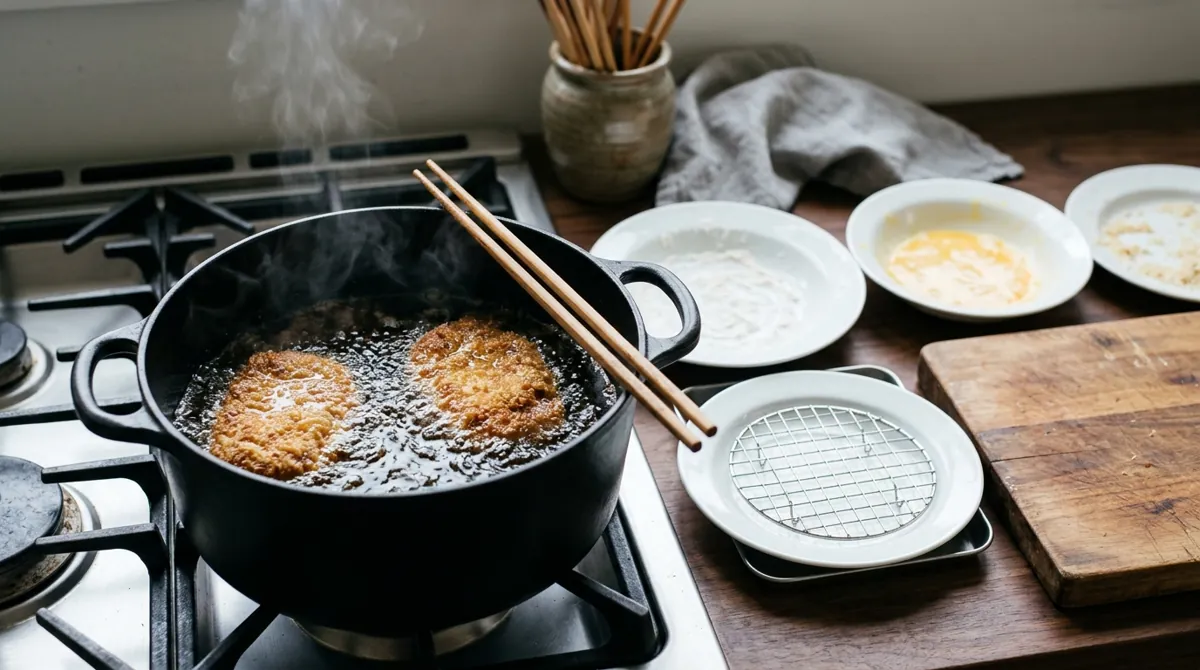
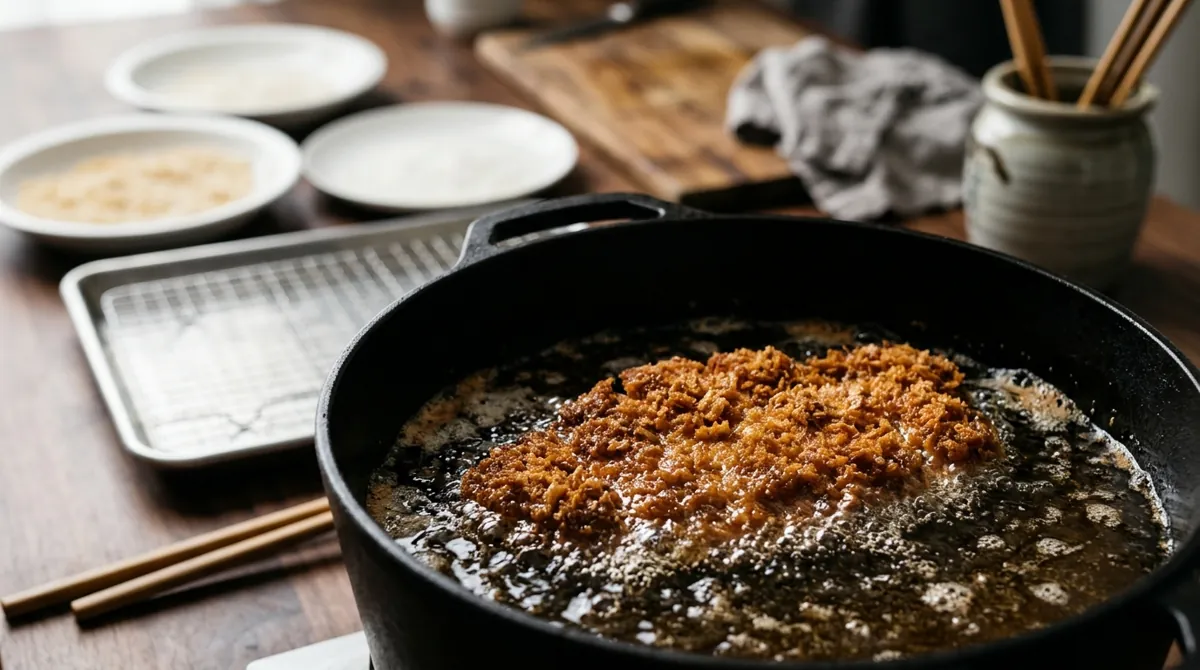
✓ What it should look like - Step 6
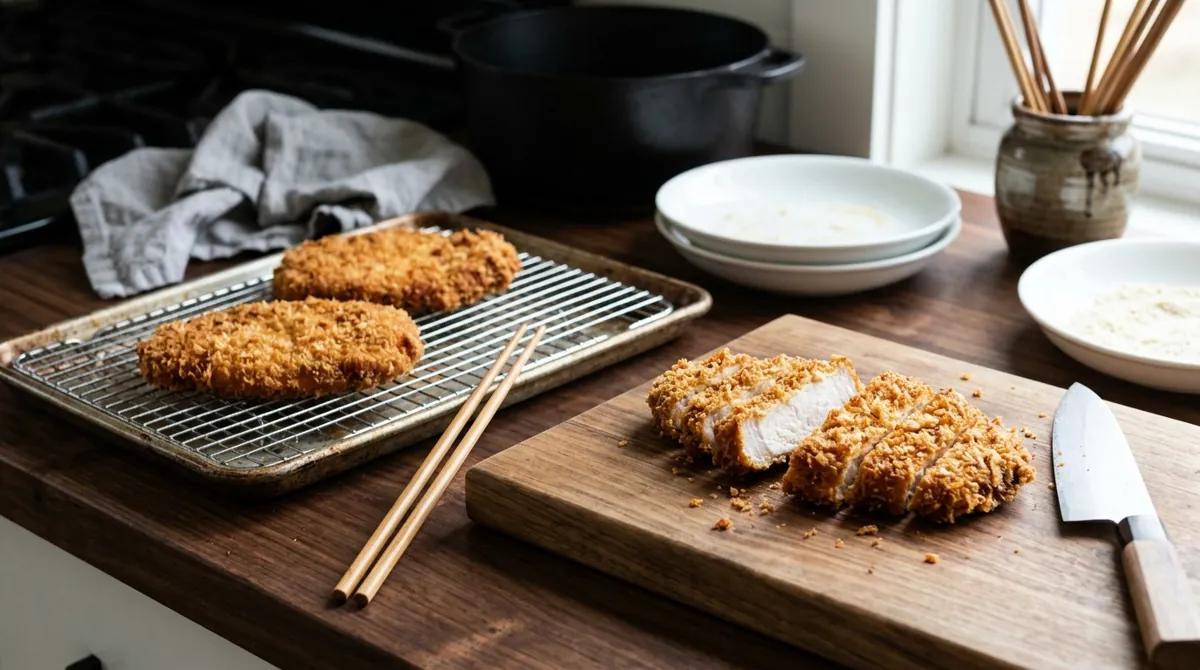
Rest the cutlets on a wire rack set over a tray for 5 minutes, then slice them crosswise into strips about 3/4 inch wide.
- Step 7
Mound the cabbage on a plate, lay the sliced cutlet beside it and serve with the sauce, hot mustard and lemon.
Tonkatsu
Serves 2 · 2 cutlets · 40 min total
Pork
- 2 boneless pork loin chops, 1 inch thick (about 170 g each, 340 g total)
- 1/2 tsp fine salt and plenty of black pepper
Coating
- 1/4 cup all-purpose flour (30 g)
- 1 large egg (50 g), beaten
- 1 cup panko breadcrumbs (50 g)
For frying
- About 3 cups neutral oil, such as vegetable or canola (enough for 1 1/2 inches in a Dutch oven)
Cabbage and sauce
- 3 cups finely shredded green cabbage (200 g)
- 3 tbsp ketchup (51 g)
- 2 tbsp Worcestershire sauce (34 g)
- 1 tbsp soy sauce (16 g)
- 1 tbsp granulated sugar (12 g)
- Hot mustard and lemon wedges, to serve
Equipment: Wire rack, Dutch oven, Instant-read thermometer, Deep-fry or candy thermometer, Chef's knife and cutting board, Measuring cups and spoons, Mixing bowls
Method
- Shred the cabbage as finely as you can and chill it in cold water for 10 minutes, then drain and dry it. Stir the ketchup, Worcestershire, soy sauce and sugar together in a small bowl until the sugar dissolves.
- Cut four or five small slits through the white band of fat and silver skin on the edge of each chop so it will not curl. Pat the chops dry, then season both sides with salt and pepper.
- Set three shallow dishes in a row: flour, beaten egg, panko. Coat each chop in flour, shake off the extra, coat it in egg, then press it firmly into the panko on both sides until fully covered.
- Pour the oil into a heavy Dutch oven to 1 1/2 inches and heat it to 340°F. A pinch of panko should sizzle and float up at once.
- Fry the cutlets one at a time, 3 to 4 minutes a side, turning once, until deep golden and the pork reads 145°F in the center. Keep the oil near 340°F.
- Rest the cutlets on a wire rack set over a tray for 5 minutes, then slice them crosswise into strips about 3/4 inch wide.
- Mound the cabbage on a plate, lay the sliced cutlet beside it and serve with the sauce, hot mustard and lemon.
Americanized house recipe, written for this site, using the usual ratios of home recipes (1 inch loin, flour, egg, panko, oil at about 340°F, a ketchup and Worcestershire sauce). History: Wikipedia, "Tonkatsu" (the French côtelette, Rengatei 1899, the thick-cut style in 1929, the name, yoshoku, cabbage and sauce). en.wikipedia.org. Ingredient list follows the source; the method is in our own words.
All sources (1)
Tips
- Do not press down on the cutlet in the oil, and never rest it on paper towels or the underside steams soft.
- Use a thermometer. Oil that is too cool makes a greasy crust, too hot burns it before the center cooks.
- Tenderloin (hire katsu) is a leaner, softer option; thick pork loin (rosu katsu) is the classic.
- Leftover cutlets reheat best in a 400°F oven or air fryer for 6 to 8 minutes, and they make a good katsu sandwich on soft white bread.
The rules people argue about
What the sources agree on, what they don't, and what is just a good story.
- Rengatei invented tonkatsu in 1899. Disputed: it is the date and restaurant cited by Wikipedia and in the standard retelling, but cutlet cookery in Meiji Japan was spreading fast and the claim is a restaurant's own history.
Meatballs of the World

Italian-American Meatballs
Big, tender meatballs braised for an hour in red sauce over spaghetti. The one most Americans grew up with.

Pallottine (Abruzzo Meatballs)
Tiny meatballs, smaller than a marble, tossed right through square spaghetti alla chitarra. No bread at all.

Swedish Meatballs (Köttbullar)
Small, soft meatballs browned in butter, in a cream sauce made from the same pan, with lingonberry jam on the plate.

Danish Frikadeller
Pork meatballs shaped with a spoon and fried slowly in butter, crusty outside and soft in the middle.

Königsberger Klopse
German meatballs that are never fried: poached, then served in a creamy white sauce with capers.

Spanish Albóndigas in Almond Saffron Sauce
The tapas bar classic: small meatballs in a golden sauce thickened with fried almonds and bread.

Mexican Albóndigas with Chipotle and Mint
Soft meatballs with rice and fresh mint inside, simmered in a smoky tomato and chipotle broth.

Izgara Köfte (Turkish Grilled Meatballs)
Small, flat meatballs kneaded hard, rested cold, and charred on a hot grill pan.

Lion's Head Meatballs
Big, soft pork meatballs, stirred into a sticky paste, fried to set, then braised in a savory sauce.

Chicken Tsukune
Japan's chicken meatball: kneaded sticky, grilled on skewers, glazed with sweet soy tare, dipped in egg yolk.