
Lasagne Verdi alla Bolognese
Thin sheets of green spinach pasta layered at least six times with slow-cooked ragù, a light béchamel, butter and plenty of Parmigiano Reggiano. No ricotta, no mozzarella.
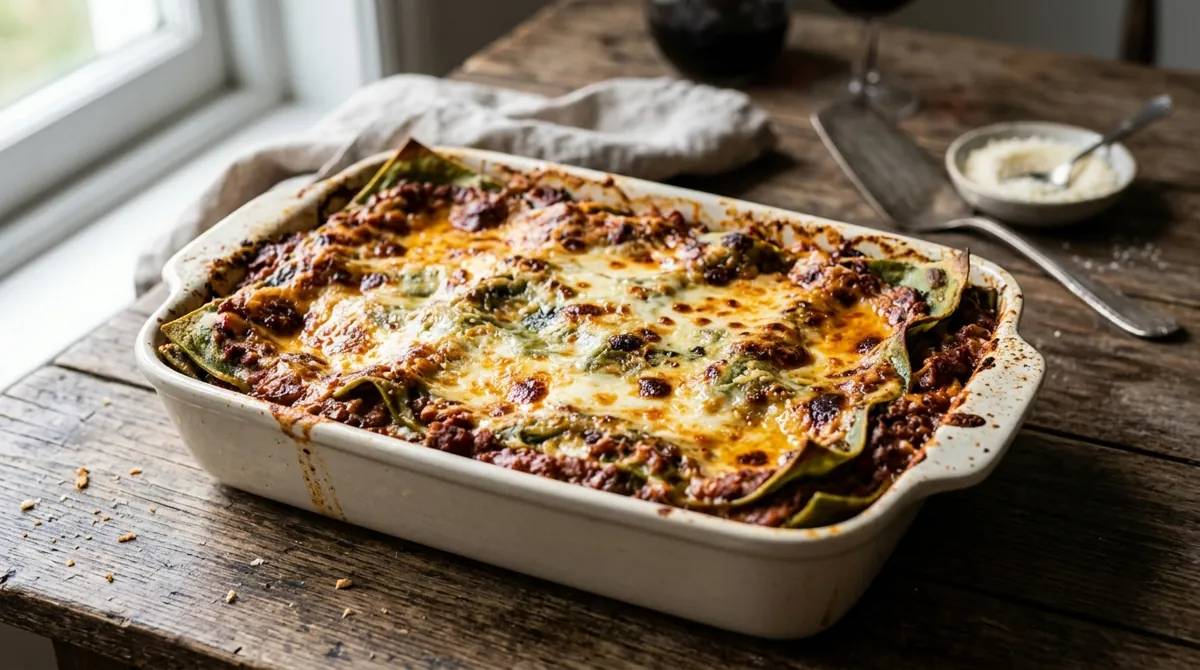
Bologna keeps an unusual cookbook: a collection of recipes sealed by notarial deed at its Chamber of Commerce, filed by the Accademia Italiana della Cucina. The collection started on 16 April 1972 with the "golden measure" of the tagliatella and now holds thirty-four recipes (Bologna Chamber of Commerce press release, 20 April 2023:). The ragù was first deposited on 17 October 1982 and replaced with an updated version on 20 April 2023 (same release). The green lasagne recipe was approved by the Accademia on 28 May 2003 and registered by notarial deed with the Chamber of Commerce at Palazzo della Mercanzia on 4 July 2003, according to the city's official tourism site. Its rules: spinach in the pasta dough, at least six layers, ragù, béchamel, butter and Parmigiano Reggiano.
🇮🇹 The original
Thin sheets of green spinach pasta layered at least six times with slow-cooked ragù, a light béchamel, butter and plenty of Parmigiano Reggiano. No ricotta, no mozzarella.
🇺🇸 The American version
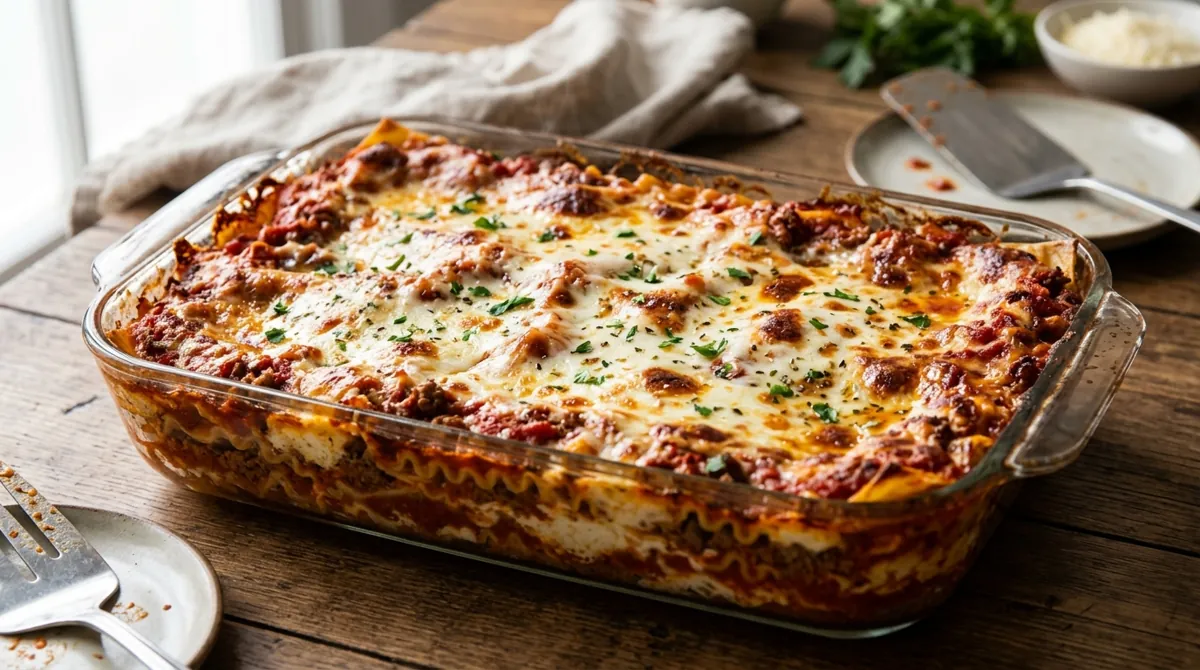
America swapped the béchamel for ricotta and mozzarella, used wide dried noodles and a tomato-heavy meat sauce, and baked it tall. See the Classic American Lasagna with Ricotta and Mozzarella recipe.
Why it works the kitchen science
Thin pasta, many layers
Very thin sheets and a little sauce on each make a lasagna that is tender and light instead of a heavy slab, and the Parmigiano and butter between the layers glue it together.
Béchamel instead of ricotta
A thin coat of béchamel keeps every layer moist and creamy and lets the slow-cooked ragù be the main flavor.
Step by step
- Step 1
Make the ragù. Warm the oil and pancetta in a heavy 10-inch Dutch oven over medium-low heat until the fat melts, about 5 minutes. Add the chopped onion, carrot and celery and cook gently, stirring, 10 minutes, until soft but not browned. Raise the heat to medium-high, add the beef and cook, stirring, about 10 minutes, until it is no longer pink and starts to sizzle (160°F).
- Step 2
Pour in the wine and cook 3 to 5 minutes, until you can no longer smell it. Stir in the tomato paste and passata, then 1 cup of the hot broth. Cover, turn the heat to the lowest setting and simmer 2 hours (up to 3), stirring now and then and adding broth a splash at a time when it looks dry. Halfway through, stir in the milk and let it absorb completely. Season with salt and pepper. It should be thick, creamy and a deep orange-brown.
- Step 3
While the ragù simmers, make the pasta. Mound the flour on a board, add the eggs and spinach to a well in the center and work them together, then knead 10 minutes, until smooth and evenly green. Wrap and rest 30 minutes. Roll it out by hand or machine to about 1/16 inch thick and cut into rectangles about 6 by 4 inches.
- Step 4
Make the béchamel. Heat the milk until steaming, about 5 minutes. In another saucepan melt 7 tbsp butter over medium heat, whisk in the flour and cook 2 minutes. Whisk in the hot milk a little at a time, then simmer, whisking, 5 to 8 minutes, until it coats a spoon. Season with salt and nutmeg.
- Step 5
Bring a large pot of salted water to a boil. Cook the sheets a few at a time just until they float, about 1 minute, move them to a bowl of cold water, then lay them flat on clean cotton towels to dry.
- Step 6
Heat the oven to 350°F. Butter a 9 by 13-inch or 10 by 14-inch dish at least 2 1/2 inches deep and spread a few spoonfuls each of ragù and béchamel on the bottom. Layer: pasta, a thin coat of béchamel, plenty of ragù, small dots of butter and a generous shower of Parmigiano. Prick each pasta layer 3 or 4 times with a toothpick to let out air. Repeat for at least six layers.
- Step 7
Finish with a sheet of pasta topped with the last ragù stirred into the last béchamel, dots of butter, the rest of the Parmigiano and a piece of butter in each corner. Bake 25 to 30 minutes, until bubbling at the edges and golden on top, with the center at 165°F. Rest at least 5 minutes (15 minutes gives cleaner slices), then serve.
Lasagne Verdi alla Bolognese
Serves 8 · one 9 by 13-inch (or 10 by 14-inch) lasagna, 8 large pieces · 4 hr 30 min total
Ragù
- 4 1/2 tbsp extra-virgin olive oil
- 8 oz fresh (unsmoked) pancetta, finely chopped or ground
- 1 small onion, 1 1/2 carrots and 1 1/2 ribs celery (about 3 oz each), very finely chopped by hand
- 1 1/3 lb coarsely ground beef (80% lean), ideally from chuck, shank or brisket
- 3/4 cup dry red or white wine
- 1 1/2 tbsp tomato paste (double-concentrated if you can find it)
- 1 1/4 cups tomato passata (strained tomato purée)
- About 2 cups hot light beef or vegetable broth
- 3/4 cup whole milk (optional, but traditional)
- Salt and black pepper
Green pasta
- 5 2/3 cups (700 g) all-purpose or Italian "00" flour
- 3 large eggs
- 12 oz (350 g) cooked spinach, squeezed very dry and finely chopped (start with about two 10-oz boxes of frozen spinach and weigh it after squeezing)
Béchamel and finishing
- 4 1/4 cups (1 liter) whole milk
- 3/4 cup plus 1 tbsp (100 g) all-purpose flour
- 14 tbsp (200 g) butter: 7 tbsp for the béchamel, the rest for the dish and dotting the layers
- Salt and freshly grated nutmeg
- 14 oz (400 g) Parmigiano Reggiano, finely grated (about 7 cups)
Method
- Make the ragù. Warm the oil and pancetta in a heavy 10-inch Dutch oven over medium-low heat until the fat melts, about 5 minutes. Add the chopped onion, carrot and celery and cook gently, stirring, 10 minutes, until soft but not browned. Raise the heat to medium-high, add the beef and cook, stirring, about 10 minutes, until it is no longer pink and starts to sizzle (160°F).
- Pour in the wine and cook 3 to 5 minutes, until you can no longer smell it. Stir in the tomato paste and passata, then 1 cup of the hot broth. Cover, turn the heat to the lowest setting and simmer 2 hours (up to 3), stirring now and then and adding broth a splash at a time when it looks dry. Halfway through, stir in the milk and let it absorb completely. Season with salt and pepper. It should be thick, creamy and a deep orange-brown.
- While the ragù simmers, make the pasta. Mound the flour on a board, add the eggs and spinach to a well in the center and work them together, then knead 10 minutes, until smooth and evenly green. Wrap and rest 30 minutes. Roll it out by hand or machine to about 1/16 inch thick and cut into rectangles about 6 by 4 inches.
- Make the béchamel. Heat the milk until steaming, about 5 minutes. In another saucepan melt 7 tbsp butter over medium heat, whisk in the flour and cook 2 minutes. Whisk in the hot milk a little at a time, then simmer, whisking, 5 to 8 minutes, until it coats a spoon. Season with salt and nutmeg.
- Bring a large pot of salted water to a boil. Cook the sheets a few at a time just until they float, about 1 minute, move them to a bowl of cold water, then lay them flat on clean cotton towels to dry.
- Heat the oven to 350°F. Butter a 9 by 13-inch or 10 by 14-inch dish at least 2 1/2 inches deep and spread a few spoonfuls each of ragù and béchamel on the bottom. Layer: pasta, a thin coat of béchamel, plenty of ragù, small dots of butter and a generous shower of Parmigiano. Prick each pasta layer 3 or 4 times with a toothpick to let out air. Repeat for at least six layers.
- Finish with a sheet of pasta topped with the last ragù stirred into the last béchamel, dots of butter, the rest of the Parmigiano and a piece of butter in each corner. Bake 25 to 30 minutes, until bubbling at the edges and golden on top, with the center at 165°F. Rest at least 5 minutes (15 minutes gives cleaner slices), then serve.
Adapted from the Accademia Italiana della Cucina's registered "Lasagne verdi alla bolognese" as published by Bologna Welcome (serves 8: 1 kg green pasta from 700 g flour, 3 eggs and 350 g boiled spinach; 1 kg ragù; béchamel from 1 liter milk and 100 g flour; about 200 g butter; 400 g Parmigiano; 25 by 35 cm dish; about 180°C for 25 to 30 minutes; 5 minute rest). The ragù is the Accademia's 2023 deposited recipe, scaled by 1.5 to give about 1 kg. The Bologna Welcome page credits the travel book "The Old Market" for its text; we could not read the notarial deed itself. US conversions and the split of the butter are ours. bolognawelcome.com. Ingredient list follows the source; the method is in our own words.
All sources (3)
Tips
- Short on time? Use store-bought fresh spinach lasagna sheets and boil them the same way. The ragù is the part not to rush.
- The ragù tastes better the next day and keeps 3 days in the fridge, so make it ahead.
- Chop the vegetables by hand; the Accademia's recipe specifically says not to use a food processor.
- This is a rich, Accademia-size portion. Cut it into 12 pieces for a lighter serving (about two thirds of the calories below).
The rules people argue about
What the sources agree on, what they don't, and what is just a good story.
- Green pasta made with spinach. Documented (Accademia recipe via Bologna Welcome).
- At least six layers. Documented (same source).
- Béchamel, not ricotta or mozzarella. Documented: the registered recipe uses only ragù, béchamel, butter and Parmigiano (same source).
- No garlic, herbs, veal or smoked pancetta in the ragù. Documented: the 2023 deposit lists these as "variants not allowed", along with pork alone, brandy and flour. Allowed variants include a 60/40 beef-and-pork mix, hand-cut meat, rolled pancetta and a hint of nutmeg (Chamber of Commerce release, 2023).
- Milk in the ragù. Disputed: the 2023 Accademia recipe adds wine first and makes milk optional, stirred in halfway. Marcella Hazan's widely reprinted Bolognese simmers the meat in milk before the wine (David Leite's adaptation:). We could not check Hazan's book text directly.
- Red or white wine. Documented: the 2023 recipe accepts either.
- Rest time. Folklore that it must rest 30 minutes or more: the Accademia's own text says 5 minutes.
Every other lasagna
Neapolitan Carnival Lasagna (Lasagna di Carnevale)
Curly dried lasagna layered with a long-simmered Neapolitan tomato ragù, tiny meatballs, sliced sausage, ricotta, fresh mozzarella, hard-boiled eggs and salami: the Carnival feast before Lent.
Vincisgrassi alla Maceratese
The Marche's protected baked pasta: seven or eight layers of Marsala-scented egg pasta with a ragù of chunked chicken, veal and pork plus chicken livers, a little béchamel and a crisp Parmigiano top.
Classic American Lasagna with Ricotta and Mozzarella
The lasagna most Americans grew up with: a quick beef, pork and veal tomato sauce, a basil-flecked ricotta layer and a blanket of melted mozzarella, built with no-boil noodles.
White Chicken Lasagna (Alfredo-Style)
A tomato-free lasagna of tender poached chicken and golden mushrooms in a garlicky Parmesan white sauce, under a lid of melted mozzarella.
Spinach and Ricotta Lasagna
A meatless lasagna with a bright green spinach-ricotta filling, a fresh basil tomato sauce and plenty of mozzarella and Parmesan.
Lasagna Roll-Ups
Curly lasagna noodles spread with herby ricotta, rolled into spirals and baked in a beef, mushroom and pepper tomato sauce under melted mozzarella.
35-Minute One-Skillet Lasagna
Broken lasagna noodles simmered right in a meaty tomato sauce in one covered skillet, finished with Parmesan and creamy dollops of ricotta. No oven, no layering.
Restaurant-Style Lasagna Classico, Inspired by Olive Garden
Inspired by, not official: a big, saucy restaurant-style lasagna with a beef-and-Italian-sausage meat sauce and four cheeses: ricotta, mozzarella, Parmesan and Pecorino Romano.
Meatballs of the World

Italian-American Meatballs
Big, tender meatballs braised for an hour in red sauce over spaghetti. The one most Americans grew up with.

Pallottine (Abruzzo Meatballs)
Tiny meatballs, smaller than a marble, tossed right through square spaghetti alla chitarra. No bread at all.

Swedish Meatballs (Köttbullar)
Small, soft meatballs browned in butter, in a cream sauce made from the same pan, with lingonberry jam on the plate.

Danish Frikadeller
Pork meatballs shaped with a spoon and fried slowly in butter, crusty outside and soft in the middle.

Königsberger Klopse
German meatballs that are never fried: poached, then served in a creamy white sauce with capers.

Spanish Albóndigas in Almond Saffron Sauce
The tapas bar classic: small meatballs in a golden sauce thickened with fried almonds and bread.

Mexican Albóndigas with Chipotle and Mint
Soft meatballs with rice and fresh mint inside, simmered in a smoky tomato and chipotle broth.

Izgara Köfte (Turkish Grilled Meatballs)
Small, flat meatballs kneaded hard, rested cold, and charred on a hot grill pan.

Lion's Head Meatballs
Big, soft pork meatballs, stirred into a sticky paste, fried to set, then braised in a savory sauce.

Chicken Tsukune
Japan's chicken meatball: kneaded sticky, grilled on skewers, glazed with sweet soy tare, dipped in egg yolk.