
Vincisgrassi alla Maceratese
The Marche's protected baked pasta: seven or eight layers of Marsala-scented egg pasta with a ragù of chunked chicken, veal and pork plus chicken livers, a little béchamel and a crisp Parmigiano top.
In 2022 the European Union registered "Vincisgrassi alla maceratese" as a Traditional Speciality Guaranteed (Commission Implementing Regulation (EU) 2022/509:). The specification, filed by the Macerata cooks' association named after the 18th-century cook Antonio Nebbia, describes a baked first course of fresh egg pasta, a meat sauce with poultry giblets, a little béchamel and grated Parmigiano Reggiano or Grana Padano, with at least seven layers (EU Official Journal C 504/57, 14 December 2021:)). It says the dish was first codified in Cesare Tirabasso's "La guida in cucina" (Macerata, 1927) and that giblets, long thrown away by others, are what set it apart. The name is often traced to the Austrian general Windisch-Graetz in 1799; that story, and how it fits with Nebbia's earlier "princisgras" recipe, is DISPUTED (see Rules).
Why it works the kitchen science
Chunked meat, not ground
Braising pieces of chicken, veal and pork on the bone and then chopping them gives the sauce a meatier, richer texture than ground beef, and the bones add body.
Little béchamel, lots of layers
The spec keeps the béchamel to a small share so the dark meat sauce and the crisp cheese crust stay in charge.
Step by step
- Step 1
Make the dough. Mix the flour, eggs, yolk, Marsala, oil and salt into a firm dough and knead 10 minutes, until smooth. Wrap and rest in a cool place 1 hour.
- Step 2
Start the ragù. In a large Dutch oven, cook the pancetta in 3 tbsp oil over medium heat 3 minutes. Turn the heat to high, add the chicken, beef, pork, bone if using, celery, carrot, clove-studded onion and herbs, and brown well, about 10 minutes. Season, add 1/2 cup wine and let it bubble away, 3 minutes. Stir in the tomato paste and passata for 2 minutes, then add hot water to cover.
- Step 3
Simmer gently, uncovered, about 2 hours, until the sauce has reduced by half and the meat is falling apart. Lift out the meat, bones, vegetables and herbs. Chop the meat into small pieces and return it to the sauce; discard the rest.
- Step 4
Brown the chicken livers in 1 tbsp oil over medium-high heat 3 minutes, add the remaining 2 tbsp wine and cook 15 minutes, until cooked through (165°F). Stir them into the ragù.
- Step 5
Make the béchamel: heat the milk with salt, pepper and nutmeg until steaming. Melt 2 tbsp butter, stir in the flour 1 minute, then whisk in the hot milk and cook 5 minutes, until smooth and lightly thick.
- Step 6
Roll the dough to about 1/16 inch and cut rectangles to fit the dish. Blanch them a few at a time in boiling salted water 1 to 2 minutes, cool in cold water and dry on towels. Heat the oven to 350°F.
- Step 7
Butter a 9 by 13-inch dish. Layer pasta, ragù, a little béchamel and grated cheese, and repeat for 7 to 8 layers. Finish with plenty of ragù, a little béchamel and lots of cheese so the top turns crisp.
- Step 8
Bake 30 to 40 minutes, until the top is dark golden and crunchy at the edges and the center reaches 165°F. Rest 15 minutes before cutting.
Vincisgrassi alla Maceratese
Serves 8 · one 9 by 13-inch dish, 7 to 8 layers · 4 hr 30 min total
Pasta
- 4 cups (500 g) all-purpose flour (or half semolina)
- 5 large eggs plus 1 yolk
- 2 tbsp dry Marsala (or vino cotto)
- 1 tbsp extra-virgin olive oil
- Pinch of salt
Ragù
- 2 oz pancetta or guanciale, finely chopped
- 3 tbsp extra-virgin olive oil, plus 1 tbsp for the livers
- 1 lb boneless chicken thighs, cut into large pieces
- 8 oz beef chuck or veal and 4 oz pork shoulder, cut into large pieces (plus 1 small beef marrow bone, optional)
- 1 rib celery and 1 carrot, cut into chunks
- 1 medium onion, peeled and studded with 2 whole cloves
- A few sprigs fresh rosemary and bay leaves, tied together
- 1/2 cup plus 2 tbsp dry white wine, divided
- 2 tbsp tomato paste
- 1 1/2 cups tomato passata
- About 4 cups hot water
- 4 oz chicken livers (or livers and gizzards), trimmed and chopped
- Salt and black pepper
Béchamel and finishing
- 1 1/2 cups whole milk
- 3 tbsp butter (2 for the sauce, 1 for the dish)
- 3 tbsp all-purpose flour
- Salt, pepper and nutmeg
- 4 oz Parmigiano Reggiano or Grana Padano, grated (about 2 cups)
Method
- Make the dough. Mix the flour, eggs, yolk, Marsala, oil and salt into a firm dough and knead 10 minutes, until smooth. Wrap and rest in a cool place 1 hour.
- Start the ragù. In a large Dutch oven, cook the pancetta in 3 tbsp oil over medium heat 3 minutes. Turn the heat to high, add the chicken, beef, pork, bone if using, celery, carrot, clove-studded onion and herbs, and brown well, about 10 minutes. Season, add 1/2 cup wine and let it bubble away, 3 minutes. Stir in the tomato paste and passata for 2 minutes, then add hot water to cover.
- Simmer gently, uncovered, about 2 hours, until the sauce has reduced by half and the meat is falling apart. Lift out the meat, bones, vegetables and herbs. Chop the meat into small pieces and return it to the sauce; discard the rest.
- Brown the chicken livers in 1 tbsp oil over medium-high heat 3 minutes, add the remaining 2 tbsp wine and cook 15 minutes, until cooked through (165°F). Stir them into the ragù.
- Make the béchamel: heat the milk with salt, pepper and nutmeg until steaming. Melt 2 tbsp butter, stir in the flour 1 minute, then whisk in the hot milk and cook 5 minutes, until smooth and lightly thick.
- Roll the dough to about 1/16 inch and cut rectangles to fit the dish. Blanch them a few at a time in boiling salted water 1 to 2 minutes, cool in cold water and dry on towels. Heat the oven to 350°F.
- Butter a 9 by 13-inch dish. Layer pasta, ragù, a little béchamel and grated cheese, and repeat for 7 to 8 layers. Finish with plenty of ragù, a little béchamel and lots of cheese so the top turns crisp.
- Bake 30 to 40 minutes, until the top is dark golden and crunchy at the edges and the center reaches 165°F. Rest 15 minutes before cutting.
Built from the TSG specification published in the EU Official Journal (2021/C 504/22):) (a copy of the same text is at cdn.cronachemaceratesi.it). The spec gives percentages, not a home recipe: pasta 32 to 35% egg and 60 to 65% flour with up to 4% vino cotto or Marsala; sauce meats 45 to 55% poultry, 35 to 40% veal or beef and pork (chunked or coarsely ground, with bones), 10 to 15% chicken stomachs and livers; onion studded with cloves; dry white wine; tomato paste and passata; milk optional; béchamel 6 to 10% of the dish; 7 to 8 layers; 180°C for 30 to 40 minutes. The quantities below are our home-kitchen version guided by those ranges, not a certified product. eur-lex.europa.eu. Ingredient list follows the source; the method is in our own words.
Tips
- Livers not your thing? Chop them very fine; they melt into the sauce and deepen it. The spec treats giblets as essential, so leaving them out makes it a different dish.
- Vino cotto is a Marche specialty made from cooked-down grape must; dry Marsala is the spec's other allowed choice.
- Bake it a day ahead: the spec itself allows baking 20 minutes, chilling, then finishing later.
The rules people argue about
What the sources agree on, what they don't, and what is just a good story.
- Giblets in the sauce. Documented as required (TSG specification).
- At least seven layers. Documented (TSG specification: "at least 7/8" visible layers).
- Marsala or vino cotto in the dough. Documented as traditional and allowed (TSG specification, up to 4%).
- Where the name comes from. Disputed: the popular story says it honors the Austrian general Alfred von Windisch-Graetz after the siege of Ancona in 1799 (Wikipedia:). Wikipedia also notes that Antonio Nebbia's book "Il cuoco maceratese" already had a rich lasagna called "princisgrass" years earlier, which would make the general story impossible as an origin. The TSG text mentions neither story and says the dish was first codified in 1927.
- Nebbia's date. Disputed: Wikipedia and Gourmet Traveller give 1779; other accounts say 1781. We did not see the book itself.
- Béchamel always. Disputed: the TSG requires it, while Wikipedia and Scatti di Gusto note older and family versions without it.
Every other lasagna
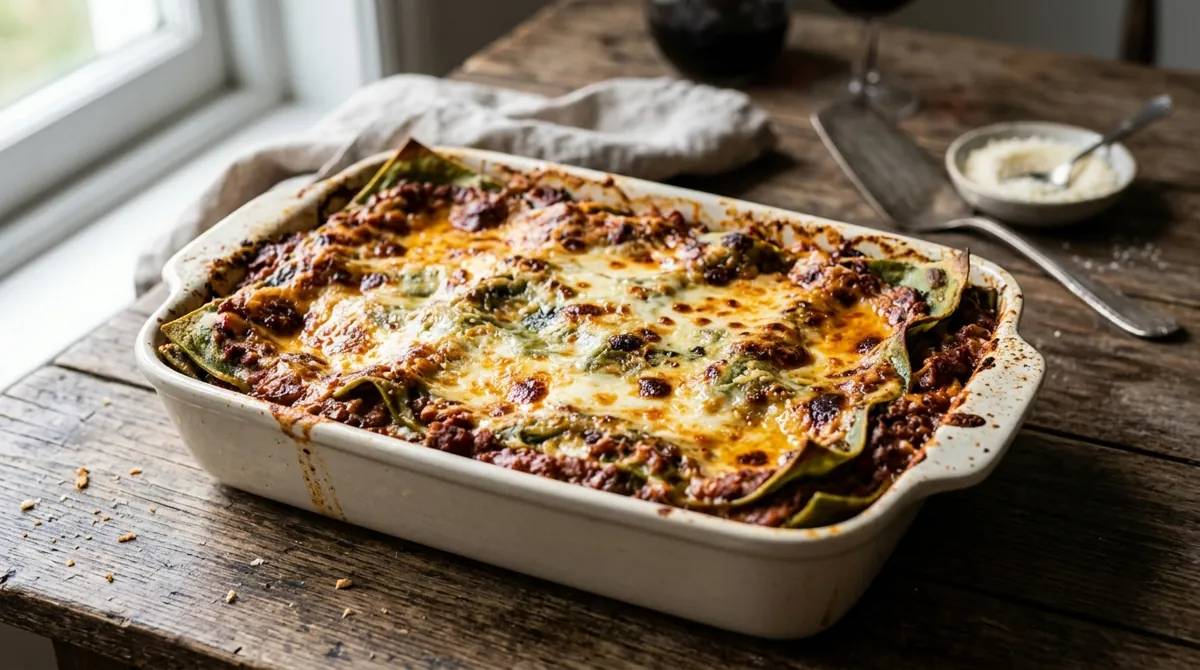
Lasagne Verdi alla Bolognese
Thin sheets of green spinach pasta layered at least six times with slow-cooked ragù, a light béchamel, butter and plenty of Parmigiano Reggiano. No ricotta, no mozzarella.
Neapolitan Carnival Lasagna (Lasagna di Carnevale)
Curly dried lasagna layered with a long-simmered Neapolitan tomato ragù, tiny meatballs, sliced sausage, ricotta, fresh mozzarella, hard-boiled eggs and salami: the Carnival feast before Lent.
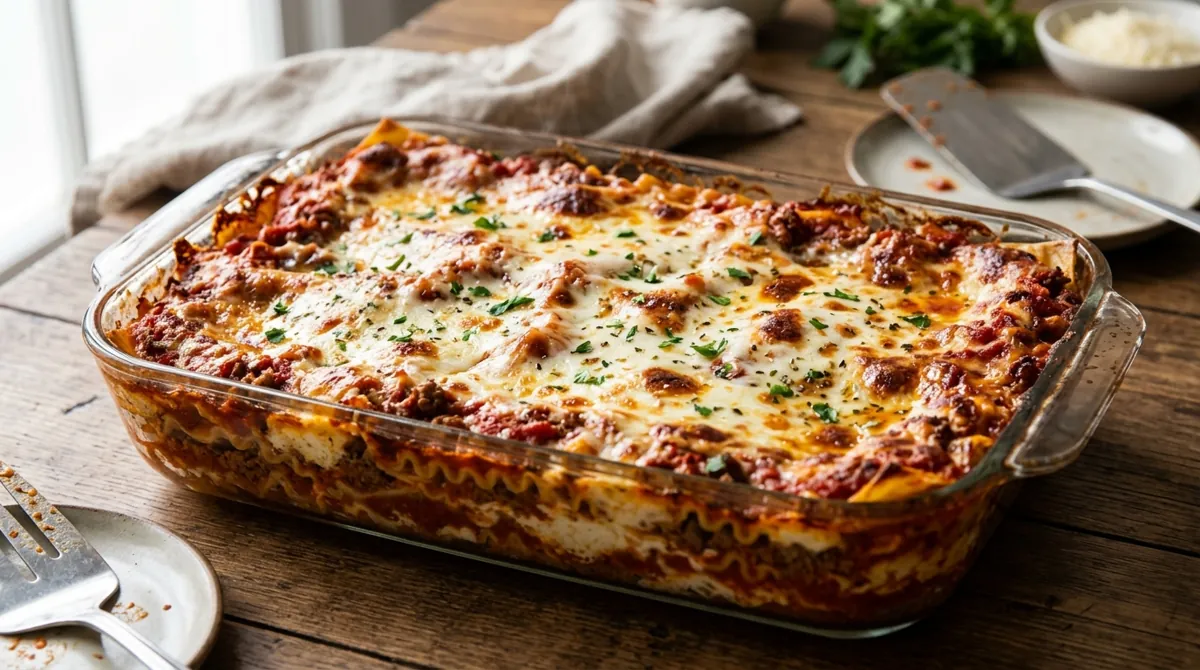
Classic American Lasagna with Ricotta and Mozzarella
The lasagna most Americans grew up with: a quick beef, pork and veal tomato sauce, a basil-flecked ricotta layer and a blanket of melted mozzarella, built with no-boil noodles.
White Chicken Lasagna (Alfredo-Style)
A tomato-free lasagna of tender poached chicken and golden mushrooms in a garlicky Parmesan white sauce, under a lid of melted mozzarella.
Spinach and Ricotta Lasagna
A meatless lasagna with a bright green spinach-ricotta filling, a fresh basil tomato sauce and plenty of mozzarella and Parmesan.
Lasagna Roll-Ups
Curly lasagna noodles spread with herby ricotta, rolled into spirals and baked in a beef, mushroom and pepper tomato sauce under melted mozzarella.
35-Minute One-Skillet Lasagna
Broken lasagna noodles simmered right in a meaty tomato sauce in one covered skillet, finished with Parmesan and creamy dollops of ricotta. No oven, no layering.
Restaurant-Style Lasagna Classico, Inspired by Olive Garden
Inspired by, not official: a big, saucy restaurant-style lasagna with a beef-and-Italian-sausage meat sauce and four cheeses: ricotta, mozzarella, Parmesan and Pecorino Romano.
Meatballs of the World

Italian-American Meatballs
Big, tender meatballs braised for an hour in red sauce over spaghetti. The one most Americans grew up with.

Pallottine (Abruzzo Meatballs)
Tiny meatballs, smaller than a marble, tossed right through square spaghetti alla chitarra. No bread at all.

Swedish Meatballs (Köttbullar)
Small, soft meatballs browned in butter, in a cream sauce made from the same pan, with lingonberry jam on the plate.

Danish Frikadeller
Pork meatballs shaped with a spoon and fried slowly in butter, crusty outside and soft in the middle.

Königsberger Klopse
German meatballs that are never fried: poached, then served in a creamy white sauce with capers.

Spanish Albóndigas in Almond Saffron Sauce
The tapas bar classic: small meatballs in a golden sauce thickened with fried almonds and bread.

Mexican Albóndigas with Chipotle and Mint
Soft meatballs with rice and fresh mint inside, simmered in a smoky tomato and chipotle broth.

Izgara Köfte (Turkish Grilled Meatballs)
Small, flat meatballs kneaded hard, rested cold, and charred on a hot grill pan.

Lion's Head Meatballs
Big, soft pork meatballs, stirred into a sticky paste, fried to set, then braised in a savory sauce.

Chicken Tsukune
Japan's chicken meatball: kneaded sticky, grilled on skewers, glazed with sweet soy tare, dipped in egg yolk.