
📖 Food facts
How Long Does Cheesecake Last in the Fridge?
Cheesecake is an egg dish, so it lives in the refrigerator. The trick is getting it there without a crack and inside the 2-hour window.
 By Americanized · Edited by JP Lambiase · October 19, 2026
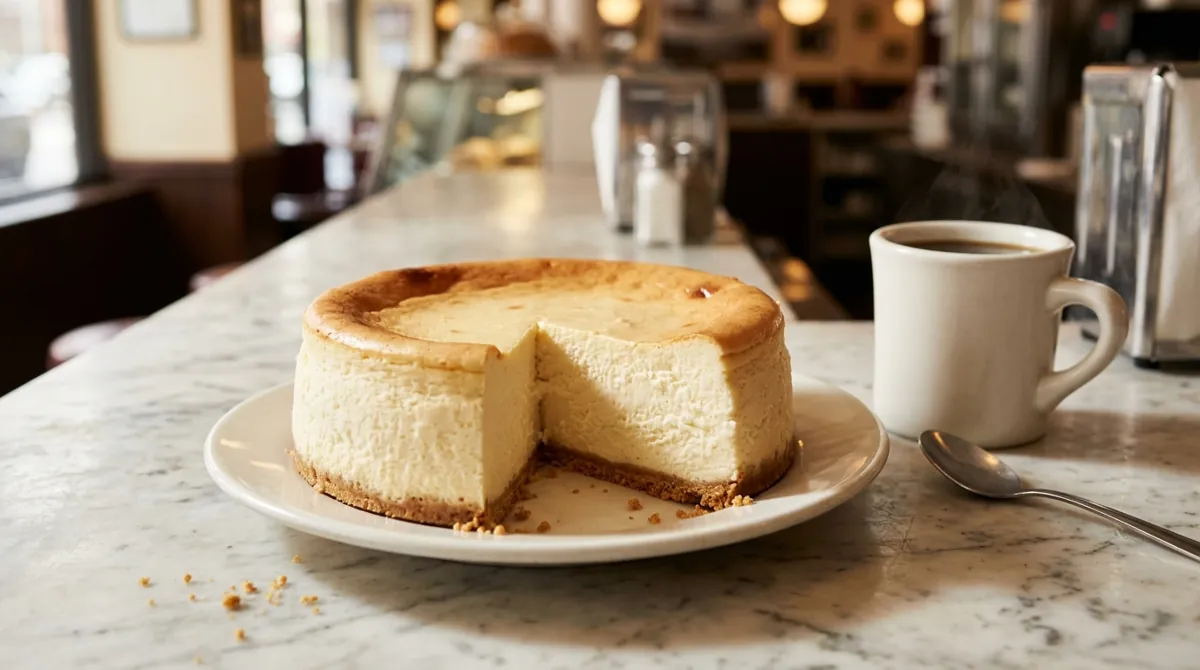
Homemade cheesecake keeps 3 to 4 days in the refrigerator, covered, and 2 to 3 months in the freezer. It must be refrigerated: it is an egg dish, and the FDA says egg dishes shouldn't sit out more than 2 hours. Cool it gradually so it doesn't crack, but get it into the refrigerator within 2 hours of baking.
In the refrigerator: 3 to 4 days
The FDA says leftover cooked egg dishes should be refrigerated and used within 3 to 4 days. America's Test Kitchen (ATK) keeps its New York-style cheesecake up to 4 days, wrapped. USDA's FoodKeeper data gives bakery cheesecake longer, 5 to 7 days after opening, but for a homemade cake we go with the shorter number: 3 to 4 days.
Wrap it well once it is cold so it doesn't dry out or pick up refrigerator smells. ATK wraps its cake tightly before chilling it at least 3 hours, which means a cheesecake for a holiday dinner is best made a day or two before.
Yes, it has to be refrigerated
Cheesecake is mostly cream cheese and eggs. The FDA says to keep egg dishes refrigerated until time to serve, and never to leave cooked eggs or egg dishes out more than 2 hours, or 1 hour when it is above 90°F. That clock covers the dessert table too, so put the leftovers back in the refrigerator when people go back for coffee.
ATK lets its cheesecake stand at room temperature about 30 minutes before slicing, which fits easily inside those 2 hours. No-bake cheesecakes need the refrigerator just as much: our no-bake icebox cheesecake is cream cheese and whipped cream set by chilling, and stays refrigerated.
Cool it before chilling, without cracks
King Arthur Baking says overbaking is the biggest cause of cracks, and cooling too suddenly is another. Its fix is to turn off the oven when the cake is done, prop the door open 4 to 5 inches and let the cake cool slowly inside. For a creamy cake, King Arthur takes it out of the oven when the center reads 150°F to 155°F, while it still jiggles. ATK runs a paring knife around the edge right away so the cake doesn't stick to the pan as it shrinks.
Here the sources disagree on timing. King Arthur leaves the cake in the oven until it reaches room temperature, and America's Test Kitchen cools its New York cheesecake until barely warm, 2 1/2 to 3 hours. The FDA's limit is 2 hours, so we count from when the oven goes off and move the cake to the refrigerator by the 2-hour mark, even if it is still slightly warm. Our New York cheesecake follows that 2-hour rule.
Freezing cheesecake
Cheesecake freezes well. Kansas State Research and Extension says to cool a baked cheesecake completely before wrapping it, keep it frozen 2 to 3 months, and thaw it, still wrapped, in the refrigerator for 4 to 6 hours. USDA's FoodKeeper allows bakery cheesecake 3 to 6 months frozen; we stick with the shorter time for a homemade cake.
Thaw it in the refrigerator, not on the counter, for the same 2-hour reason. More styles, from Basque to Japanese, are in our cheesecake hub, and our Hanukkah recipes page includes cheesecake too.
Questions people ask
How long can cheesecake sit out?
No more than 2 hours at room temperature, or 1 hour above 90°F, the FDA's limit for egg dishes. After that, refrigerate it or throw it out.
Is cheesecake with a jiggly center safe?
Sources differ. King Arthur bakes creamy cheesecakes to 150°F to 155°F in the center, while the FDA says egg dishes should reach 160°F. If you are serving anyone pregnant, elderly, very young or with a weak immune system, bake to 160°F or use pasteurized eggs, as the FDA advises for undercooked eggs.
Can I put a warm cheesecake in the refrigerator?
Yes, once it has cooled gradually for a while. Cooling slowly in the turned-off oven prevents cracks, but don't let it sit out more than 2 hours in total.
Parts of this history are disputed. Where sources disagree, we say so.
Sources
- U.S. Food and Drug Administration, "What You Need to Know About Egg Safety" (content current as of March 5, 2024)
- America's Test Kitchen, "New York-Style Cheesecake" (February 27, 2013)
- PJ Hamel, "Why did my cheesecake crack?", King Arthur Baking (May 9, 2024)
- USDA FSIS FoodKeeper data, Cheesecake entry (foodkeeper.json, data version 128; Internet Archive copy, July 2, 2025)
- Linda K. Beech, Ellis County Extension, "Freezing Baked Goods", K-State Research and Extension
More food facts
Cook it
New York Cheesecake (Lindy's-Style, Graham Crust)
Two and a half pounds of cream cheese beaten with sugar, sour cream, lemon, vanilla and eight eggs over a graham cracker crust, blasted at 500°F for 10 minutes, then baked low at 200°F until the center reads 150°F for a tall, dense, creamy cake.
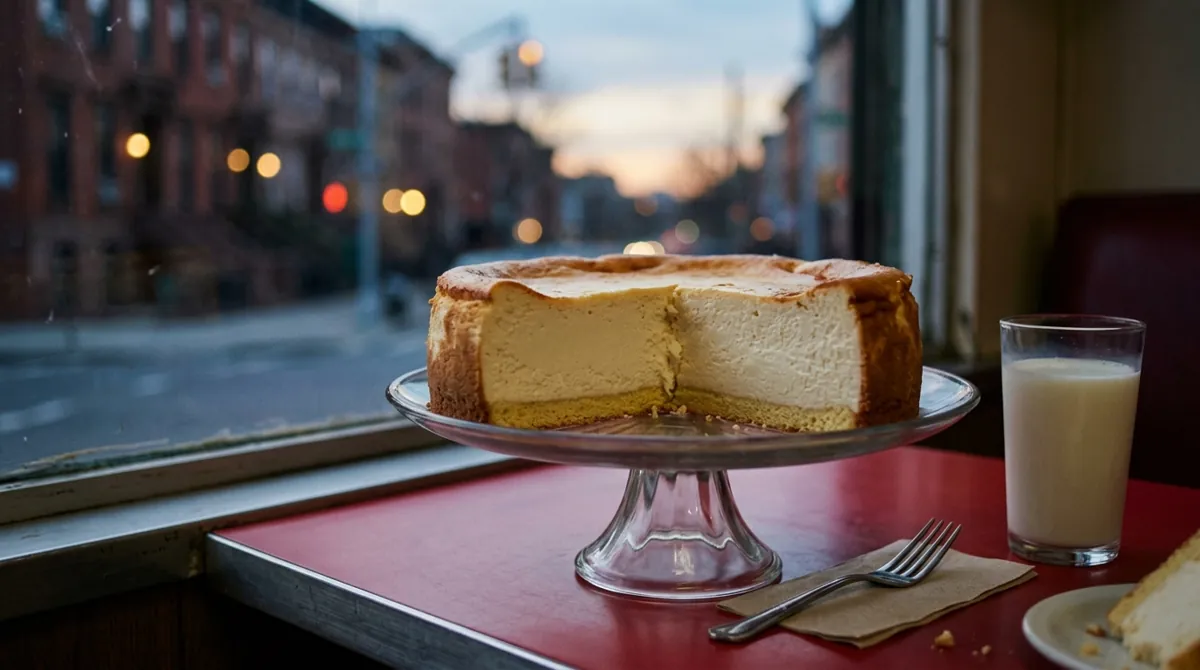
Brooklyn Sponge-Crust Cheesecake (Junior's Style)
A thin, golden sponge cake baked in the springform as the crust, covered with two pounds of cream cheese beaten with sugar, cornstarch, vanilla, eggs and heavy cream, and baked in a water bath at 350°F until the top is lightly tanned and the center still jiggles.
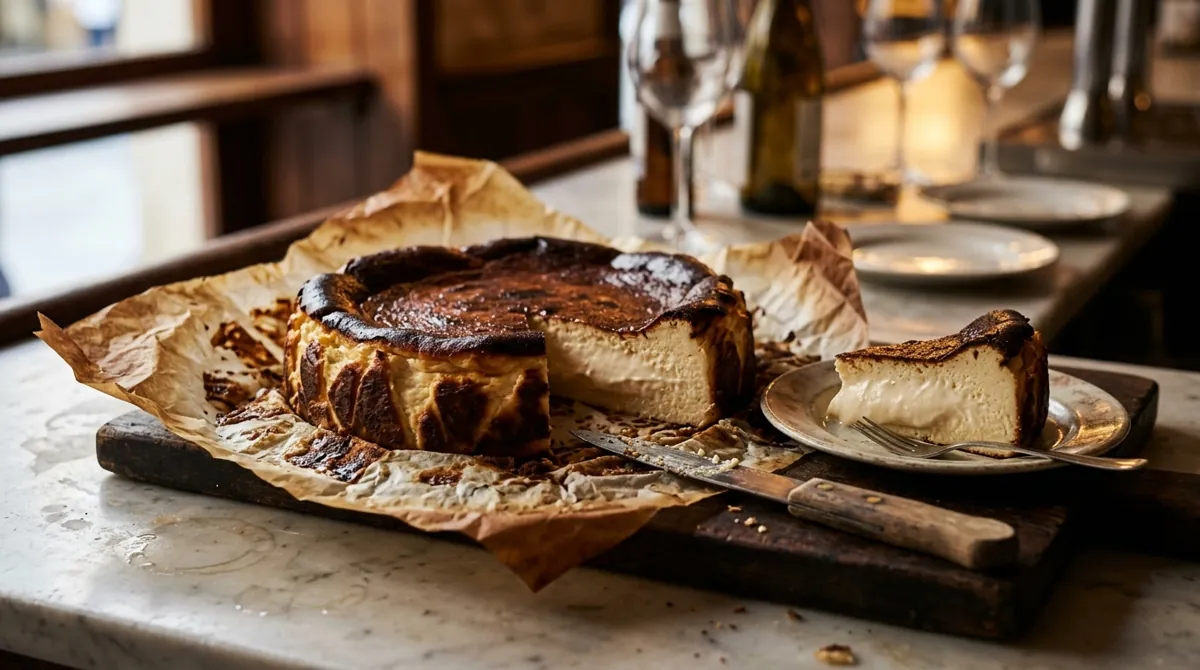
Basque Burnt Cheesecake (San Sebastián Style)
No crust and no water bath: cream cheese, eggs, sugar, a spoonful of flour and cream stirred together by hand, poured into a crumpled parchment-lined pan and baked hot at 410°F until the top is nearly black and the center still trembles.
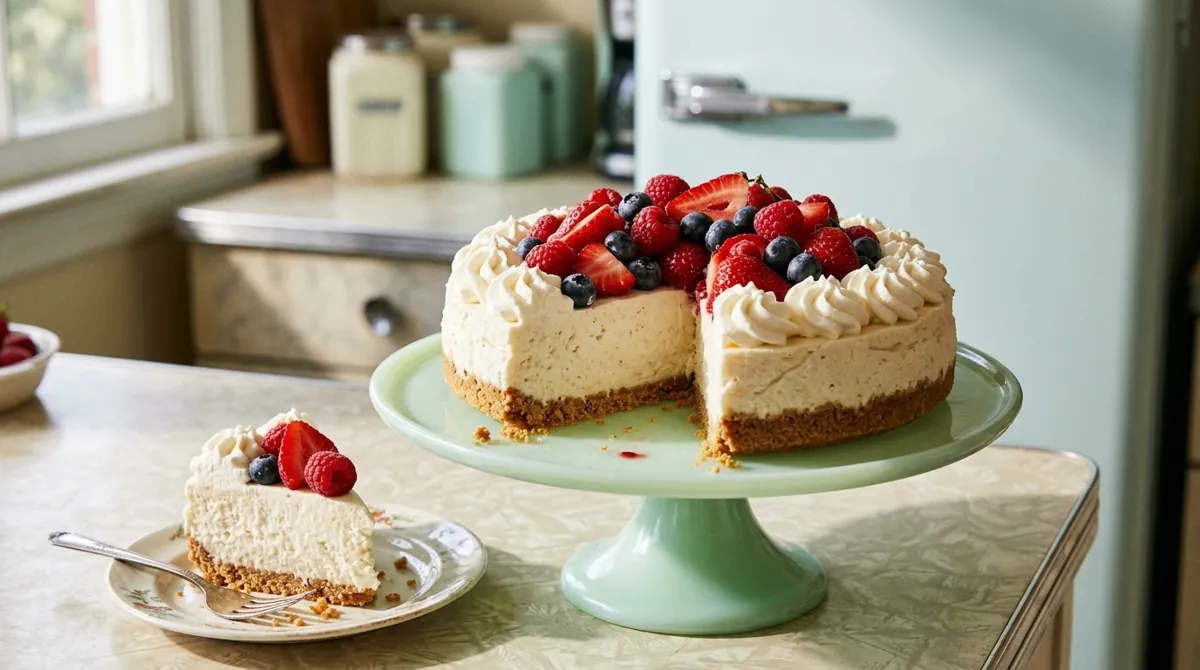
No-Bake Icebox Cheesecake
No eggs and no oven: cream cheese beaten with sugar, lemon juice, sour cream and vanilla bean, lightened with whipped cream, spread into a brown sugar graham crust and chilled overnight, then finished with whipped cream and fresh berries.
Mini Cheesecakes (Muffin-Pan Cheesecakes)
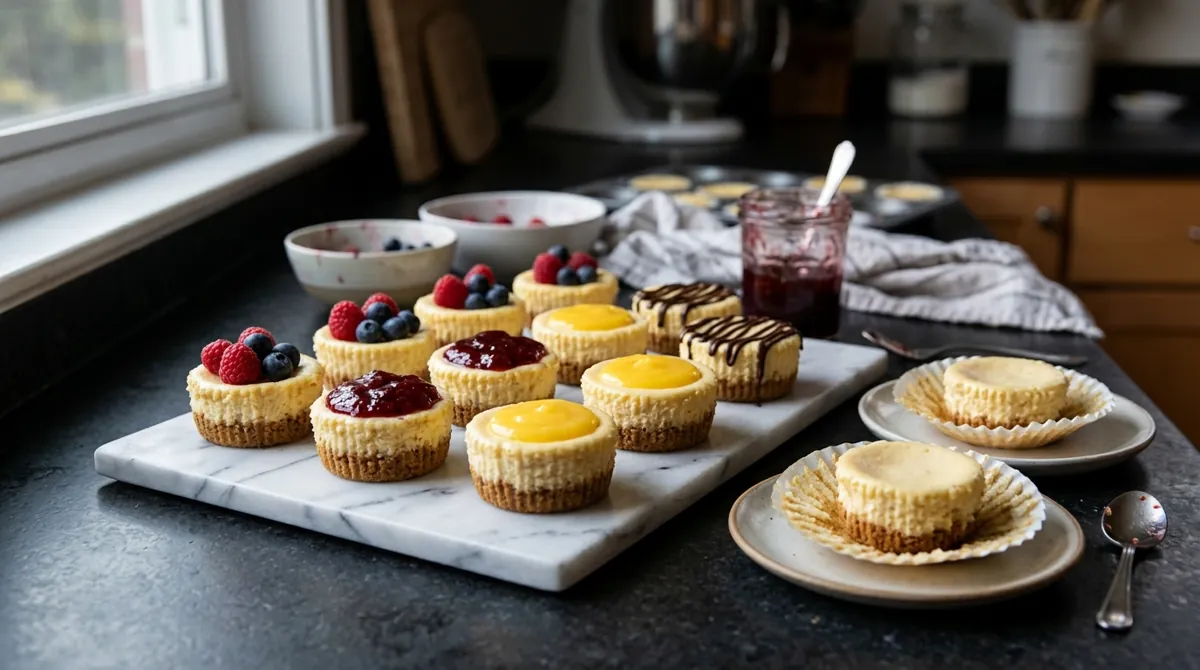
Twelve little cheesecakes in a muffin pan: a pressed graham crust under a smooth cream cheese, sour cream and lemon batter, baked at 325°F for 15 to 18 minutes, 30 minutes of hands-on work and about an hour start to oven-off, then chilled at least 3 hours and topped with berries or jam.