
💡 One tip
How to Check Meatball Seasoning: Fry One Test Meatball First
One small piece, a hot pan and a few minutes. It is the only way to know the salt is right before you roll forty meatballs.

Pinch off about a teaspoon of the raw mix, flatten it, fry it until it is cooked all the way through, then taste it and adjust the salt before you shape the rest. Tasting the raw mix is not a safe check, and once the batch is cooked the seasoning is locked in. The same test works for meatloaf, sausage and dumpling fillings.
Why a test meatball beats the recipe
A recipe can tell you how much salt the writer used, but not how salty your batch will taste. Brands of salt, stock, cheese and even the meat itself differ. Once the meatballs are browned and sauced, there is no way to work more salt into the middle.
Tasting the raw mix is not the answer either. The CDC lists 160°F as the safe internal temperature for ground meats like beef and pork, and notes that color and texture are not reliable signs that food is cooked. A cooked test piece gives you an honest taste without that problem.
A teaspoon of salt is not always the same amount
Salt is where volume measurements go wrong. America's Test Kitchen weighs a tablespoon of table salt at 23 grams, Morton kosher at 16 grams and Diamond Crystal kosher at 10 grams. Milk Street's numbers are close: about 5 grams per teaspoon for Morton and 3 for Diamond Crystal.
Run our Swedish meatballs through those figures. Their 1 1/2 teaspoons of salt for a pound of meat is about 11.5 grams with table salt, 8 with Morton and 5 with Diamond Crystal. That is roughly 2.5, 1.8 or 1.1 percent of the meat's weight, from the same written recipe.
Salty add-ins move the target too. The Swedish mix also gets a tablespoon of concentrated beef stock, and our lion's head meatballs get soy sauce and oyster sauce. A test piece accounts for all of it at once.
Salt also holds the meatball together
Salt is not only flavor. Wes Schilling, a food science professor at Mississippi State, explains that salt dissolves the muscle proteins in meat. Meat scientists call this protein extraction, and those freed proteins are what help a ground meat mixture hold together as it cooks.
Meat processors watch the low end for this reason. Gary Sullivan of the University of Nebraska-Lincoln cites research putting the minimum at about 1.4 percent salt for higher-fat products like sausage, when no phosphates are added. That is why our Danish frikadeller start by mixing the salt into the pork before anything else.
How to fry a test meatball
Mix the batch fully first, since the seasoning has to be evenly spread for the test to mean anything. Pinch off about a teaspoon, flatten it into a thin coin so it cooks through quickly, and fry it in a little butter or oil over medium heat until it is done all the way to the center.
Let it cool for a moment, then taste. If it is flat, add salt in small steps, about 1/4 teaspoon per pound of meat, mix again and fry another piece. Both our Swedish meatballs and frikadeller build this step into the method, and it works for every recipe on our meatballs of the world page.
Questions people ask
Is it safe to taste raw meatball mixture?
Raw ground meat is not considered safe to eat. The CDC's safe internal temperature for ground beef and pork is 160°F, which is why cooks fry a small test piece instead of tasting the raw mix.
Can I use the microwave for the test piece?
You can, as long as it cooks all the way through, but a skillet tastes closer to the finished meatball because it browns the outside. Browning changes the flavor, so a pan-fried test is the more accurate preview.
Does the test meatball trick work for meatloaf and sausage?
Yes. Any ground meat mixture seasoned before cooking, including meatloaf, sausage and dumpling fillings, can be checked the same way: cook a small piece through, taste, adjust. Plain burgers are the exception, since they are usually salted only on the outside, just before cooking.
Sources
More food facts
Cook it
Swedish Meatballs (Köttbullar)
Small, soft meatballs browned in butter, in a cream sauce made from the same pan, with lingonberry jam on the plate.

Danish Frikadeller
Pork meatballs shaped with a spoon and fried slowly in butter, crusty outside and soft in the middle.

Lion's Head Meatballs
Big, soft pork meatballs, stirred into a sticky paste, fried to set, then braised in a savory sauce.

Italian-American Meatballs
Big, tender meatballs braised for an hour in red sauce over spaghetti. The one most Americans grew up with.
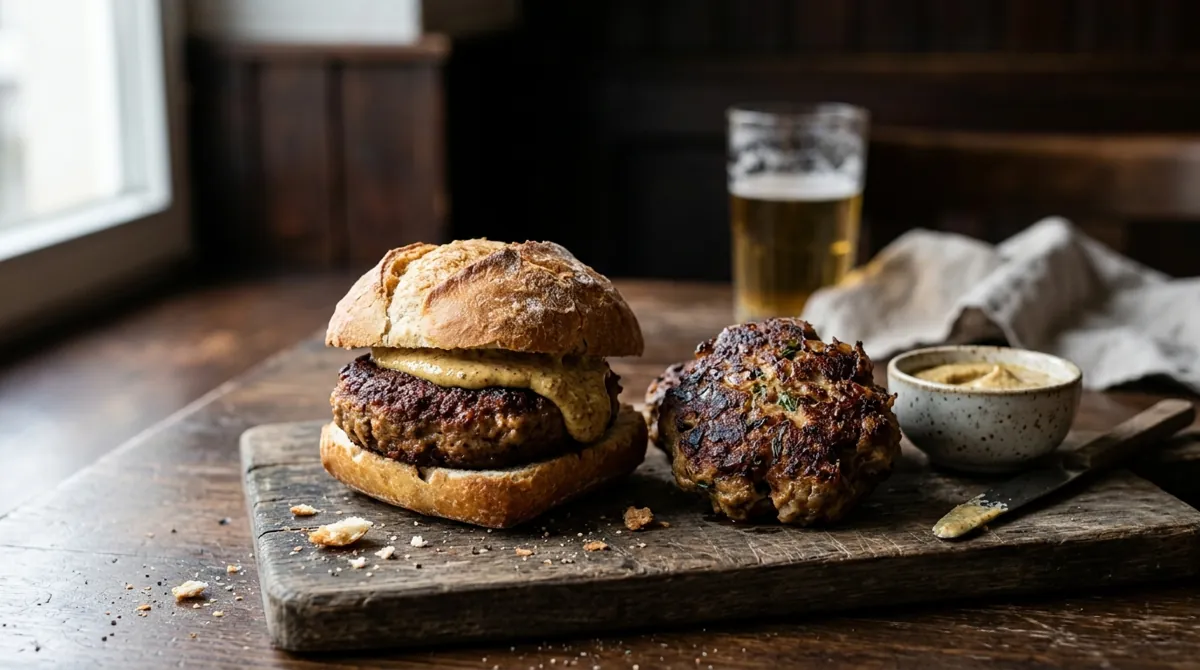
German Frikadellen (Hamburg-Style Meat Patties)
Germany's pan-fried meat patties, made with half beef and half pork, a stale roll soaked in milk, sweated onion and parsley, then fried slowly to a deep brown crust and served with mustard.

Königsberger Klopse
German meatballs that are never fried: poached, then served in a creamy white sauce with capers.