
🔬 Myth check
Should Cornbread Have Sugar? The North vs South Fight
The sugar argument goes back to two of America's earliest cookbooks. Here is what the old recipes actually say, and what nobody can prove.
 By Americanized · Edited by JP Lambiase · October 20, 2026
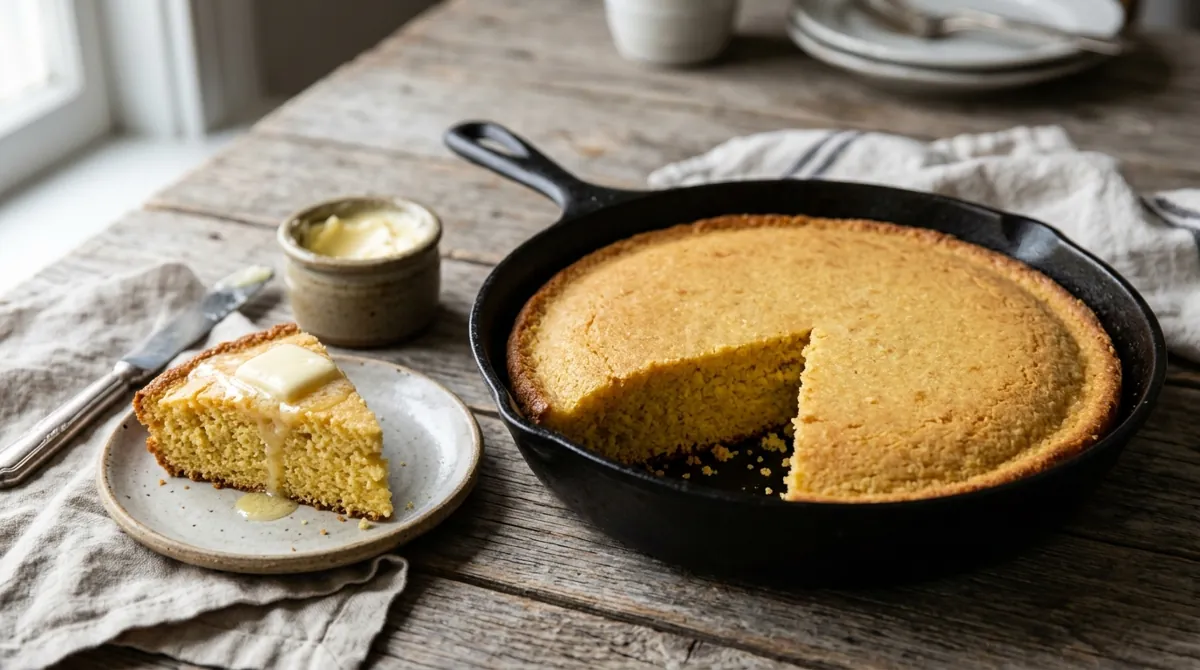
It depends on which tradition you are cooking. Traditional Southern skillet cornbread is usually unsweetened, while Northern cornbread tends to be sweet and cakey. The split is old: a 1796 Hartford cookbook offered a johnny cake variation with molasses, and Mary Randolph's Virginia cookbook, first published in 1824, made corn meal bread with no sweetener at all.
The two oldest recipes already disagree
Amelia Simmons's "American Cookery," printed in Hartford, Connecticut, in 1796, is one of the earliest American cookbooks. Her "Johny Cake, or Hoe Cake" is mostly Indian meal (cornmeal) scalded with milk, with a little wheat flour, baked in front of the fire. Then she gives a second way to make it, with "salt, molasses and shortening" worked in.
So the sweetener is real, but it sits in a variation, not the main recipe. Mary Randolph's "The Virginia House-Wife" goes the other way. Her corn meal bread is cornmeal rubbed with butter, two eggs, milk and a spoonful of yeast, left by the fire for an hour to rise, then baked in small buttered pans. No sugar, no molasses.
Where the line falls today
America's Test Kitchen draws the modern line plainly. Its Southern skillet cornbread recipe describes Northern versions as sweet and cakey, more like dessert, and says Southern recipes contain neither sugar nor flour, so the bread is savory enough to eat with the main course.
Not every Southern cook agrees on the flour. Southern food writer Sheri Castle's skillet cornbread for King Arthur Baking is sugar-free and baked in bacon fat, but it uses half a cup of flour to hold the coarse whole-grain meal together. She notes that some cooks from the Mountain South may object to the flour. Flour or none is its own argument, and both camps are Southern.
Why the South stopped sweetening: nobody knows
Search for the reason and you will find two stories. One says sugar was too expensive for Southern cooks. The other says modern milling made cornmeal less sweet, so Northern cooks added sugar to make up for it. We could not find a historian or a dated source for either one, so we are not picking a side.
Plenty of Southern cooks sweeten their cornbread anyway. The fair way to put it: traditional Southern skillet cornbread is usually unsweetened, and sweet cornbread has deep roots too.
Make it either way
Our Southern skillet cornbread follows Sheri Castle's ratios: whole-grain cornmeal, buttermilk, one egg and a smoking-hot cast-iron skillet of bacon fat. The tang of real buttermilk does the work sugar does in sweeter versions. If you want it sweet, whisk 2 to 4 tablespoons of sugar into the dry ingredients and accept that you are starting an argument.
Cornbread rarely sits alone on the holiday table. Serve it with collard greens and their pot likker, or crumble a batch into Southern cornbread dressing. More sides are in our Thanksgiving recipes.
Questions people ask
Is sweet cornbread a Northern thing?
Mostly, by today's convention. America's Test Kitchen calls Northern cornbread sweet and cakey. But the oldest sweetened version we found, Simmons's 1796 johnny cake with molasses, was printed in New England as a variation, and many Southern cooks add sugar today.
What is a johnny cake?
In Simmons's 1796 cookbook it is a flat cornmeal bread, also called a hoe cake, made from scalded meal with milk or water and baked before the fire. Her main version has no sweetener; the variation adds molasses.
Does Southern cornbread have flour?
Sources disagree. America's Test Kitchen says Southern recipes use none. Sheri Castle's Southern recipe for King Arthur uses half a cup to bind coarse whole-grain meal.
Why does Southern cornbread start in a hot skillet?
The batter hits fat that heated with the oven, which fries the outside on contact. That gives the crisp, brown crust that defines the Southern style, with or without sugar.
Parts of this history are disputed. Where sources disagree, we say so.
Sources
- Amelia Simmons, "American Cookery" (Hartford, 1796), Project Gutenberg
- Mary Randolph, "The Virginia House-Wife," Project Gutenberg (text of an 1860 printing)
- Edward Behr, "Mary Randolph's Corn Bread," The Art of Eating (June 11, 2017)
- America's Test Kitchen, "Southern-Style Skillet Cornbread"
- Sheri Castle, "Skillet Cornbread," King Arthur Baking
More food facts
Cook it
Southern Skillet Cornbread (No Sugar)
Whole cornmeal, buttermilk and one egg poured into a smoking-hot cast-iron skillet of bacon fat, so it sizzles into a crisp, brown crust. No sugar, a little flour, and ready in 45 minutes.
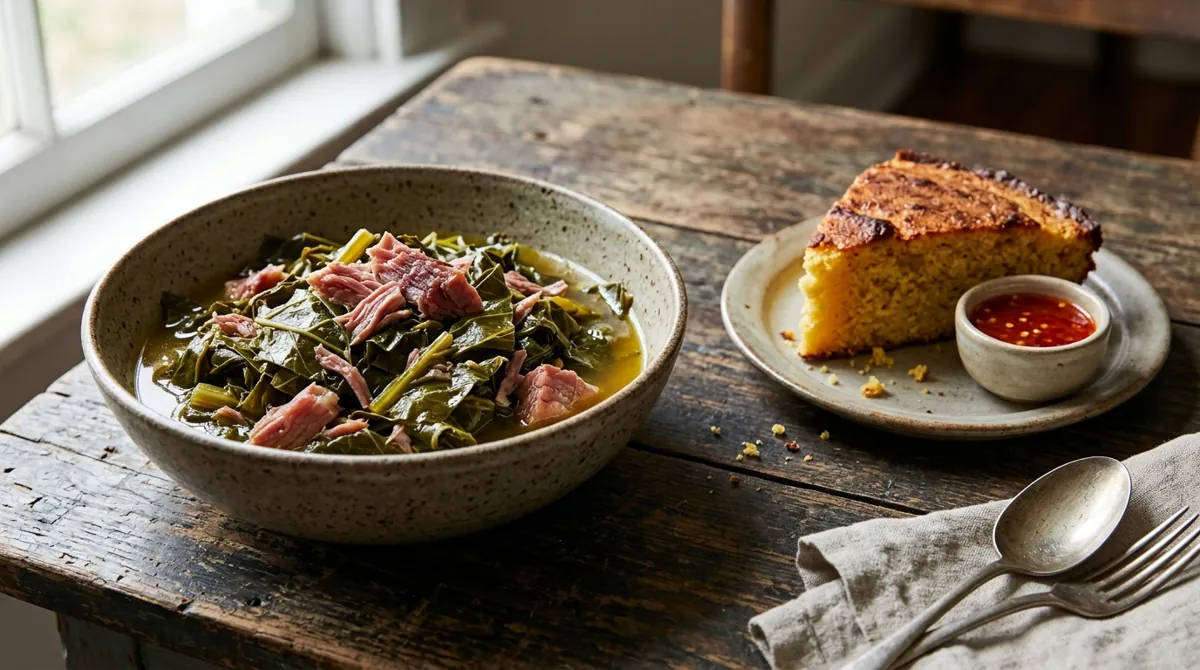
Southern Collard Greens with Ham Hocks
Collard greens braised low and slow in the oven with smoked ham hocks, onion and a pinch of sugar and chile until silky, then served in their own smoky broth, the pot likker, with hot sauce on the side.
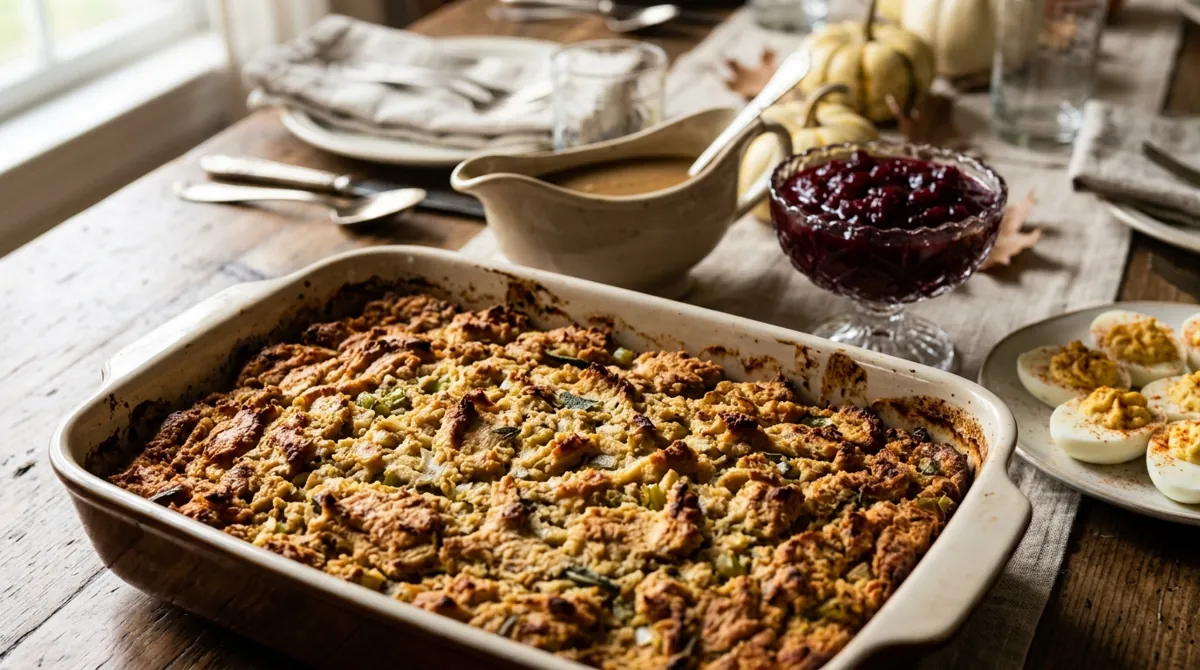
Southern Cornbread Dressing
A pan of cornbread baked, crumbled while hot and mixed with sausage, onion, bell pepper and celery, poultry seasoning, broth, milk and eggs, then baked in ridges with butter brushed on top until crisp outside and almost creamy inside.
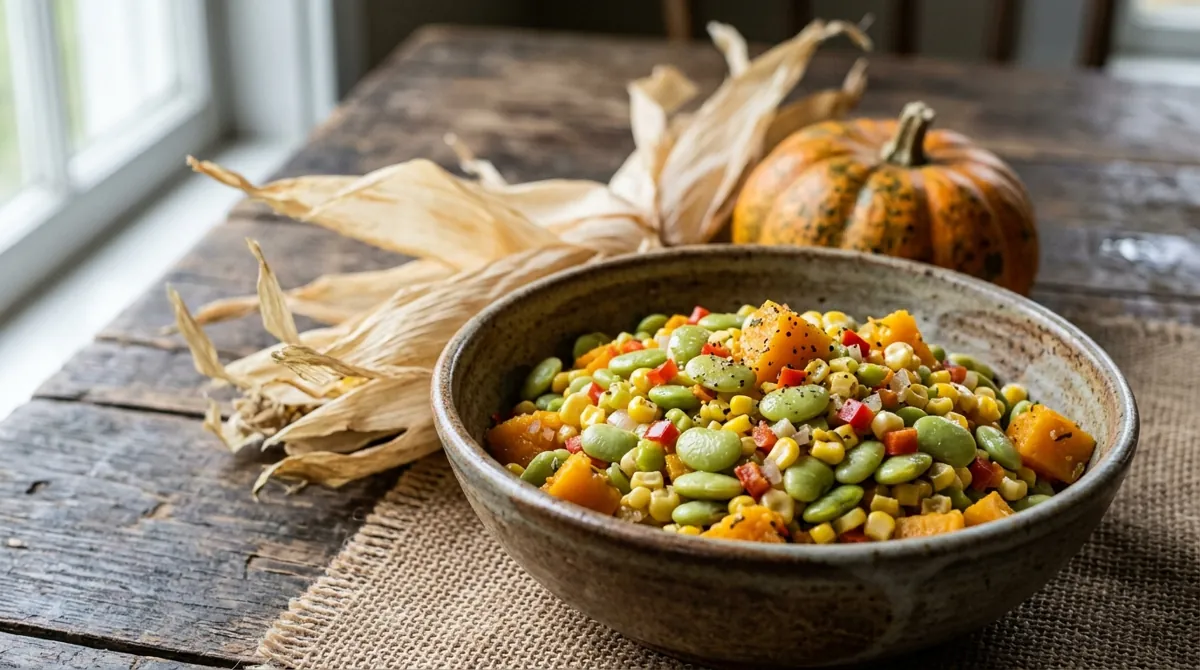
Three Sisters Succotash
Corn, beans and squash, the Three Sisters of Native American farming, simmered together in a little stock with onion and sweet pepper. No butter, no cream: the dish New England learned from the Narragansett and Wampanoag, before Yankee cooks changed it.
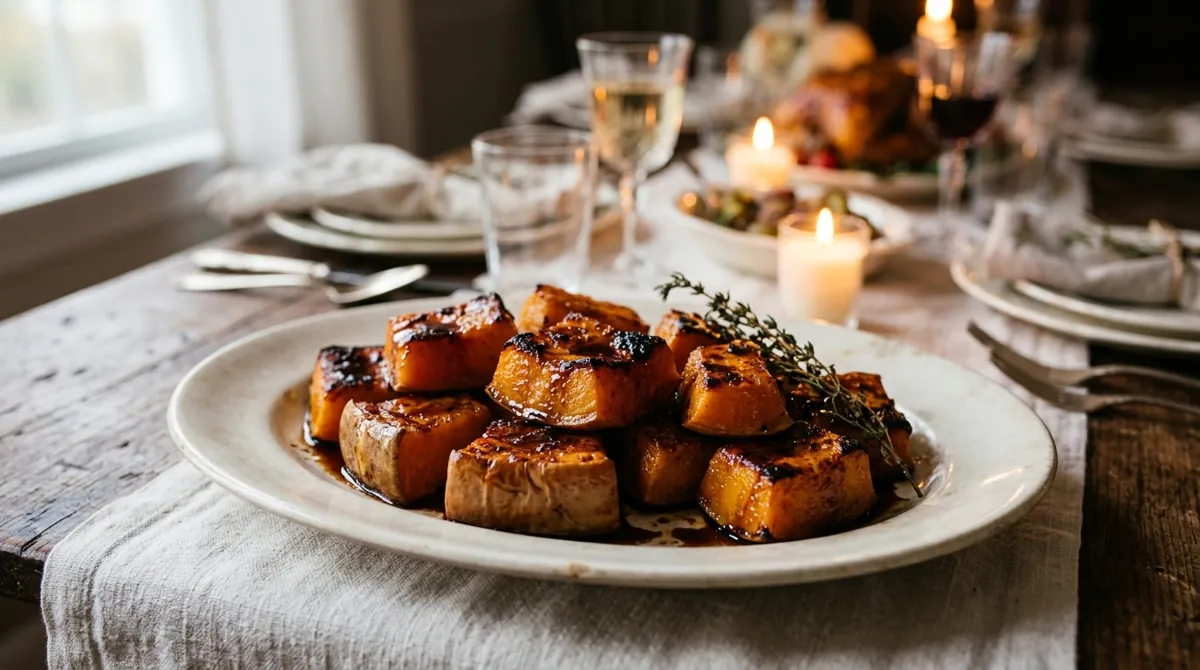
Molasses-Baked Winter Squash (Boston Cooking-School, 1896)
The squash on an 1896 Boston Thanksgiving menu: two-inch squares of butternut baked in their skins with salt, pepper and a little molasses and melted butter on each piece, covered first, then uncovered until glazed.