
Pâté Chinois (Quebec Beef, Corn and Potato Pie)
Quebec's three-layer supper pie, "steak, blé d'Inde, patates": seasoned ground beef, a stripe of kernel corn and cream-style corn, then buttery mashed potatoes dusted with paprika and baked golden.
 Edited by JP Lambiase
Change the estimate
Swaps change the price only: cook any meat to its own safe temperature. Where these numbers come from
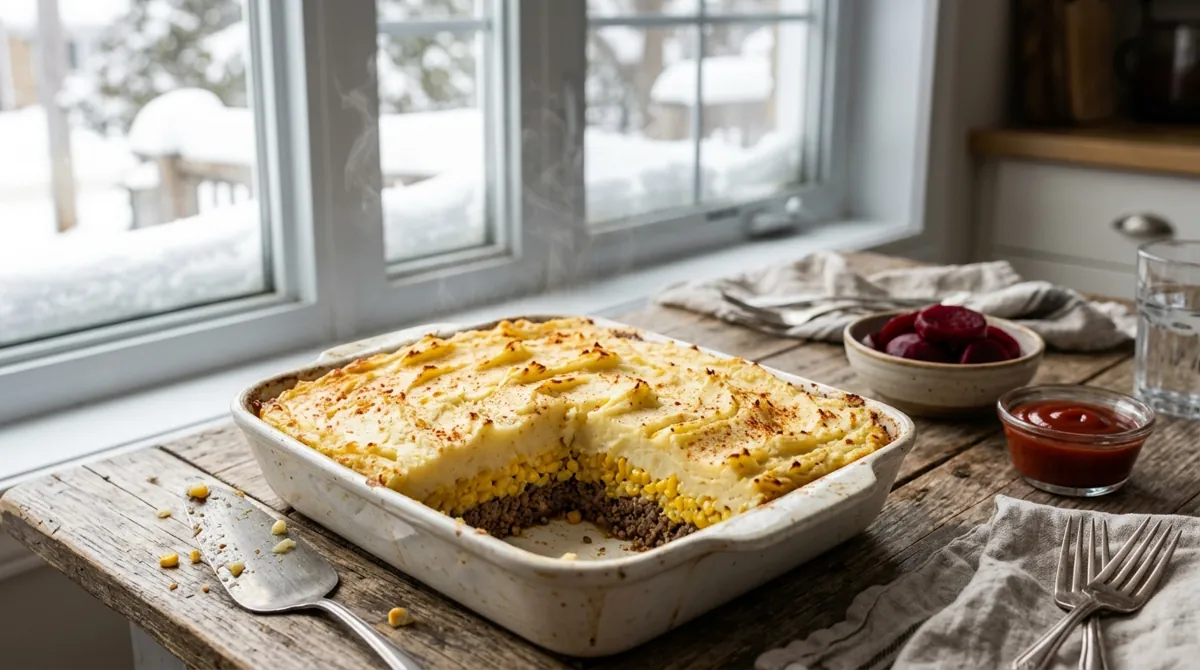
Pâté chinois, "Chinese pie", is a Quebec dish of three layers baked in this order: ground beef, corn and mashed potato, often sprinkled with paprika and eaten with pickles or ketchup; a public poll by the Montreal newspaper Le Devoir informally named it the national dish of Quebec (Wikipedia:). Quebecers sum it up as "steak, blé d'Inde, patates", beef, corn, potatoes.
Nobody can say why it is "Chinese". Wikipedia sets out the theories studied by food historian Jean-Pierre Lemasson and linguist Gabriel Martin. A New France origin in the 1600s does not fit the dates. The story that it fed Chinese laborers building the Canadian Pacific Railway has been rejected; Quebec's language office, the OQLF, says the first written uses of the name date only to the 1930s, which "demolishes" the railway theory. Then there is China, Maine, a town where many French Canadians went to work in the 1800s: the idea is that a local "China pie" was translated into pâté chinois. The *Dictionnaire historique du français québécois* records that theory, and its earliest quotation for the dish is from La Presse, Montreal, November 19, 1930. Martin says the China, Maine story rests on one informant's secondhand account, and the OQLF suggests "Chinese pie" and "China pie" may themselves be translations back from the French.
The American thread is real either way. Cooks Info says "Chinese pie" was a staple of school menus in Massachusetts and Maine in the 1950s and 1960s, with a 1964 Biddeford, Maine, school menu listing "potato-hamburg-corn", and that the earliest printed recipes, from the 1920s, used rice instead of potato. The OQLF calls it a likely adaptation of the shepherd's pie that British settlers brought to the northeastern United States, a region later filled with French Canadian workers.
🇨🇦 The original
Quebec's three-layer supper pie, "steak, blé d'Inde, patates": seasoned ground beef, a stripe of kernel corn and cream-style corn, then buttery mashed potatoes dusted with paprika and baked golden.
🇺🇸 The American version
Minnesota trades the mashed potato roof for crisp potato tots. See the Minnesota Tot Hotdish (Ground Beef, Green Beans and Potato Tots) recipe.
Why it works the kitchen science
Two kinds of corn
Kernels give a sweet pop and keep the stripe visible in every slice; cream-style corn glues the layer together and keeps the meat moist.
A pressed meat layer
Patting the beef flat makes a level base, so the corn and potato stay in three clean stripes instead of sinking into each other.
🧰 You'll need 7 items
Everything the steps call for. Tick off what you have before you start.
Appliances
Pans and pots
Tools
Step by step
- Step 1
Boil the potatoes in salted water 15 to 20 minutes, until tender. Drain well and mash with the butter, warm milk, salt and nutmeg.
- Step 2
While they cook, heat the oil in a large skillet over medium heat and cook the onion and garlic 2 to 3 minutes, until translucent. Add the beef and cook 7 to 8 minutes, breaking it up, until no pink remains. Spoon off the fat.
- Step 3
Stir in the Worcestershire, tomato paste, salt and pepper and simmer 2 minutes.
- Step 4
Heat the oven to 350°F. Press the beef into an even layer in a 9x13-inch baking dish. Scatter the corn kernels over it, then spread the cream-style corn on top.
- Step 5
Spread the mashed potatoes over the corn right to the edges, smooth the top and dust with paprika.
- Step 6
Bake 30 to 35 minutes, until hot through and the center reads 165°F, then broil 2 to 3 minutes until the top is lightly golden. Rest 5 minutes and serve with ketchup and pickles.
Pâté Chinois (Quebec Beef, Corn and Potato Pie)
Serves 8 · one 9x13-inch pan · 1 hr 15 min total
Beef layer
- 1 tbsp vegetable or canola oil
- 1 medium onion (150 g), finely chopped
- 2 cloves garlic, minced
- 1 1/2 lb (680 g) ground beef, 85% lean
- 1 tbsp Worcestershire sauce
- 1 tbsp tomato paste
- 1 tsp kosher salt
- 1/2 tsp black pepper
Corn layer
- 10 oz (284 g) frozen corn kernels, thawed
- One 14.75-oz (418 g) can cream-style corn
Potato layer
- 2 1/2 lb (1,134 g) russet potatoes, peeled and cut in 2-inch chunks
- 4 tbsp (56 g) butter
- 2/3 cup (163 g) whole milk, warmed
- 1 tsp kosher salt
- Pinch of ground nutmeg
- 1 tsp paprika, for the top
To serve
- Ketchup, pickled beets or dill pickles
Equipment: Oven, 9x13-inch baking dish, Large skillet, Instant-read thermometer, Chef's knife and cutting board, Measuring cups and spoons, Colander
Method
- Boil the potatoes in salted water 15 to 20 minutes, until tender. Drain well and mash with the butter, warm milk, salt and nutmeg.
- While they cook, heat the oil in a large skillet over medium heat and cook the onion and garlic 2 to 3 minutes, until translucent. Add the beef and cook 7 to 8 minutes, breaking it up, until no pink remains. Spoon off the fat.
- Stir in the Worcestershire, tomato paste, salt and pepper and simmer 2 minutes.
- Heat the oven to 350°F. Press the beef into an even layer in a 9x13-inch baking dish. Scatter the corn kernels over it, then spread the cream-style corn on top.
- Spread the mashed potatoes over the corn right to the edges, smooth the top and dust with paprika.
- Bake 30 to 35 minutes, until hot through and the center reads 165°F, then broil 2 to 3 minutes until the top is lightly golden. Rest 5 minutes and serve with ketchup and pickles.
Adapted from Les Chats Gourmets, "Traditional Québec Pâté Chinois: Ultra-Easy and Flavorful", serves 6. We follow its layers and seasoning (beef browned with onion and garlic, Worcestershire and tomato paste; a can of kernel corn and a can of cream-style corn; mash with butter, warm milk and nutmeg; 350°F for 25 to 30 minutes, then a short broil) scaled to a 9x13 for 8: 1 1/2 lb beef instead of 500 g, 2 1/2 lb potatoes instead of 800 g, and frozen corn for the canned kernels. The paprika is the OQLF's and Wikipedia's finish; the longer bake and the 165°F check are ours. Estimated cost: about $16.81 for the pan, about $2.10 a serving (cream-style corn at our estimate of $1.19 a can). leschatsgourmets.com. Ingredient list follows the source; the method is in our own words.
Tips
- Make ahead: assemble, cover and refrigerate up to 24 hours (house rule), then bake 45 to 50 minutes, to 165°F. It freezes well for up to 3 months; thaw overnight in the refrigerator and add 15 to 30 minutes.
- Leftovers keep 3 to 4 days refrigerated; reheat to 165°F.
- All kernels or all cream-style both work; Wikipedia notes cooks use fresh, frozen, canned or creamed corn.
- Leftover roast beef, chopped, is the old way to make the meat layer (Wikipedia, DHFQ quotations).
The rules people argue about
What the sources agree on, what they don't, and what is just a good story.
- It is named for Chinese railway workers. Disputed: the story is popular, but the OQLF says the name appears in writing only from the 1930s, and Lemasson, Francœur and Martin all reject it (Wikipedia).
- It is named for China, Maine. Disputed: the *Dictionnaire historique du français québécois* records the theory and the Usito dictionary states it as fact (Wikipedia); Martin says it rests on one secondhand informant; the OQLF thinks "China pie" may be a back-translation; Cooks Info calls the name unexplained.
- How old it is. Disputed: the DHFQ's first quotation is from La Presse in 1930; Martin finds references from 1931 and even 1917 (Wikipedia); Lemasson found a 1941 version made with rice; Cooks Info says printed recipes began in the 1920s, with rice.
- It is Quebec's national dish. Documented as the result of a Le Devoir reader poll (Wikipedia; Cooks Info dates it to November 2007).
- It must be cream-style corn. Folklore: the OQLF defines it with creamed or kernel corn, and Cooks Info says the creamed corn arrived only in the 1930s or 1940s.
Every other casserole
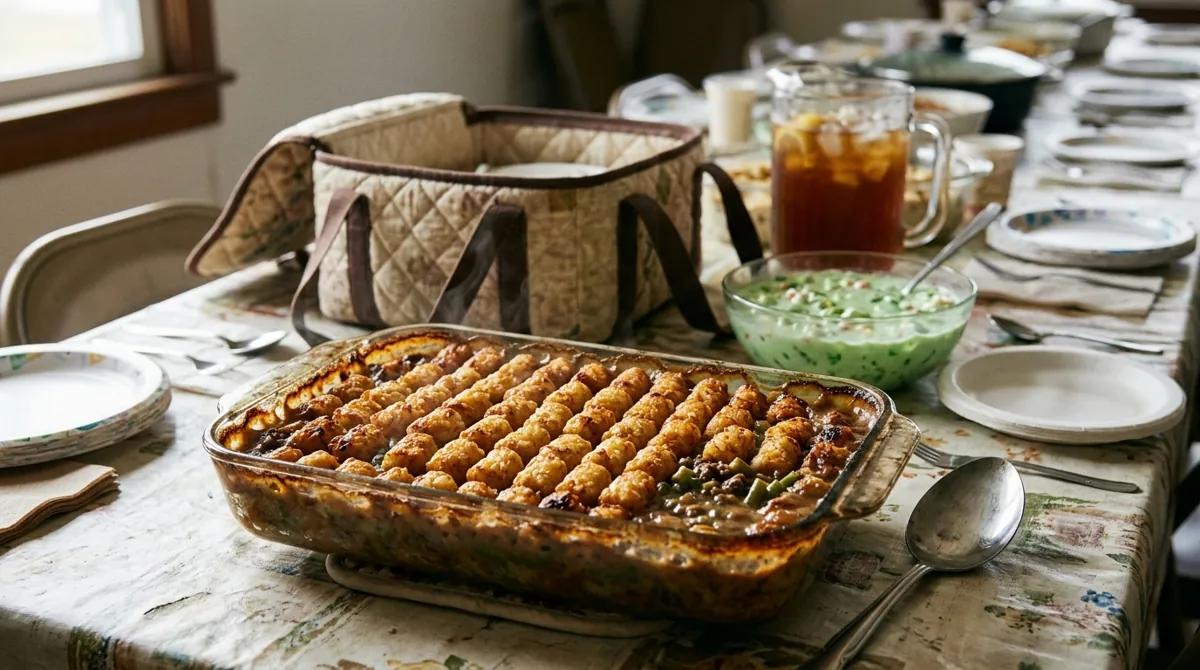
Minnesota Tot Hotdish (Ground Beef, Green Beans and Potato Tots)
The Upper Midwest church-supper classic: browned ground beef and green beans folded into a from-scratch creamy sauce, covered edge to edge with frozen potato tots and baked hot until they crisp.
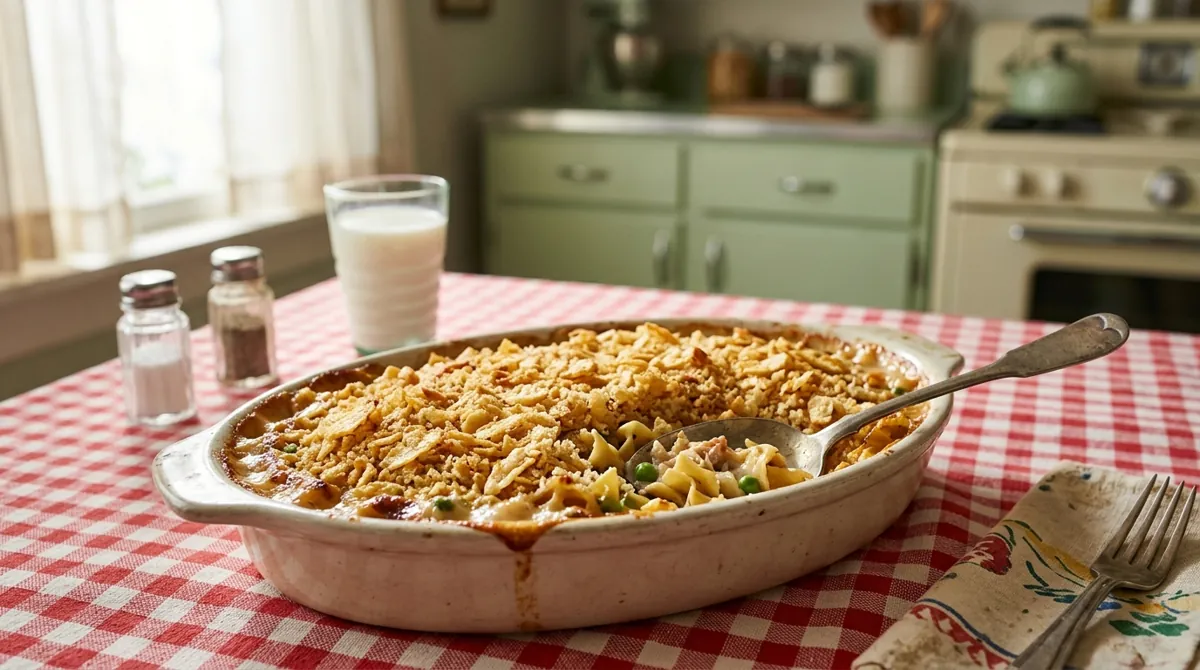
Tuna Noodle Casserole (From Scratch)
The canned-soup-era weeknight bake rebuilt from the pantry: egg noodles, canned tuna and peas in a quick mushroom and onion cream sauce, under a buttery crumb top.
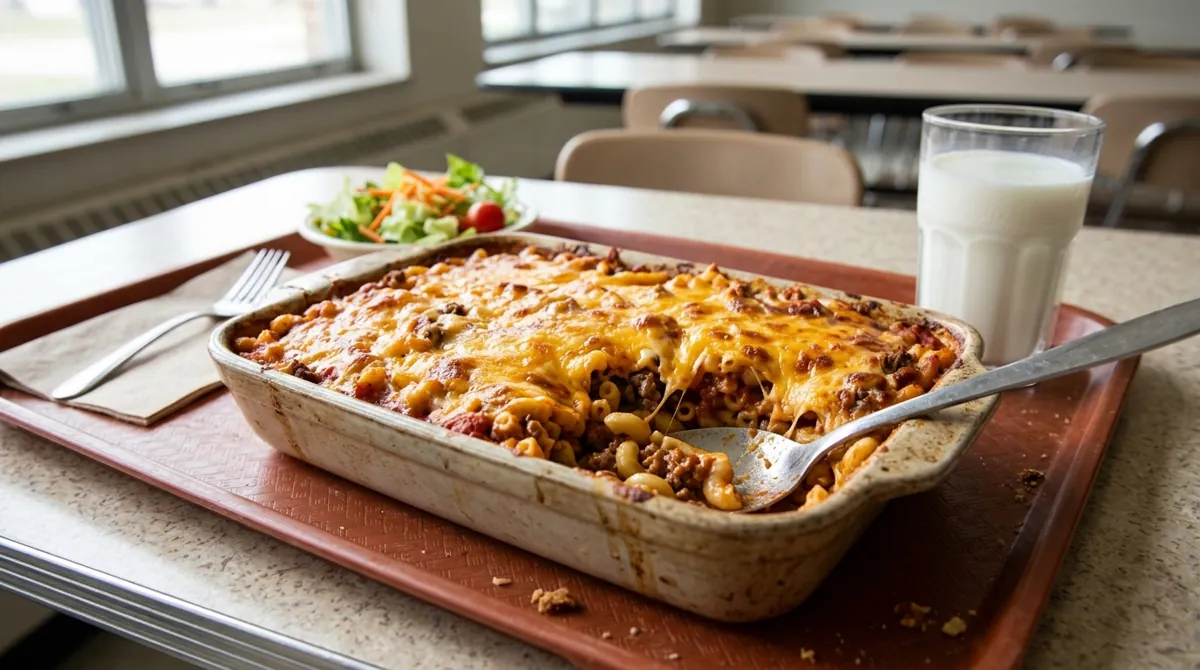
Johnny Marzetti (Ohio Beef and Cheddar Pasta Bake)
Columbus, Ohio's signature casserole: corkscrew pasta, ground beef, mushrooms and hand-crushed tomatoes stirred with sharp cheddar and baked under more cheddar until browned and bubbling.
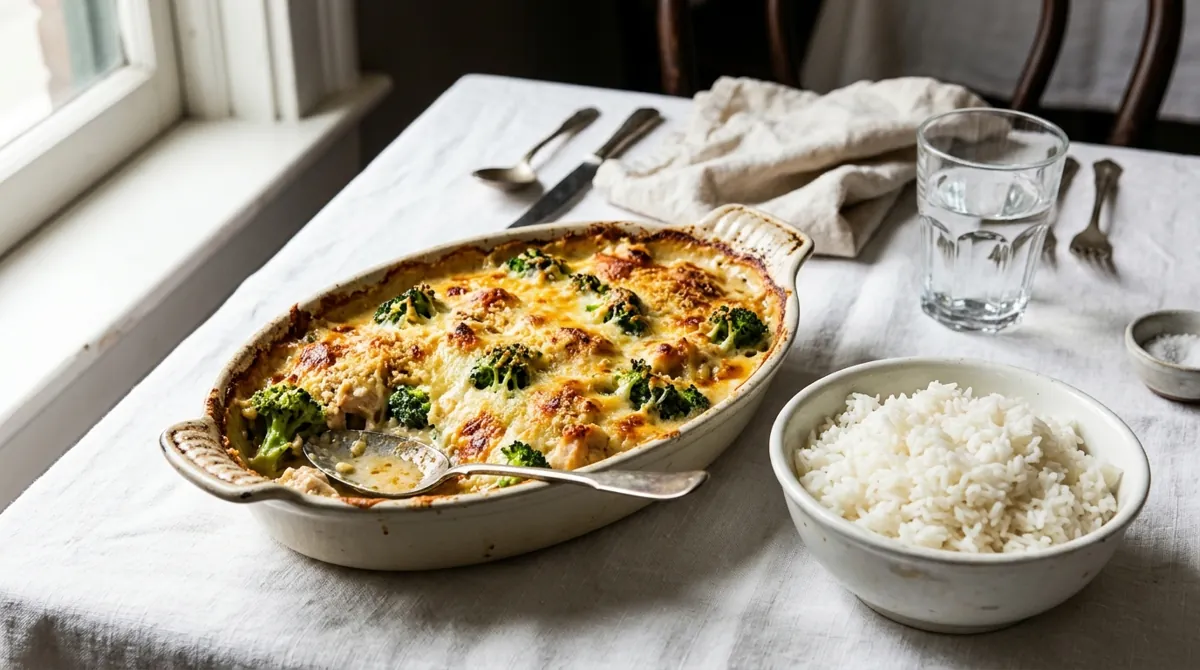
Chicken Divan (Chicken and Broccoli in Cheese Sauce)
A New York hotel restaurant's secret dish turned into a family casserole: poached chicken and broccoli under a cheddar and Parmesan cheese sauce made with the poaching broth, baked golden and served over rice.
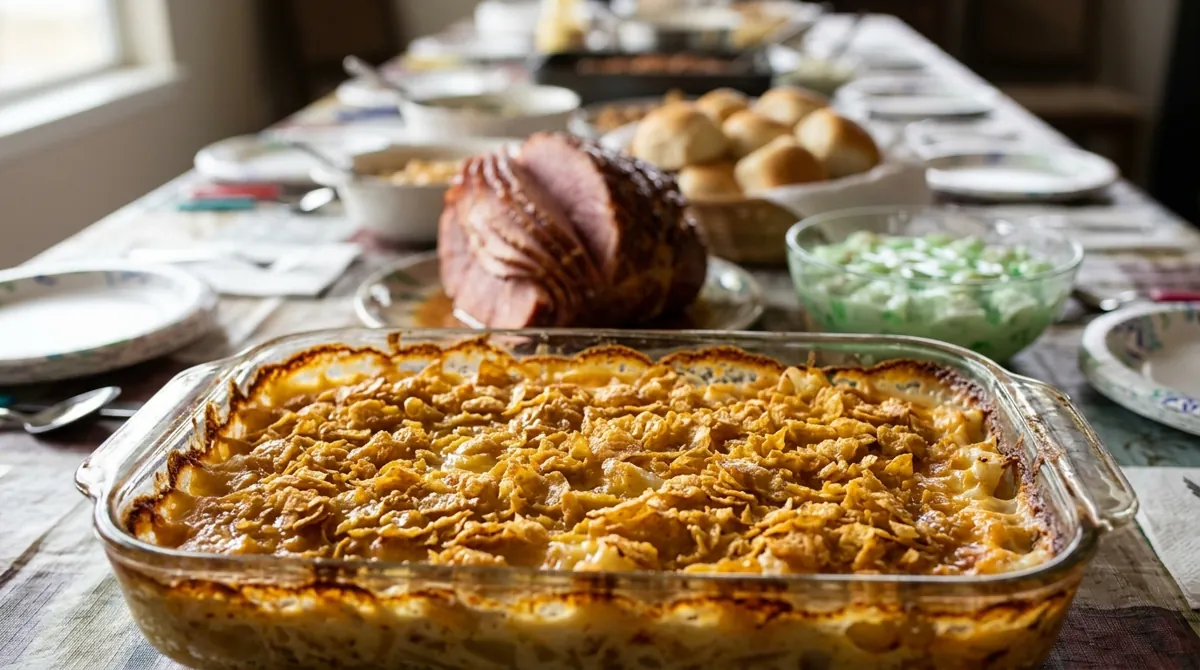
Utah Funeral Potatoes (Cheesy Potato Casserole with Corn Flake Crust)
The Utah potluck and after-funeral classic: shredded potatoes in a creamy sour cream and cheddar sauce under a buttery corn flake crust, enough for a crowd of twelve.
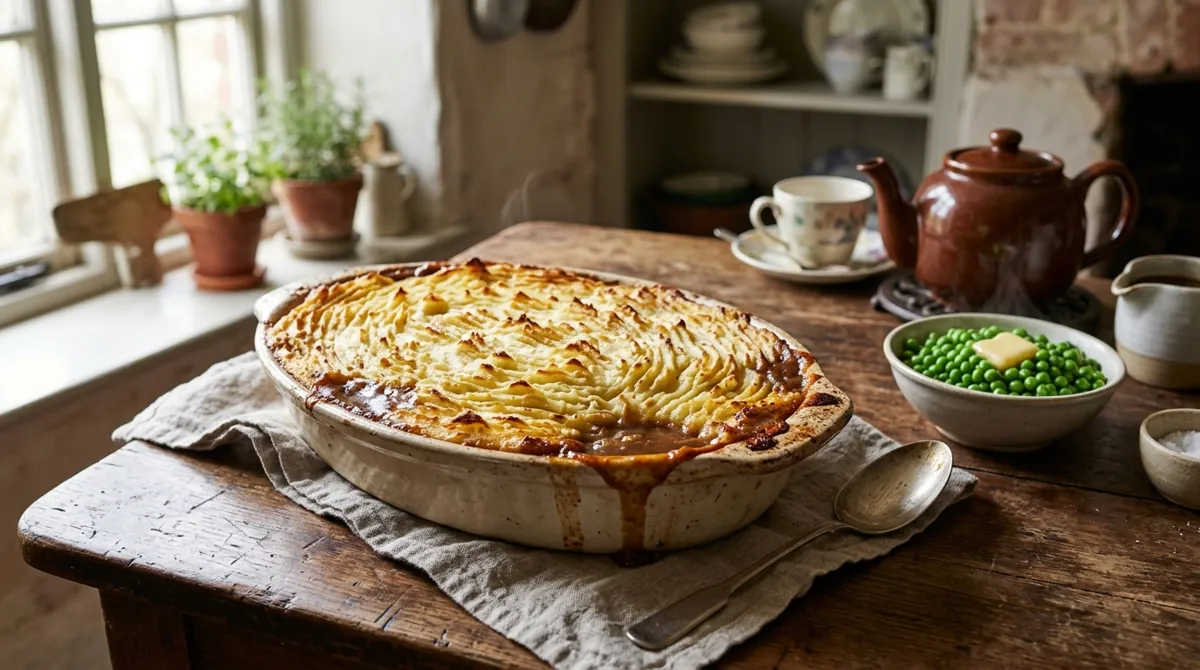
British Shepherd's Pie (Lamb, with a Cottage Pie Option)
Britain's potato-roofed pie: ground lamb, onion and carrot simmered in beef broth with tomato paste and Worcestershire, topped with buttery mash raked with a fork and baked until the ridges brown.
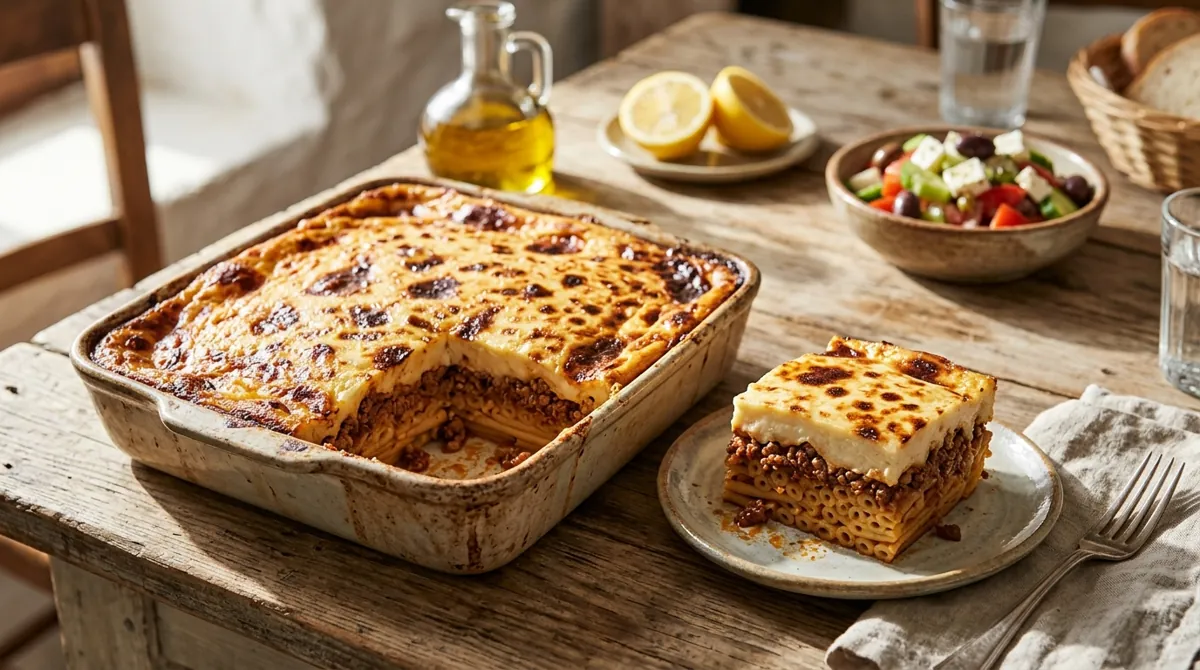
Greek Pastitsio (Baked Pasta with Meat Sauce and Béchamel)
Greece's tall pasta bake: tube pasta and a cinnamon and clove-scented beef and tomato sauce in layers under a thick, cheese-enriched béchamel that bakes into a golden, custardy cap.
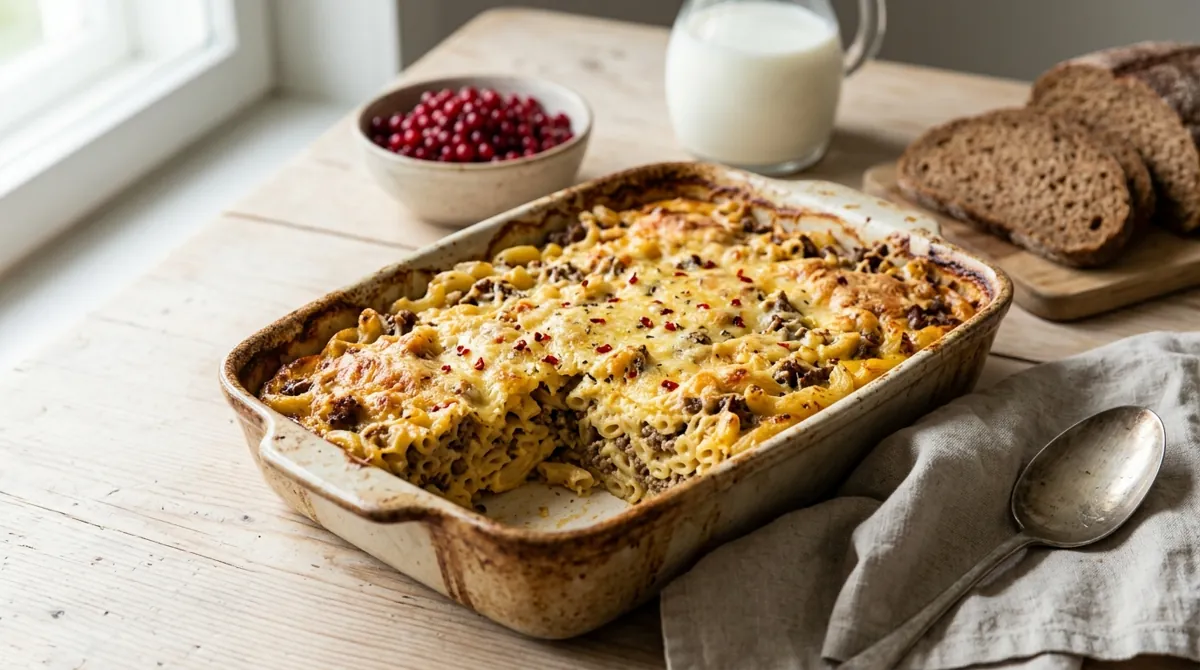
Finnish Makaronilaatikko (Macaroni and Beef Custard Bake)
Finland's everyday macaroni casserole: elbows and browned ground beef baked in a milk and egg custard under Swiss cheese until set and golden, served the Finnish way with ketchup or lingonberries.
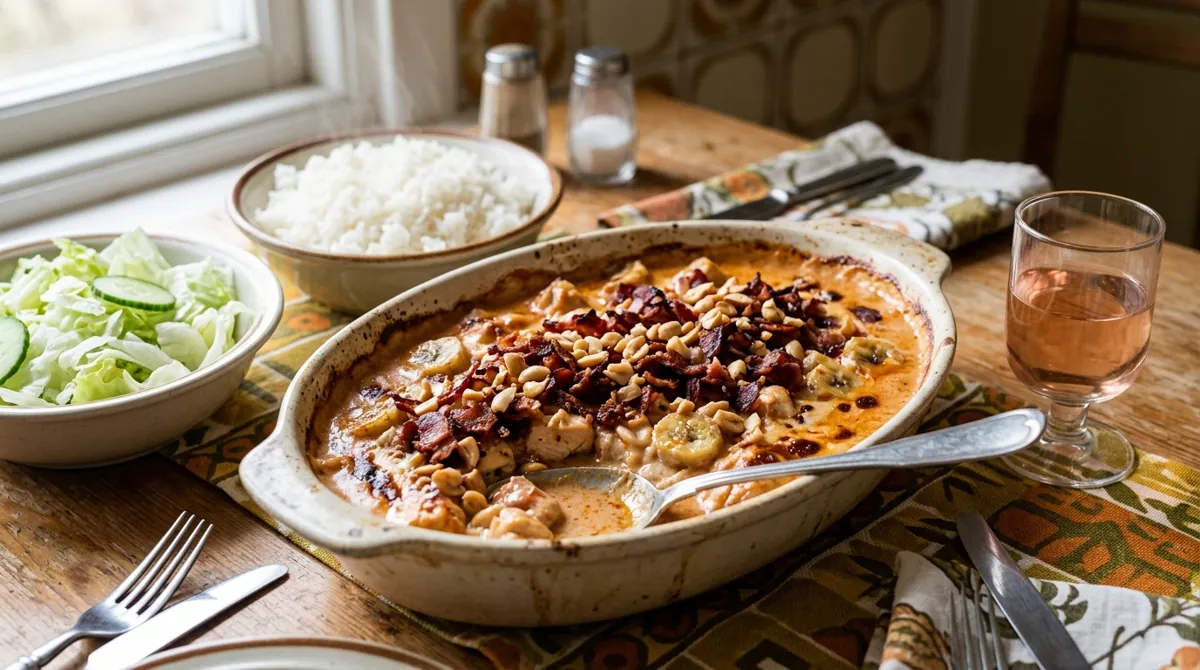
Swedish Flying Jacob (Chicken, Banana and Peanut Casserole)
Sweden's famous 1976 party casserole: chicken and bananas baked under whipped cream mixed with ketchup-style chili sauce, then showered with crisp bacon and salted peanuts and served over rice.
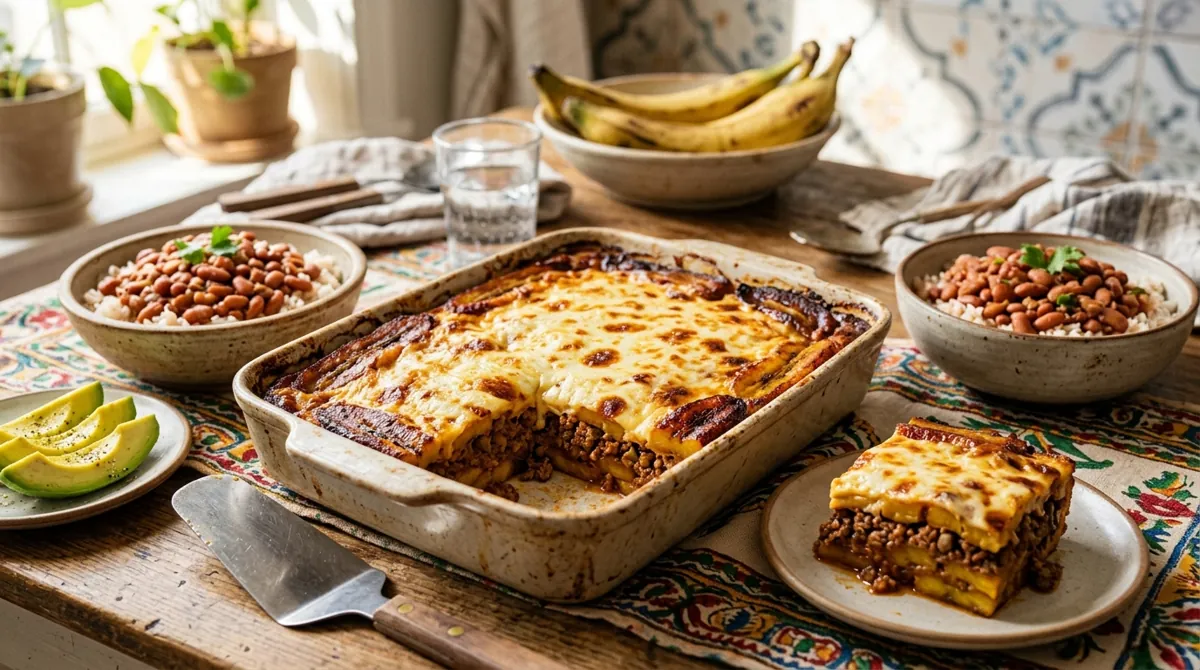
Puerto Rican Pastelón (Sweet Plantain and Picadillo Bake)
Puerto Rico's "big cake": strips of very ripe plantain, oven-roasted until caramelized, layered like lasagna noodles with a beef picadillo of olives, capers and tomato, bound with beaten egg and melted mozzarella.
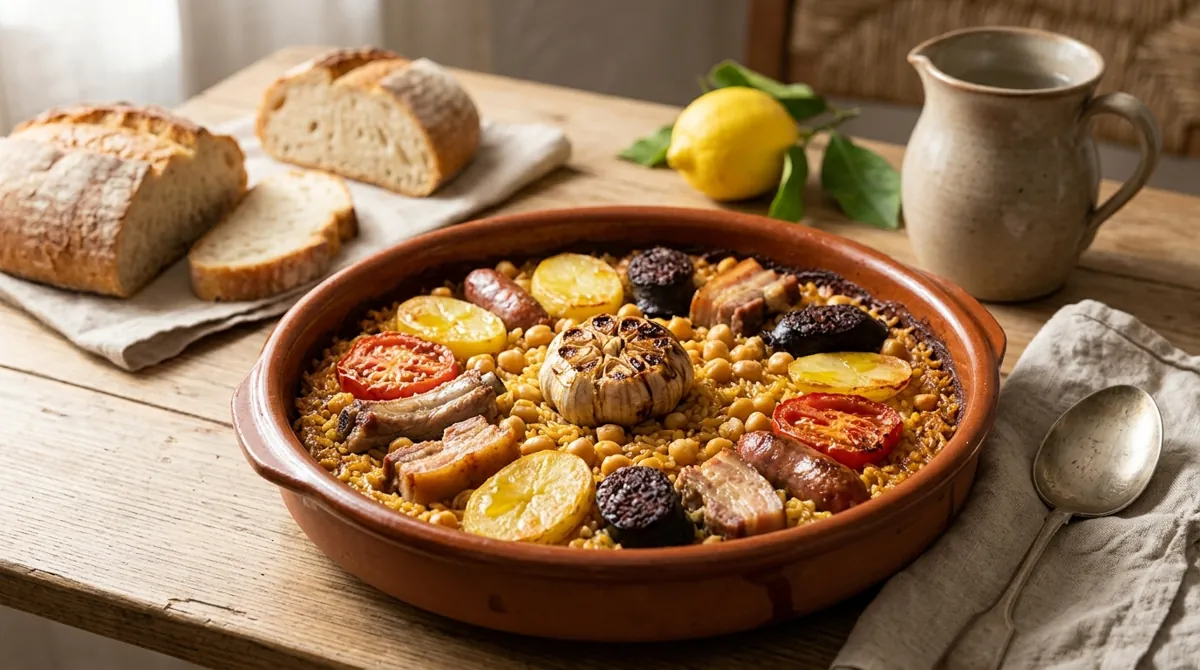
Valencian Arroz al Horno (Oven-Baked Rice with Pork, Chickpeas and Potatoes)
Valencia's Sunday-leftover rice: pork ribs, bacon, chorizo, chickpeas and potato slices browned, then baked with short rice and hot broth around a whole head of garlic and halved tomatoes until the top turns crisp.
Meatballs of the World

Italian-American Meatballs
Big, tender meatballs braised for an hour in red sauce over spaghetti. The one most Americans grew up with.

Pallottine (Abruzzo Meatballs)
Tiny meatballs, smaller than a marble, tossed right through square spaghetti alla chitarra. No bread at all.

Swedish Meatballs (Köttbullar)
Small, soft meatballs browned in butter, in a cream sauce made from the same pan, with lingonberry jam on the plate.

Danish Frikadeller
Pork meatballs shaped with a spoon and fried slowly in butter, crusty outside and soft in the middle.

Königsberger Klopse
German meatballs that are never fried: poached, then served in a creamy white sauce with capers.

Spanish Albóndigas in Almond Saffron Sauce
The tapas bar classic: small meatballs in a golden sauce thickened with fried almonds and bread.

Mexican Albóndigas with Chipotle and Mint
Soft meatballs with rice and fresh mint inside, simmered in a smoky tomato and chipotle broth.

Izgara Köfte (Turkish Grilled Meatballs)
Small, flat meatballs kneaded hard, rested cold, and charred on a hot grill pan.

Lion's Head Meatballs
Big, soft pork meatballs, stirred into a sticky paste, fried to set, then braised in a savory sauce.

Chicken Tsukune
Japan's chicken meatball: kneaded sticky, grilled on skewers, glazed with sweet soy tare, dipped in egg yolk.