
⚖️ What's the difference?
Custard vs Philadelphia Ice Cream: What's the Difference?
The split is eggs. One base is a cooked custard, the other is just cream, milk and sugar, and a federal rule decides when custard ice cream gets to be called frozen custard.
 By Americanized · Edited by JP Lambiase · November 2, 2026
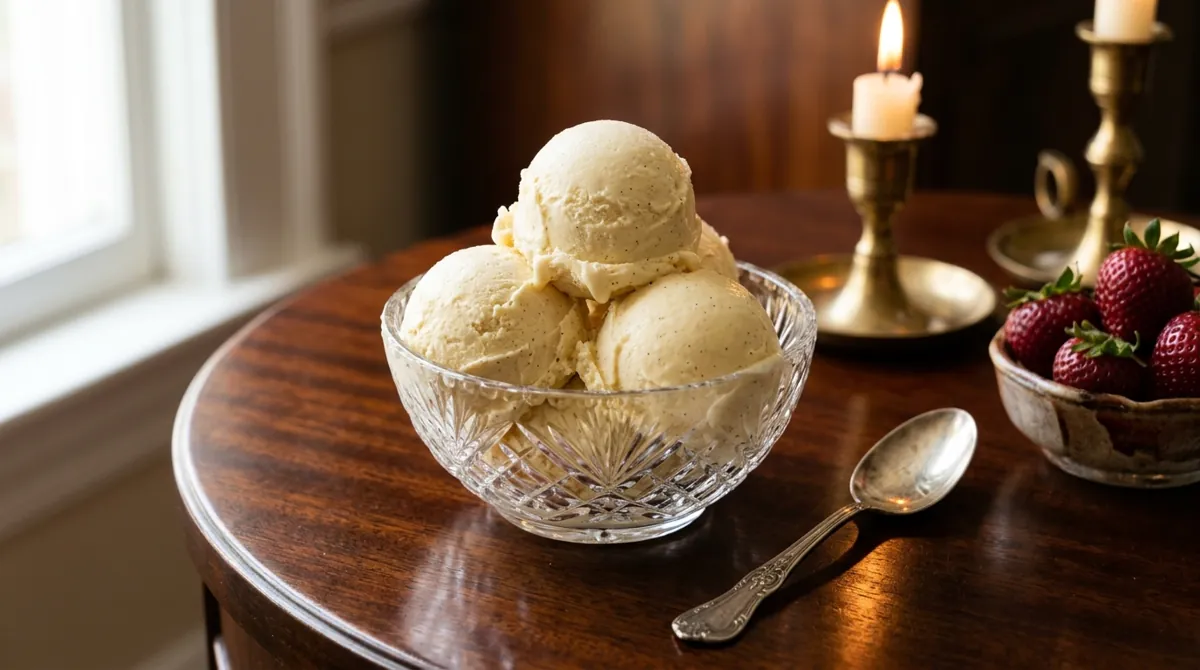
French-style ice cream is a cooked custard of milk, cream, sugar and egg yolks. Philadelphia-style leaves the eggs out and is often not cooked at all. Yolks make the custard version smoother but can mute delicate flavors. Commercial "frozen custard" is a legal term: US rules require 1.4 percent egg yolk solids, and it is typically churned with less air.
| Custard (French-style) | Philadelphia-style | |
|---|---|---|
| Eggs | Egg yolks, cooked into the base | None |
| Cooking | Custard cooked until thick | Cold stir, or just warmed to dissolve sugar |
| Texture | Smooth, rich, small ice crystals | Lighter, tends to turn icier |
| Flavor | Eggs can mask cream and vanilla | Fresh, bright, vanilla stands out |
| Time | Cook, then chill overnight | Quicker, nothing to cook or temper |
| Name | French signals a cooked egg custard | Means eggless; city link is unconfirmed legend |
| Legal line | 1.4 percent yolk solids can be frozen custard | Eggless, so under that line |
The split: eggs and a stove
French-style ice cream starts with a custard. Milk and cream are warmed, tempered into egg yolks, cooked until thick, then chilled and churned. Philadelphia-style leaves the eggs out. King Arthur Baking's test kitchen notes the eggless base needs only part of the dairy warmed to dissolve the sugar, which is why it is the quick one.
Our Philadelphia-style vanilla is cream, milk, sugar and vanilla stirred together cold, with nothing cooked. Our classic vanilla custard ice cream takes five yolks cooked to 170 to 175°F, the same idea as the recipe Thomas Jefferson wrote out by hand.
What the yolks change
King Arthur's testers found the egg base made smooth, creamy ice cream with small ice crystals. The trade is flavor: eggs can taste noticeable and mask cream and vanilla, while the eggless version tastes fresh and bright. The Takeout makes the same point, saying the eggless style suits fruit and mint.
The eggless style tends to turn icier. Sources disagree on how fast. The Takeout says to eat it within a couple of days, while King Arthur saw little change in a two-week test.
Frozen custard is a legal line
Federal regulation 21 CFR 135.110 says ice cream contains less than 1.4 percent egg yolk solids by weight, except frozen custard, which must contain 1.4 percent. At that level the label may read "frozen custard," "french ice cream" or "french custard ice cream." With bulky flavors the yolk content may dip, but never below 1.12 percent.
Frozen custard still has to meet the ice cream floors of 10 percent milkfat and 4.5 pounds per gallon. Our frozen custard concrete uses five yolks in about a quart of base, which by our arithmetic puts it well over that line.
Air and serving temperature
Overrun is the air whipped in during freezing. The weight rule keeps makers from selling mostly air, Consumer Reports explains. Madison Magazine says store-brand ice cream can reach 100 percent overrun, against about 20 percent for frozen custard. St. Louis Magazine's George Mahe gives custard 15 to 30 percent, against 35 to 45 for soft serve. These are press figures, not a standard.
Custard machines add as little air as they can, The Takeout reports, which fits the dense, silky scoop. Mahe adds that it is meant to be served within minutes of coming off the machine.
Where the names come from
"Philadelphia-style" is the fuzzy one. The usual explanation is that it simply means eggless, as opposed to the custardy "French" kind. The city link rests on an unconfirmed legend, The Daily Meal says: Augustus Jackson, a former White House chef who opened a confectioner's shop in Philadelphia in the 1830s, is often credited, but he never wrote his recipes down.
Wondering where gelato fits? See gelato vs ice cream. Then pick a side in our French vs Philadelphia vanilla vote.
Questions people ask
Is frozen custard the same as French ice cream?
Legally, yes. Both names are allowed for ice cream with 1.4 percent egg yolk solids or more under 21 CFR 135.110. In practice, custard stands usually mean a dense, freshly made machine style.
Does Philadelphia-style ice cream have eggs?
No. It is the eggless style, usually just cream, milk, sugar and flavoring. The base can go straight to the freezer without the custard step.
Which is easier to make at home?
Philadelphia-style, since there is no custard to cook or temper. French-style asks you to heat yolks gently until the base thickens, then chill it, with King Arthur advising an overnight rest.
Parts of this history are disputed. Where sources disagree, we say so.
Sources
- 21 CFR 135.110, Ice cream and frozen custard (eCFR, verified via the eCFR versioner API; Cornell LII copy also read)
- 21 CFR 135.110 (Cornell Legal Information Institute copy)
- King Arthur Baking, "Ice cream two ways" (blog, August 24, 2018)
- The Takeout, "What Makes Philadelphia-Style Ice Cream So Different?"
- Dennis Lee, The Takeout, "Ice Cream Vs Frozen Custard: Is There Even A Difference?"
- George Mahe, St. Louis Magazine, "Ask George: Why does frozen custard taste so much different than soft-serve ice cream?"
- Madison Magazine (Channel 3000), "Ice Cream vs. Frozen Custard," June 17, 2012
- Consumer Reports (originally Consumerist), "What's the Difference Between Ice Cream, Frozen Custard and Gelato?"
- The Daily Meal, "What Makes Philadelphia-Style Ice Cream So Unique?"
- Philadelphia Magazine, "Philadelphia ice cream history," July 7, 2021
More food facts
Cook it
Philadelphia-Style Vanilla Ice Cream
The American eggless ice cream: cream, milk, sugar and vanilla stirred together cold, chilled and churned, with nothing cooked and nothing to temper.
Classic Vanilla Custard Ice Cream (Jefferson's Recipe, Updated)
The rich American vanilla: a cream-heavy custard with five yolks cooked to 170 to 175°F, the same idea as the recipe Thomas Jefferson wrote out by hand.
Frozen Custard Concrete with Cookies and Fudge, Inspired by Shake Shack
A rich vanilla frozen custard, churned and frozen firm, then mashed with crushed chocolate sandwich cookies and fudge into a concrete so thick you can turn the cup upside down.
French Crème Glacée à la Vanille (Custard Ice Cream)
The French way: a vanilla crème anglaise of milk and six egg yolks, cooked until it coats the spoon, finished with a little cream and churned.
Fior di Latte Gelato (Italian Milk Gelato)
Italy's plainest gelato and the test of every gelateria: mostly milk, a little cream, no eggs, thickened with a spoonful of cornstarch and served softer and warmer than American ice cream.