
📜 Origin story
What Are Sufganiyot? Why Jelly Doughnuts Mean Hanukkah
The frying goes back to a Temple lamp, and the jelly goes back to a German cookbook. Israel put the two together, with a push from its bakers.
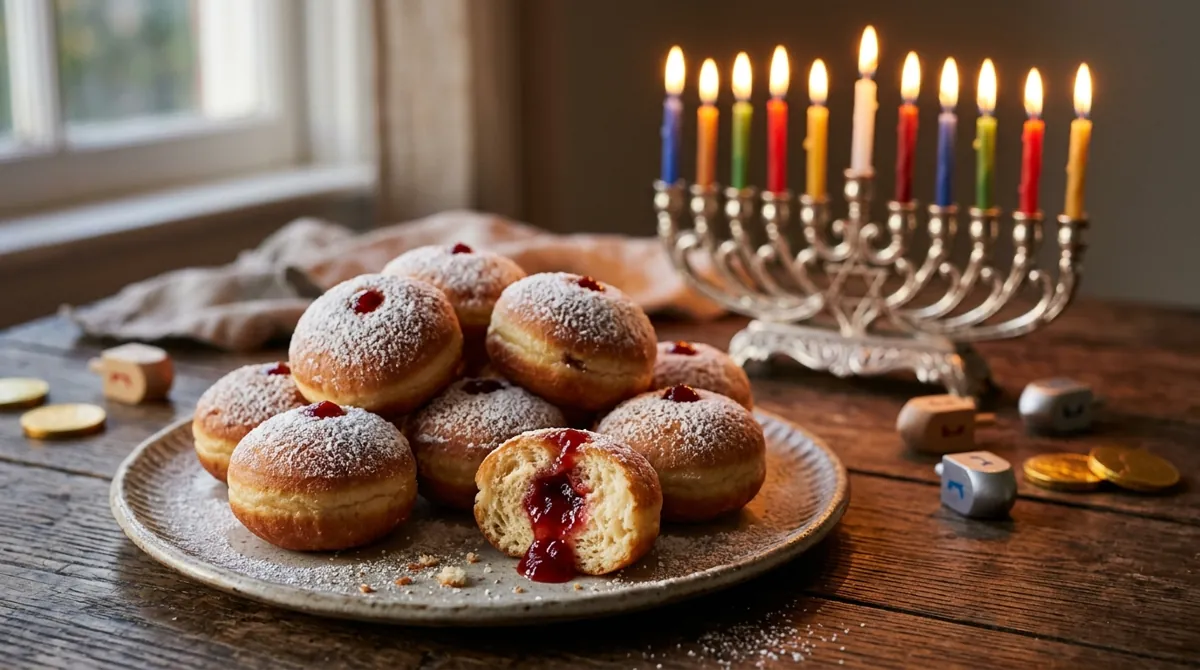
Sufganiyot are jelly doughnuts eaten for Hanukkah, above all in Israel: small rounds of yeast dough fried in oil, filled with jam and rolled in or dusted with sugar. The oil is the point. Hanukkah recalls a Temple lamp that burned eight days on one day's oil, and Jews have eaten fried foods for the holiday since at least the 12th century.
The oil behind the doughnut
The Talmud's explanation of Hanukkah is short. When the Hasmoneans retook the Temple, they found a single sealed cruse of pure oil, enough to light the lamp for one day, and it burned for eight. The next year the sages made those eight days a festival. In 2026 Hanukkah begins at sundown on Friday, December 4, and ends at nightfall on Saturday, December 12.
Frying in oil became the holiday's way of remembering. In the 12th century Rabbi Maimon ben Yosef, the father of Maimonides, scolded people who made light of eating fried sofganim on Hanukkah, calling it "a custom of the ancient ones." Those were most likely syrup-soaked fritters, writes Carol Green Ungar in the Orthodox Union's Jewish Action, not jelly doughnuts. In America the fried food of Hanukkah is usually the potato latke; in Israel it is the sufganiyah.
Where the jelly came from
The filled doughnut is a European idea. The food historian Gil Marks traced it to the Küchenmeisterei, the first cookbook printed in German, published in Nuremberg in 1485, which has a recipe for gefüllte Krapfen: jam sandwiched between two rounds of dough and fried in lard. Germans still eat its descendant, the jam-filled Berliner.
According to Marks, Jews who made it swapped the lard, which is not kosher, for goose fat, and the doughnut traveled east to Poland, where Jews called it a ponchik (in Polish, pączek, plural pączki). In some Polish towns, Marks said, ponchiks rather than latkes were the Hanukkah treat. The food historian Emelyn Rude told NPR that jam fillings arrived once sugar got cheap in the 16th century.
How Israel made it the Hanukkah food
The name is a modern Hebrew coinage built on an old root: sfog means sponge, for the way the dough drinks up oil, and the Talmud uses a related word for a spongy dough. Who brought the doughnut itself is less clear. The historian John Cooper has suggested German Jews brought it in the 1930s; Marks thought it was there earlier.
The usual story credits the Histadrut, the labor federation founded in December 1920. In the late 1920s, Marks wrote, it championed the doughnut over the latke because anyone could fry latkes at home, while doughnuts needed people to make, haul and sell them. Joan Nathan told NPR that early leaders were looking for foods that felt distinctly Israeli. How decisive the union's push was is hard to measure, but it worked: bakeries now sell sufganiyot for weeks before the holiday, and in 2018 Israel's Defense Ministry bought some 360,000 for its troops, filled with jam or chocolate.
How sufganiyot are made
Our Israeli sufganiyot follow Joan Nathan's 1979 recipe: a soft yeast dough with egg yolks and a pinch of cinnamon, risen 2 hours, rolled thin and cut into 2-inch rounds with a glass. After a 15-minute second rise they fry four or five at a time at 375°F.
Nathan's warning is the whole technique. Oil that is too cool soaks into the dough, and oil that is too hot browns the outside before the middle cooks. Each doughnut then gets a little jam through a hole in the top and a roll in sugar, and is eaten hot. Her recipe makes 30 to 35 small ones. You can compare it with every other filled doughnut in our doughnuts hub.
Questions people ask
When is Hanukkah in 2026?
Hanukkah 2026 begins at sundown on Friday, December 4, when the first candle is lit, and ends at nightfall on Saturday, December 12. The dates move each year because they follow the Hebrew calendar (25 Kislev).
What does sufganiyah mean?
It comes from the Hebrew root for sponge, sfog, describing a spongy dough that soaks up oil; the Talmud uses a related word for spongy dough. Sufganiyah is one doughnut and sufganiyot is the plural.
Are sufganiyot the same as Berliners or pączki?
They are close cousins. All three are yeast doughnuts fried and filled with jam, and Gil Marks traced the whole family to a German recipe of 1485. Sufganiyot are tied to Hanukkah, and Nathan's are small, about 2 inches across.
Parts of this history are disputed. Where sources disagree, we say so.
Sources
- Babylonian Talmud, Shabbat 21b, William Davidson Edition (Sefaria)
- Hebcal, Chanukah 2026
- Carol Green Ungar, "The 'Hole' Truth About Sufganiyot," Jewish Action (Orthodox Union), Winter 2012
- NPR, All Things Considered, "How The Israeli Sufganiyah, Or Jelly Doughnut, Got Its Start As A Hanukkah Treat," Dec 19, 2017
- Peter Lang, Küchenmeisterei edition (publisher's description)
- U.S. Library of Congress, Israel: A Country Study, "The Histadrut"
- Anna Ahronheim, "Doughnut delights: Happy Hanukkah IDF!," The Jerusalem Post, Nov 25, 2018
- Joan Nathan, "Sufganiyot (Jelly Doughnuts)," adapted from Jewish Holiday Cookbook (1979), NPR, Dec 20, 2006
More food facts
Cook it
Israeli Sufganiyot (Hanukkah Jelly Doughnuts)
Small yeast doughnuts scented with cinnamon, fried hot and fast for Hanukkah, filled with a spoonful of berry or plum preserves and rolled in sugar, from Joan Nathan's 1979 holiday cookbook.
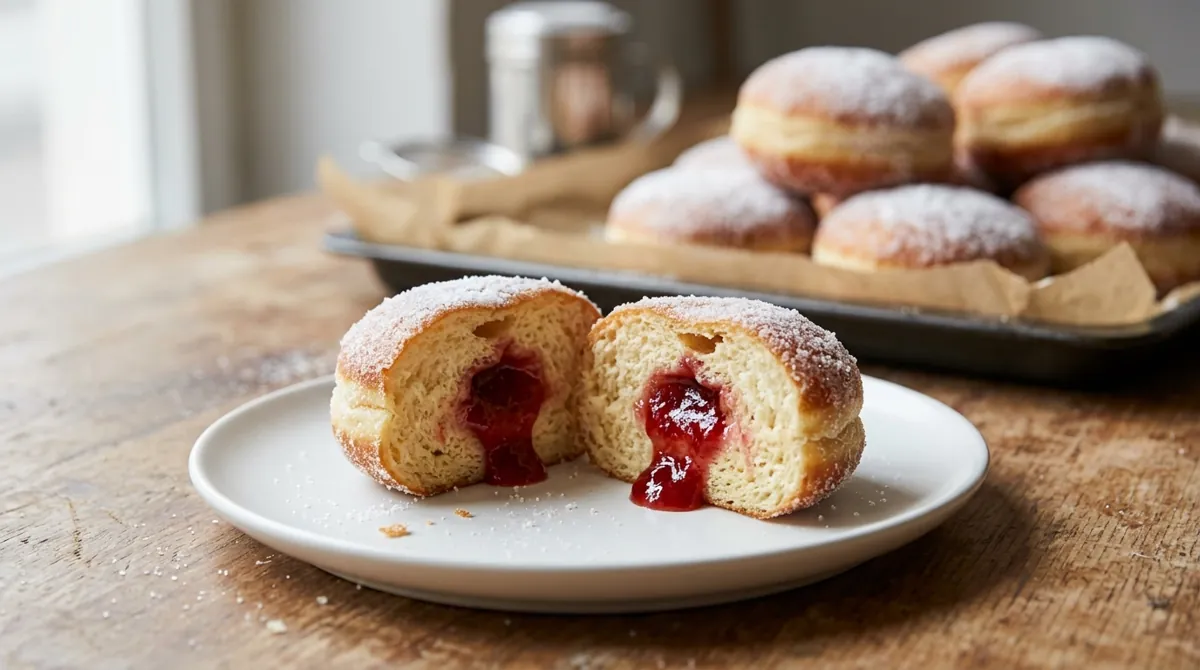
German Berliner (Jam-Filled Krapfen)
Soft balls of butter-and-egg yeast dough fried with their pale "collar", rolled in sugar and piped full of jam: the German jelly doughnut, called Berliner, Pfannkuchen, Krapfen or Kreppel depending on where you buy it.
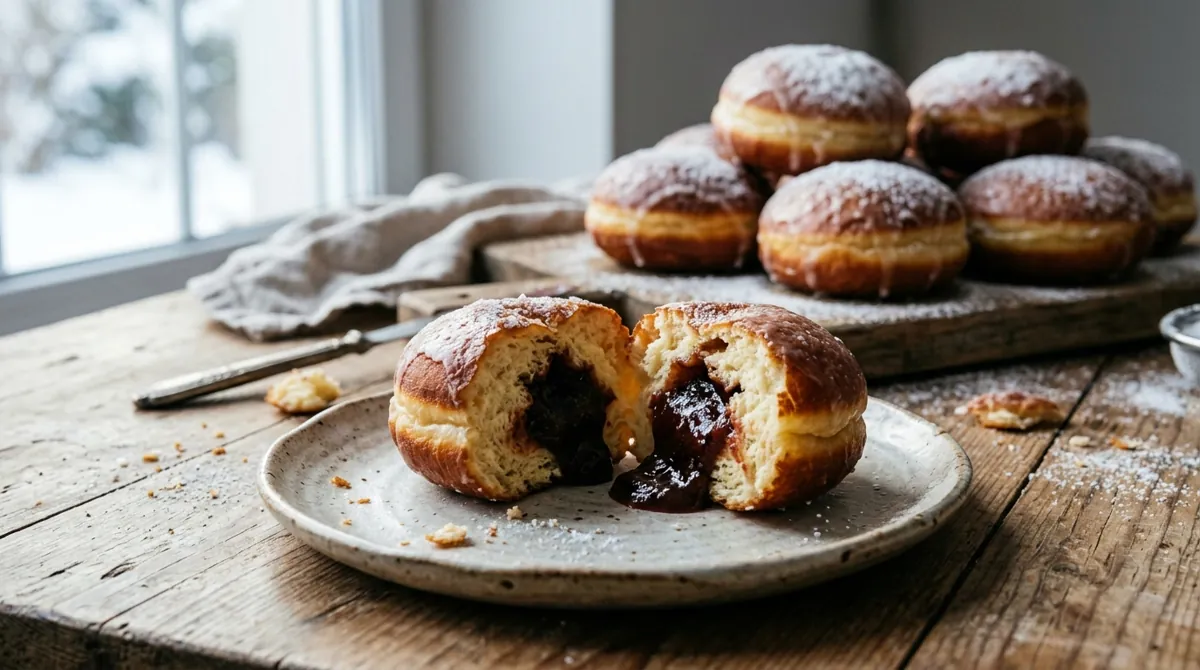
Polish Pączki (Fat Thursday Doughnuts)
Extra-rich jelly doughnuts made with egg yolks, butter and vanilla, fried deep mahogany, tossed in powdered sugar and filled with plum, rose petal or raspberry jam for Fat Thursday.
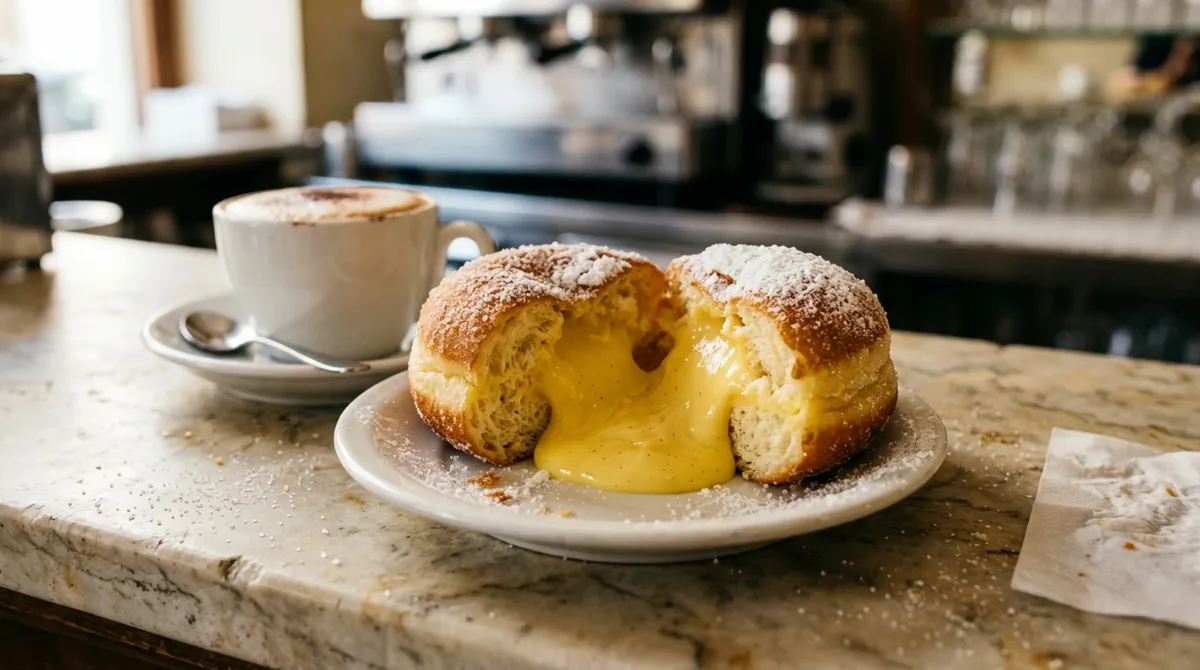
Tuscan Bomboloni alla Crema (Custard Doughnuts)
Big, cloud-soft Italian doughnuts made from a folded yeast dough, fried slow and pale gold, filled with lemon-and-vanilla pastry cream and dusted with powdered sugar, the way Tuscan bakeries and beach carts sell them.
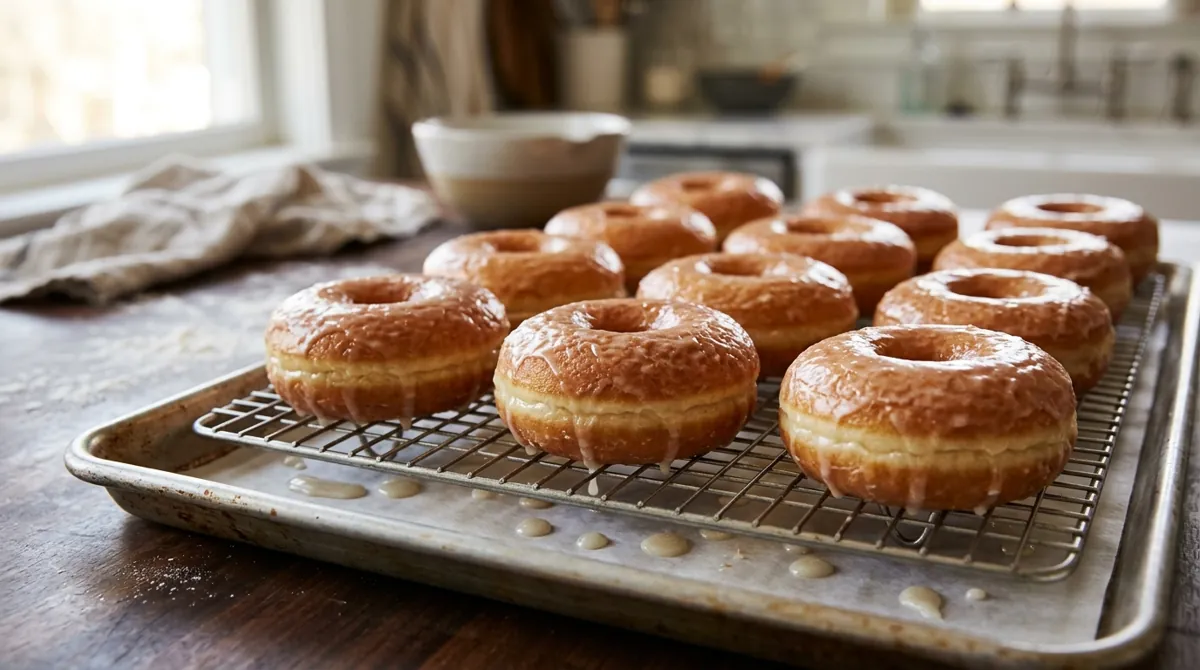
Classic Yeast-Raised Glazed Doughnuts
Tall, airy ring doughnuts from a buttery dough that rests overnight in the fridge, proofed in a steamy oven, fried golden and dipped in a sheer vanilla glaze that sets matte and crackly.